Search This Blog

January 10, 2013

2012: INDIES AND THE PROFOUND

Well, Manohla Dargis tells me that writer Max Landis and director Josh Trank's Chronicle "is the latest big-studio release in indie-sheep’s clothing." They had me. If it had been an indie, there's much I could have forgiven, but since it's not, I can only consider Chronicle a big fat flop. Adolescent friends Max, Steve, and Andrew -- whose camera lens provides our point of view --enter a cavernous hole in the ground, experience something akin to a psychedelic acid trip, and come out with telekinetic powers. They gradually exploit those powers to greater and greater advantage, Max and Steve for fun, but Andrew increasingly for more sinister reasons that allow the film to hurtle into a gratuitous climax of end of the world proportions complete with exploding bodies. Landis's script is sprinkled  with pseudo-philosophizing, most notably references to Schopenhauer's world as will, which I guess is supposed to support the nihilistic, orgiastic ending. What starts out looking like a potentially thoughtful little sci-fi vehicle devolves into its own superficiality and nothingness.


I'm not sure what the title Blue Like Jazz, great sounding as it is, has to do with Steve Taylor's movie about a Baptist Texas boy (...in Texas that would be pronounced "bo"). The film, adapted from the book Blue Like Jazz: Nonreligious Thoughts on Christian Spirituality by Donald Miller, revolves around Don Miller (Marshall Allman, whom I do not know but who is one of my best friends' husband's cousin). Don finds himself a misfit at affluent Reed College in Oregon, where religion -- at least Christianity -- and conformity are mocked. At one point the character who parades about as The Pope takes a wheelbarrow 'round to strip students' dorm rooms of books he scorns. "How can there be a God if Chicken Soup for the Soul exists?" he excoriates as he throws it into the flames (to which I say, "Amen!"). The whole is full of nice character acting, but ultimately it tries a little too hard at its philosophical aspirations, and its "theology" undermines its attempts at profundity. (Rachel Saltz's NYT review)


The reach for things profound seeps around the edges of Zal Batmanglij's Sound of My Voice about Peter and Lorna, a young couple who, in order to make a documentary about its leader, infiltrate a cult. The guru, who claims to have come from 2054, is a lithe, blond-haired, chipped fingernail polished woman named Maggie, with a tattoo of something resembling an anchor on her ankle, who is surrounded by acolytes.

Recently I've been seeing the trailers for what portends to be a bloated OZ, in which the Midwestern magician is asked, "Are you the great man we've been waiting for?" There is an abiding human desire for salvation to come from the outside to those who passively wait. It fuels contemporary fundamentalist religions as much as it fuels our love of super heroes. Here is The One. All I need do is follow.

What Peter and Lorna do not anticipate is the degree to which which they will fall under Maggie's spell. (Manohla Dargis's NYT review)


Set in a post-Katrina Louisiana, Behn Zeitlin's Beasts of the Southern Wild (nominated for Best Picture, Actress, Director, Adapted Screenplay) is a beautiful parable woven of magic realism. It is profoundly about many things, one of which is the damage the overarching faith we place in material "progress" exerts on the soul. Six-year-old Hushpuppy (Quvenzhané Wallis as a pure force of nature) listens to the heartbeats of birds, sows, leaves, her father's breast. The father Wink (Dwight Henry) is an abusive drunkard whose anger seems to emanate from guilt at the knowledge that his imminent death will leave Hushpuppy alone in a hostile world, and from his desire to toughen her up before he leaves her. If there is an equivalent in film to visionary outsider visual art, this film is as close as it gets. (A. O. Scott's NYT review/A NYT Critics' Pick)

"A Mythical Bayou's All-Too-Real Peril: The Making of Beasts of the Southern Wild" by Rachel Arons in The New York Times.
"Still Too Good, Too Bad or Invisible" by Nelson George in the New York Times


2012: BIOPIC CONTENDERS

Usually one or two biopics are represented in the Oscar contenders, but this year we have a slew of them for some reason. Every film nominated in the Foreign Language Film category is based on a true story. The Chilean film No directed by Pablo Larrain is an historical drama about a man who helped topple the Pinochet regime; Montreal-based director Kim Nguyen's War Witch is based on the actual events of a child soldier in Burma that have been re-envisioned in the Democratic Republic of Congo; Danish director Nikolaj Arcel's A Royal Affair is about the mentally ill 18th century Danish King Christian VII and the affair between his queen and the royal physician; and likewise, the Norwegian directors Joachim Rønning and Espen Sandberg's Kon-Tiki is an historical drama about the ethnographer Thor Heyerdahl's 1947 expedition undertaken in an attempt to prove his theory that people from South America settled in Polynesia in pre-Columbian times. Even the French director Michael Haneke's Amour is based on his own family experience. (Oscar nominations noted in parens)


Paul Thomas Anderson's The Master (Best Actor, Supporting Actress, Supporting Actor) is...well, masterful. What Anderson freely admits, and the actors deny, is that it is a meticulously researched story of L. Ron Hubbard and the cult of Scientology. In addition to the available literature, Anderson unearthed pamphlets and other contemporary ephemera that came out of Scientology circa 1950, but the cast, fearing harassment from the ranks of the faithful, have insisted that no parallel is intended. That said, it is important to realize that the film is not a standard biopic. Its source material may be Hubbard, but the film has a propulsion it could not have achieved had Anderson set out to do nothing more than tell the story of Scientology.

Every actor in the film delivers a virtuoso performance. Philip Seymour Hoffman's megalomaniac Lancaster Dodd is a self-deluded narcissist, the center around which his self-made constellation revolves. Joaquin Phoenix plays the alcohol-/chemical-deranged Freddie Quell (whose mother has been institutionalized with schizophrenia). (If there is a wee problem with the casting it's that one could say Phoenix has been type cast as the self-destructive persona of his documentary hoax I'm Still Here, though Quell is the victim of his demons, not the author of them.) Phoenix's performance is physically wrenching juxtaposed against Hoffman's beady control.

Both men give powerful, nuanced performances, but, as the projector rolls and this magisterial film builds momentum, we come to realize that at its center, the true mover and shaker is Dodd's wife (his third) Peggy, played with equal certainty and nuance by Amy Adams. Dodd may manipulate his gullible followers, but Peggy is Dodd's sly puppeteer. She knows exactly to what extent she will allow Dodd to feed his habit for power and control with his new pet project, Freddie Quell. And she knows exactly when it is time to intervene and withdraw the drug. She is like the queen who will stop at nothing to see her son made king, the mother lion defending her cubs.

Mihai Malaimare Jr.'s cinematography is beautiful, at times breathtakingly so. Johnny Greenwood's score subtly heightens the action without a trace of emotional manipulation. (John Williams could learn a lesson.) The set dressing, the costumes, the hair styles -- everything is pitch perfect. We are left with a powerful examination of human hubris and the dangers of the unexamined life. (A. O. Scott's NYT review/A NYT Critis' Pick)


Ben Affleck's Argo (Best Picture, Adapted Screenplay, Supporting Actor) is a nail biter. On November 4, 1979 Iranian revolutionaries stormed the United States embassy in Tehran, taking 52 American citizens hostage. Six others managed to escape to the safety of the Canadian ambassador's house. CIA officer Antonio Mendez came up with a crazy scheme by which to get them safely out of Iran, and was sent to Tehran to carry out the ruse: the escapees would pose as a Canadian film crew scoping out locations in Iran for a fake sci-fi film, Argo. That Affleck keeps us on the very edge of our seats, holding our breath, squirming with anxiety -- when we already know the ending -- is remarkable. John Goodman and Alan Arkin offer much needed comic relief as the Hollywood insiders (makeup artist and producer) who give credence to the hair-brained plot. Their location stateside in Hollywood also provides some breathing room in juxtaposition to the claustrophobia of otherwise cramped settings. Despite his roles as both director and star, Affleck deserves credit for not dominating the film and for giving his cast space. (Manohla Dargis's NYT review/A NYT Critics' Pick)


I am thrilled that Helen Hunt has an Oscar nomination for Ben Lewin's The Sessions (Best Supporting Actress). I only wish that John Hawkes had been nominated for Best Supporting Actor, as well. The Sessions is the true story of 38-year-old Mark O'Brien. O'Brien, who died in 1999, was a journalist and a poet. He was also a quadriplegic, having suffered childhood polio. After much reflection he makes what is for him a momentous decision. He no longer wishes to be a virgin. Hunt plays the sex therapist he hires with enormous nuance, subtlety and care. I started to say, with sensitivity, but that would not come close to the benevolence she brings to the role. Either performance could have been disastrous in other hands, yet together Hawkes and Hunt gently weave O'Brien's story with humanity and grace. (Stephen Holden's NYT review/A NYT Critics' Pick)


Daniel-Day Lewis, David Strathairn, James Spader, Hal Holbrook, Tommy Lee Jones, John Hawkes... distracted, I started to wonder which big-name actors would NOT appear in Steven Spielberg's Lincoln (Best Picture, Actor, Director, Adapted Screenplay, Supporting Actress, Supporting Actor). I was also annoyed that virtually every African American in the film was expected to look supplicatingly at all the nice white people. I was gratified, therefore, when, after the onslaught of laudatory reviews, I ran across a critical opinion in The New York Times editorial pages by Kate Masur, associate professor of history at Northwestern and the author of An Example for All the Land: Emancipation and the Struggle Over Equality in Washington, D.C. The film is determined, she argues, "to see emancipation as a gift from white people to black people, not as a social transformation in which African-Americans themselves played a role."

Masur informs us that, "In fact, the capital was also home to an organized and highly politicized community of free African-Americans, in which the White House servants Elizabeth Keckley [played by Gloria Reuben in the film] and William Slade [played by Stephen Henderson "as an avuncular butler, a black servant out of central casting," says Masur] were leaders. Keckley, who published a memoir in 1868, organized other black women to raise money and donations of clothing and food for the fugitives who’d sought refuge in Washington. Slade was a leader in the Social, Civil and Statistical Association, a black organization that tried to advance arguments for freedom and civil rights by collecting data on black economic and social successes."

We are right back in Tate Taylor's 2011 adaptation of The Help. One expectation I  harbored did not materialize, to my surprise. I was dreading one of those gratuitously manipulative John Williams scores. Instead, the score is, by Williams' standards, positively understated. It evokes popular music from the era including the Stephen Foster song "Was My Brother in the Battle" and George Root's "The Battle Cry of Freedom," and the final track is reminiscent of one of Lincoln's favorite songs, "For the Dear Old Flag I Die" about a drummer boy who died at the Battle of Gettysburg. (A. O. Scott's NYT review/A NYT Critics' Pick)

"Still Too Good, Too Bad or Invisible" by Nelson George in the New York Times

Postscript:
My February issue of Harper's Magazine was in my mailbox yesterday, and if you don't subscribe, go out and buy it or get it at your library. The Easy Chair essay (alas Lewis Lapham is gone, but...) by Thomas Frank calls Spielberg out in no uncertain terms. I will confine myself to only the last two paragraphs here, but you must read THE WHOLE THING:

"Lincoln is a movie that makes viewers feel noble at first, but on reflection the sentiment proves hollow. This is not only a hackneyed film but a mendacious one. Like other Spielberg productions, it drops you into a world where all the great moral judgments have been made for you already -- Lincoln is as absolutely good as the Nazis in Raiders of the Lost Ark are absolutely bad -- and then it smuggles its tendentious political payload through amid those comfortable stereotypes.

"If you really want to explore compromise, corruption, and the ideology of money-in-politics, don't stack the deck with aces of unquestionable goodness like the Thirteenth Amendment. Look the monster in the eyes. Make a movie about the Grant Administration, in which several of the same characters who figure in Lincoln played a role in the most corrupt era in American history. Or show us the people who pushed banking deregulation through in the compromise-worshipping Clinton years. And then, after ninety minutes of that, try to sell us on the merry japes of those lovable lobbyists -- that's a task for a real auteur."


Spanish director J. A. Bayona's The Impossible (Best Actress) is an international effort and utilizes digital imagery as well as old-school modeling and editing techniques to  reproduce the devastating tsunami that, in 2004, pummeled 14 countries the day after Christmas. It pinpoints our gaze on the true story of a single family vacationing in Thailand, all five of whom miraculously survived. The film could so easily have tipped into the sniffling realms of Hallmark Hall of Fame land, but thanks to deeply felt performances, most notably Naomi Watts as the critically injured mother, it rises above its based on a true story-disaster movie origins. I have to agree with A. O. Scott, however, that "the terrible effects of the tsunami on the local population are barely acknowledged." Somewhat like the slaves of Spielberg's Lincoln, the few Thai characters presented in The Impossible seem to be there simply to serve the tourists.

AGAINST THE ODDS The film tells the true story of a family who nearly perished in Thailand during the 2004 tsunami

Last year's My Own Private Cinema covered the short documentary The Tsunami and the Cherry Blossom: Lucy Walker’s self-described visual poem, The Tsunami and the Cherry Blossom (UK), opens with chilling amateur footage of the approaching tsunami wave making its inexorable way inland to higher and higher ground. Dread sets in as it becomes clear that the path of destruction has no apparent limit. The Tōhoku earthquake and tsunami struck on March 11, 2011 -- just before the sakura, or cherry blossom, blooms -- and in the aftermath of the tragedy, Walker's camera finds a number of victims whose words vacillate between utter despair and stoic resolve. Each conveys a Shinto perspective that finds beauty in imperfection and accepts the natural cycle of growth and decay. The Japanese symbol of hope and renewal, sakura is central to the culture, and at one point we visit the Miharu-Takizakura cherry tree in Miharu, Fukushima, which is more than 1,000 years old. It endures, and the people of Japan will likewise endure. [With hypnotic score by Moby.]


Kathryn Bigelow's Zero Dark Thirty (Best Picture, Actress, Original Screenplay)
I attend a Sunday morning class at my Unitarian Universalist Church where we are entering the final nine weeks of a 36-week lecture series from The Great Courses DVDs, Why Evil Exists, with a wonderful lecturer, Dr. Charles Mathewes of the Universities of Virginia and Chicago. As a UU church, many points of view are represented in our discussions after the lectures, and one among us is a self-professed Libertarian who hews to an Ayn Randian brand of self-interest and greed-as-good. A couple of weeks ago, fed up with his oft-repeated line that any action is acceptable as long as it hurts no one else, I raised my hand and said, "My very existence on this earth hurts someone or something else. I eat, I drive a car, I pollute. There is no such thing as purely benign existence, but there are all sorts of window dressings." A young woman across from me raised her hand and said, "She is absolutely correct. I served in Iraq, and my presence there shielded all of you from facing the truth that she is talking about. I was there so that you didn't have to be. When I am there you can all remain complacent and look away."

This young woman's remarks echoed in my head as I watched Kathryn Bigelow's virtuoso Zero Dark Thirty. I had not expected the controversy that has arisen over the film's depiction of torture. I get the impression, overall, that our politicians, the CIA, and certain members of the Academy of Motion Picture Arts and Sciences doth protest too much. Bigelow does not make heroes of torturers; she shows them to us -- and by extension, she shows us that we are them, which is the real underbelly of the protestations against the portrayals of torture in the film. There has been no large scale popular movement against torture by United States citizens for the simple reason that as a country we really don't mind. What we do mind is having someone remove the blinkers and point our heads at it.

There was an exchange in a much lesser film earlier this year that struck me. In Tony Gilroy's The Bourne Legacy from the Robert Ludlum franchise, Eric, a retired US Air Force colonel responsible for overseeing the CIA's clandestine operations, remembers a conversation he had with Aaron, a member of a US Defense Department's black ops program, in the field:
Eric (Edward Norton): We got screwed on the intel, okay? Nobody knew those people were in there. It would be perfectly normal for a person to have doubts about the morality of what we just asked you to do.
Aaron (Jeremy Renner): Is that a question, sir?
Eric: No, it's not. Tune in to what I'm trying to say to you. Do you know what a Sin Eater is?
[Aaron shakes his head]
Well, that's what we are. We are the Sin Eaters. It means that we take the moral excrement that we find in this equation and we bury it deep down inside of us so that the rest of our cause can stay pure. That is the job. We are morally indefensible and absolutely necessary. You understand?
Aaron: Will that be all?

Compared with Bigelow's film, that is a rather clumsy exchange. CIA agent Maya, in a complex performance by Jessica Chastain, does not explicate this reality. She inhabits it with single-minded focus. Without the crutch of explication, Bigelow's film puts us in the midst of the moral dilemma and forces us each to grapple with our moral complicity without herself passing judgment. That is an achievement.

Beyond the torture brouhaha, Zero Dark Thirty is the work of an extraordinary film maker. The editing is genius. I would be fascinated to have a count of the sheer number of shots that make up the film, and yet taken together, one to the next, they give the film fluidity, a smoothly undulating rhythm that reminds us that Bigelow cites Peckinpah and the early Scorsese (Mean Streets) as influences, along with David Lean's Lawrence of Arabia and Hitchcock's oeuvre.

Another notable aspect of the film is that it seems virtually score-less. For a film that runs to 2 hours, 37 minutes,  Alexandre  Desplat's soundtrack comes in at just under 54 minutes, and much of it is almost inaudible in the film, the sounds emanating from the action and slowly morphing into the deep rumbling of a tympani or a single sustained note from a flute or reed.

Manohla Dargis's NYT review/ A NYT Critics' Pick
"As Enigmatic as Her Picture: Kathryn Bigelow on Zero Dark Thirty" from the NYT Magazine's Oscars Issue
David Denby's New Yorker review
NYT columnist Roger Cohen on "Why 'Zero Dark Thirty' Works"


January 9, 2013

2012: BIOPICS...OR NOT

Red Tails is pretty darned awful, and that's a crying shame because the story of the 332nd Fighter Group, known as the Tuskegee Airmen, deserves better. Even very good actors, like David Oyelowo (wonderful in The Paperboy), are wooden, and the love interest is unnecessary and contrived. It is the first feature film directed by Anthony Hemingway, but it is really the product of its executive producer George Lucas who, according to Stephen Holden's NYT review, described the film to Jon Stewart as “Patriotic," “jingoistic,” “old-fashioned,” “corny” and “inspirational for teenage boys.” Nuff said.


If only Red Tails had a contemporary character who was in some way channeling historical figures, it could have joined the ranks of what I'm calling "Layer after Layer ...after Layer." Into this category go Madonna's W.E., along with Brian Klugman and Lee Sternthal's The Words, and that morass of layers written and directed by Lana Wachowski, Tom Tykwer and Andy Wachowski, Cloud Atlas. The principle problem with this narrative trope is that the contemporary story always falls dreadfully short of the historical story. Is this a novelistic tic that has infected film through Stephen Daldry's adaptation of Michael Cunningham's The Hours, Gilles Paquet-Brenner's adaptation of Tatania de Rosnay's Sarah's Key, Wayne Wang's adaptation of Lisa See's Snow Flower and the Secret Fan, and the Wachowski-Tykwer adaptation of David Mitchell's novel?

Bored wife Wally obsesses over Wallis Simpson, the commoner for whom King Edward (Get it? W. E.) abdicated the throne of England. Wally believes she is channeling Wallis, especially when she attends the Sotheby's 1998 auction of the Duke and Duchess of Windsor's estate. W.E.'s narrative structure can't get out of its own way. It trips and falls over its layers, and has more and more trouble getting up.

The second major quarrel I have with the film (setting aside its general vapidity) is that it dredges up the hysterical female (as did last year's Black Swan and A Dangerous Method and this holiday season's Anna Karenina). Observing this phenomenon last year in the NYT, Terrence Rafferty put these films into context with their progenitors from Lady in the Dark, The Snake Pit, The Three Faces of Eve to Marnie, Repulsion, A Woman Under the Influence, The Story of Adele H., Face to Face to Frances and Mulholland Drive.

Movies hold up a critical mirror to the tragic fact that, in the narrative ways through which we make movies and the uncritical ways in which we receive them as audiences, sexist stereotypes remain just as entrenched as racist ones.


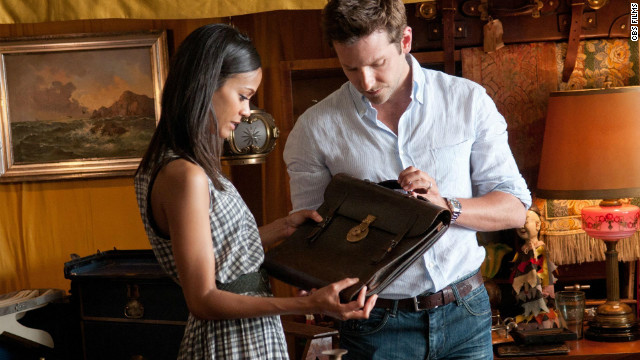
So while we're on the subject of parallel lives and layering, we might as well take up the aforementioned The Words, directed by Brian Klugman and Lee Sternthal. (The Words' layers required two directors; the stratum of Cloud Atlas required three!) The foundation of the story rests on an historical incident in 1922 when Hadley Richardson, Ernest Hemingway's first wife, lost a suitcase containing some of his manuscripts in a Paris railway station. The Words has blocked, contemporary author Rory Jansen -- whose publisher, public and girlfriend are anxious for his second book after his first success -- find a valise in an antique shop. In it is -- you guessed...a manuscript, which will turn out to be, not by Hemingway but by an unnamed Old Man (Jeremy Irons as our only bright light). The film moves into the manuscript's historical story as Rory reads. When he turns down the last page, and after only a brief hesitation, he plagiarizes word for word his brilliant best seller. So we have Rory and his girlfriend, the ghost of Hemingway and Hadley, the couple in the WWII manuscript, and the Old Man and his story. As Robert Ebert said, "I doubt if either one of us could pass a quiz on [the] plot. It's a level too many and sidesteps a more promising approach: What if the movie were about the real Ernest Hemingway discovering that his lost manuscript had been found and published by a stranger?" Exactly. (Stephen Holden's NYT review)

Zoe Saldana stars as Dora Jansen and Bradley Cooper as Rory Jansen in
This still sorta says it all...


Curtis Hanson and Michael Apted directed Chasing Mavericks, a nice little movie based on the Santa Cruz surfing legend Jay Moriarity. Jay's (Johnny Weston) father has abandoned him and his mother. Having dreamed of the surf seemingly all of his days, Jay longs to follow his bliss and dogs surfer Rick (Frosty) Hensson (Gerard Butler) to coach him. Frosty finally gives in and becomes, naturally, both mentor and surrogate father. The ensuing story is pretty formulaic, but with big waves and impressive surfing spectacles. (Manohla Dargis's NYT review)


Unlike Manohla Dargis in the NYT, I thoroughly enjoyed Sacha Gervasi's Hitchcock based on the book Alfred Hitchcock and the Making of Psycho by Stephen Rebello. The film is as much a biopic about Psycho as it is about Hitchcock and his wife Alma. Dargis finds the characterization of Hitchcock prurient, but it seemed to me that Anthony Hopkins and Helen Mirren clearly enjoyed playing off of each other and brought intelligence and insight into the dynamic of a complicated yet mutually respectful relationship. The film chronicles the difficulty Hitchcock went through and the risks he and Alma took to get Psycho made.


Bill Murray as FDR and Laura Linney as his distant cousin Daisy are pleasant enough in Roger Mitchell's Hyde Park on Hudson, but the real stars of the film, the ones who give it sparkle, are Samuel West as Bertie and Olivia Coleman as Elizabeth, the King and Queen of England on the eve of WWII. Where I did not object to a bit of titillation in Hitchcock, I was bothered by it in Hyde Park. I'll use that hackneyed excuse that one should not demean the office of the president. As it is portrayed here, Roosevelt surrounds himself with a bevy of women whom he uses as emotional crutches in parallel to his wooden crutches. The film is redeemed, however, as I say, by the wonderful portrayals of Bertie and Elizabeth by West and Coleman, who have a wonderful onscreen rapport and convey the sense not only of a deeply loving and reciprocal marriage but of a keen friendship far deeper than anything between Roosevelt and any woman in his circle. (Manohla Dargis's NYT review)

2012: MISCELLANEOUS DOCUMENTARIES

Manohla Dargis's NYT review argues that Dan Lindsay and T. J. Martin's "Undefeated is all about uplift, about cranking the spirituals and making you cry and laugh and root for its subjects.... [who are] waiting to get called in, to go home, to realize their dreams, to have a future that may never arrive, a trajectory that this movie scarcely considers." Maybe this documentary does not overtly consider that a hoped for future may never arrive in spite of the football players' hard won victory game, but I thought about it throughout every frame. Bill Courtney and Mike Ray, two white volunteers, coached the North Memphis Manassas Tigers, the worst team in the state of Tennessee, all the way to the season final play off game. This is as much a film about race in America as it is about football, though, again, it is not overtly discussed. Finally, it is about confronting odds in the face of almost certain futility. Courtney says, "You think football builds character. It does not. Football reveals character." (The film opened in February 2012, but was a 2011 Oscar Documentary contender.)


It is the controversial policy of the United States Bureau of Land Management to round up wild horses each year, arguably to control populations. In 2007 the Mustang Heritage Foundation partnered with the Bureau to organize the first Extreme Mustang Makeover, and in the ensuing years has facilitated the adoptions of more than 3,3000 mustangs. Husband-wife Greg Gricus and Alex Dawson's Wild Horse, Wild Ride follows nine trainers of widely varied backgrounds through the 100 days they have between being assigned a wild horse and showing it at the two-day Extreme Mustang Makeover showcase in Fort Worth, Texas. (There are as many as six Extreme Mustang Makeover challenges across the country in any given year.)  The day after the showcase the horses are auctioned in what is most often a heart-wrenching breakup with their trainers, who are rarely able to afford to bid what the horses bring. (Another documentary, Mara LeGrand's 2011 Wild Horses in the Winds of Change, challenges "the current management system and the non-scientific myths and biased views about wild horses" says the film's website.)


Wild Horse, Wild Ride

Last year's My Own Private Cinema covered Buck: The inspiration for Robert Redford's The Horse Whisperer is Buck Brannaman, the subject of Cindy Meehl's debut film Buck. Brannaman grew up performing, with his brother, trick rope routines from the age of three, in an act promoted by their brute of a father. Finding himself without direction in his early 20s, Buck encountered Ray Hunt and his teacher, Tom Dorrance, the pioneers of natural horsemanship, a method of training horses that focuses on creating a bond of trust rather than a breaking into submission. The philosophy struck a chord with the young man who himself had suffered relentless abuse. There are moments when Meehl's inexperience as a filmmaker shows, but watching Buck and his horse move as one is a dance you will not soon forget. (Manohla Dargis's NYT review/A NYT Critics' Pick)


David Siegel is the mogul of Westgate Resorts. In the way housing loan agents cajoled people into signing onto mortgages they would never be able to service in order to profit from the transaction, Seigel's agents cajole people into extravagant time-share packages. It was very lucrative, and his wife, Jackie (Seigel's third and younger by 30 years), indulged herself by proceeding to build and furnish the largest and most expensive single-family residence in the U.S. at 90,000 square feet ...until the banks halted construction. The Great Recession had arrived.

Lauren Greenfield's The Queen of Versailles traces their humble beginnings and their classic rags to riches to, well not quite rags again, but at least a slip in the trajectory. Jackie, to her credit, got herself a college education in her former, younger life and worked professionally, though by the time we see her she's almost become another person, shopping obsessive-compulsively even if that now means Walmart. Their current digs, a mere 26,000 square feet, are littered with fast food debris, dog shit from their litter of fluffy white pups, pet snakes and turtles and lizards dead from neglect, and the various tacky accouterments of eight children. Watching, Schadenfreude might be the first reaction, but it ebbs, for there is something about the Siegels that speaks simply to a matter of degree. In his NYT review, A. O. Scott observes that "Schadenfreude and disgust may be unavoidable, but to withhold all sympathy from the Siegels is to deny their humanity and shortchange your own. Marvel at the ornate frame, mock the vulgarity of the images if you want, but let’s not kid ourselves. If this film is a portrait, it is also a mirror." (A NYT Critics' Pick)

Joe Nocera's NYT article on David Siegel's lawsuit against Greenfield.


Cleavage and catastrophe: Jackie Siegel is pure gold for a documentary maker.


I'm including Bart Layton's The Imposter here, though it's really a mix of documentary (interviews and home video footage) and re-enactment -- a biopicdoc? Nicholas Barclay was a blond, blue-eyed 13-year-old living in San Antonio, Texas, when one day he disappeared. He showed up in Spain, where authorities contacted the family who sent his sister to bring him home. I have often argued that the dominant theme of David Mamet's plays and screenplays is the limitless desire and uncanny ability so many people possess to deceive themselves. This is a true story of just such inexhaustible self-deception. Despite the 23-year-old French-Algerian Frédéric Bourdin's general lack of likeness and his black hair, he gets away with the con. "Everyone is contaminated," as Jeannette Catsoulis says in her NYT review, "from Child Protective Services and the United States Embassy in Madrid to the American news media and the F.B.I." And what became of Nicholas Barclay -- and why?

January 8, 2013

2012: COUTURE DOCUMENTARIES

Diana Vreeland: The Eye Has to Travel (a subtitle any good curator is bound to appreciate) is the only 2012 film here. I include the others because, taken together with Vreeland, they make a perfect quartet. Certainly without knowing it at the time, I came of age under the aesthetic influence of Vreeland, Yves St. Laurent, and Vidal Sassoon. They have all had an indelible impact on how we dress, how we wear our hair, and consequently, how we live our day to day lives. Meanwhile, Bill Cunningham has been documenting fashion as it is translated day in, day out by real people outside the ateliers.


The word "doyenne" might have been invented for Diana Vreeland, who reigned over Harper's Bazaar for two and a half decades and then Vogue for almost a decade more. Lisa Immordino Vreeland's Diana Vreeland: The Eye Has to Travel chronicles a woman born in Paris, of a British father and American mother, into a world  of art and culture, a girl who consorted with the likes of Diaghilev and the Ballet Russes. The early years of her marriage, to Reed Vreeland, were spent in England, where she was presented at court to King George V and Queen Mary. The couple returned to New York during the Depression. With finances short, Vreeland realized that in order to live the life she wished to invent for herself, she needed money, so in 1936 when Carmel Snow, editor at Harper's Bazaar, asked her to write a column for the magazine (Vreeland would call her trifles "Why Don't You?"), she embarked on a half-century-long career as the self-made "high priestess of fashion."

Like Yves St. Laurent, she was an admirer of Coco Chanel, and like Laurent, she sensed the need for fashion to be reinvented to fit the needs of women in the age of modernity -- streamlined, yet chic; practical, yet extraordinary. Always at the forefront, not just of fashion but of pop culture (she hobnobbed with Jagger, the Beatles, Warhol, Catherine Deneuve, Jacqueline Kennedy Onassis, Oscar de la Renta, et al.), she took the potential flaw (Streisand's nose, Jagger's lips, Twiggy's anorexic look) and made it the centerpiece of a person's style. She made models' careers -- Veruschka, Penelope Tree, Lauren Hutton. When she departed Vogue, friends arranged a post at the Metropolitan Museum of Art's Costume Institute, then a dusty little afterthought. Despite the Met's initial consternation, Vreeland transformed the department into a showcase, a vibrant, living tribute to the history of fashion, bringing to it the curatorial brilliance she had brought to the fashion magazine -- for what is a successful fashion editor if not a curator of the body on the page?


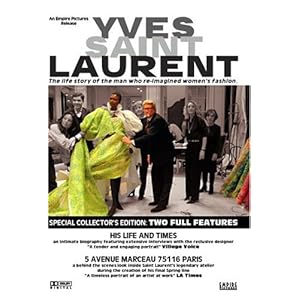
Over the holidays I rented David Teboul's 2002 double documentaries YSL: His Life and Times and Yves St. Laurent: 5 Avenue Marceau 75116 Paris. YSL covers Laurent's childhood (at age three he told his great aunt that she needed to change her dress, and she complied!) and early career. A fashion contest got him a position with Christian Dior, and by 26, he had opened his own house of couture. An ardent admirer of Coco Chanel, Laurent appreciated the simplification Chanel had brought to women's clothing while retaining, though pared down, elegance. The film chronicles a vanishing world of which Laurent may have been the last great couturier, and also makes clear that Laurent understood that the working woman deserved accessibility to chic fashion and was the first to champion ready-to-wear lines. YSL is slow-paced, but 5 Avenue Marceau moves at a crawl...and that's OK. It is a behind-the-scenes look at the 8-week-long creation of a single season's collection, specifically the spring/summer collection for 2001. From conception to sketch to toile (the term for the plain, white linen fabric and for the test garment made from it) to final preparation, which itself is a laborious process of fabric selection, adjustments, meticulous collar and flounce creation, nipping and tucking, sometimes on a dress form, but most often on the living person of the model. There is no hustle and bustle, just a hush of concentration and a palpable mutual respect amongst everyone involved in the process. The designer's admiration and gratitude toward the men and women dedicated to the art of drape and handwork, and their admiration and gratitude toward him, are infectious. 

Yves Saint Laurent - His Life and Times/5 Avenue Marceau 75116 Paris


I was in Houston last spring and though my cheap hotel had no ice machine, much to my chagrin, it did have HBO. Playing was Craig Teper's 2010 Vidal Sassoon: The Movie. I know several women who wear Vidal Sassoon haircuts. One is an artist who patronized Sassoon's salon in the 1970s. The others probably have never heard of Sassoon except as the name of a product line, nor do they know that he was the first to utilize the success of his name to create a product line brand. Vidal Sassoon probably understood hair better than anyone who ever lived. While my mother was still going to a "beauty parlor" to have her hair rolled onto curlers, teased and sprayed into a helmet, Sassoon was making hair bounce and swing for the swingin' '60s. He made it look effortless, when in fact it was exactingly difficult (to which I, as one who has been given dozens of botched efforts at Sassoon-esque haircuts, can attest). It took years for Sassoon to perfect the five-point haircut that would forever transform the way women wear their hair.


For those who don't know, in her New York Times review Carina Chocano explains that Bill Cunningham is "the legendary street-fashion photographer and society chronicler for The New York Times." Richard Press's 2010 Bill Cunningham New York was previewed at my theater in 2011, and then never came, so I rented it over the holidays. For decades Cunningham's eye has synthesized what fashion means. From the abstraction of couture runways, to the society events where the wealthy who can can afford to don such creations go to see and be seen, to the person on the street from the flaneur to the Wall Street MBA to the housewife to the butcher, the baker, the candlestick maker -- Cunningham is not simply interested in fashion, he is interested in how it is translated into real clothes on real people and morphed into individual style.

Fashion is our most immediate manifestation of the aesthetic, and by extension, serves a valuable function. "In Paris, every six months," says Cunningham, "fashion educates the eye. Why would the world [perceive] fashion as ... a frivolity that should be done away with in the face of social upheavals and problems that are enormous. The point is that fashion is the armor to survive the reality of everyday life. I don't think you could do away with it. It would be like doing away with civilization."

Whether cycling around traffic or crouching amongst street bustle in his signature Paris street sweeper jacket, Cunningham, with his encyclopedic knowledge of fashion history, is the omnipresent arbiter of where fashion stands on any given day. He would self-effacingly reject the idea. "I don't decide anything. I let the street speak to me, and in order for the street to speak to you, you've got to go out there and see what it is."


Bill Cunningham photographing women attending a Fashion Week show in Chelsea

2012: MUSIC DOCUMENTARIES

Each of these three marvelous music documentaries is a 2012 NYT Critics' Pick.


As Stephen Holden points out in his NYT review, Kevin Macdonald's Marley "is far from hagiography; and while stocked with musical sequences, it is not a concert film. Few if any of his songs are heard all the way through [a fact that bothered me]. Marley is a detailed, finely edited character study whose theme -- Marley's bid to reconcile his divided racial legacy -- defined his music and his life." As Marley becomes more absorbed in Rastafarianism, he takes on an almost cult guru persona. This grandiosity may have played a  part in his refusal of treatment for the melanoma that would eventually kill him.


There is a town in north Ontario...
Whereas the 2006 Heart of Gold was a poignant foray into nostalgia, a reunion of old friends playing familiar favorites in an easy, loving ramble, the solo performances that constitute Jonathan Demme’s third concert film with Neil Young, Neil Young Journeys, are at times almost confrontational, as if to say – especially in the first set – we’ve been talking about slaughter, love and war, the rumblin’ in the ground, and still we have to ask: When will I learn how to listen, learn how to give back, learn how to heal? The question is not asked plaintively. It is howled, wailed, implored. The second song is "Ohio," delivered as an incantatory denunciation as we watch the historical footage of the events at Kent State and tributes to the four who died.

The second set is tempered with a few lighter pieces – "My My, Hey Hey (Into the Black)," the then unreleased "Leia," which oscillates between the tinkling of a toy piano sounding much like a calliope and a thunderous antique pipe organ – but the set is only slightly less intense with a magisterial rendition of "After the Gold Rush" on the same organ.

The whole often has an almost operatic quality, while at the same time being a palpable valentine to his audience. Just as we think the concert is over, Young seems to have second thoughts in his dressing room and returns to the stage for an encore of "Walk with Me," which he addresses directly to his fans. He closes by setting the reverberating guitar in front of the speakers. As it sings its feedback across the music hall, he periodically shakes and adjusts it in a musical equivalent of action painting, looks back again over his shoulder to the crowd, and heads back to the road.

The concert is juxtaposed with Young’s road trip in a 1956 Crown Victoria, from his hometown of Omemee, Ontario, 90 miles southeast to Toronto’s Massey Hall. Reminiscing, he says that we may lose people along the way but will always have them with us in memory. “I lost some people I was traveling with, I missed a soul and the old friendship.” (Stephen Holden's NYT review)


I have a problem when 1% celebrities -- musicians, movie stars, athletes -- drop in to show their solidarity with the Occupy movement. The elephant in the crowd leaves me squirming. So as I came to know Rodriguez over the course of an hour and three quarters, my admiration for both the music and the man grew exponentially. Swedish director Malik Bendjelloul's documentary, Searching for Sugar Man, is the story of a poor poet/singer-songwriter who had the good fortune to record two albums in Detroit, and then the misfortune to have them go unheard by his countrymen. It is the story of the South African anti-apartheid movement, an uprising fueled, at least by its white proponents, with bootleg recordings of Rodriguez's music, a development of which the musician was wholly unaware in a pre-Internet era and a South Africa sealed off from the rest of the world. It is the story of an ascetic artist who languished in obscurity, but in 1998, learns of his South African fame, flies there to play to what he does not realize will be packed adoring crowds and will result in a series of South African tours in subsequent years (as well as tours of Sweden and Australia). Sold-out concerts are profitable, and yet, Rodriguez gives the money away, and continues to work as a construction laborer and to live in a tiny, ramshackle house. Not least, it is the story of family devotion and love and the redemptive power of art.


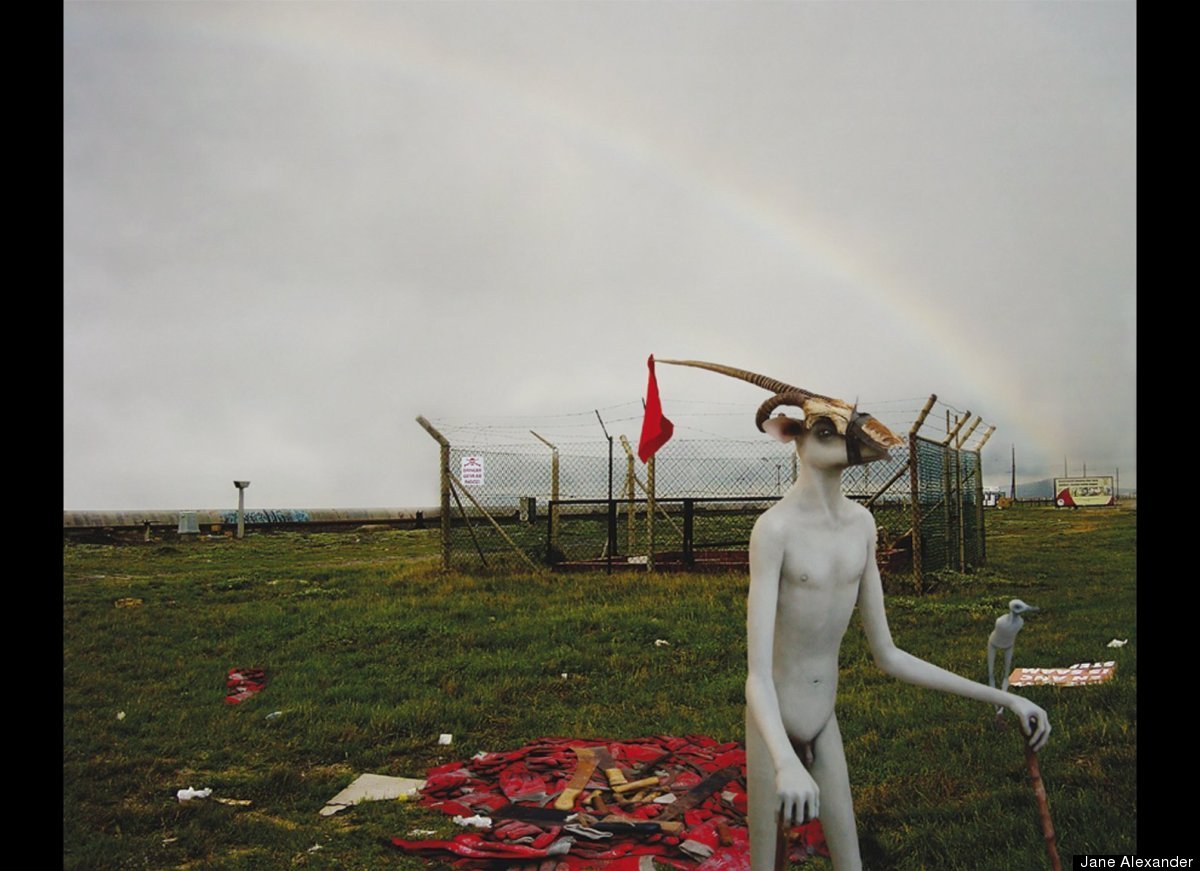
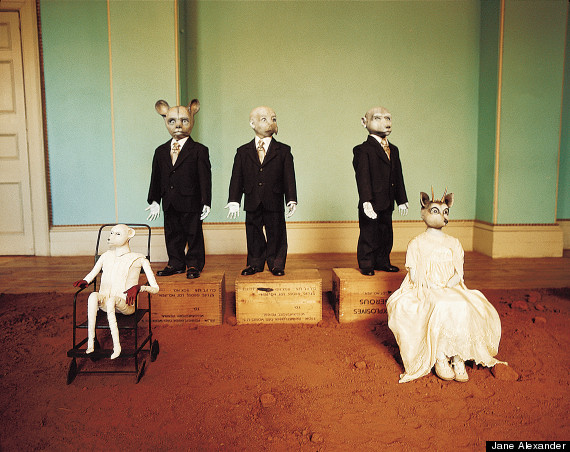
I saw Searching for Sugar Man the weekend before I saw the South African artist Jane Alexander's exhibition Surveys (From the Cape of Good Hope) at the Contemporary Art Museum Houston. It was an astounding synchronicity. Art in America conducted an interview with the artist.


jane alexander_african adventure_detail 2

January 7, 2013

2012: MATTHEW MCCONAUGHEY

As a Matthew McConaughey fan I was glad to see him in many incarnations this year. There were the Southern Gothic freaks of Flannery O'Connor descent, and small town characters that faintly evoked Sherwood Anderson's grotesques.


Richard Linklater trekked to Carthage, Texas (not just Texas, but East Texas, which the film makes clear distinguishes it, in dialect, conventions and inclinations, from other distinct Texas regions) to tell the true story of undertaker Bernie Tiede, delightfully portrayed by Jack Black -- a compelling figure on the screen. Shirley MacLaine plays the wealthy, widowed sourpuss Mrs. Nugent, whom Bernie sets himself the challenge to befriend -- a challenge he achieves too successfully as she increasingly circumscribes his independence to the point of essentially holding him hostage. He finally reaches the breaking point, for which we, and the Greek chorus of Carthaginians, forgive him. DA Danny Buck alone, in a seriocomic turn by Matthew McConaughey, sees Bernie as deserving of punishment rather than as a victim of the smothering Mrs. Nugent. The townspeople of Carthage play themselves, including McConaughey's mother Kay. By turns charming and menacing, Bernie is a must-see for anyone who has ever experienced small town Texas. (Manohla Dargis's NYT review)


Steven Soderbergh's Magic Mike is mostly just plain terrible. I was at lunch with a friend, when out of the blue she said, "Let's go to a movie!" Magic Mike was the movie she picked. Walking out I remarked, "Well, that was the thinnest plot possible," to which she replied, "What plot??!!" Manohla Dargis, writing in the NYT, found Channing Tatum in the lead, as a construction worker who opens up his new employee to the world of male stripping to make an extra buck, "terrific." I simply found him miscast. By contrast, Matthew McConaughey as the club owner gives it his all and ya gotta love him for it.


My indie theater staff tells me I saw the cut version of William Friedkin's Killer Joe, adapted from Tracy Letts's play. If so, the film still does what it can to earn its NC-17 rating. Matthew McConaughey can be superb (even in a failure of a movie like Magic Mike), and he does not disappoint as Joe. Chris has gambling debts and decides the easiest way out is to have his mother Sharla killed for the insurance money. Joe, the hit man he invites into his self-destructive American Gothic family, sees where the whole scenario is headed, and insinuates himself into the dysfunction with cunning manipulation. Manohla Dargis argues in the NYT that "The other characters are merely supporting players, and so too are the actors wrangling the roles," and believes Emile Hirsch (brother Chris) and Juno Temple (sister Dottie) are particularly miscast. I disagree. I think the ensemble works. I have peripherally known people like Hirsch's Chris. (I was rejected for a jury in juvenile court for a trial of a girl accused of a stabbing. She was 14, but if you didn't know that and saw her on the street you would have guessed a weary 35-40.)

Dargis also takes issue with Friedkin's direction. Again I disagree. Friedkin uses the seedy landscape to excellent effect as the backdrop for the domestic abjection of a family whose greed and stupidity bring their own downfall. Scenes oscillate between gritty vistas and the family's cramped trailer with fewer and fewer open spaces as the claustrophobia tightens. Dargis says Friedkin "...takes such a creepily intimate approach to Sharla’s and Dottie’s violent degradation that you might think he enjoys it." The camera work, it seems to me, doesn't intend to revel in the degradation; rather it seems designed to show us what we would rather not confront in the underbelly of human nature. The shots are artfully framed, the camera work interesting without getting in the way. And I defy anyone to fail to enjoy the moment at which Joe has had it with the drivel on the ever present TV!

Alert: This is not a movie for the squeamish. If you're bothered by psychopathic violence, physical and psychological, this is NOT for you.


Lee Daniels (Precious) adapted The Paperboy from Pete Dexter's novel. A. O. Scott, writing in the NYT, calls it a "hot mess" -- and what a hot mess it is. A Southern Gothic Bildungsroman set in and around a pre-air conditioned Florida Everglades in 1969, every frame drips with humidity, sweat, sex. Nicole Kidman is Charlotte Bless who, in the course of pen pal exchanges with convicted killer Hillary Van Wetter (!), chillingly executed by John Cusack, has come to believe in his innocence. She convinces Fort Lauderdale investigative reporter Ward Jansen (McConaughey) and his researcher Yardley Acheman (David Oyelowo) to come to town and set justice right. The paperboy is Ward's younger brother Jack (Zac Efron), who can't help his hormone-fueled id from falling for the teasing, tease-haired vamp. To avoid a spoiler, suffice it to say that Charlotte and Hillary's first jailhouse encounter implicates the audience in its voyeurism as much as anyone physically present in the scene. The story slithers deeper into the Everglades, as it penetrates deeper into the id. Every performance is a gem in this steamy primordial ooze.