Search This Blog

November 11, 2015

NO GOOD MOVIES: A RANT

As has been Hollywood's wont for too many years now, come January (and February and March) the big-box multiplexes get hit with bombs the studios are just trying to recoup some production costs on. This year it was Black Hat (which took the thrill out of the thriller), Focus (which took the sting out of the con), and Chappie (which took the doom out of dystopia). There was Kingsman: The Secret Service looking like it longed to spawn a franchise, which we can only hope it will not, and the unfortunately titled second installment of the teen trilogy Divergent -- Insurgent, beyond awful in its utter lack of narrative or anything resembling imagination. In the BoaTS category, Al Pacino and Annette Bening made the unlikely Danny Collins shine, but even Helen Mirren could not salvage Woman in Gold, which barely limped along.


It is a sad state of affairs when it has to be said that Cinderella was the first good movie of the year. Kenneth Branaugh did a lovely job, though I found the stepsisters (Sophie McShera and Holliday Grainger) a bit over the top. Lily James is a perfect embodiment of Ella and Richard Madden suitably handsome. Cate Blanchett gives the Wicked Stepmother psychological depth, and when you say, "Fairy Godmother," it's a given Helena Bonham Carter be cast. Watching the pumpkin and its attendant goose and mice and lizards transform into and out of carriage and driver and footmen was worth the price of admission. On her deathbed Ella's mother tells Ella, "Have courage and be kind," a message Ella repeats to herself whenever tempted otherwise. There are worse lessons to be learned.


Recently I found myself at a small gathering among people with whom I was only mildly acquainted or had never met. In small talk (a talent I lack) one of the latter opined, "There just aren't any good movies anymore."

I hear this a lot, and it always makes me angry. It has become the default statement people make when the subject of movies comes up in conversation. What's worse, it is said in a tone meant to convey the speaker's acute discernment. I believe people who hold this opinion are part of the movie devolution problem, and my rejoinder to the "no-good-movies-anymore" assertion is to declaim, "Yes, there are. YOU just don't go to them." On the evening in question I checked myself ("Have courage and be kind"), but as Brooks Barnes and Michael Cieply observe in a recent New York Times article, "Hollywood Is Producing Higher Highs, Lower Lows," "For months, American moviegoers have either been going big or staying home." For months, people? For years!

I do not live in New York, L.A., or Chicago where movie goers have the chance to see most everything they desire. I live in one of the more populous U.S. cities, but that doesn't translate into much meaningful cultural substance. I am very fortunate that the locally-owned theater chain reserves one venue for films that never make it to national multiplexes, but their audiences are typically small, and, when it comes to foreign films, likely to be very sparse indeed. As a consequence, fewer foreign films are billed each year. If an obscure film becomes an Academy Award contender, I might get to see the contender in January... or February... or March... or maybe not at all in the theater especially, again, if it is a foreign film.

That meant I had to wait to see 2014's Inherent Vice, A Most Violent Year, Cake, and Still Alice in the theater until 2015. All four of these films might be characterized as "dark" in one way or another and thus less salable to a mainstream audience. It was an even longer wait for Mr. Turner, Wild Tales, Leviathan, Clouds of Sils Maria, Two Days and One Night, and Mommy. I have a wide-ranging circle of acquaintances -- academics and professional artists and musicians among them -- hardly any of whom went to any of these movies unless they reside in or around New York, L.A. or Chicago. Some go out of their way to travel to see new releases, and some view these films later on DVD or Pay-For-View. Still, some films, like the Roger Ebert documentary Life Itself, despite previews here, never made it into our theaters.
Same with documentaries: The Salt of the Earth, Lambert and Stamp, and Dior et Moi were all late comers, and despite the wide range of subjects among them -- Sebastião Salgado's social documentarian photographs,  The Who's unwitting managers, the self-effacing haute couture designer Raf Simons who took over House of Dior in 2012 -- neither the social justice advocates nor the rock aficionados nor a former costumier saw any of the three.

Back to Barnes and Cieply's NYT article: "[I]f [audiences] keep behaving that way [i.e., going big or staying home], 2015 may set new marks for both hits and misses — while leaving a hole in the middle, where Oscars are typically born." That Oscars often go to "the middle" is proof the Academy rarely has an interest in recognizing quality and depth. A look at the winners of the first decade of the 21st century reveals some powerful and deserving pictures such as The Hurt Locker and No Country for Old Men, but it also turns up The King's Speech, Slumdog Millionaire, The Lord of the Rings: The Return of the King, A Beautiful Mind and -- really?! -- Gladiator. (I'm looking at the lists and the runners-up aren't that noteworthy either.) Going further back: Shakespeare in Love, Titanic (aaarrrggghhh...), Braveheart, Forrest Gump, Dances with Wolves, Driving Miss Daisy.... I'll stop there.

With the exception of Titanic, none of these are bad movies, but they are not films that should be on anyone's 100 best cinematic achievements list. "[I]n both [September and October]," Barnes and Cieply continue, "high-profile, midrange films that were being closely monitored as awards prospects flopped — among them Sony’s The Walk, Universal’s Steve Jobs and Warner’s Our Brand Is Crisis." Now, I saw all three of these films, and to think that any one of them is being considered  an "awards prospect" is depressing. I liked (the vertiginous) The Walk, but John Marsh's 2008 documentary Man on Wire is infinitely better. Unlike Steve Jobs devotees who felt the actor was miscast, I thought Michael Fassbender was terrific -- as was Kate Winslet, by the way -- and I would have no qualms with accolades for their performances or for Aaron Sorkin's script for that matter or for sound mixing or some such, but in no way should Danny Boyle's film be in the running for Best Picture. On the other hand, Our Brand Is Crisis is a shallow, cynical mess that manages to side-step any ethical considerations its story might pose and should not be considered for Anything. At All. Ever.

So what does interest the Academy? Barnes and Cieply's next paragraph reflects the Academy's criteria, noting the Bond franchise's opening weekend take for Spectre, "the most expensive 007 installment ever, costing Sony Pictures Entertainment, Metro-Goldwyn-Mayer and Eon Productions roughly $400 million to make and market," (Does this strike anyone other than me as obscene?) was "down sharply" from 2012's Skyfall, though it took in "an additional $223 million overseas, breaking records."

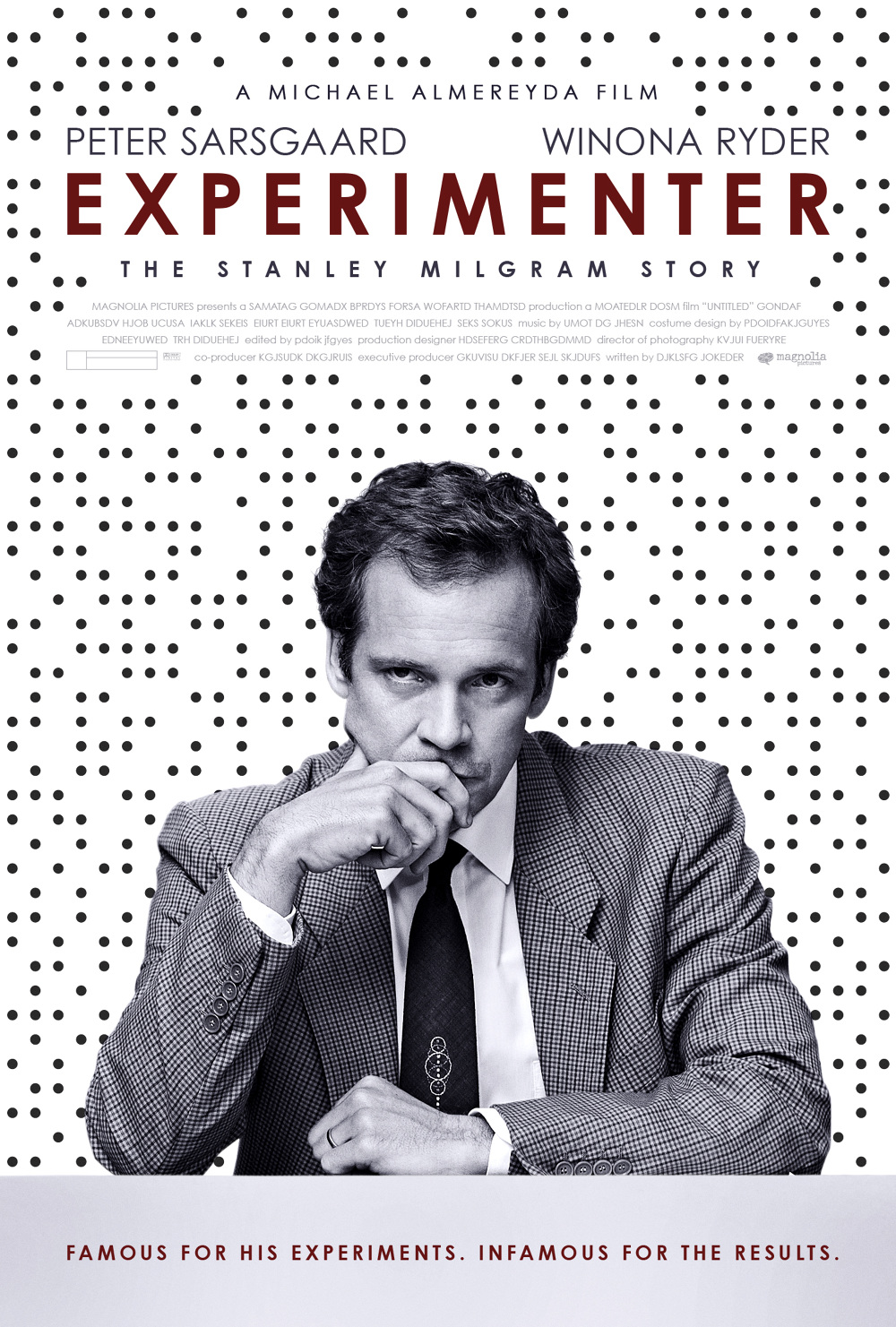
The October box office "belonged to The Martian," according to Barnes and Cieply, whereas September had been driven by Hotel Transylvania 2...." I can see the appeal of The Martian -- I know I had fun -- but Hotel Transylvania 2? This brings me back to my "no-good-movies-anymore" opinionators and the blame I cast on them for the sad state of contemporary cinema. The little old lady at the soirée chewing my ear probably took her grandchildren to Hotel Transylvania 2 but did not see Jimmy's Hall, Sicario, Black Mass, Experimenter, Beasts of No Nation, 99 Homes or Freeheld (the latter two being a double opportunity to see Michael Shannon performances), all of which were right here in River City concurrent with Hotel Transylvania 2's duration.


I admit to a warm feeling of  schadenfreude learning that the "more commercially oriented" Pan, Rock the Kasbah, The Last Witch Hunter, Jem and the Holograms and Scouts Guide to the Zombie Apocalypse (none of which I saw) were "wipeouts" at the box office. That said in 2015, tons and tons and tons of people went to Jurassic World, The Avengers: Age of Ultron, Furious 7, Mission Impossible: Rogue Nation and the aforementioned Hotel Transylvania 2 (also none of which I saw) and then walk around saying, "There just aren't any good movies anymore."

Coming up on December, the odds are a wee bit better that a few "no-good-movies-anymore" people will go to The Danish Girl, Macbeth, Legend, Carol, Youth, Brooklyn, Room, Spotlight, Son of Saul, or The Revenant -- not to mention the foreign films and documentaries that even this late in the calendar have been held back from us. Ah, heck, that's just pie in the sky.

Michael Caine and Harvey Keitel in Paolo Sorrentino's Youth

October 27, 2015

THE AMERICAN DREAM IN EXTREMIS: THE FILMS OF RAMIN BAHRANI

Ramin Bahrani may be our sharpest cinematic critic of the capitalist machine that is the present-day United States. His characters work hard within a system designed to crush them; then they compromise their ethics to survive in a world dictated by the almighty dollar. Bahrani's vision is cynical, but, in a different way, Hollywood's tendency to edit out the disenfranchised is cynical, too. In movies not exclusive to Nancy Meyers- and Judd Apatow-esque vehicles, and in television series like The Good Wife, Madam Secretary, House of Cards, etc., affluent characters inhabit sprawling, well-appointed homes with no hint as to how they get dusted and vacuumed, how toilets get cleaned, how beds get made, laundry washed, yards manicured. Where are the housekeepers, the gardeners?
Set for Nancy Meyers's 2003 Something's Gotta Give
We see the servants in old movies on TCM, in period pieces like the eponymous The Help, and in depictions of ridiculously rich people like multimillionaire John du Pont in Foxcatcher, but affluent characters in present-day Southern California, New York City, Washington, D.C., et al., despite their tacit claim to "middle class," betray their upper class status through pretentious set-dressing alone. A willing suspension of disbelief, especially in the week-in/week-out of serial television, where we feel more intimate with characters than we might in a two-hour feature film, is required to never once wonder who cleans the house. For some reason, the entertainment industry is loath to be honest about the domestic workers necessary to make wealthy fictional lives realistically hum. Bahrani's characters are the invisible people -- taxi drivers, cart vendors, salvagers, farmers, carpenters. Many are immigrants. All yearn for the American Dream yet vary in their vision of the grail.

Bahrani's first full-length feature, Man Push Cart (2005), is a painfully literal Sisyphean tale. We meet Ahmad (Ahmad Razvi) before dawn as he carries an airtank to a food cart depot, wrangles his cart up streets and down -- but mostly up and up and up -- to a corner in midtown Manhattan. He exchanges greetings with fellow vendors, preps coffee filters with grounds, sets out muffins and bagels, arranges tea bags in paper cups stacked for efficiency. Customers begin to arrive, friendly regulars, impatient passers-by, and a suit who recognizes Ahmad as Pakistani. "Yeah, from Lahore," Ahmad acknowledges. "Me, too," the suit says in a sort of solidarity. Those are the first 5 minutes, and the routine will play itself out over and over and over in a metronomic cadence for the next hour and a quarter, each rotation accompanied by a short musical phrase reminiscent of tolling Islamic calls to prayer.
Ahmad Razvi as Ahmad in Man Push Cart
Ahmad lives an hour's subway ride away in a Muslim immigrant, Brooklyn neighborhood. His day starts at 3:00 a.m. and ends after dark in the depot where he washes the cart down for the night before the subway ride home. For reasons we never discover, he has immigrated to the United States. We do learn he is a widower with a son in the custody of his mother-in-law. The fellow Pakistani customer, Mohammad, hires Ahmad in Ahmad's off hours to paint his loft apartment, where Mohammad recognizes Ahmad as the Pakistani rock star who recorded a CD in Lahore. When Mohammad lends Ahmad $500 to pay off his cart, the moment seems it should feel propitious but feels ominous instead. As Ahmad makes the final payment, the seller tells him to insure the cart first thing, foreshadowing the story's denouement.

Ahmad is the first in a line of characters who, as Roger Ebert, an early champion of Bahrani's work and the dedicatee of 99 Homes, said: "Like so many Americans who work low-wage jobs...his work essentially subsidizes his ability to keep on working."

In The Great Gatsby, F. Scott Fitzgerald called the 20 blocks of junkyards that comprise Willet's Point, Queens, "The Valley of the Ashes." In Chop Shop (2007), Alejandro (Ale), a Latino street orphan, lives there, scraping by on the good graces of Rob, the owner of the auto-body shop where Ale works. Rob lets Ale (Alejandro Polanco) live in the shop's corner nook, and when Ale finds a job for his sister Isamar (Isamar Gonzales) at a neighborhood food truck, he gets her to stay with him. She's 16, he's 12; she's finished 7th grade, he's never been to school -- but he is street-wise and wary beyond his years.

When Ale's friend tells him about an old food van his uncle is selling, Ale's dreams open to the possibility of a new life. Yet, it doesn't take long for Ale to realize it will take more than he makes to come up with the $4,500 to buy the van. He takes up a second job in a chop shop owned by Ahmad (Ahmad Razvi of Man Push Cart). Izzy, too, needs money, and when Ale inadvertently sees her with a trick, the knowledge saddens him, but survival does not admit the luxury of sentimentality or judgment.

Ale buys the van before Ahmad can explain it will cost $10,000 to pass inspection. Ale's world closes in again. For Ahmad in Man Push Cart, insurance is beyond reach; for Ale in Chop Shop, bringing the van up to code is beyond reach. Bahrani shows us only a slice of his characters' lives. We can only imagine how they have been tested before we meet them, what their journeys have involved, what obstacles they have overcome to reach what seems will be the turning point, the grail they have worked and worked and worked to find until it is just within reach, only to be snatched away.
Alejandro Polanco as Ale and Isamar Gonzales as Izzy in Chop Shop
Bahrani's characters are not blameless, but their guilt derives more from naïveté than willful villainy. They are burdened not only with the cost of the means to make a living, but with a dearth of time. The structure of the classic quest narrative allows the hero interludes of rest to regain strength between trials. Because Ahmad and Ale are always working, they can never revive, as much because they have no time as because they have no money. They are prevented from playing by the rules: filing for business certificates; applying for employee ID numbers, certificates of authority to collect sales tax, mobile food vending permits, insurance coverage; passing food protection exams ($114 in Queens); registering as self-haulers with the DMV; acquiring the required equipment for commercial vehicles, etc. Like Sisyphus, they wake up to the same ordeal day after day as though trapped in some cruel cosmic joke.

That indifferent cosmos pervades the Piedmont plateau of the Appalachian range midway between the Blue Ridge and Great Smoky Mountains where Goodbye Solo (2008) is set. The man in the taxi, a curmudgeonly 70-year-old named William (Red West), asks the cabbie, a garrulous Senegalese immigrant named Solo (Souleymane Sy Savane) who likes to address people as Big Dog, if he, Solo, will take him, William, to a place called Blowing Rock in two-weeks time for $1,000.

Solo takes an irrepressible pleasure in life, but his usual exuberance is tested when his wizened passenger poses this bargain for a one-way fare. The implication transgresses the foundations of Solo's world-view centered around family and mutual support. He determines to change the course of the old man's resolve, dragging the reluctant William into his daily rounds and his own dysfunctional family -- that is, into life. In contrast to William's resignation, Solo is studying for airline steward certification, a challenge he faces with resolute optimism. What unfolds between this odd couple is an unlikely bond, and a meditation on the moral commitments genuine friendship entails.

That a suicide constitutes the most hopeful of Bahrani's films seems ironic on its face, but Bahrani says, "Solo is...a complex man, full of flaws, who comes to learn...from his encounter with William. Ultimately Solo must find the courage and strength to love his new friend selflessly in order to help him do something seemingly horrible, or leave him to face it alone."

Souleymane Sy Savane as Solo and Diana Franco Galindo
as his stepdaughter Alex in Goodbye Solo
Just as the pre-dawn labyrinthine streets through which Ahmad wrangles his cart, the chop shop jungle of Willet's Point, and the mist-filled atmosphere of Blowing Rock are all silent, ambient characters in Bahrani's first three films, so the rolling Iowa plains become part of the dramatis personae in At Any Price (2013), an allegory of the shifting American ethos through the mirror of three generations of Iowa farmers. The first three films peeked into immigrant lives on the fringes. At Any Price brings hypocrisy home to roost.

At Any Price trains its lens not on immigrants, but on the rural people we romantically like to think "made America great" alongside their urban manufacturing counterparts. For those not engaged in the agriculture economy, the popular imagination limns "corporate farming" and "family farming" as morally antithetical. Though it is true that "Large farms with over $1 million in sales account for only 4 percent of all farms" in the U.S., the balance mostly functions in a hybrid system of contract farming: the farm is family owned but operates under powerful corporate authority. Many state laws prohibit corporate farming, but the fuzzy distinction between "corporate" and "contract" creates a legal gray area that effectively allows corporations to farm in those states through contracts with local farm owners.

With the exception of Red West in Goodbye Solo, Bahrani cast nonprofessional actors in his first three features, but for At Any Price, he turned to professional actors with Dennis Quaid in an outstanding performance in the central role of Henry Whipple. Henry has spent a lifetime working the land. His aging father Cliff (West again) has handed the reins of the family farm to Henry, who has been trying to bring the operation into the 21st century and preserve it in the face of what contemporary agribusiness has become. Henry's son Dean (Zac Effron), hoping to escape the farm for good, has fantasies of a life of celebrity and reckless excitement as a racecar driver.

The 1966 Farmall 1206D Tractor was International Harvester's
first U.S.turbocharged diesel engine and the first two-wheel drive
to exceed 100 horsepower.
Cliff is wont to remind his son of the hard physical work farming used to be, yet Henry faces challenges of his own. Unlike his father, for whom a Farmall 1206 would have been state of the art technology, Henry stables air conditioned, self-steering combines with electronic sensors, GPS, and computer monitoring systems and foots the mortgages for the upwards of $250,000 each costs. Additionally, he and his neighbors are contracted to agri-business corporations and are bound by the laws that protect the corporate patents. Henry subsidizes his farming income by working as the local sales rep for one of those corporations (a stand-in for Monsanto/DuPont/Syngenta) that genetically engineers the seed he and his neighbors plant. What his customers don't know is that while Henry sells them the new strain for planting each spring, he has stashed last year's harvested seed and saved himself a small fortune in the bargain. Trying to explain to his son's girlfriend the Catch-22 big agri has created by manipulating the law to its profit advantage, Henry simply says, "They've patented life."

Speaking with Mark Olsen of the Los Angeles Times, Bahrani explained his desire to focus on Iowa corn farmers and debunk the romantic myth of the bucolic family farm: "These are not small farmers getting crushed by the banks, these are multimillion-dollar farms destroying each other, because they have to, to stay alive. And that was very different from what we think about farms. I found it very telling about where we are." Truth is thorny, and we share culpability for refusing to understand it in its complexity.
Dennis Quaid as Henry Whipple in At Any Price
With 99 Homes, Bahrani takes his examination of the American Dream into the foreclosure mania that swept pockets of United States suburbs. Some places were particularly hard hit, one of which was Orlando, Florida. Bahrani structures this film as a tightly wound suspense thriller. Real estate broker Rick Carver -- embodied in Michael Shannon's nuanced performance -- needs 100 foreclosure deals to go down on 100 homes before he can make an even bigger haul on 1,000. The final showdown takes place at the metaphorical 99th, a house not owned by Frank Green but mortgaged to Frank Green, for the bank, not Frank, owns the house. It is a critical distinction that 99 Homes dispassionately makes. "Home ownership" is a signal part of that woolly American Dream. As ubiquitous as credit card debt is in the U.S., some stigma attaches to excessive credit balances. A mortgage, on the other hand, has typically been considered desirable (e.g., tax code favors a mortgage deduction).

Rick Carver is based on David J. Stern, the now disbarred real estate attorney who came to be dubbed the "foreclosure king." In 2010, the relentless investigative reporters Matt Tiabbi of Rolling Stone and Andy Kroll of Mother Jones broke the story of Stern and Florida real estate fraud. "The foreclosure lawyers down in Jacksonville had warned me," Tiabbi begins, "but I was skeptical. They told me the state of Florida had created a special super-high-speed housing court with a specific mandate to rubber-stamp the legally dicey foreclosures by corporate mortgage pushers like Deutsche Bank and JP Morgan Chase. This 'rocket docket,' as it is called in town, is presided over by retired judges who seem to have no clue about the insanely complex financial instruments they are ruling on — securitized mortgages and labyrinthine derivative deals of a type that didn't even exist when most of them were active members of the bench. Their stated mission isn't to decide right and wrong, but to clear cases and blast human beings out of their homes with ultimate velocity."
Michael Shannon as Rick Carver in 99 Homes
Andrew Garfield plays Dennis Nash, a single father supporting his young son as well as his mother (Laura Dern). After being evicted by Carver, Nash goes to work for him. Despite his better angels, Nash gets sucked into Carver's scheme for the same reason Carver has pursued his ruthless line of work -- he needs to survive and support a family. Carver's father, a carpenter, scraped by until he died; Carver has no intention of following in those footsteps.

In preparation for his films, Bahrani immerses himself in his subjects' lives and milieus, sometimes over a span of several years in what sociocultural anthropologists call participant-observation. For 99 Homes, he, Shannon and Garfield all spent extended periods of time in Florida -- day after day in the rocket docket courts and nights in cheap motels populated by "gangbangers, prostitutes, day-laborers and normal middle class families.... [families who are] not broke but with part-time jobs, living in motels, and so many kids...that school buses have to get diverted to take them to school," Bahrani told Candid Magazine. "[O]ne night [Garfield] told me he'd met a day-laborer in a Home Depot parking lot who practically [told] him the story of the film although we'd already written the script." Because the real estate scandal became the only game in town, the day-laborer, after being evicted, himself became an evictor. His story was not unique, a fact that made framing the film in black and white, good vs. evil impossible, even irresponsible. As Bahrani warns, "[I]t's important to remember that despite [Carver] being the devil, the actual villain in the movie is the system. [Carver] is just the child of the system...." When he went to Florida, Bahrani says, he thought he was going to make a social drama, but the world he found said, "No, you're not. You will make a thriller, you will make this Faustian story with a social heart because that's what it is. We all carry guns, there's danger at every corner, every door we knock on has danger, every place we turn to has opportunity for corruption and scams." That's the real American story.
Andrew Garfiield as Dennis Nash and Michael Shannon as
Rick Carver in 99 Homes


October 20, 2015

MEH...: STEVEN SPIELBERG'S BRIDGE OF SPIES

It's that time of year when the Steven Spielberg contender is released to adoration. This year it's Bridge of Spies, the 17th Spielberg movie I've suffered out of the 30 he's directed to date. I have only seen the first in the Indiana Jones franchise, Raiders of the Lost Ark (1981). I have not seen Jaws (1975); Twilight Zone: The Movie (1983) of which Spielberg's segment is #2; Jurassic Park (1993) or its sequel (1997);  A.I. Artificial Intelligence (2001) – I took issue with Spielberg being handed a Stanley Kubrick-conceived film; Minority Report (2002); War of the Worlds (2005); two I've never heard of: 1941 (1979) and Always (1989); and 2002's Catch Me If You Can, the only one I might consider seeking out. I have (groan) seen all the rest. Why? So I can defend my position against Spielberg as the worst highly acclaimed director of all time.

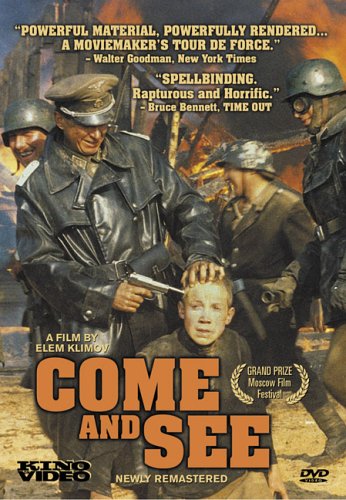
Let's take The Color Purple (1985) as an arbitrary starting point. Good god, man – it takes more than a bucket, a mop and a good cinematographer to turn a hovel into a bucolic cottage set amidst billowing fields of sun-dappled wildflowers. Then there's the requisite, manipulative John Williams score. Midway through, as I heaved yet another sob, sinuses swollen, I was ready to strangle the both of them for so artificially wrenching emotion out of the audience. Schindler's List (1993)? What's with that fleeting little girl in the red coat who keeps showing up in the frame? Is she a metaphor? If so, a metaphor for what? Then in 1998, the inaugural film in what we might call "Spielberg's Tom Hanks Era," Saving Private Ryan: Quit telling me it is the most realistic depiction of war ever captured on film, because anyone who makes such a claim has not bothered to see Bernhard Wicki's 1959 The Bridge, Elem Klimov's 1985 Come and See, or Patrick Sheane Duncan's 1989 84 Charlie MoPic.

In 2011, I subjected myself to both Spielberg holiday movies. The Adventures of Tintin starts out remarkably true to the wonderful Hergé creation, but instead of using one Tintin story, Spielberg proceeds to mash up three (“The Crab With the Golden Claws” [1941], “The Secret of the Unicorn” [1943] and “Red Rackham’s Treasure” [also 1943]). Tintin is a child journalist who, attended by his Wire Fox Terrier Snowy, is forever finding himself called to distant shores to solve inscrutable mysteries. Spielberg makes no attempt to mine the sharp geopolitical parody that was the raison d'etre for many of the Tintin stories. Instead, Hergé's intrepid character and the graphic charm of the ligne claire (clean line) style he pioneered are soon mauled when, no longer able to contain himself, Spielberg lets loose an endless animated CGI orgy. The youngsters in my audience began to crawl out of their seats and into the aisles to tune Spielberg out altogether and lose themselves in their own imaginations. Usually scornful of restless audiences, I sympathized while trying to stifle one sigh of annoyance after another. Writing in London's The Guardian, literary critic Nicholas Lezard rued, "Coming out of the...film..., I found myself, for a few seconds, too stunned and sickened to speak; for I had been obliged to watch two hours of literally senseless violence being perpetrated on something I loved dearly. In fact, the sense of violation was so strong that it felt as though I had witnessed a rape."
Young reporter Tintin and his dog Snowy come to the rescue
of Professor Calculus, who has invented a machine that destroys
objects with sound waves. He is the subject of kidnapping attempts
by the competing European countries of Borduria and Syldavia.
Published in 1956, the story reflects the Cold War tensions of the 1950s. 

Then came War Horse right on Tintin's heels, with yet another John Williams score and good actors playing caricatures for Hallmark-Hall-of-Fame-tear-jerker effect. The horse is about the only player in the film Spielberg was unable to turn into a stock character. His sentimental nostalgia for overwrought Hollywood epics is almost as gratuitous as his addiction to CGI.

Daniel-Day Lewis, David Strathairn, James Spader, Hal Holbrook, Tommy Lee Jones, John Hawkes... distracted, I started to wonder which big-name actors would NOT appear in Lincoln (2012). I was also annoyed that virtually every African American in the film was expected to look supplicatingly at all the nice white people. (In all fairness, for once I liked John Williams' score.) I was gratified, therefore, when, after the torrent of laudatory reviews, I ran across a critical opinion in The New York Times editorial pages (not the Movies Section, mind you) by Kate Masur, associate professor of history at Northwestern and the author of An Example for All the Land: Emancipation and the Struggle Over Equality in Washington, D.C. Lincoln is determined, Masur argues, "to see emancipation as a gift from white people to black people, not as a social transformation in which African-Americans themselves played a role."
Almost 180,000 African Americans fought in the Civil War,
constituting about one-tenth of the manpower of the Union Army.
Source: William A. Gladstone. United States Colored Troops, 1863-1867 (1996) 
So this weekend, it was Bridge of Spies, in which Spielberg moves from World War II (Empire of the Sun, Schindler's List, Saving Private Ryan) to the Cold War and turns again to Tom Hanks (because, as NPR's Bob Mondello pointed out, Jimmy Stewart wasn't available). Hanks plays James B. Donovan, the attorney appointed to defend Rudolph Abel, the Soviet KGB spy captured in 1957. (Mark Rylance's performance as Abel is reason enough to see the film. It is masterful.) Donovan is then saddled with effecting Abel's trade for Gary Powers, the young U-2 espionage pilot shot down over the USSR (which occurred in 1960, but the film compresses the historical events). Into the bargain, Donovan works to include an American graduate student enrolled at the Free University of West Berlin who, caught in the eastern sector just as the first stones for the wall are being laid (which historically was 1961), is being held without charges by East German police. It's the Cold War and no one but no one believes a Soviet spy should be handed the luxury of a trial. The film is built around the flag-waving premise that what has become the U.S. "justice" system is restored to the U.S. Justice system by the Stewart/Hanks patriot. Flouting attorney/client privilege, an FBI agent insists that Donovan reveal whatever Abel has said to him:
FBI Agent Hoffman (Scott Shepherd): We need to know what the Russian was telling you. Don't go all boy scout on me. We don't have a rule book here... 
Donovan: You're Agent Hoffman, yeah? You're German extraction. My name's Donovan. Irish. Both sides. Mother and father. I'm Irish, you're German. But what makes us both Americans? Just one thing. One, only one. The rule book. We call it the Constitution. We agree to the rules, and that's what makes us Americans. It's all that makes us Americans so don't tell me there's no rule book and don't nod at me like that, you son of a bitch. [I don't think the violins soared, but this little speech certainly gives the cue.]
Center: Tom Hanks as James B. Donovan and
Amy Ryan as his wife Mary in Bridge of Spies
On the positive side, when it came time to score the film, John Williams was in the hospital so the score was composed by Thomas Newman – serviceable and it spared the sinuses. On the set direction, let me admit that I criticize directors who overdo period set-dressing. Take Clint Eastwood's Changeling, for example, which takes place in eve-of-Depression 1928. The streets are filled with overly restored vehicles sleeker than they looked coming off the factory floor; the costumes are straight out of wardrobe undistressed; and all of the office and domestic accoutrements are just so. In Bridge of Spies, Spielberg errs in the opposite direction. A veritable army must have been deployed to comb every prop shop, flea market and hoarder's attic for authenticating decor and accessories: Vernon Ward/Paul Jones-esque botanical prints and period knickknacks abound as do cigarette packs, ashtrays and advertising matchbooks. There are atomic saucer desk lamps, a Bakelite radio, pastel plastic snap-on hair curlers – and in the final sequence, the children in front of the black and white television set eat TV dinners. There must have been a checklist. Let's see, what might we have forgotten? The Swanson TV dinners are not sitting on folding TV trays. Missed that one! The filmmaker is so anxious for us to notice these details that we keep getting pan or cut shots to close-up, but the close-ups are a problem because everything is in as-found condition when it all would have all been brand new in post-war 1957 America. The motel room where the young U-2 pilots are given their secret mission would not have looked like a flea bag. The Danish modern knock-off furniture would not have been chipped and the vinyl upholstery would not have been sagging.

Spielberg has clearly modeled Donovan's family on Father Knows Best. The son (Noah Schnapp) is all Leave It to Beaver earnestness; the daughters (Jillian Lebling and Eve Hewson) suitably vulnerable; and Donovan, a jovial and tolerant dad à la Ozzie, is protective of his indulgent and devoted wife Mary à la Harriet. Mary (Amy Ryan) dons the same string of pearls June Cleaver, Donna Reed and Margaret Anderson were never without. She wears eyeglasses in one scene only, presumably to establish that the prop manager was able to come up with period spectacles.

Bridge of Spies is designed to tap our nostalgia – at least the heartstrings of those of us who are boomers – while at the same time suggesting how bad the Soviet "evil empire" was. Yet it never penetrates its veneer to convey the ubiquity of the fear the threat of imminent nuclear annihilation provoked (despite a scene of tearful youngsters as their teacher shows them a "Survival Under Attack" type government film). If it wants to establish some sort of parallel between the Cold War and Putin's recent annexation of Crimea in Ukraine and his interventionist tactics in Syria, it misses the mark and merely drapes itself in superficial patriotism and family values rather than confront difficult questions posed by the realities of the contemporary world.

Writing about Lincoln in the February 2013 issue of Harper's Magazine, Thomas Frank called Spielberg out in no uncertain terms. I will confine myself to the last two paragraphs here but recommend the entirety:

"Lincoln is a movie that makes viewers feel noble at first, but on reflection the sentiment proves hollow. This is not only a hackneyed film but a mendacious one. Like other Spielberg productions, it drops you into a world where all the great moral judgments have been made for you already  – Lincoln is as absolutely good as the Nazis in Raiders of the Lost Ark are absolutely bad – and then it smuggles its tendentious political payload through amid those comfortable stereotypes.

"If you really want to explore compromise, corruption, and the ideology of money-in-politics, don't stack the deck with aces of unquestionable goodness like the Thirteenth Amendment. Look the monster in the eyes. Make a movie about the Grant Administration, in which several of the same characters who figure in Lincoln played a role in the most corrupt era in American history. Or show us the people who pushed banking deregulation through in the compromise-worshipping Clinton years. And then, after ninety minutes of that, try to sell us on the merry japes of those lovable lobbyists – that's a task for a real auteur."

Substitute "Bridge of Spies" for "Lincoln," and Frank's is an excellent review of Spielberg's latest "historical" effort. What Bridge of Spies says about the political zeitgeist – about prisoners at Guantánamo Bay who, unlike Abel who served just over four years of his sentence, will never see a trial; about the deleterious effects of recent Acts of Congress like the Patriot Act (2001) and Supreme Court rulings like Citizens United (2010) –  what the movie says about the current moment in relationship to that Constitution Spielberg is so eager to romanticize, is zip.

August 27, 2015

A QUIET HUMILITY: THE END OF THE TOUR


A road movie and a variation on the buddy movie, which often go hand in hand, James Ponsoldt's The End of the Tour instead most resembles Louis Malle's 1981 My Dinner with Andre in which the actors Andre Gregory and Wallace Shawn, playing Andre and Wally, talk. The dinner is prompted at the urging of a mutual friend Andre comes across in the street sobbing -- so profoundly has he been moved by Charlotte Andergast's (Ingrid Bergman) line in Ingmar Bergman's 1978 Autumn Sonata: "I could always live in my art, but never in my life."

This question or dilemma or predicament of existing within narrative order to keep the random chaos of lived experience at bay informs Autumn Sonata, My Dinner with Andre, and The End of the Tour. Another quandary hovers around, beside, and within the first, which is to what extent the artist (not unlike the rest of us -- an important consideration) seeks the substance of creative work (and the man-child seeks the substance of slacking) as one method (there are many) to avoid the tedium of adult responsibility.

Ingrid Bergman and Liv Ullmann in Ingmar Bergman's 1978 Autumn Sonata
In My Dinner with Andre, the old childhood friends reluctantly agree to meet, and over dinner the conversation ranges from a discussion of the nature of theater, which is to say a discussion of the nature of art, which is to say a discussion of the nature of life. Andre, a director of experimental theater who often leaves his family to embark on soul-searching sojourns to exotic lands, has just returned to the city after a five year hiatus.

Wally, a stage actor and bon vivant, argues that Andre's is a rarefied life, impossible for most people who, all other considerations aside, at the very least would not even be able to remotely afford such peripatetic luxuries. Wally makes the case for quotidian joys and little pleasures. Andre argues that what passes for life in New York City is an artificial construct of desires and sums up his position saying, "I don't know about you, Wally, but I just had to put myself into a kind of training program to learn how to be a human being." 

Wallace Shawn and Andre Gregory in Louis Malle's
1981 My Dinner with Andre
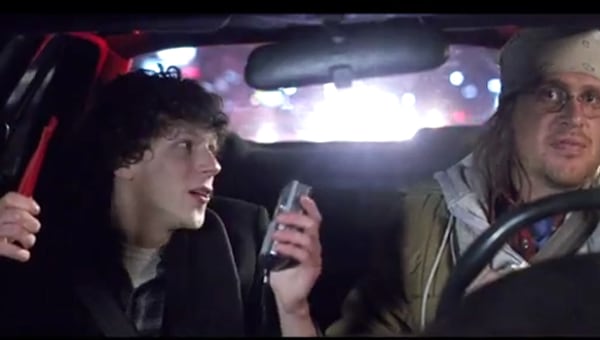
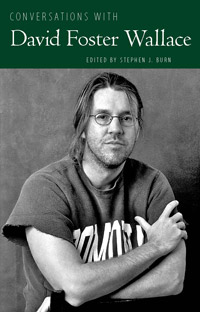
The End of the Tour gives us David Lipsky, a self-absorbed writer for Rolling Stone who, we'll come to learn, has bi-coastal romantic involvements, and David Foster Wallace, the depression-haunted and reclusive but newly lionized novelist who has reluctantly agreed to Lipsky's interview.

Lipsky heads out to Normal, Illinois, and after an uncomfortable introduction -- and the intrusion of a pocket recorder that itself becomes a character -- immediately begins to tape. The two writers settle into a sometimes relaxed, sometimes awkward rhythm of smoking, soft drinks, junk food, and conversation that ranges from a discussion of the meaning of Wallace's new novel Infinite Jest; to a discussion of the nature of popular culture; to a discussion of the meaning of life, the nature of despair and the conditions necessary for hope. 

Jesse Eisenberg as David Lipsky in The End of the Tour

Jesse Eisenberg as David Lipsky and Jason Segel as David Foster Wallace
 in The End of the Tour
After hitting what twelve-step programs call rock bottom, Wallace put himself into a kind of training program to learn how to be a human being. Lipsky has just been trying to get ahead and doesn't mind using other people to his own ends  -- which is to bask in the fame he envies Wallace for.

Wallace knows the addictive nature of contemporary life first hand. In the past he has alternately used alcohol and running to assuage crippling depression. He has at one point committed himself, fearing he would botch a suicide.

One of Lipsky's first observations is that there is no television in Wallace's house, and before long we realize there is good reason for that. Wallace's real Achilles' heel is junk television, and its ubiquity on the road sucks him in like Lorelei. 
Jesse Eisenberg as David Lipsky, Jason Segel as David Foster Wallace
and Joan Cusak as their Minneapolis escort in The End of the Tour
In my opinion, Jesse Eisenberg lacks range, but he has developed a weaselly persona that has been put to good use, not least in The End of the Tour where Lipsky's exploitative nature, journalistic and otherwise, inhibits his relationships.

I first saw Eisenberg as one of William Hundert's (Kevin Kline) pupils in Michael Hoffman's The Emperor's Club (2002), but he really emerged in 2005 in Noah Baumbach's The Squid and the Whale as the elder of two sons forced to take sides in their parents' self-involved breakup. I did not see any of his intervening films until he appeared in David Fincer's The Social Network (2010) playing the contemptuous billionaire Mark Zuckerberg; then a cavalier Woody-Allen-character in To Rome with Love (2012), an arrogant street magician in Louis Leterrier's Now You See Me (2013), a scornful domestic terrorist in Kelly Reichardt's Night Moves (2013), and the self-righteously inferior office drone James/bumptious Simon in Richard Ayoade's The Double (2013).
Then there's Jason Segel who has made a career out of the eternal man-child persona, yet demonstrates in The End of the Tour that he has range galore. His name is inextricably linked with Judd Apatow's, though only five of Segel's 25 films to date (a surprising number I come to find out he wrote) were made with Apatow.

The only Segel film I've liked (of the very few I've seen) was the Duplass brothers' Jeff, Who Lives at Home about an adult stoner who still lives with his mother (Susan Saradon) and who, in his quest to find meaning, has latched on to the movie Signs, and thus believes that every single thing he witnesses is indeed an omen he must pursue to realize his destiny. 


Ponsoldt's master stroke with The End of the Tour has been to cast both actors to type. "Some David Foster Wallace fans recoiled when they heard that sitcom veteran Jason Segel had been cast to play the Infinite Jest author in a movie," Mark Jenkins noted in his NPR review.

My reaction on first viewing was that The End of the Tour is quintessentially American but uniquely so, though I left that "uniquely" vague. That is wrong. It is not unique at all.

Indeed, the argument the film makes is that Infinite Jest is a quintessentially American novel; that David Foster Wallace was a quintessentially American novelist; and that the man-child is the quintessential American character. If our protagonists are not the kids Huckleberry Finn or Holden Caulfield themselves, they are grown men behaving like boys: Jay Gatsby, Augie March, Rabbit Angstrom. American literature is one big song of myself.

The Davids of The End of the Tour are traveling the road of the American mythos like Sal Paradise and Dean Moriarty. In the film, the Minneapolis NPR affiliate's interviewer begins by disdainfully describing the physical size of Infinite Jest: "1,079 pages and weighing in at three pounds, three ounces." Philip Roth took more time to do it, but his affair with Nathan Zuckerman ran to 2,200 pages.

Jesse Eisenberg as David Lipsky and Jason Segel in The End of the Tour
Though we hear Lipsky read from his novel, The Art Fair, and from Although of Course You End Up Becoming Yourself: A Road Trip with David Foster Wallace, the book that came out of the days he spent with the writer, we never hear anything from Infinite Jest. The camera cuts away from the bookstore reading just as Wallace walks toward the microphone, as if to divorce the novelist from the man.

Wallace talks and talks and talks about the very motifs the novel explores -- our abandonment of genuine community for the artificial connectedness of screens, our detachment from the natural world, our active disinterest in existential meaning, our addiction to porn -- not necessarily actual pornography, though that's part of it, too, but the pornographic pleasure we derive from the mastication, in the words of the film, of junk food and junk TV and junk consumerism and junk politics and junk thinking that sustain us neither nutritionally nor spiritually.

Keep in mind that Infinite Jest was published in 1996, almost 20 years ago; our disengagement has only intensified since. It's not the glamorous decadence of heroine addiction ala Lou Reed lyrics. It's just banal addiction that makes American consumerist culture thrive, which the film juxtaposes with the valiant attempt Wallace makes to resist the siren song.

Even if it is all talk, this is a raw, moving narrative about an enormously creative individual trying to come to terms with the truth of his own addictions and the truth of some overarching meaning.

Jesse Eisenberg as David Lipsky and Jason Segel as David Foster Wallace
in The End of the Tour
For all his idiosyncrasies and introversion, Wallace is possessed of a deep empathy that the opportunistic Lipsky lacks. At one point Wallace proudly insists that what is most important to him is his regular guy-ness. If the unexamined life is not worth living, then the irony -- and it hangs like a pall over The End of the Tour -- is that this deeply examined life ends a suicide.

On the morning of Lipsky's departure, Wallace goes outside to scrape snow from his car. Lipsky uses the opportunity as one last chance to pry, quickly speaking a list into his tape recorder of the random set dressing of Wallace's life: doggie chew toys, posters, refrigerator postcards, books, soda cans, tchotches, a fluffy toilet seat cover, and then, for the first time, Lipsky notices a plaque in the bathroom:

O my God, teach me to be generous,
teach me to serve you as I should,
to give without counting the cost,
to fight without fear of being wounded
to work without seeking rest, to labor without expecting any reward
but the knowledge that I am doing your most holy will.
                     
~~ St. Ignatius of Loyola

Jason Segel as David Foster Wallace and Jesse Eisenberg as David Lipsky
in The End of the Tour
If there is one element of Wallace that Segel's characterization brings most to the fore, it is Wallace's humility, and it is this humility that Ponsoldt plays against Lipsky's self-interest.

In his now famous 2005 Commencement Address at Kenyon College (I am an admirer of Wallace as an essayist and probably never will read Infinite Jest), Wallace opens with a story about two young fish to whom an old fish passing by calls out: "Morning, boys. How's the water?" "[O]ne of them looks over at the other and goes, 'What the hell is water?'"

The point, Wallace explains, "is that the most obvious, ubiquitous, important realities are often the ones that are the hardest to see and talk about." The point is to cultivate critical awareness about ourselves and about our certainties, which are usually false. 

"This is not a matter of virtue," Wallace insists, "It's a matter of my choosing to do the work of somehow altering or getting free of my natural, hard-wired default-setting, which is to be deeply and literally self-centered, and to see and interpret everything through this lens of self. [....] "[L]earning how to think really means learning how to exercise some control over how and what you think. It means being conscious and aware enough to choose what you pay attention to and to choose how you construct meaning from experience. Because if you cannot exercise this kind of choice in adult life, you will be totally hosed." 

Jason Segel as David Foster Wallace in The End of the Tour
David Foster Wallace made a conscious effort to grow out of the egoistic man-child default-setting where Lipsky is stuck.

If you can do that, Wallace so generously advises the Kenyon graduates, "It will actually be within your power to experience a crowded, loud, slow, consumer-hell-type [adult] situation as not only meaningful but sacred, on fire with the same force that lit the stars -- compassion, love, the sub-surface unity of all things. Not that that mystical stuff's necessarily true: The only thing that's capital-T True is that you get to decide how you're going to try to see it. You get to consciously decide what has meaning and what doesn't. You get to decide what to worship." 

"None of this is about morality, or religion, or dogma, or big fancy questions of life after death. The capital-T Truth is about life before death. .... It is about simple awareness -- awareness of what is so real and essential, so hidden in plain sight all around us, that we have to keep reminding ourselves, over and over: "This is water, this is water.'"


Links to Additional Resources

The End of the Tour. Critics Round Up.

Andrew O'Hehir. "Jason Segel on Playing David Foster Wallace." Salon, July 29, 2015.

A.O. Scott. "The Death of Adulthood in American Culture." New York Times, September 11, 2014.

Amy Taubin. My Dinner with Andre: Long, Strange Trips. The Criterion Collection. June 8, 2015.A Qui

August 4, 2015

THE SENTIMENTAL JOURNEY OF THE DYING GIRL

Emotion and Morality

The idea that emotion directs moral behavior was articulated as early as the 4th century BCE by Mencius, the most significant interpreter of Confucius. "The feeling of commiseration is the beginning of humanity; the feeling of shame and dislike is the beginning of righteousness; the feeling of deference and compliance is the beginning of propriety; and the feeling of right or wrong is the beginning of wisdom."

The western philosophers of moral sensibility – Anthony Ashley-Cooper, 3rd Earl of Shaftesbury; Francis Hutcheson; David Hume; and Adam Smith – all sought to refute Thomas Hobbes's mechanistic view of human nature. Hobbes's 1651 Leviathan lays out a safety net for human interaction that Hobbes calls the social contract – to assure their protection the people agree to accept government, an admittedly artificial political construct, though in doing so they relinquish their own power. Hobbes sees the social contract as a vital necessity for orderly co-existence, but he does not envision rights as inalienable in the Jeffersonian sense. It will be Jean Jacques Rousseau who expands the concept of the social contract to include popular sovereignty, the belief that governmental power emanates from the people, and John Locke who extends the idea to protecting the rights of the individual.

The establishment of the social contract is necessary, Hobbes believes, because without it our animal nature will inevitably leave us in a state of every man for himself (and God against all, as Werner Herzog would have it). This egoistic doctrine of self-interest – the belief that to act in the interest of others is a violation of human nature and that even actions disguised as sympathy are actually in service to self-love – troubled 18th century philosophers who tended toward a theory of moral sensibility.

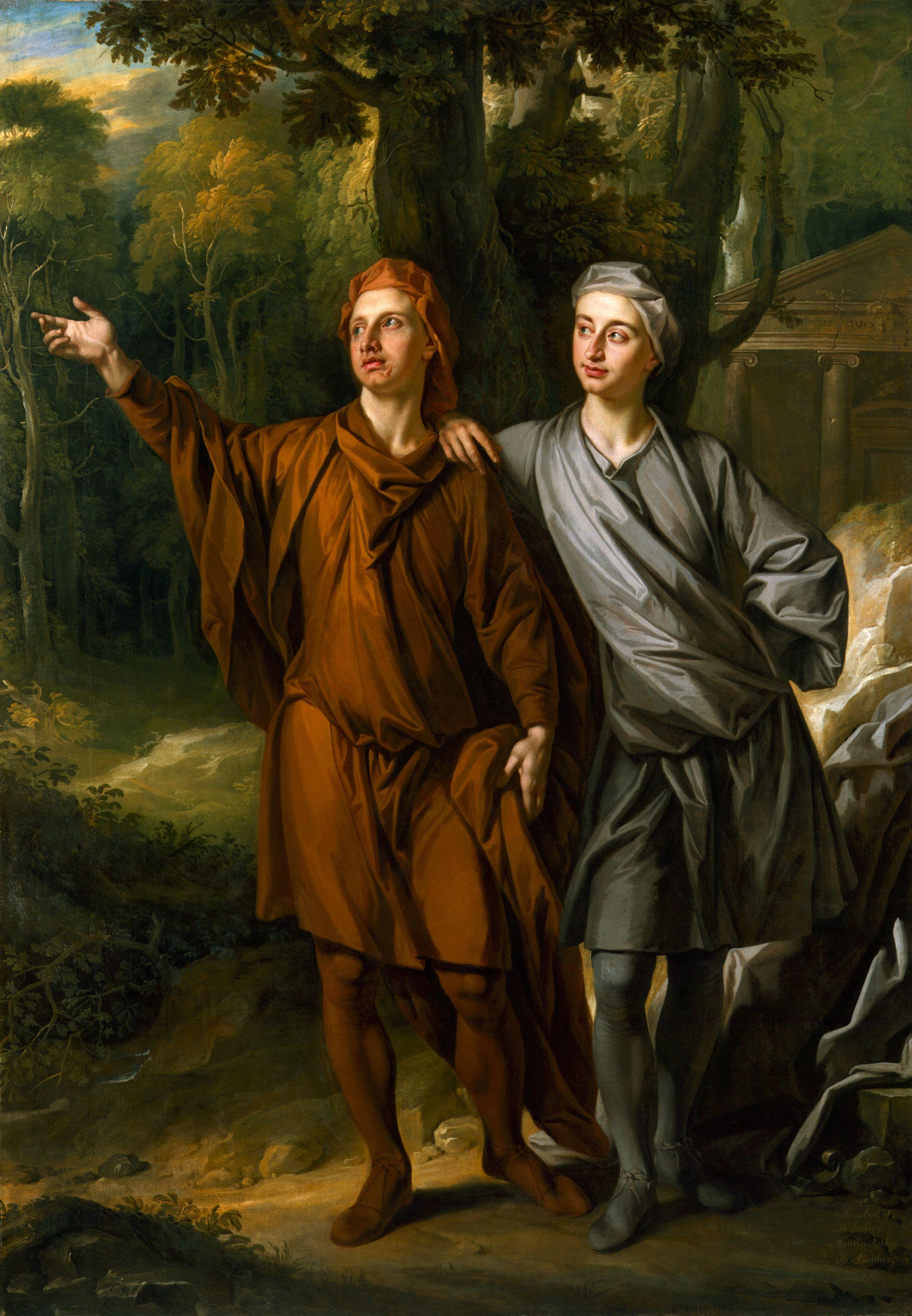
Shaftesbury’s 1699 An Inquiry Concerning Virtue, or Merit espouses a moral sense theory that both the impulse toward egoism and the impulse toward altruism are natural, yet imperfect, and must be balanced.

Anthony Ashley-Cooper with his brother Maurice in a
1702 painting by John Closterman designed to illustrate
his Neo-Platonist beliefs. (National Portrait Gallery)
In An Essay on the Nature and Conduct of the Passions and Affections, with Illustrations on the Moral Sense (1728) and the posthumous System of Moral Philosophy (1755), Hutcheson (whose family of Scottish Presbyterians are known as the founding fathers of the Scottish Enlightenment) identifies, in addition to the five external senses, six internal senses – consciousness, the sense of beauty, the public sense, the moral sense, the sense of honor, and the sense of the ridiculous – of which the moral sense is the most important, being instinctive and immediate, unlike reason, which is mediated.

Hume's An Enquiry Concerning the Principles of Morals (1751) also provides a naturalistic explanation of morality – that it "depends on some internal sense or feeling, which nature has made universal in the whole species." Hume’s moral sense theory, or sentimentalism, is based on a principle of communication and sharing of sentiments, positive and negative – what we call empathy – and rejects psychological egoism.

In The Theory of Moral Sentiments (1741), Adam Smith argues that even as selfish human beings, we are inclined toward pity and compassion. "That we often derive sorrow from the sorrows of others, is a matter of fact too obvious to require any instances to prove it; for this sentiment…is by no means confined to the virtuous or the humane, though they perhaps may feel it with the most exquisite sensibility."

Shaftesbury, Hutcheson, Hume, and Smith share the view of human beings, not in isolation, but in community. Shaftesbury believed humans are social beings and only through virtuous interaction with their fellows can they be deemed moral. Hutcheson held that actions that flow from self-love alone are morally indifferent, that only actions that promote "the greatest happiness for the greatest number" can be regarded as morally good. For Hume, sentiment, because it is based in sympathy, motivates us to pursue altruistic ends.

From Philosophy to Fiction

Of his novel Sentimental Education (1869), Gustave Flaubert wrote, "I want to write the moral history of the men of my generation – or, more accurately, the history of their feelings." The concept of sensibility – the idea that knowledge comes by way of acute perception that heightens certain individuals' feelings for the world, for others, for beauty and moral truth – entered the popular culture in the century before Flaubert's through poetry, music and the newly minted novel.

Among the 18th century's freshly fashioned novelistic genres was the Bildungsroman, the novel of the sensitive young man's coming of age. The genre typically involves a traumatic event that occasions the young protagonist to journey into a world whose values he finds hostile. Only by adapting to society through a trajectory from oppression to worldly acceptance can the character reach maturity.


Though the genre has precursors dating as far back as the 12th century, and is related to ancient quest narratives, its popularity gained momentum throughout the 18th century in England and France: Henry Fielding’s Tom Jones (1749), Voltaire’s Candide (1759), Laurence Sterne’s Tristram Shandy (1759), Rousseau’s Emile (1762), culminating in Goethe’s German masterpiece, Wilhelm Meister’s Apprenticeship (1795-1796). Indeed, 19th and 20th century German writers produced exemplary works in the genre from Gottfried Keller’s Green Henry (1855) and Adalbert Stifter’s Indian Summer (1857) to Robert Musil’s The Confessions of Young Törless (1906) and Thomas Mann’s The Magic Mountain (1924).

Pierre Staal illustration from Rousseau's Emile
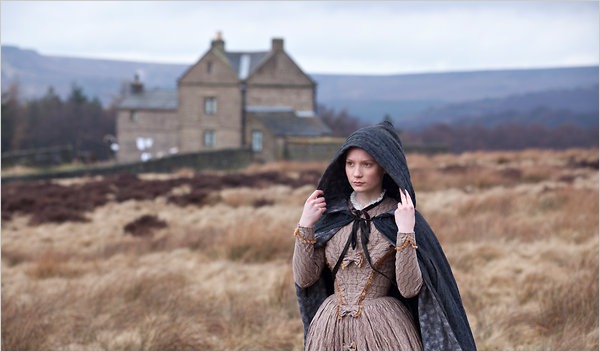
No Bildungsroman of the 18th century features a female protagonist (that I know of), and in the 19th, only Charlotte Brontë’s Jane Eyre (1830) and Henry James’s What Maisie Knew (1897) come to mind – in both of which the main characters determine their fates outside marriage. Jane refuses St. John Rivers’ proposal (though she will ultimately decide to marry Edward Rochester), and Maisie chooses her guardian over her parents. By and large, the female protagonist figures in the novel of sensibility rather than in the Bildungsroman, and her fortunes are determined by the man she does or does not marry. Her emotions and sensitivity inform her virtue from Samuel Richardson’s Pamela (1740) to Jane Austen's heroines struggling to balance sense (prudence) and sensibility (emotion) in their choice of husbands. By the mid-late 19th century, she's cheating her way through men and money like William Thackeray’s Becky Sharp in Vanity Fair (1847) who ends well and Gustave Flaubert’s Emma Bovary (1856) who makes a mess of things and ends it all with arsenic, or she is at the mercy of fate (and libertines) in Thomas Hardy's Wessex.

Mia Wasikowska as Jane Eyre in Cary Fukunaga's 2011 film adaptation
Sentiment and Consumption

Because the protagonist of the Bildungsroman has experienced persecution, he often grows up to mitigate others' misfortunes, whereas the protagonist of the sentimental novel grows up to marry, if she is lucky. By the 19th century, however, she might not get the nuptial chance, for when the nerves of young women of sensibility are over-taxed, they have a tendency to succumb to illness in one form or another.

Susan Sontag’s Illness as Metaphor was published in 1978. In it Sontag assaulted the metaphorical uses to which illness is put to turn disease into mythology. The Romantic poets of the 19th century made consumption an innate psychic state experienced by sensitive artistic spirits possessed of the spiritual and moral attributes of nobility, creativity, and melancholy. In "Ode to a Nightingale" (1819), Keats's "youth grows pale, and spectre-thin, and dies...." (Keats himself died of tuberculosis in 1821, aged 25 – as did much of his family.) The female consumptive, by contrast, suffers the wasting disease as a natural consequence of her desires. She is sensitive, yes, but she brings her suffering on herself.

Joseph Severn's "Sketch of the Dying Keats" inscribed:
"20 Janry 3 o'clock mng. Drawn to keep me awake -
a deadly sweat was on him all this night."

Sometimes female characters die because they reject the established social order. Samuel Richardson's Clarissa (1748) succumbs to illness as a result of her attempts to evade the vile Lovelace’s captivity. In Mary: A Fiction (1788), Mary Wollstonecraft's only completed novel, Mary's sensibility runs counter to the conventions of the times, and the ending suggests that, forced as she is to conform to those conventions, she faces the inevitability of premature death. Both women are doomed because they seek to live lives of freedom on their own terms.

Just as the philosophical concepts of moral sentiment paved the way for 19th century Romanticism, they laid the groundwork for Freud. From Hippocrates until the late 19th century, the disorder that went by the name "hysteria" was believed to be a uniquely female malady of sexual dysfunction. (Greek "hystera" means "uterus.") Freud would alter that view by arguing that hysteria was the unconscious mind's attempt to shield an individual from psychic trauma, though he, too, would focus attention on the condition as evinced in women. In literature the manifestation of psychic distress is a literal disease rather than vague hysteria.

And so the popular imagination, just as it had venerated female martyrs throughout the ages, was primed by the 19th century to romanticize, even idolize, the dying heroine, making the dying girl a staple of Romance (with an upper case "R") novels, Italian opera – and in our own time, romance (with a lower case "r") novels, young adult lit, and Hollywood tear-jerkers.

Prior to the 20th century most people lived amidst death with an immediacy that we (that is "we" in first world, affluent countries) cannot imagine, so it is natural that mortality should inform the fiction. Disease and dying in literature, however, are disproportionately the province of heroines over heroes.  In Jane Austen's Sense and Sensibility (1811), Marianne suffers from a "putrid tendency" (probably typhus). Though she doesn't die, the illness creates a crisis of sense to bring her back round to sensibility. 

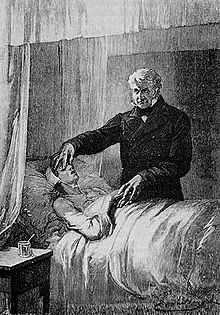
The death of Fantine: Valjean (as Mayor Madeleine)
closes her eyes.
The allure of the dying heroine, particularly those wasting away from consumption, was not exclusive to English writers. Afflicted heroines become standard fare in French literature as well. In Victor Hugo’s 1862 novel Les Misérables, Fantine, having had to resort to prostitution, succumbs to consumption. Another two novels – and the Italian operas adapted from them – feature likewise stricken heroines. In 1848, Alexandre Dumas (fils) created the consumptive Marguerite – based on his lover Marie Duplessis – in The Lady of the Camellias. The dramatic adaptation became the basis for Giuseppe Verdi’s 1853 opera La Traviata. Violetta, a consumptive courtisane, moves among the aristocracy but their wealth and status cannot save her.

Three years after Dumas’s novel, Henri Murger, best known for his poem “La Chanson de Musette,” penned the episodic novel La Vie de Bohème with Mimi, another consumptive heroine, at its center. Giacomo Puccini adapted the novel into the late-Romantic opera La Bohème, which premiered in 1896. The wan youths of the Romantic poets and then Romantic heroines like Marguerite/Violetta and Mimi gave consumption the cachet Sontag so vociferously excoriated. Indeed the English poet Lord Byron declared, “I should like to die from consumption.” (He would die instead of banal sepsis from unsterilized bloodletting instruments.) La Traviata and La Bohème remain among the most performed operas across the globe to this day, attesting to the allure of the tragic heroine dying in the fullness of youth.

To say Dumas’s courtisane has legs is understatement. In addition to many Camille stage adaptations, there are the musical adaptations – the 2008 production Marguerite set in 1944 Vichy France and Baz Luhrmann's 2001 film Moulin Rouge! with Nicole Kidman set at the fin de siècle.

Baz Luhrmann's 2001 Moulin Rouge! with Nicole Kidman:
Satine's death scene
The Lady of the Camellias has been dramatized in dance as well. In 1963 Sir Frederick Ashton premiered his choreography specially created for Rudolph Nureyev and Dame Margot Fonteyn, Marguerite and Armand. Veronica Paeper premiered her Camille in 1990, which has been performed ever since; and Lady of the Camellias set to music by Frédéric Chopin was choreographed for Marcia Haydée by John Neumeier in 1978 and for Ballet Florida by Val Caniparoli in 1994.

Silent films include the 1907 Danish Kameliadamen with Oda Alstrup; the 1911 French La Dame aux Camélias with Sarah Bernhardt; the 1915 Italian La Signora delle Camelie with Hesperia; a 1921 English version with Nazimova and Rudolph Valentino; and the 1925 Swedish Damen med kameliorna with Tora Teje.

The first sound adaptation was the 1934 La Dame aux Camélias adapted by Abel Gance and directed by Gance and Fernand Rivers with Yvonne Printemps and Pierre Fresnay; then George Cukor’s 1936 Camille with Greta Garbo and Robert Taylor; a 1944 Mexican Camelia with Lina Montes and Emilio Tuero; the 1953 French La Dame aux Camélias with Micheline Presle and Gino Cervi; the 1954 Mexican Camelia with María Félix and Jorge Mistral; the 1954 Argentinean La mujer de las camellias with Zully Moreno and Carlos Thompson; a 1957 Turkish Kamelyalı Kadın with Çolpan İlhan and Fikret Hakan; yet another French version, the 1981 La Dame aux Camélias with Isabelle Huppert and Gian Maria Volonté; and a 1994 Polish Dama Kameliowa with Anna Radwan and Jan Frycz.

Greta Garbo and Robert Taylor in George Cukor's 1936 Camille
And then there was Eric Segal's book and Arthur Hiller's movie adaptation of Camille that besotted teen girls throughout the 1970s: Love Story. (Film critic Judith Crist called Love Story,"Camille with bullshit.") By this time, Love Story absurdly and vacuously makes the claim that "Love means never having to say you're sorry," and the disease du jour has changed from consumption to the scourge of our era – cancer, specifically in Love Story's case, leukemia. 

Arthur Hiller's 1970 Love Story
Maladies in the Movies 

(NB: The criteria for the films under discussion do not allow the central character to be a child or elderly, but young or relatively young – even middle aged – characters ailing from disease, and do not allow for Christian or Nicholas Sparks movies.)

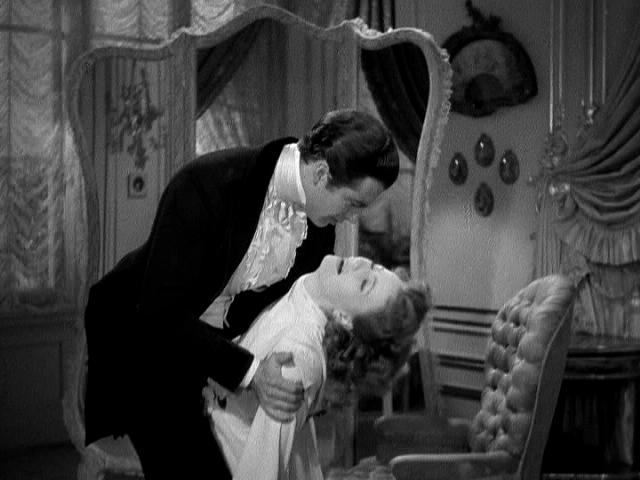
In contrast to the more vague – and romantic – diagnosis of "consumption," post-19th century fiction is predominated by cancer, identified with increasing specificity as time has gone by. Judith Traherne (Bette Davis) in Edmund Goulding's 1939 Dark Victory suffers from a brain tumor, and the film goes to some lengths to incorporate the medical terminology of the day. In Gary Marshall's 1988 Beaches, Hillary Whitney (Barbara Hershey) is dying of viral cardiomyopathy; in Pat O'Connor's 2001 Sweet November, Sara Deever (Charlize Theron) is dying of Non-Hodgkin lymphoma; in Ol Parker's 2007 Now Is Good, Tessa Scott (Dakota Fanning) is dying of acute lymphoblastic leukemia; and in Josh Boone's 2014 The Fault in Our Stars, Hazel Lancaster (Shailene Woodley) is dying of thyroid cancer that has spread to her lungs.

Bette Davis and Humphrey Bogart in Edmund Goulding's 1939 Dark Victory
Sontag held that in the 20th century, cancer patients are characterized as emotionally repressed, pessimistic loners. Again, the popular culture has more often than not gendered the stereotype, and the young women dying of cancers in the movies far outweigh the young men. I came up with only a few films that treat a young man's impending death from cancer from a purely dramatic perspective, the earliest of which was Joel Schumacher's 1991 Dying Young. Others include Bruce Joel Rubin's 1993 My Life; Wendell Morris's 2001 The Medicine Show; Chris Kraus's 2002 Shattered Glass; Patrice Chéreau's 2003 Son frère; Todd Kessler's 2008 Keith; and Conrad Jackson's 2011 Falling Overnight.

Filmmakers seem to feel more at ease wedging dying male characters into more comfortable tropes like the Buddy Movie: Neal Israel's 1992 Breaking the Rules; Judd Apatow's 2009 Funny People; Jonathan Levine's 2011 50/50; and the German director Thomas Jahn's 1997 Knockin’ on Heaven’s Door, in which two hospital patients, both of whom have what we are only told is an untreatable disease, go on a picaresque spree.

Martin Brest and Rudi Wurlitzer in Thomas Jahn's 1997
Knockin' on Heaven's Door
The two films with dying men that come closest to reflecting the redemptive character type are Irwin Winkler's 2001 Life as a House, in which Kevin Kline's disagreeable architect ultimately functions as a catalyst of grace for his family, and Alejandro González Iñárritu's 2010 Biutiful, in which the rumpled, beatific Javier Bardem is cast as something of a modern-day shaman/saint.

I have excluded films like Bill Sherwood's 1986 Parting Glances, Jonathan Demme's 1993 Philadelphia, and Joe Mantello's 1997 Love! Valour! Compassion! – based on Terrence McNally’s 1994 play – where the protagonist is dying of AIDS, because the AIDS drama has evolved into something of a genre unto itself, and its central characters, as men, exhibit more obstinacy and resolve than their wasting female counterparts. 

Javier Bardem in Alejandro Gonzalez Inarritu's 2010 Biutiful
In contrast to Hobbes's belief that without a social contract our animal nature will inevitably leave us in a state of anarchic chaos were philosophers who believed not only that emotion and its attendant morality are inherently human, but that empathy is universal and bound up in feeling. The Bildungsroman was, and to some extent still is, predominantly the province of male protagonists, the sentimental novel the province of heroines: men make their way in the world, women marry – or die. The Romantics pathologized feeling and introduced the young man whose nearness to death heightens his sensitivity, making him a conduit of transcendent insight. Also pathologized is the young woman who resists marriage and has little to teach us of transcendent worlds. His sickness is a result of his creative soul, hers the result of her resistance to her proper place in nature.

Dying Alone

Part of the dramatic appeal of La Traviata and La Bohème and their heirs (including Jonathan Larson’s 1996 musical Rent, which transports La Bohème into an East Village, HIV-positive gay theater milieu) is the demi-monde community that circulates around their protagonists. The 20th and 21st century dying girl is surrounded by much smaller casts of supporting dramatis personae. She may only have a boyfriend or husband at her side (Love Story), maybe a best friend (Beaches), or estranged members of a nuclear family (James Brooks's 1983 Terms of Endearment adapted from Larry McMurtry's 1975 novel).

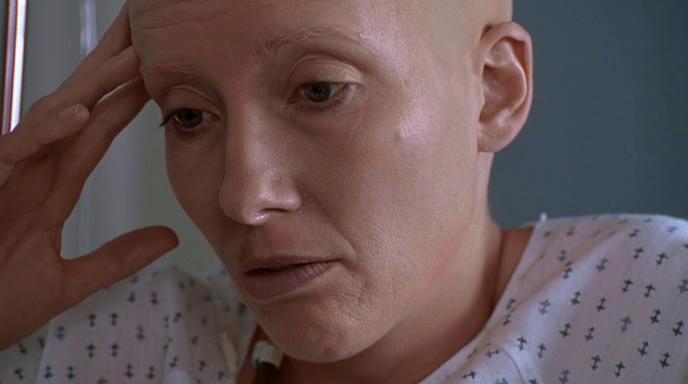
Emma Thompson as Vivian Bearing in Mike Nichols's 2001 adaptation
of Margaret Edson's 1995 play
The character who goes it solely alone is Vivian Bearing, a scholar of metaphysical poet John Donne, in W;t, Margaret Edson's 1999 Pulitzer Prize-winning play adapted by director Mike Nichols and actress Emma Thompson into the 2001 Emmy Award-winning television drama. On its surface, W;t might seem to break the trope of the dying heroine, but in reality it only reinforces it. In one of the best analyses of W;t I have read, Jacqueline Vanhoutte of the University of North Texas places the play squarely in the midst of the dying heroine metaphor with all its trappings, most notable among them that Vivian's intellectual rigor is the root cause of her cancer and that her suffering provides the catalyst for her redemption. Vanhoutte cites the Shakespearean scholar A. C. Bradley: tragedy necessitates "calamities and catastrophe follow inevitably from the deeds of men." From that premise, Vanhoutte argues that "to make a cancer patient the subject of a tragedy is to reproduce and legitimate the 'moralistic and punitive' fantasies about cancer that Sontag describes."

"Edson proposes," Vanhoutte continues, "that, in privileging reason over emotion, 'research' over 'humanity,' Vivian has pursued a course that ensures her 'immense success' as an academic even as it proves detrimental to her health." Treated as an object of research with a piteous absence of compassion, Vivian comes to realize that intellectual rigor (sense) is a barrier to kindness (sensibility).

In the previous essay I said that Me and Earl and the Dying Girl comes at the sentimental trope of the deathbed heroine obliquely and makes it into something else, something larger. Rather than a movie about a dying girl, it is a story about art, a story about the stories we tell, a story about the idea that in doing and making we transcend mortality. And focusing as it does on "ME," Me and Earl and the Dying Girl is not a story of sentiment but a modern-day Bildungsroman, in which the dying girl is an impetus for the young man's coming of age.

The Redoubtable Woman Instead

Dying is universal and profound so we are bound to tell stories about it, but aside from being sad, the dying girl trope is too often pretty shallow – and sexist. There is sometimes something even prurient about it. The dying girl notwithstanding, independent heroines have been out there – for centuries. In the 6th century Chinese poem, The Ballad of Mulan, a 17-year-old goes to war in her father's stead and triumphs in battle again and again. She has been variously imagined since, most recently and unfortunately in 1998 as a bumbling Disney animated character. Chaucer invented the bawdy Wife of Bath in the 14th century, who would become the most memorable of his pilgrims. There are the various heroines of YA trilogies, and there is that Nordic goth of The Girl with the Dragon Tattoo (2005), Stieg Larsson's Lisbeth Salander, brilliant computer hack and rebellious outsider.

Hua Mulan
In America's Women: Four Hundred Years of Dolls, Drudges, Helpmates, and Heroines, Gail Collins observes that "Some of our national heroines were defined by the fact that they never nested  – they were peripatetic crusaders like Susan B. Anthony, Clara Barton, Sojourner Truth, Dorothy Dix." Let's tell more stories – not biopics about these actual women necessarily – but stories about strong, imagined women like them. Doing so would deepen and enrich our understanding not only of our female compeers but of our collective human psyche.