Search This Blog

January 13, 2014

2013: FOREIGN FILMS

Discussed here;
A Royal Affair
No 
Renoir
Kon-Tiki
Fill the Void
The Attack
I'm So Excited
Populaire

With the exception of Pedro Almodóvar's I'm So Excited! and Zad Doueiri's The Attack, every foreign film I saw this year was a 2012 release that only made it to San Antonio in 2013, which is such a pathetic commentary on the United States that I won't even go into it.

France -- Michael Haneke's Amour, the 2012 Foreign Language Film Oscar recipient, is reviewed in my February 2013 post. 

Denmark -- In his New York Times review, A.O. Scott describes Nikolaj Arcel's A Royal Affair as "an Advanced Placement bodice-ripper." Probably best known for playing James Bond's bête noir Le Chiffre in the 2006 Casino Royale,  Mads Mikkelsen is Johann Friedrich Struensee, a German-born physician and a free-thinker who was brought to the Dutch court to attend to Christian VII, an insufferable spoiled brat whose insecurities Struensee is able to direct to his own ends in an attempt to reform the Danish legal code, which had remained immune to the Enlightenment that had taken place across much of western Europe. Oh, and he also beds the king's neglected young wife. An interesting slice of history, even if overly romanticized. (Nominated for the 2012 Foreign Language Film Oscar.)


Chile -- Pablo Larraín's No, based on the Chilean novelist Antonio Skármeta's play, El Plebiscito, is set in 1968 when Pinochet's repressive government faces a constitutionally mandated referendum to determine whether he will be ousted. In this advertising-conquers-all telling, the agency with whom our central character Rene (Gael García Bernal) is employed develops the "NO" campaign with the slogan: "Chile, happiness is coming." Larraín goes for the feel of a low budget documentary using two rebuilt Sony U-Matic video cameras, which, along with Rene's halfhearted involvement in the campaign specifically and politics generally, prevent the film from saying much about the abuses of power and the will of the people. (Nominated for the 2012 Foreign Language Film Oscar.)


France -- Based on Jacques Renoir's book Le Tableau Amoureux, Gilles Bourdos' Renoir has the look of, well, a Renoir, thanks to Taiwanese Mark Ping Bing Lee's luscious cinematography. Add to the dappled countryside of the Côte d'Azur the hand of convicted art forger Guy Ribes creating the Renoir paintings on-screen and the composition is complete. The aged Renoir himself is brought to life by the great French actor Michel Bouquet. Renoir has just lost his beloved wife, and his two eldest sons, Pierre and Jean, have returned from World War I with battle scars. Henri Matisse has sent over DeeDee, a model whose youth and sensuality keep the painter working despite excruciating arthritic pain. The youngest son seems least tethered to the family and roams the grounds of Les Collettes. Hollywood could never make a film like this -- the pace is of the day to day, the interpersonal conflicts unobtrusive. DeeDee is muse to the father, lover to the son. Her desire to be an actress piques Jean's interest in the cinema, a passing craze, Pierre tells him, that will never catch on.  

Norway -- Thor Heyerdahl's The Kon-Tiki Expedition comes to life on the screen in Joachim Roenning and Espen Sandberg's Kon-Tiki. Heyerdahl sets sail from Peru for Polynesia to bear out his theory that South Americans populated the island. He builds a balsa-wood raft for the journey based on assumptions about the materials and methods pre-Columbian people would have used. Even though I knew how it ends, there were times when the suspense was palpable. (Nominated for the 2012 Foreign Language Film Oscar.)


If I forget you, O Jerusalem, let my right hand wither;
Let my tongue stick to my palate if I cease to think of you,
If I do not keep Jerusalem in memory even at my happiest hour.

Israel -- Knowing little more than that Rama Burshtein's Fill the Void is set among contemporary Hasidic Jews, and that the story hinges on an arranged marriage, I came to it with some prejudice and preconceived ideas that the film upended. In the first place, marriages are not arranged but facilitated by parents and professional matchmakers within a very close knit community, and the decision to marry is ultimately that of the two people involved. When Shira's sister dies, leaving behind a newborn and a gentle husband named Yochay, the family respond with shock, but as they begin to manage their grief the idea dawns that it would be best for all if Shira and Yochay marry. The arc of the story follows Shira's shifting feelings, the tension she must resolve for herself between her sense of personal destiny and her place in the larger community. Hadas Yaron infuses Shira with a luminous interiority. Playing a children's song on her accordion at the preschool where she works, she unconsciously segues into a powerful dirge unaware that the classroom has fallen silent to stare at the absent young woman. Indeed, the rhythms of their faith and traditional Hasidic music are central to these lives. The music alone is worth the price of admission, and the leitmotif of the soundtrack by Itzhak Azulai, "Eim Eshkachech," taken from verse 137 in the Book of Psalms, will haunt long after you have left the theater.
NYT Critics' Pick 


Palestinian -- Lebanese director Zad Doueiri's The Attack is based on the novel by Yasmina Khadra. An Arab doctor, affluent and assimilated in Tel Aviv, highly respected by his Jewish colleagues and the recipient of many honors and awards, discovers that his wife has committed a suicide bombing when the authorities arrive at his door. As their case moves forward, he searches back to try to understand and come to terms with his life with a person he thought he knew. Especially troubling is the fact that the restaurant she bombed was filled with children celebrating a birthday. The narrative is nuanced, making no judgments and taking no sides.


Spain -- Pedro Almodóvar's I'm So Excited! takes place during a flight that never makes it from Madrid to Mexico City due to a malfunction that keeps it circling above Toledo, a metaphor for the ruts we create that hobble our lives. Sounds deep, but it devolves into nothing much more than a drag show -- without the drag.


France -- Régis Roinsard's Populaire tells the story of a blundering young woman named Rose Pamphyle who can do but one thing well. Having salvaged an old typewriter from her family's basement, she has become a speed typist using only her index fingers. It is post World War II France, and the rage among young ladies in the western world is the dream that the true path to freedom for the single girl is to land a secretarial job. Louis Échard runs an insurance concern and hires Rose, more out of lecherous desires than professional ones. Nevertheless, once he discovers that she has two left feet he thinks of letting her go, just when... he discovers there is to be a local typing contest. He decides to use her as a surrogate through whom he can vicariously compete, brings her to live platonically at his home, and proceeds to develop a rigorous coaching strategy for her. Populaire is a period set piece, a charmingly delightful romantic comedy ala Doris Day and Rock Hudson by way of a French confection.

January 10, 2014

2013: AMERICAN HUSTLE, THE WOLF OF WALL STREET & THE CON IN AMERICAN CULTURE

David O. Russell's American Hustle and Martin Scorsese's The Wolf of Wall Street are based on true stories about notorious scams of recent memory. American Hustle is a fictionalization of the late 1970's-early '80s FBI sting operation known as Abscam for which the FBI hired convicted con artist Melvin Weinberg to help plan and conduct the operation. The film opens with the onscreen declaration that "Some of this actually happened," and indeed, the film takes the bare bones of the investigation as a springboard for a great long con.

The Wolf of Wall Street is based on Jordan Belfort's memoir describing his genesis in a penny stock boiler room to big time securities fraud to a brief stint in prison to motivational speaker, which is to say to a confidence artist in respectable clothing.

Before I make the case for my defense of American Hustle and my dissatisfaction with The Wolf of Wall Street, allow me to attempt to give my thoughts some context.

The con is not unique to America, but America seems uniquely built upon the con. We're the country of gold rush, land rush, get rich quick, Manifest Destiny and Wall Street. The con is embedded in our vernacular. I don't like people who think they can pull the wool over my eyes, a phrase that appears to have been coined in 1839 in the Milwaukee Daily Sentinel and Gazette: "And we ask one question that they dare not firmly answer, whether they are not now making a tolerable attempt to pull the wool over the eyes of the people."

I include the quote because it is telling (just as the tell gives away a player in poker). Whoever "they" are in that sentence, they are being asked if they are on the up and up and "they dare not firmly answer." 

Indeed, we have a large and colorful vocabulary for the con: scam, hoax, flimflam, shell game, euchre, bluff, bunco. The confidence artist is a chiseler, hustler, snake oil salesman, mountebank, hoser, grifter, thimblerig, charlatan, sharpie, shark, who swindles, fleeces, bilks, bamboozles, shakes down, rips off, honeyfuggles, hornswoggles, gulls, gaffles, nobbles, rooks, chouses and knows that the dodge won't work, the game is up if the mark doesn't believe hook, line and sinker. The confidence artist understands that trust is central to the successful fraud and that, not only must the mark be persuaded that he has to have skin in the game, he has to desperately want to get in.

"There's a sucker born every minute," P. T. Barnum purportedly said, and for every sucker there's a confidence trickster. The trickster is as old as the human species. Pagan myth and folklore reflect the human frailties that make us vulnerable to exploitation: credulity, naïveté, vanity, envy, recklessness, dishonesty, and especially greed, but also compassion, generosity -- and trust.

There are surely many more, taking into account the myriad cultural myths across time and geography, but Wikipedia's list of trickster gods totals 39 starting with Amaguq, an Inuit wolf god, through Wisakedjak, the Algonquin god who destroyed the Creator's world to create the present world of magic. For Carl Jung, the Greek trickster Hermes (Roman Mercury) is, ironically, the good as well as the bad side of narcissism. Narcissism plays a central role in the instinct for self-preservation, but it also accounts for an inflated sense of self that can overshadow conscience.

The trickster's method relies not simply on his cleverness and his subjects' gullibility. What guarantees the trickster's conquest are subjects' unconscious desires to believe what they want to believe, which is something quite different from simple naïveté. It is self-delusion and denial.

In 19th century America, with immigrants thronging cities, speculators and opportunists going West, and Carpetbaggers exploiting Reconstruction in the South, conditions were ripe for fraud and deception of every stripe. In the United States, the idea of reinvention and the self-made man had become central to the young country's identity. From Benjamin Franklin's The Autobiography, written over the course of almost 20 years in the latter part of the 18th century, to Horatio Alger's rags to riches stories that saturated the 19th, the insistence that with enough determination and hard work, material success is within anyone's grasp fueled the popular imagination.

But... sometimes pulling yourself up by your own boot straps isn't, in fact, enough, so it comes as no surprise that the corollary to the myth of the self-made man is the confidence man. William Thompson, for whom the term "confidence man" was coined, was the source for Herman Melville's 1857 The Confidence Man: His Masquerade. "Have you confidence in me to trust me with your watch until tomorrow?" Thompson would ask his mark. When given the watch, Thompson would walk away.

There has been no end of real life swindlers and impostors. Notorious con artists of the 19th century included Denver's Lou Blonger, who ran the "Million Dollar Bunco Ring" using the "Wire Con" like the one depicted in George Roy Hill's 1973 The Sting; Big Bertha Heyman: The Confidence Queen, who swindled thousands out of men, including her own attorney, even behind bars; Canada Bill Jones, King of the Three-Card Monte, about whom the German writer Karl May wrote two stories, "Ein Self-man" (1878) and "Three carde monte" (1879); Victor Lustig, "the man who sold the Eiffel Tower," and George C. Parker who sold the Brooklyn Bridge twice a week for years; Charles Ponzi, of course, whose name has become synonymous with get rich quick pyramid schemes; Soapy Smith of the prize package soap sell racket; and Joseph "Yellow Kid" Weil who is alleged to have said, "Each of my victims had larceny in his heart."

In the 20th century, Bert Cantor's The Bernie Cornfield Story chronicles Cornfield's Investors Overseas Services, a company that sold mutual funds to American servicemen in Europe in a lucrative Ponzi scheme; Ferdinand Waldo Demara, "The Great Impostor," whose sobriquet provides the eponymous title for Robert Mulligan's 1961 movie, with Tony Curtis in the role, which itself is based on Robert Crichton's 1959 biography; Don Lapre, a TV pitchman who hawked get rich quick schemes; and Alvin Clarence "Titanic Thompson" Thomas, an ambidextrous golfer, card and pool shark, and proposition bet con man who is the model for Sky Masterson in Damon Runyon's 1933 story "The Idyll of Miss Sarah Brown" on which Frank Loesser's 1950 Guys and Dolls is based.

Still with us are Frank Abagnale, a check  forger and impostor whose 2000 autobiography is the basis for Steven Spielberg's 2002 Catch Me If You Can; Marc Stuart Dreier, convicted for an investment fraud Ponzi scheme and chronicled in a 2012 BBC documentary, "The $750 Million Thief"; James Arthur Hogue, who was accepted into Princeton posing as a self-taught orphan and is the subject of David Samuels's 2008 biography The Runner: A True Account of the Amazing Lies and Fantastical Adventures of the Ivy League Impostor James Hogue and of Jesse Moss's 2003 documentary Con Man; Bernie Madoff, who admitted to the largest Ponzi scheme in history and is chronicled in Jeff Prosserman's 2011 documentary Chasing Madoff  based on Harry Markopolos's 2010 biography No One Would Listen: A True Financial Thriller (An HBO movie starring Robert De Niro based on  Diana Henriques's book The Wizard of Lies is upcoming.); Barry Minkow, founder of ZZZZ Best scam, another Ponzi scheme; Richard Allen Minsky, whose sex scams were so vile I do not wish to describe them however briefly here; Lou Pearlman, convicted of one of the largest and longest-running Ponzi schemes in American history and who, with co-author Wes Smith, published Bands, Brands and Billions: My Top 10 Rules for Making Any Business Go Platinum in 2002; Steven Jay Russell, con artist and prison escapee whose life was the basis for Glenn Ficarra and John Requa's 2009 I Love You Phillip Morris; Kevin Trudeau, convicted of larceny and credit card fraud, a true latter-day snake oil salesman who touted his books Natural Cures "They" Don't Want You to Know About and  The Weight-Loss Cure "They" Don't Want You to Know About on late night infomercials getting him into serious trouble with the U.S. Food and Drug Administration; and Jack Abramoff of the Indian lobbying scandal from the mid-1990s-mid-2000s, in which Ralph Reed, Grover Norquist and Michael Scanlon also participated, that involved grossly over-billing Native American casino gambling interests, secretly orchestrating lobbying against clients in order to squeeze them for redoubling lobbying services, and giving illegal gifts and campaign donations to congressmen in return for legislation -- energetically recounted with Kevin Spacey as the manic Abramoff in George Hickenlooper's 2010 Casino Jack.

Other films based on con artists include Fred Schepisi's 1993 Six Degrees of Separation adapted from John Guare's 1993 play based on the real-life con artist David Hampton; Brian Cook's 2006 Color Me Kubrick about Alan Conway who impersonated the director during the 1990s; Steven Soderbergh's 2009 Informant! about Mark Whitacre, who in the early '90s, blew the whistle on a price-fixing scheme and aided the FBI in a sting all in an attempt to hide his own embezzlement; and Bart Layton's 2012 The Imposter, which explores the story of  French con artist Frédéric Bourdin, who took the identity of Nicholas Barclay, a boy who went missing from San Antonio, Texas.

The confidence man first emerges as a fictional character in 19th century American literature and becomes one of its most enduring narrative figures. Edgar Alan Poe's tales, such as "Diddling" (1843) and "Hop-Frog" (1849); Mark Twain's The Adventures of Huckleberry Finn (1884); F. Scott Fitzgerald's The Great Gatsby (1925); Nathanael West's Miss Lonelyhearts (1933); Ralph Ellison's Invisible Man (1952); Flannery O'Connor's stories in A Good Man Is Hard to Find (1953); and Patricia Highsmith's Ripliad: The Talented Mr. Ripley (1955), adapted as Purple Noon by René Clément in 1960 and under its original title by Anthony Minghella in 1999; Ripley Under Ground (1970) adapted in Roger Spottiswoode's 2005 film; Ripley's Game (1974) filmed by Wim Wenders as The American Friend in 1977 and under its original title by Liliana Cavani in 2002; and The Boy Who Followed Ripley (1980) and Ripley Under Water (1991), both adapted for BBC Radio 4 in 2009.

Not to mention our fictional movie confidence artists in Preston Sturges's 1941 The Lady Eve; Joseph Anthony's 1956 The Rainmaker; Irvin Kershner's 1967 The Flim-Flam Man; Mel Brooks's 1968 The Producers; John Schlesinger's 1969 Midnight Cowboy; Paul Bogart's 1971 Skin Game; Joseph Mankiewicz's 1972 Sleuth from Anthony Shaffer's 1970 play; Peter Bogdanovich's 1973 Paper Moon; George Sluizer's 1988 The Vanishing; Frank Oz's 1988 Dirty Rotten Scoundrels; Stephen Frears's 1990 The Grifters; Bryan Singer's 1995 The Usual Suspects; James Foley's 2003 Confidence; Ridley Scott's 2003 Matchstick Men; and Rian Johnson's 2009 The Brothers Bloom, to name some of the highlights among many others.

The real life criminality of AIG, Goldman Sachs, Lehman Brothers, Bear Stearns, Merrill Lynch, Citigroup, Morgan Stanley, Countrywide Financial and Ameriquest that caused the Great Recession of 2007-2008 can also be viewed through the narrative lens of the movies. In 1974, when Roman Polanski's brilliant Chinatown came out, greed was a sleazy affair. Even in 1984, when David Mamet won the Pulitzer Prize for Glengarry Glen Ross, our protagonists still had a sordid air and an awareness that they transgressed. But by 1987's Wall Street, with Ronald Reagan well into his second term, Oliver Stone does not mince the words he gives to Gordon Gekko to describe the prevailing zeitgeist: "Greed is good," a mantra many hungry young MBA's took up as they headed to Wall Street.

Martin Scorsese's 1995 Casino, based on Nicholas Pileggi's reporting, is about THE place that is about greed, so that one came as no surprise except perhaps in its sheer scope. But by 2010, executives who have lived by greed's code have the rug pulled out from under them in John Wells's The Company Men.

On the heals of downsizing the company men, we get a telling of the crash in 2011's Margin Call in which C.J. Chandor repeatedly emphasizes that no one at the top understands the Byzantine, arcane financial instruments Wall Street wonks have created, and just as it played out in real life, everyone makes sure not to be held accountable. The film even manages to elicit sympathy from us, whereas we have more contempt for Richard Gere's Robert Miller in Nicholas Jarecki's 2012 Arbitrage. Miller sells his company for 500 million having cooked the books to hide the 412 million that's gone missing. James Mayfield (Graydon Carter) is told of the deception moments after he's signed the agreement and Miller has taken his leave. Mayfield smiles wryly and shrugs. It doesn't matter. He's awash in so much money, the missing sum is a mere trifle.

Greed played a very big role on 2013's movie bill. Discussed elsewhere: Michael Bays's Pain and Gain in Biopics, a chronicle of the true story of the bumbling gym-rat trio who kidnapped Victor Kershaw and proceeded to turn the metaphor of behaving like a kid in a candy store into a literal pig-out; Woody Allen's Blue Jasmine in Women's World, a character examination of a divorcee scheming to live in the manner to which she has become accustomed; as well as American Hustle and The Wolf of Wall Street, in which crooked broker Jordan Belfort, to literalize two more metaphors, is rolling in dough and has money to burn.

Whereas Glengarry Glen Ross takes us into the seedy world of the short con in shady real estate sales -- which have a long history in the United States -- Mamet's 1987 House of Games is a brilliant example of the long con. A patient reveals to his psychiatrist Margaret Ford (Lindsay Crouse) that his life is being threatened by a loan shark to whom he is deeply in debt. Ford ventures to the pool hall where Mike (Joe Mantegna) conducts business. Mike convinces her to accompany him to a card game to help him spot a player's tell. She gets sucked into the rush enough to volunteer $6,000 of her own money, which, of course, is the set up, but they have to pack up the con when she notices a give-away drop of water hanging from the barrel of the gun the player pulls on her. Infected with the excitement, nevertheless, she convinces Mike to let her follow him. At one point, Mike explains the confidence game to her. The con man gives his trust to the mark, which makes the mark trust the con man, thus developing the relationship of one trustworthy person seeking another trustworthy person. That's as much as I'll give away.

Suffice it to say House of Games is one of the greatest long cons in the movies, and the perfect vehicle for Mamet, whose entire oeuvre explores the degree to which we will convince ourselves of that which we wish to believe. From 1982's The Verdict, 1992's The Water Engine, 1994's Oleanna, 1996's American Buffalo (in which the two protagonists maddeningly refuse to look up the value in the Blue Book), to 1997's The Spanish Prisoner and Wag the Dog -- the majority of Mamet's oeuvre explores the extent to which human beings believe what they want to believe. Though not his best work, 1997's The Edge is notable in that, of the two protagonists, Anthony Hopkins's character survives because he refuses to delude himself. Unflinchingly looking reality in the eye, facing the facts as they are, he may be unique among Mamet's protagonists.

Americans like transgression and our favorite narrative heroes are transgressors and criminals who throw into question bourgeois values. As much as Americans will always be saddled with the Puritan ethic, we are equally defined by transgression. Prohibition's corollary was the bootlegger, and the Great Depression made folk heroes of criminals like Jesse James, John Dillinger, Pretty Boy Floyd and Bonnie and Clyde -- glorified as latter-day Robin Hoods when they were nothing of the sort, Woody Guthrie's romanticized "Ballad of Pretty Boy Floyd" notwithstanding. This is not to say that the Pinkertons and FBI who pursued them were any less criminal.

Later, in post-War America, Jack Kerouac led the way for a Beatnik counter culture, then Haight-Ashbury, "sex, drugs and rock 'n' roll," Timothy Leary and Ken Kesey. Arguably, Americans were more in love with The Rolling Stones than the Brits, and all the while, one musician after another succumbed to overdose.

Poet musicians, most especially Bob Dylan, possess an innate understanding of this undertow in the American psyche, what Greil Marcus calls "the old, weird America," a phrase he coined to describe the songs collected in the Anthology of American Folk Music by Harry Smith for Smithsonian Folkways and first released in 1952. The ballads and blues and country songs' lyrics often dwelt on murder, death and the macabre. The Anthology unearthed Blind Lemon Jefferson, Mississippi John Hurt, Dick Justice and many, many others -- some still obscure -- and brought them to the attention of young musicians who became the force behind the folk and blues revival of the 1950s and '60s, most notable among them Bob Dylan. Before Dylan, Pete Seeger had chosen to blinker himself from this darker side of the American vernacular, opting to revive rosier subject matter.

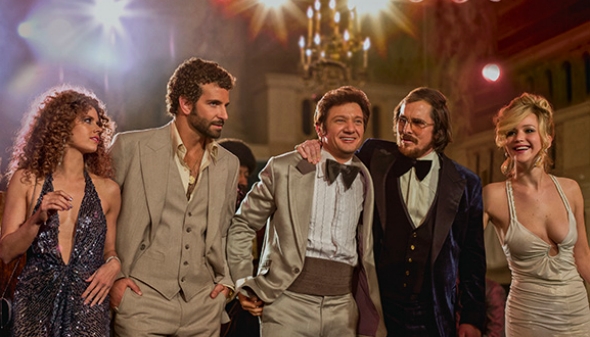
To return to American Hustle and The Wolf of Wall Street -- American Hustle is the Horatio Alger story. Irving Rosenfeld (Christian Bale -- and it was wonderful to see him in this incarnation after having seen his excellent performance as a completely different type in Out of the Furnace the week before) and Sydney Prosser (Amy Adams as one of those deeply intuitive women she plays so well as she did in Paul Thomas Anderson's 2012 The Master) are two people who have had to learn to live by their wits. Each comes from nothing but has been determined to make it and, in their own way, they have. Yes, they are con artists, but they know their limitations, and they are careful never to get in too deep. When FBI agent Richie Di Maso (Bradley Cooper, again in fine manic form) entraps, then recruits them, they plan a good, solid sting. But as Di Maso's head swells, Irving and Sydney know things are getting out of hand. They are very, very smart people who save themselves when they know the jig is up. The film is fast-paced. Jeremy Renner as the mayor of Camden, New Jersey, and Jennifer Lawrence as Irving's passive aggressive wife round out a superb ensemble. (To his credit, Russell has enormous respect for ensemble, and has been assembling a great one.)

The Wolf of Wall Street, on the other hand, lacks any of the humanity of Russell's film. In fact, ever since Scorsese (for whom I had always had the greatest admiration) cast Leonardo DiCaprio in The Gangs of New York in 2002, the collaborations have been self-indulgent disasters. The Wolf of Wall Street is no different. I said that American Hustle's Irving and Sydney are very, very smart people who know when it's time to give up the game rather than risk exposure. DiCaprio's Jordan Belfort is not smart. He's clever, he's lucky, he's a skilled manipulator, but there's no there there. True, Irving and Sydney have chosen to make a living preying on other people's vulnerabilities, but they still have a moral compass. Belfort has no such thing, not the merest vestige, nor do any of the people with whom he surrounds himself, including Donnie Azoff, played by Jonah Hill, another self-indulgent actor of whom I am not fond.

I'm not asking for agitprop, but were The Wolf of Wall Street about something more than greed, about something more than knuckleheads who never, ever learn a lesson no matter how many times they, to use an AA term, hit rock bottom, it might have some redeeming value. As it is, it's just gratuitous aggrandizement of greed.

 Americans not only have a talent for reinvention, they have convinced themselves that they really can get rich quick, that they deserve the good life and any means to get it are justified by the ends. America is the birthplace of the how-to manual and subsequently, of the self-help book, a veritable $10 billion a year industry, and each generation produces a crop of its own secular quasi-gurus.

Wallace Wattles published The Science of Getting Rich in 1910, and it is still in print today. The 1930s ushered in Dale Carnegie's How to Win Friends and Influence People and Napoleon Hill's Think and Grow Rich. During the 1940s we seem to have been too preoccupied with the war to have been distracted by self-help flimflam -- though L. Ron Hubbard was cooking up his theory of Dianetics which would later become Scientology -- but in 1952 Norman Vincent Peale sprang The Power of Positive Thinking on post-war Americans, and we were again agog. Maxwell Maltz followed in 1960 with Psycho-Cybernetics, and the '70s brought Wayne Dyer's Your Erroneous Zones and Zig Ziglar's See You at the Top. The 1980s saw Malcolm Baldrige's TQM (Total Quality Management) and the flowering of the Stephen Covey empire with The 7 Habits of Highly Effective People.  The '90s opened with Anthony Robbins's Awaken the Giant Within, followed in mid-decade by the craze over Emotional Intelligence (EI) and Deepak Chopra's The Seven Spiritual Laws of Success, then Eckhart Tolle's The Power of Now rounded out the decade. Jim Collins welcomed the new millennium with Good to Great. Not to mention your Phil Donohues, Ophrah Winfreys, Dr. Phils, et al.

Hell, America even has its own homegrown gospel of success. Prominent leaders in the development of prosperity theology include E. W. Kenyon whose 1938 Signposts on the Road to Success formed the foundation for Oral Roberts, A. A. Allen, Robert Tilton, T. L. Osborn, Joel Osteen, Creflo Dollar, Kenneth Hagin, and their even more cockamamie offshoots, Jim and Tammy Bakker and Jerry Falwell. None of which ask us to do the really hard work of the examined life. We can have it all, we insist, without reflection. Just gimme some Dr. Kilmer's Swamp Root, Zoloft,Viagra, Botox, cut-rate insurance and a Ninja mortgage. Lemme win the Publishers Clearing House Sweepstakes and the HGTV Dream Home Giveaway, scrape off  my lottery ticket and play the stock market -- and I shall enter Valhalla. Which, of course, is a sham, a house of cards, a narcissistic delusion.

Alexander Payne's Nebraska perfectly reflects the degree to which this kind of thinking has been drummed into us, and how easily we accept the wolves in our midst, from Wall Street to Main Street. We've based an entire nation state's economy on nothing more than a crap shoot. Irving and Sydney ultimately go legit, which is to say, at least they try to grow up. If Jordan Belfort the man, The Wolf of Wall Street the movie, and the real-life denizens of Wall Street are any indication of the zeitgeist, however, a reflection that we want to dwell in a state of arrested adolescence forever and that we have convinced ourselves of what we so desperately want to believe which is that the refusal to accept personal and civic responsibility is perfectly OK, even a desirable state of affairs, then believe it we shall.
  
American Hustle
NYT Critics' Pick
AMERICAN HUSTLE

Abscam, the NSA and the '70s: The real

The Wolf of Wall Street
NYT Critics' Pick


Leonardo DiCaprio, Jon Bernthal, Jonah Hill and Margot Robbie in The Wolf of Wall Street (2013).

January 9, 2014

2013: THRILLERS: GREED & VENGEANCE

Discussed here:
Side Effects
Paranoia
The Reluctant Fundamentalist
Closed Circuit
Prisoners
Runner Runner

In 1974, when Roman Polanski's brilliant Chinatown came out, greed was a sleazy affair. Even in 1984, when David Mamet won the Pulitzer Prize for Glengarry Glen Ross, our protagonists still had a sordid air and an awareness that they transgressed. But by 1987's Wall Street, with Ronald Reagan well into his second term, Oliver Stone does not mince the words he gives to Gordon Gekko to describe the prevailing zeitgeist: "Greed is good."

Martin Scorsese's 1995 Casino, based on Nicholas Pileggi's reporting, is about THE place that is about greed, so that one was no surprise except perhaps in its sheer scope. By 2010, executives who have lived by greed's code have the rug pulled out from under them in John Wells's The Company Men. Stephen Holden notes that "As depicted in the film the modern corporation is a sterile Darwinian shark tank in which the only thing that matters is the bottom line. The old days of corporate beneficence and loyalty to longtime employees are long gone."

On the heals of downsizing the company men, we get a telling of the crash in 2011's Margin Call in which C.J. Chandor repeatedly emphasizes that no one at the top understands the Byzantine arcane financial instruments Wall Street wonks have created, and just as it played out in real life, everyone makes sure not to be held accountable. The film even manages to elicit sympathy from us, whereas we have more contempt for Richard Gere's Robert Miller in Nicholas Jarecki's 2012 Arbitrage. Miller sells his company for 500 million having cooked the books to hide the 412 million that's gone missing. James Mayfield (Graydon Carter) is told of the deception moments after he's signed the agreement and Miller has taken his leave. Mayfield smiles wryly and shrugs. It doesn't matter. He's awash in so much money, the missing sum is a mere trifle. In her New York Times review of the film, Mahola Dargis concludes, "These days, it seems, the illegal manipulation of hundreds of millions of dollars simply isn't enough to incite moral outrage."

Greed played a very big role on 2013's movie bill. Discussed elsewhere: Michael Bays's Pain and Gain in Biopics, a chronicle of the true story of the bumbling gym-rat trio who kidnapped Victor Kershaw and proceeded to turn the metaphor of behaving "like a kid in a candy store" into a literal pig-out; Woody Allen's Blue Jasmine in Women's World, a character examination of a divorcee scheming to live in the manner to which she has become accustomed; and David O. Russell's American Hustle loosely based on Abscam and Martin Scorsese's The Wolf of Wall Street about crooked banker Jordan Belfort, who, literalizing other metaphors, is "rolling in dough" and "has money to burn."
~~~~~~~~~~~~~~~~~~~~~~~

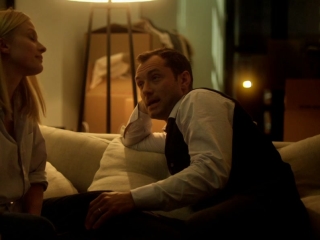
In Steven Soderbergh's Side Effects, a tight, shrewd pharma-caper, we are introduced to an anti-depressant, Ablixa, through an ad narrated by one of those smooth, mellow, mesmerizing voices whose tone is designed to reassure while the actual words describe horrible consequences... sometimes including death. I as well as many people I know have commented on the absurdity of these ads, and it is not lost on Soderbergh. Emily (Rooney Mara) suffers from depression; her husband (Channing Tatum) is recently released from prison after serving time for insider trading. Dr. Jonathan Banks (Jude Law) is treating her; he has also taken on a consultancy with Ablixa's pharmaceutical company. When he suspects Ablixa may have played a role in a scandalous incident, he seeks out Emily's previous therapist (Catherine Zeta-Jones). Each subsequent meeting increases his suspicions as he attempts to follow the money.
NYT Critics' Pick


Gary Oldman is such a good actor. There is a scene in Robert Luketic's Paranoia when high-tech company titans who were once partners, Nic Wyatt (Oldman) and Jock Goddard (Harrison Ford), face off. It is not a closeup when the camera pans to Oldman and we see his temple throbbing. In this double cross, Wyatt reels in a young and hungry Adam Cassidy (Liam Hemsworth) to tailor into a slick corporate player who is to worm his way into Goddard's top ranks as Wyatt's spy. The problem is that in the tug-of-war between the two tech giants, Adam is not a worm in his heart of hearts, nor is Helmsworth enough of an actor to stand up to his formidable co-stars. The film is based on the 2004 novel by Joseph Finder.


I have not read Pakistani-born writer Mohsin Hamid's novel The Reluctant Fundamentalist, but according to Manohla Dargis, it is a far more subtle and challenging narrative than Mira Nair's film makes of it. Nair's Changez is a Princeton graduate who has achieved the moneyed American Dream as a capital venture firm whiz. After 9/11, he is profiled by authorities, which eventually leads him to return to Pakistan where he is pursued by an American journalist wire-taped by the CIA. Dargis contends that "by literalizing the idea of American military aggression and all that it implies Ms. Nair doesn’t just invest Mr. Hamid’s story with Hollywood-style beats, she also completely drains it of ambiguity." In my experience, with few exceptions (Stanley Kubrick's Lolita, Hal Ashby's Being There, even Ken Russell's Women in Love) original novels are superior to the films made from them. However, having not read the novel, I did not find the film stripped of ambiguity, and felt that its ambiguous nature was one of its strengths. A very keen observation that Dargis does make is that Changez is "a narrative conceit in a novel that puts different fundamentalisms [American "conquering" capitalist fundamentalism v. terrorist Islamic fundamentalism] into dialectical play."
Fred Kaplan on Mira Nair for the New York Times


Hollywood came up against a problem in the late '80s with the end of the Cold War, which had provided an excellent narrative scapegoat for decades with the Red Scare. At first, screenwriters turned to the IRA and the The Troubles. Now our scapegoats of choice are Islamic extremists and NSA-style surveillance. John Crowley makes a nice concoction of the two in Closed Circuit, a tight, slick legal thriller. Two British lawyers have been hand picked to defend a Turkish immigrant. They do not admit their conflict of interest: they are past lovers. Not having disclosed this fact, the powers that be believe, makes any case they might build vulnerable. And just to be sure, there is a sophisticated infrastructure of cameras crisscrossing the London landscape to further complicate their cause. Here it is the government machine that must protect its greed for power against two attorneys fighting the good fight.


"Of all evil I deem you capable: Therefore I want good from you. Verily, I have often laughed at the weaklings who thought themselves good because they had no claws." ~~Friedrich Nietzsche
Technically and structurally, Denis Villeneuve's Prisoners is a fine tuned thriller about that most feared possibility -- the abduction of a child by a sadistic psychopath. The day is winding down  for neighbors sharing Thanksgiving when they realize their young daughters have not come in from outdoors. A call to 911 brings Detective Loki, realized in an excellent performance from Jake Gyllenhaal, who doggedly pursues the case while dealing with two couples who are a study in contrasts. Keller Dover (Hugh Jackman) is a man's man, a hunter and survivalist whose gut instinct is to take things into his own hands while his wife Grace (Maria Bello) sinks into passive despair. Franklin Birch (Terrence Howard) is a reasonable man who is inclined to defer to the law, but he is also vulnerable to Dover's persuasion. His wife Nancy (Viola Davis) functions as the moral center of the quartet, though by the time she knows what is going on the situation has devolved into tragedy as the developmentally challenged young man (Paul Dano) suspected of the crime is held hostage by the vigilante Dover. The plot unravels a number of mysteries that seem as though they will refuse to coalesce, adding not only to the suspense but to the feeling of the paralysis of grief and desolation. (The cast also features Melissa Leo.)  


Brad Furman's Runner Runner involves another young and hungry protagonist. An online poker ace (Justin Timberlake) bets everything to make his Princeton tuition... and gets played. The site is owned by a gambling mogul (Ben Affleck) headquartered in Costa Rica, so the earnest kid wrongheadedly hops a flight to confront him. The mogul recruits him with promises of six figures a week, and the rest is pretty predictable.

‘Runner Runner’ craps out

January 7, 2014

2013: BIOPICS

Discussed here:
42
The Sapphires (2012)
The Iceman
Lovelace
Jobs
The Grandmaster
Rush
Saving Mr. Banks
Mandela: Long Walk to Freedom

As the time neared for the opening of 42, the story of Jackie Robinson and Branch Rickey, I worried that it would miss the mark, be hijacked by excessive sentimentality, and/or that the narrative would be flat-footed and subvert the underlying mythic proportions of the historical moment and those who peopled it. I needn't have worried one whit. The actors, the writer and director Brian Helgeland, the cinematographer, et al. -- everyone gives 200%, and the result is a fitting tribute to an American icon. 
(My long time friend Jerry Holt wrote a fabulous one-man play, Rickey, that premiered at the Vern Riffe Center in Portsmouth, Ohio. I was fortunate to see it at the Baseball Hall-of-Fame in Cooperstown, New York. It has been performed, with Geoff Nelson playing Rickey, in venues across the U.S., including Atlanta; St. Louis; Bexley, Delaware; Columbus, Ohio; and Brooklyn's Long Island University.)


At the start of The Sapphires (2012), text explains that Aboriginal people were classified as “flora or fauna” until 1967 when Australia finally re-classified them as citizens. Children were routinely taken from their families and placed in institutions or raised by white families, as has happened to the fourth Sapphire in the quartet. The story is based on the experiences of Beverley Briggs, whose son Tony and his co-author Keith Thompson wrote the screenplay. I will go to pretty much any movie about music, and this one is filled with brio and infectious charm. In fact almost every reviewer utilizes some form of the word "charm" to describe the story of the 1960s female group discovered and managed by Dave Lovelace (an ever delightful Chris O'Dowd), who shepherds the teens and their repertoire away from country to soul, and away from Australia to a gig in Vietnam. Along the way they learn about themselves and become young women.


Ariel Vromen directed and co-wrote with Morgan Land The Iceman, which is based on the novel The Iceman: The True Story of a Cold-Blooded Killer by Anthony Bruno that is based on the real-life Richard Kuklinski, a veritable killing machine from the 1960s into the 1980s. Michael Shannon sinks his teeth into Kuklinski who is at once a fiercely loving family man, whose wife believes he is raking in money with a Wall Street job, and hit man who clearly relishes his job for crime boss Roy DeMeo. Even when the action does not involve psychopathic violence, the film seethes with a suppressed animal rage that Shannon sustains with frightening credibility and authority. In fact, every actor in the film does impressive work that keeps you riveted to the screen.
NYT Critics' Pick


Had I had known that Rob Epstein and Jeffrey Friedman, who jointly directed Howl with a barely recognizable James Franco inhabiting the persona of Allen Ginsburg, also directed Lovelace, I would not have embarked with such low expectations. To my surprise, it is a worthwhile, if sometimes difficult to watch, film. I live in San Antonio, Texas, where State Senator Leticia Van de Putte has championed several bills to change laws against prostitution to laws against sex trafficking and to set up a task force to carry them out. Amanda Seyfried gives a generous performance as Linda Boreman and Peter Saragaard is excellent as her brutally abusive husband/pimp. Sharon Stone is unrecognizable as Linda's suppressed, angry mother, and Chris Noth, Hank Azaria and Bobby Cannavale play the '70s coifed producers who released the notorious Deep Throat. After the publication of her book Ordeal, a TV interviewer insists Linda is being less than truthful in her claim to have changed. Linda, now-Marchiano with a husband and child, asks the skeptic why she should be judged on the basis of the two weeks in her life that involved the shoot. Because the set dressing and costumes are so accurately done, the only down side to the film is having to so thoroughly re-live that '70s aesthetic.


I have seen no feature films with Ashton Kutcher, and though I've heard of the TV shows, have never watched That '70s Show or Two and a Half Men nor have I ever heard of Robot Chicken until just now looking the actor up on IMDB. Consequently, I had no preconceptions going in to Jobs. Kutcher certainly masters the physical look, but gives a somewhat one-dimensional performance, which, reviewers who know more about Steve Jobs's biography than I do attribute to the director Joshua Michael Stern and the writer Matt Whiteley. Josh Gad, on the other hand, delivers a believable and nuanced performance as Steve Wozniak.


The Grandmaster came to San Antonio suddenly and disappeared just as fast. I knew nothing about it, and almost didn't go, since martial arts movies are not my thing, but, man, am I glad I did. First of all, it is not fiction but a bio-pic about Ip Man, the Chinese martial arts master who kept alive the art of wing chun ("beautiful spring"), a form of kung fu, through the Japanese occupation, World War II and the Communist Revolution, and was Bruce Lee's mentor. Second, the film is gorgeous throughout, and the opening sequence is a masterful, mesmerizing, choreography of violence in a downpour of rain in which Tony Leung's Ip Man dominates with meditative ease. Third, what truly elevates the film is that its subject is not really martial arts so much as it is a reverie about what it means to live life and to love as an artist and an inner looking human being. I was not familiar with Hong Kong director Wong Kar-wai's oeuvre, but I will be seeking out more films by this grand master.
NYT Critics' Pick


Like The Grandmaster, Ron Howard's Rush has motor racing as its subject, but it is really about relationships between people, in this case the great rivalry between James Hunt and Niki Lauda. By the time I became involved in Formula One in 1981, these names were legend. Howard takes us behind the headlines to a study in opposites -- Hunt, the self-destructive playboy who races for the thrill and the celebrity; Lauda, the disciplined driver who is as skilled as an engineer as he is behind the wheel. Chris Hemsworth as Hunt and Daniel Brühl as Lauda are excellently cast, as are the women in their lives, played by Olivia Wilde and Alexandra Maria Lara. If I have one little quarrel with the film, it is that with such spectacular venues as Watkins Glen, Nürburgring, Monza, Howard misses opportunities for beautiful sweeping landscapes, but that is quibbling.
NYT Critics' Pick

Rush


John Lee Hancock's Saving Mr. Banks is an odd movie. It is made by Disney, Walt is himself a character, and surely it was meant to be a self-promotional vehicle. The narrative structure introduces a determined Walt Disney earnestly trying to cajole P. L. Travers (Emma Thompson) into signing over the rights to her book Mary Poppins for what would become the now classic movie musical. That tug-of-war informs half of the film's narrative. The other half is provided in alternating flashbacks, the story of an Australian family reduced to a hardscrabble life by the father's acute alcoholism. P. L. Travers, it turns out, was Helen "Ginty" Goff, the daughter of Travers Goff (Colin Farrell). This back story holds promise but is played out with excessive sentiment from both narrative and cinematic points of view. Furthermore, introducing Ginty's childhood relationship to her father as the cause of a conflicted psychology that Mrs. Travers brings to her material and its realization in the Disney studio's hands ends up making the movie seem like an intensive two-hour gestalt therapy session. Finally, we can only imagine how superior Disney's Mary Poppins would have been had more of Mrs. Travers's demands been heeded, which undercuts Disney's aim at self-promotion.


Idris Elba is magisterial as Nelson Mandela in Justin Chadwick's Mandela: Long Walk to Freedom. Naomie Harris more than rises to the challenge of playing opposite Elba as Winnie. The film follows Mandela from his ritual initiation into manhood in his Xhosa village through to his election as South Africa's prime minister, and as Stephen Holden observes, "Mr. Elba’s towering performance lends Long Walk to Freedom a Shakespearean breadth." The film is also deeply humbling. Much as I thought I knew about apartheid, after watching this film, I am shamed to have to admit that I can claim only to have had a vague awareness of it and its atrocities. That a Dutch Reformed Church cleric could successfully campaign on a policy of apartheid is a scathing commentary on religion. That the rest of the globe allowed the Herenigde Nasionale Party (Reunited National Party) to impose such an inhumane and violently brutal regime for almost half a century is execrable. That the Party's criminality was only redressed as recently as 1994 is unfathomable. That Mandela's African National Congress party now stands accused of corruption and black South Africans are burdened with 26 percent unemployment make the assurance of Mandela's legacy tenuous and is cause for us to remember Mandela's sacrifice and work to preserve his legacy in South Africa, and advance it across the globe.
NYT Critics' Pick

December 20, 2013

2013: CHOICES & CONSEQUENCES

Discussed here:
The Place Beyond the Pines
The Company You Keep
To the Wonder
Adore
The Counselor
Out of the Furnace


I have read that Derek Cianfrance's The Place Beyond the Pines is an indie film. If so it does not look it in the least. It has a grand sweep in three acts, and its themes are large. Set in Schenectady, New York, the first act opens on a stunt motorcycle rider, a carny named Luke (Ryan Gosling) who is a peripatetic loner. When the tour brings him back into town, he shows up on a past girlfriend's doorstep and learns he has a son. The second act involves Avery (Bradley Cooper), a police officer who also has an infant boy. The second act closes when  the two men's paths cross. By the third act, Avery is a successful politician, both men's sons are teens, and the narrative takes the form of the sins of the fathers and the legacy a machismo culture of manhood leaves the next generation. We could suspend our disbelief in the last act were it not stretching our credulity so thin. Still, The Place Beyond the Pines is worth watching, and Cianfrance should be credited for his willingness to confront existential questions of moral choice and responsibility.

(In  conceiving the character of Luke, Ryan Gosling reportedly told Derek Cianfrance, "Hey, D. How about the most tattoos in movie history?" To this end he added a face tattoo of a dagger dripping blood. Cianfrance told him, "Look, if I was your parent, I would tell you, don't get a face tattoo. You're going to regret it. But you have to be this guy, not me, so do what you want." At lunch on the first day of shooting Cianfrance sensed something bothering Gosling. "Hey, D, can I talk to you for a second? I think I went too far with the face tattoo." Cianfrance said, "Well, that's what happens when you get a face tattoo: You regret it." Gosling said, "I know. You think we can take it off and reshoot everything?" "Absolutely not. This movie's about consequence. And now you've got to live with it for the rest of the movie.")


Motivated by the escalation of the war in Vietnam, the Weather Underground split from the SDS and issued a "Declaration of a State of War" against the United States government in 1970. Between 1969 and 1975 the group targeted police stations, banks, and a number of prominent government buildings for bomb and arson attacks. Considering the number of strikes they carried out, it is a wonder there were so few casualties. In 1970, a bomb at the SFPD's Golden Gate Park branch killed one officer and injured several more, though no organization claimed credit, and later that year, three Weathermen were killed when the nail bomb they were constructing in a Greenwich Village townhouse detonated. The organization slowly disbanded, though its final adherents carried out the 1981 Brinks armored car robbery with members of the Black Liberation Army, stealing $1.6 million, and killing two police officers and one Brinks guard in the ensuing shootout. Throughout the years, secret federal grand juries were convened and the Chicago Police Department, the NYPD, and the FBI pursued the militants. Some were arrested, some came forward on their own, others managed to successfully remain underground.

Robert Redford's The Company You Keep is adapted from Lem Dobbs's novel. It uses, as the central experience of the former Weathermen we meet, an amalgam of Weather Underground attacks: a bank robbery that went tragically wrong leaving a security guard dead. The film opens thirty years hence when, weary of her secret, Sharon Solarz (Susan Sarandon) turns herself in, generating headlines. Ben Shepard (Shia LaBeouf) is a hungry, young investigative reporter who latches on to the story, but when he visits Solarz in jail she thwarts his desire for a simple I-have-seen-the-error-of-my-ways plea for forgiveness. Instead she is defiant. This sets up a chain of events that puts her former fellow activists at risk, at the center of which is Jim Grant (Robert Redford) who, because he was not present at the robbery, sets out to find his former lover, Mimi Lurie (Julie Christie), who, he hopes, will testify to his absence.

Ben's perspective-less judgment is juxtaposed with the self-judgment of aging people who have grappled with the ethics of their actions for over three decades and profess through that painful lens their continued commitment to their ideals. The question of means versus ends hangs over the story, and though it is a dilemma the film confronts, it is one that it refuses to resolve. The reporter Ben wants a tidy narrative, with right and wrong assigned their proper, righteously indignant places. Instead, The Company You Keep asks us to consider the Weather Underground's terrorism in a broader context that many in the audience will have forgotten or are too young to have an awareness of, and gives the lie to easy moralizing and compartmentalization.

(Independent Lens: The Weathermen Today)


Terrence Malick's To the Wonder, like The Tree of Life, attempts to find cosmic meaning in ordinary lives, but this time the narrative, or what there is of it, isn't up to the challenge. The Tree of Life presented, with stunning visual creativity that was understated and audacious by turns, the microcosm of a boy's interior life, within the microcosm of the family, within the microcosm of the community, within the macrocosm of Earth, within the larger microcosm of the cosmos within eternity. It was a staggering undertaking, and worth the journey. But To the Wonder, as beautiful as it is, looking like a Wyeth painting on the screen, just cannot stand up to its grand designs. If not religion per se, then spirituality is too obvious to its ambition, and none of the characters appears grounded enough to sustain the kinds of deep human connections the film seems to want to be about. Neil (Ben Affleck) is a somewhat autobiographical Malick who moves between two women. The more ethereal of the two says of his inability to make choices, "Weak people never bring anything to an end themselves. They wait for others to do it."

I was not alone in my annoyance at the incessant twirling with which both women are afflicted. A.O. Scott echoes my feelings when he notes that "what Jane and Marina have in common, apart from their attraction to Neil, is a serious commitment to twirling. Not the highly disciplined marching-band, baton-assisted kind, but rather the languid, flowing-dress-wearing, I’m-so-in-tune-with-the-universe-that-I-will-never-get-dizzy kind."


Ann Fontaine's Adore is based on Doris Lessing's novella The Grandmothers, and is notable in this section on the consequences our actions engender for having none. Two women -- Roz (Robin Wright) and the widowed Lil (Naomi Watts) -- have been friends since childhood. When Roz's husband is offered a job in Sydney, it would be professional suicide for him to refuse, but Roz can't find it in herself to leave Lil and the bubble in which their relationship exists in their next door proximity. As a leisurely summer ensues, Lil gives in to the seduction of Roz's son, and, in what begins as retaliation, Lil's son likewise seduces Roz. A.O. Scott observes that "...the same movie about a couple of dads sleeping with each other’s 20-year-old daughters would need, at a minimum, to confront the ickiness of the situation. Really, such a movie would be unlikely to make it into theaters, in spite of the commonness of real-life relationships between older men and younger women."


The day after I screened Cormac McCarthy's The Counselor, directed by Ridley Scott, I raved about it to some people, one of whom remarked, "The reviews say it's terrible." Aghast, my first question was, What reviews? "Rotten Tomatoes." (Who thinks Rotten Tomatoes is a credible source?!?) For what reasons? "They say it's predictable." Well, there are many predictable tropes. What matters is what is done with them. And in fact, in exchanges with the Counselor, first nightclub owner Reiner (Javier Bardem) and then hustler Westray (Brad Pitt), both of whom know what they are talking about, try again and again to dissuade the Counselor by enumerating in successive encounters each of the terrifying consequences the Counselor should expect -- to no avail. The Counselor, brilliantly realized by Michael Fassbender, is possessed of an unshakable naïveté that neither Reiner nor Westray can penetrate. "I'm in," he insists.

The film is set, of course, on the border, a shadowland where conscience is a stranger. The first irony is the title itself. The Counselor -- we never learn Everyman's name -- does not give counsel but is counseled by each egregious character with whom he associates and the inevitable ensues. Even as he advises, Westray's refrain is, "I can't advise you, Counselor." The final scene in which the magnitude of consequences slowly penetrates the Counselor's consciousness is masterful as each scrim falls away.

Reiner lives in a luxury compound with Malkina. He makes it clear to the Counselor that she runs everything and she scares him. Cameron Diaz's malevolent Malkina slithers through the film; you expect to see a forked tongue dart at any moment. Even people who haven't seen the film seem to have read about her sex scene with Reiner's sports car. It is the funniest sex scene you will ever watch. Asked if it was gratuitous I said, No! You really need to laugh. It saves you from drowning in dread.

Early in the film the Counselor visits a dealer in exceptional diamonds. He is going to propose to his beloved Laura, beautifully realized by Penélope Cruz. The dealer explains the physical qualities of the diamonds, but more importantly, explains their role. They signify both a woman's beauty and her vulnerability, he says. "Each diamond is a cautionary tale." That is the first of many times that the word "cautionary" will come up in McCarthy's script.

If the film has a flaw, and this is really quibbling, it could be that Cormac McCarthy might have done better to have written the novel, then adapted it to the screen. Especially toward the end, it becomes very literary, which did not bother me, but I can see it as potentially annoying to some. As I say, this is such a minor nit to pick. Instead, McCarthy and Scott should be commended for trusting to a smart and literate audience.
NYT Critics' Pick


In 1981, I found myself in the dying steel mill town of Johnstown, Pennsylvania, southeast of Pittsburgh. I could not imagine being in a more God-forsaken place, and did not realize I would be there for the next 20 years.

Braddock, PA, where Scott Cooper's Out of the Furnace is set, is closer to Pittsburgh, just east on the banks of the Monangahela River, but it is another in the forlorn Rust Belt of mining and mill towns. The film asks us to look at what happens when a community's mores and codes of tradition have become so vulnerable that they can no longer sustain a meaningful social fabric.

Out of the Furnace pulses with intense, fully realized performances. Christian Bale is Russell Baze, a hard working mill rat until that is gone, too. His kid brother, Rodney, has come back from his third tour in Iraq and becomes a kinetic, seething powder keg in a brilliant performance from Casey Affleck. Perhaps ironically, this throwaway soldier can't bring himself to throw a fight for his handler who can forgive him or for the sadistic, crack addled hustler who can't -- Willem Dafoe and Woody Harrelson, also in fine form.

Whereas World War II brought a nation together and was followed by sustained prosperity, upward mobility, and an overall optimism about America and its supposed manifest destiny even under the pall of the Cold War, Vietnam tore the nation apart. Even so, Vietnam, as failed a war as it was, was fought by a draft army that spread the sacrifice across the socio-economic spectrum. By contrast, our recent hostilities have been fought by a volunteer army, canon fodder recruited from inner cities and failing manufacturing towns and vanishing family farms. We pay paltry lip service to our soldiers, who are relegated to places of which we give not a thought. We call them heroes and display yellow ribbons in hollow gestures through which we hope to glorify the futile wars our nation wages in the name of "democracy" and "freedom," whatever we mean by either of those words. And when our wounded return home, and they are all wounded, we give them neither democracy nor freedom.

Masanobu Takayanagi's cinematography pans over pastoral mountain landscapes that are home to brutal realities, and  Dickon Hinchliffe's beautiful, mournful soundtrack underscores the tragedy of a country that is indifferent to the sweat of its workers and the blood of its veterans, both of whom they would toss out like rubbish.


December 18, 2013

2013: OLDBOY & VENGEANCE


"You want to torture me, but I can simply kill myself first. Do you want revenge, or do you want the truth?" Oh Dae-su's captor Lee Woo-jin, Park Chan-wook's 2003 Oldboy

Revenge is, as they say, as old as the hills. My paternal grandmother Kempf was named Nancy Jett Cockrell, and both the Cockrells and the Jetts figured prominently in the notorious Breathitt County Kentucky Feuds of the latter half of the 19th century, more infamous and far bloodier than anything between the more storied  Hatfields and McCoys. 

The December 9, 1878 New York Times printed a special dispatch that began, "Affairs in Breathitt County are in a far worse condition than reported heretofore. The only two newspaper men who have made their way into that county arrived in Louisville to-day, and describe a most deplorable state of society." 

"The Beginning of the Strife," the article explains, began "During [the Civil War when] they were permitted to do pretty much as they wished, and got so used to killing their enemies on the slightest pretext that they could not or would not leave off the habit when they were called upon to do so." 

The reporters seek to discover the initiating incident for the feud, but the stories differ radically: the theft of a watermelon; a group of marauders' quarrel over the division of their spoils of war; a little boy who "set afloat a slanderous story about a Miss Cockerill;" etc. Whatever sparked the feud, the reporters were there seven years later to investigate its escalation over a tangle of events: a disputed County Judge election won "by a majority of eight votes," a subsequent contested Common School Commissioner's election, and the judge's enforcement of Jason Little's -- "one of the famous Little brothers" who murdered his wife to marry another woman -- court appearance.

"All [who came to the court] were armed to the teeth, and most of them were under the influence of whiskey. Instead of stacking their arms [in front of the courthouse] as they had agreed to do, they went about the streets, some with two or three revolvers strapped to their belts, and some with Sharp and Ballard rifles." That was on Monday. On Tuesday, "Men crazed with whiskey charged through the streets, afoot and on horseback, brandishing their revolvers and carbines, and threatening to kill every person who came in their path. Women and children ran through the yards and gardens screaming with fear, and some of them fainted. Blood flowed freely." 

"On Wednesday morning Judge Randall, without waiting to adjourn court, jumped upon his horse and took an unceremonious departure."

A second dispatch concludes, "One thing is certain -- the men of both factions...are camping out in the brush, with plenty of arms and munitions of war with them. Hidden among the mountains, they are so secluded from the rest of mankind that they seem to forget there is an outside world, and dream that the only object in life is to fight out to the death, if necessary, the petty disputes that arise among themselves."
~~~~~~~~~~~~~~~~~~~~

In Renaissance England, not surprisingly considering the political climate of the times, the revenge tragedy gained enormous popularity. Thomas Kyd is credited with establishing  the genre with The Spanish Tragedy, written some time between 1582 and 1592, but Shakespeare's Hamlet and the Scottish play are the most theatrically well-known and oft-performed. After Shakespeare's plays, John Webster's The White Devil (1612) and The Duchess of Malfi (1612-1613) are staged more often today than any other Jacobean dramas, though J. R. Mulryne argues that "Webster mockingly repudiates the revenge tragedy form in The White Devil and The Duchess of Malfi, [where he] intentionally creates a world of 'moral and emotional anarchy.'"

The genre is generally traced to three sources. Most commonly, the Roman Stoic Seneca, who wrote in the first century CE, is credited with creating the original revenge tragedies, though certainly the theme is a staple of mythology and religion. Seneca's works were first translated into English in 1559, and in the ensuing 20 years, the plays were widely circulated, especially Medea, Agamemnon, and Thyestes, from which Shakespeare borrowed plot elements for Titus Andronicus -- all tales of blood revenge. Some critics argue that the Italian nouvelle, which often revolves around feuding families -- the premise upon which Shakespeare sets Romeo and Juliet -- figured as another influence, and some that medieval contemptus mundo ("contempt of the world") is reflected in the single-mindedness, preoccupation with death, and dismissal of the quotidian for a mystical stoicism that are so much a part of the avenger's character.
~~~~~~~~~~~~~~~~~~~~

Spike Lee's Oldboy is a remake of Park Chan-wook's 2003 film, the second in Park's Vengeance Trilogy (bracketed by the 2002 Sympathy for Mr. Vengeance and the 2005 Lady Vengeance) and based on a manga by Garon Tsuchiya and Nobuaki Minegishi. Like the original, it unfolds in concentric circles of revelation as to who is the avenged and who the avenger.

The title "Oldboy" itself gives the protagonist's tale (Oh Dae-su's in Park and Joe Doucette's in Lee -- a diminutive of Joe Doe?) an aura of Everyman -- the universal id, the primal lust for  payback, blood reckoning, an eye for an eye. It is ancient, a permanent aspect of the human condition. Much as we might like to think we have evolved beyond base desires for vengeance, culturally at least, the demand for retribution is as fundamental today as it has ever been, to judge from our ten years and going engagement in Iraq and Afghanistan (not to mention all of the dirty wars the U.S. is engaged in across the globe).  

In an excellent 2009 overview of the movies of the first decade of the 21st century, A.O. Scott considers the resurgence of vengeance as a cinematic theme. He argues that with the turn of the century, we got a mixed bag of fantasy, superheroes, "midbudget Oscar bait, Will Ferrell and Sacha Baron Cohen...and the Transformers movies, along with everything else."

"Everything else including terrorism, war, political polarization, environmental anxiety and an economic bubble whose bursting cast a backward pall over the era’s extravagance, much as 9/11 seems to shadow even those pictures conceived and released before the attacks.

"How else to make sense of the prevalence of revenge as a motive, a problem and a source of catharsis? It was hardly a new topic — payback has been the common currency of cowboys and samurai, rogue cops and righteous criminals, for a very long time — but in noncomic genres vengeance could seem like the only game in town. Sometimes the urge to repay blood with blood was treated with skepticism or at least with a sense of moral complication, as in
Mystic River or In the Bedroom or The Three Burials of Melquiades Estrada. But the tone for mainstream commercial entertainment was set early on, when Gladiator won the first Best Picture Oscar of the new decade. And nearly every hero thereafter, from Aragorn and Harry Potter to Spider-Man and even the newly young Mr. Spock and the newly sad James Bond, was caught up in a Manichaean struggle defined by an endless cycle of vendetta and reprisal.

"This was even true of Jesus, whose travails in Mel Gibson's 
Passion of the Christ played like the first act of a revenge drama, the one in which the hero is humbled as pre-emptive justification for whatever fury he comes back to unleash at the end. The violence in that film, which seemed shocking at the time, now seems fairly typical of a mainstream popular cinema saturated with images of bodily torment.

"And also, perhaps, of a taste for primal, antimodern scenarios of action and reaction, in which the nuances of politics and the deliberative institutions of justice are treated with suspicion, even contempt. ....

"There is something profoundly regressive in the vision of a civilization stripped down to an essentially violent core...." 


Joe Doucette (convincingly played by Josh Brolin) is a drunk and a bully, a victim of the world just barely holding on to his advertising accounts. His wife has taken their infant daughter and moved out, we can only assume out of self defense. This particular day is the daughter's birthday, but instead of taking her present to her, Doucette embarks on a tanked-up night of self pity. He awakes imprisoned in what appears to be a seedy hotel room. The news on the TV reveals why he is condemned, but it does not help him establish the identity of his jailer, who will keep him there for 25 years (10 years longer than Park's protagonist). As the years pass, the TV is also a source of information, in the form of talk shows, about his daughter. (There is much more to all of this than what I say here, but I don't want to give anything away.)

Viewed as a two-act play, Doucette's confinement constitutes Act I, and follows the arc of an individual from wallowing fatalism to averted suicide to resolve. He religiously follows the self-help programs offered up from his TV and becomes a disciplined body builder and practitioner of yoga and meditation, all in the service of finding his captor and avenging himself. 

Act II opens with Doucette's mysterious release as he emerges from a trunk in a vacant field. His difficulty maneuvering through a world that has in practical ways become foreign to him is alleviated by a social worker he encounters when his path intersects with a mobile drug rehab clinic. When she discovers his story, she becomes his aide in tracking the identity of his captor, a process that will bring him face to face, first with his distant, then his recent, past.

For the most part, Lee's Oldboy is faithful to Park's, not only in the outline of the plot, but in visual tone and narrative pacing. Writing for Roger Ebert Movies, Matt Zoller Seitz makes the following astute observation: 

"The big problem with Lee's Oldboy is that for all its dark confidence, it doesn't reimagine the original boldly enough. This isn't like Martin Scorsese's Cape Fear, David Cronenberg's The Fly or Jonathan Demme's The Manchurian Candidate....all of which drastically rethought their inspirations. Lee's Oldboy, in contrast, is more like Point of No Return, the American remake of La Femme Nikita. It's so close to its predecessor in so many ways that I can't see much reason for it to exist, except to give xenophobic viewers an experience similar to the original, but minus the subtitled Korean and the octopus-eating scene—and with a more ostentatiously cartoonish bad guy, and lot more monologuing to explain the convoluted plot."

Scott provided the answer to the question of why Spike Lee finds the re-telling of Park's tale as relevant as it was 10 years ago. In the ensuing decade, the violence we were shocked by "now seems fairly typical of a mainstream popular cinema," as Scott says. Our "taste for primal, antimodern scenarios of action and reaction, in which the nuances of politics and the deliberative institutions of justice are treated with suspicion, even contempt," has not been slaked. Rather it has left us hungry for more.

We are in the habit of employing the phrase "as the tale unfolds," and Doucette's tale is one of pealing back the folds of many veils. What I have outlined are the broadest brush strokes of the story. Much as I am tempted, I will not produce a spoiler at this point.

Oldboy is a revenge tragedy, yes, but it also has much of the three blind men and the elephant in it. As the convolutions of the story unravel and recoil, we realize that each character understands events through the lens of his own ego. The story might also serve as a morality tale, suggesting to us that our judgment of the world is not necessarily accurate, that we might be surprised to discover that the opinions we construct around other peoples are not at all the same as the image they have of themselves as a people, and their judgments about us might equally surprise. This is the primary reason that Lee's softening of the final scenes does such a disservice. The story demands the hyperbole and intensity that Park invests in it. It is a tragedy, after all. For all the gore and stylization of both films, in the end Park's protagonist undergoes a profound transformation of the soul that is lacking in Lee's telling. Maybe he had to tone it down to appease the studio, but it detracts from the catharsis the narrative is ultimately there to serve.


Oldboykoreanposter.jpg       
Park Chan-wook's 2003 Oldboy

  Oldboy 2013 film poster.jpg
Spike Lee's 2013 Oldboy

Postscript: Vengeance in the Movies

Shakespeare has had his share of feature film productions. There has been no end of film adaptations of Hamlet, and I am going to ignore Romeo and Juliet here. The Scottish play has been brought to the screen seven times: in silents from J. Stuart Blackton in 1908 and John Emerson in 1916, Orson Welles's in 1948, Roman Polanski's in 1971, Arthur Allan Seidelman's in 1981, Jeremy Freeston and Brian Blessed's in 1997, and Geoffrey Wright's in 2006, as well as a half dozen adaptations. Marion Cotillard and Michael Fassbender are slated to star in an upcoming version directed by Australian Justin Kurzel.

Othello has one silent production, Dimitri Buchowetzki's in 1922, and four later screen versions: David MacKane's in 1946, Orson Welles's in 1952, Sergei Yutkevich's in 1955, and Oliver Parker in 1995, as well as a half dozen adaptations.

By contrast, King Lear has seen only two significant film versions: Grigori Kozintsev's in 1971 and Peter Brook's in 1971, but it has been adapted by Akiri Kurosawa in the 1985 Ran, Jean-Luc Godard in 1987, Jocylyn Moorhouse in the 1997 A Thousand Acres, and the plot has influenced numerous family dramas. Julius Caesar has seen only three film incarnations: David Bradley's in 1950, Joseph L. Mankiewicz's in 1953, and Stuart Burge's in 1970. Charlton Heston directed Antony and Cleopatra in 1972, Ralph Fiennes Coriolanus in 2012, and Julie Taymor Titus Andronicus in the 1999 Titus. 

Other notable film versions of classic revenge plays are Derek Jarman's 1991 Edward II based on the 1593 play by Christopher Marlowe, Alex Cox's 2002 Revengers Tragedy based on the 1606 play attributed to Thomas Middleton, and  Marcus Thompson's 1998 Middleton's Changling based on Thomas Middleton and William Rowley's 1662 The Changling.
    
Some of the more significant revenge narratives adapted for the screen are:
Ingmar Bergman's 1960 The Virgin Spring from the 13th-century Swedish ballad  "Töres döttrar i Wänge" ("Töre's daughters in Vänge")
J. Lee Thompson's 1962 and Martin Scorsese's 1991 Cape Fear from John D. McDonald's 1957 novel The Executioners
John Boorman's 1967 Point Blank from the 1962 novel The Hunter by Donald E. Westlake writing as Richard Stark
Henry Hathaway's 1969 and the Coen Brothers' 2010 True Grit from Charles Portis's 1968 novel
Mike Hodges's 1971 Get Carter from Ted Lewis's 1969 novel Jack's Return Home
Robert M. Young's 1986 Extremities from William Mastrosimone's 1982 play
Barry Levinson's 1996 Sleepers from Lorenzo Carcaterra's 1995 novel
Christopher Nolan's 2000 Memento from his younger brother's short story "Memento Mori"
Todd Field's 2001 masterpiece In the Bedroom from the 1979 short story "Killings"  by Andre Dubus
Martin Scorsese's 2002 Gangs of New York inspired by Herbert Asbury's historical account
Tetsuya Nakashima's 2010 Confessions from Kanae Minato's 2008 novel

...and some notable original screenplays are:
George Miller's 1979 Mad Max
John Woo's 1989 The Killer
Peter Greenaway's 1989 The Cook, the Thief, His Wife, and Her Lover
Clint Eastwood's 1992 Unforgiven
Gasper Noé's 2002 non-linear narrative Irréversible
Mike Hodges 2003 I'll Sleep When I'm Dead
Lars von Trier's 2003 Dogville, which was to be the first in his Land of Opportunities or US Trilogy, followed in 2005 by Manderlay, but the final segment, Washington, was never realized
Quentin Tarantino's 2003 Kill Bill: Vol. 1 and 2004 Kill Bill: Vol. 2 also initially conceived as a trilogy, though Vol. 3, originally planned for a 2014 release, probably will not be realized