Search This Blog

May 12, 2016

RARELY PURE AND NEVER SIMPLE: LOUDER THAN BOMBS


The truth was a mirror in the hands of God. It fell, and broke into pieces. Everybody took a piece of it, and they looked at it and thought they had the truth.” ― Rumi

“Every journey into the past is complicated by delusions, false memories, false namings of real events,” wrote the poet Adrienne Rich. There is probably a photograph of a family event from your childhood, an event that occurred too early in your life for you to have remembered, and yet, because of its ubiquity, your sense of it is as memory, and it is part of your story of yourself. There are also stories that evolve from mere tellings of this-then-this-then-that into artful narratives we subconsciously hope will evoke deeper empathetic reactions from those we tell the stories to.

One of the best explorations of family stories is Sarah Polley's 2013 documentary Stories We Tell, about the messiness of life lived and the deep need we have for narrative to impose order on memory so as to give experience meaning. Polley tries to tease out the "truth" of her mother's intimacies using home movies, family snap shots and re-enactments interspersed among contemporary interviews with relatives and family friends. What emerges as each teller's perspective accrues is an ever-widening kaleidoscope of conjecture and construal. Polley's story does not exploit her mother's, but pays tribute to it and respects its mystery.

Each of us is ordinary and mysterious, each harbors secrets. Louder Than Bombs is Norwegian director Joachim Trier’s first English-language film. It is something of a movie making anomaly these days in that it is not based-on-a-true-story, a biopic or adapted from a story or novel. Trier wrote the original screenplay with Eskil Vogt, who co-wrote Trier’s previous films, Reprise (2006) and Oslo, August 31st (2011).

Much like Polley’s documentary, Louder Than Bombs circles the mystery of its central character. Isabelle Reed (Isabelle Huppert) is a deceased conflict zone photojournalist for whom the New York Times is preparing a major retrospective.

The narrative operates on a sort of double helix. On the one hand, there are the ethical questions the photojournalist herself had about the motivations for and execution of her work. Can her photographs reveal the human truth of her individual subjects, or do they merely serve as beautiful but stock examples of those living in war-torn regions? Does her eye, in the very process of framing the shot, manipulate the image and make it less truthful?

Her creative dilemma is one that the documentarian Errol Morris has been exploring throughout his directorial career, in his book Believing Is Seeing and in his many essays, among them for the New York Times’s “Opinionator” series. Morris insists, “If you think you're going to create an unposed photograph, think again. There is no such thing.” We might conclude that the struggle to find truth is an inevitable impossibility, yet the irony is that we can glimpse it through the creative lens of imagination and mythmaking, that very manipulation that is art. Isabelle’s older son Jonah (Jesse Eisenberg) explains how much he learned about visual composition – and by extension narrative composition – from his mother’s work, through what she determined to leave out and to keep in the frame of the photograph.

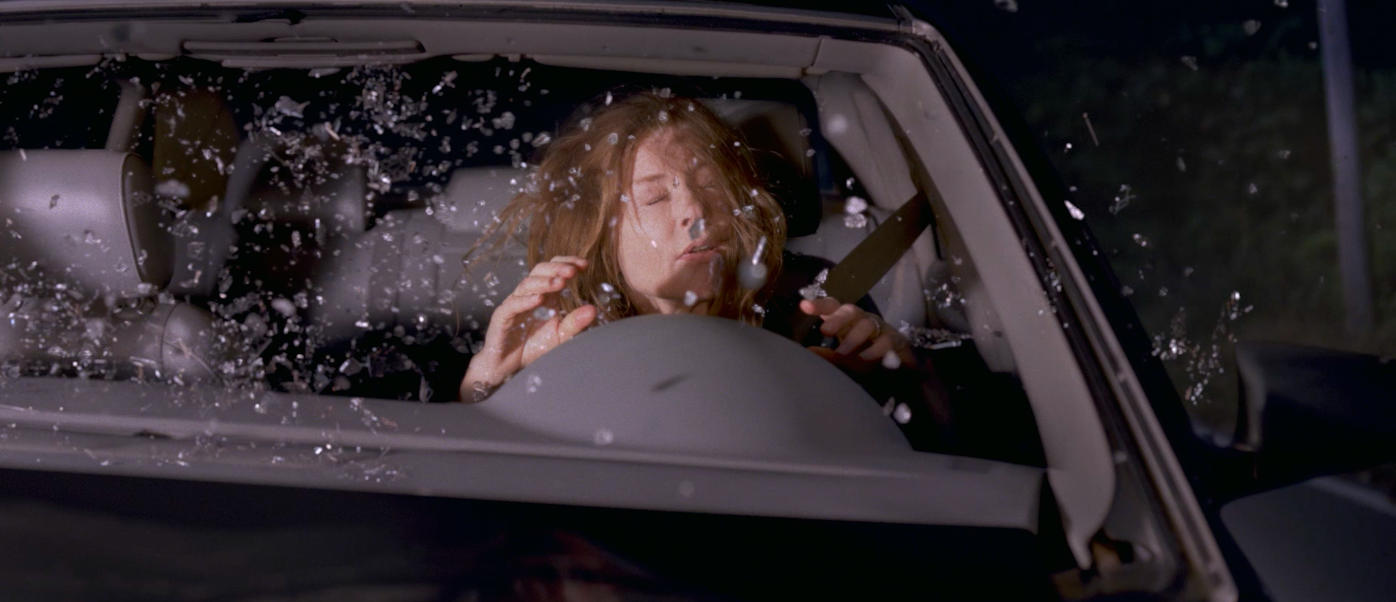
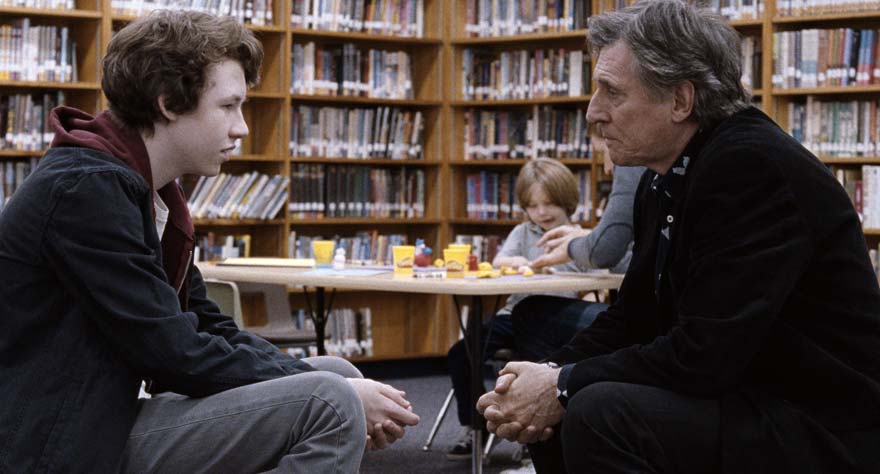
Indeed, it is her family's various frames of reference by which they placed, place and will place themselves into the context of their evolving understanding of Isabelle as secrets emerge. So, too, on the other hand, there is the dilemma of family secrets, and if not lies, then omissions. Isabelle has left behind a husband, Gene (Gabriel Byrne); a son, Conrad (Devin Druid), who was on the cusp of his teenage years when she died; and Jonah, who was in graduate school. Conrad has always been led to believe his mother died in a tragic highway accident, which he imagines in various iterations.


Not only are fragments of memories – real and imagined – explored from different perspectives, but fragments of points of view as the film eddies around Isabelle’s creative dilemma and the family’s dilemma in relation to her. A variety of flashbacks plumb, on one level, the problem of memory, and on another, the experience of the here and now, which has an equally multivariable quality depending on a character’s point of view.

There is Isabelle’s first person point of view juxtaposed with each family member’s memories of her as wife and mother. Then there is the question of the efficacy of immediate experience when a scene of the father surreptitiously following Conrad, worried about the boy’s state of mind, is repeated from Conrad’s point of view in an entirely different telling. There are also Conrad’s stream of consciousness diaristic musings that give Jonah new insight into his younger brother’s inner life, and Jonah’s warning against Conrad’s desire to share them with a girl at school because, Jonah cautions, she will not understand them for what they are.

Others characters exist on the periphery: Jonah’s wife, Amy, who has just given birth to their first child; his old girlfriend, Erin (Rachel Brosnahan); and Gene’s colleague and lover Hannah (Amy Ryan) – all of whom possess insufficient insight to avoid mistaken assumptions. 


Our ideas of the “truth” are inferential by nature. They are subjective, not objective, though we bring objective observation to bear on intuitive understanding. Kant uses a word for this experience – Anschauung. As philosopher Philip McPherson Rudisill argues, “The most difficult single word…for many non-Germans…in all of Kant is the Anschauung, the at-look or on-look.” Rudisill employs a wonderful analogy to explain the phenomenon: “When you tell a German that you see a face in the cloud, and she cannot, she might easily say, ‘Das ist Deine Anschauung,’ i.e., ‘that’s the way you’re looking at the cloud.’” Rudisill suggested another example to me: consider “an argument between two people facing each other as to who is here and who is there, since ‘here’ and ‘there’ are definitely subjective views or perspectives, and each will see him/herself as here and the other as there.”

Posing, framing. Once we are conscious of being viewed, a degree of manipulation is inevitable. I am a different person to different people and in different environments, and much as I may wish to be understood in a certain light, I will never know how I am seen through others’ eyes. What is "true"? from any one point of view, as opposed to, What is Truth? – especially when clouded by memory. “A picture,” Diane Arbus said, “is a secret about a secret, the more it tells you the less you know.”

February 26, 2016

SURVIVAL IN EXTREMIS: THE REVENANT AND SON OF SAUL

Sometimes even to live is an act of courage.
~~Seneca

You don't ask people with knives in their stomachs what would make them happy; happiness is no longer the point. It's all about survival; it's all about whether you pull the knife out and bleed to death or keep it in...
~~Nick Hornby, “How to Be Good”


Two of the most highly acclaimed films of this awards season have been Alejandro González Iñárritu's “The Revenant” and László Nemes’s “Son of Saul.” Oscars went to Iñárritu for Directing, Leonardo DiCaprio for Best Actor and Emmanuel Lubezki for Cinematography. Nemes’s “Son of Saul” won the Best Foreign Language Film Oscar. Both films center on a protagonist in unimaginable torment. One survives through an obsession with vengeance, the other through an obsession with atonement.

THE REVENANT

The Hugh Glass mauling incident is a perfect choice for a filmmaker given the ambiguity of the historical record, which leaves Iñárritu free to make of his narrative what he will. Hugh Glass was indeed a seasoned fur trapper who explored the watershed of the Upper Missouri River. Like a Jay Gatsby frontiersman, little is known about him. One rumor has it he was captured by privateers and forced to live as a pirate; another that he was captured by Pawnee Indians and lived among them for years, even taking a Pawnee wife. It is known that he accompanied several Pawnee delegates who had been invited to meet with U.S. authorities in 1821.

Hugh Glass
In 1822, one General William Ashley placed an advertisement in the Missouri Republican for 100 "enterprising young men...to ascend the river Missouri to its source, there to be employed for one, two, or three years" for a fur-trading venture that would become the Rocky Mountain Fur Company. In June 1823, believing they were being heralded by friendly Pawnee, the party went ashore only to be attacked by Arikara/Ree warriors. Survivors fled back to the long boats. Ashley’s associate, Andrew Henry, believed it prudent to abandon the river route, so, parting company with Ashley, he led fourteen of the men overland toward Fort Kiowa on the Missouri.

Glass kept to himself along the way, and in August, near the forks of the Grand River, was scouting for game when he surprised a grizzly with two cubs. The bear charged, Glass got off a shot, and the bear mauled him into unconsciousness. From there the story becomes conveniently murky. In one version, Glass’s trapping partners, John Fitzgerald and Jim Bridger, manage to kill the bear; in others, Glass kills the bear before they get to him. However the incident transpired, Glass appeared to his partners fatally injured. When Henry arrived, he, too, was convinced Glass could not survive, and he assigned Fitzgerald and Bridger to stay with Glass. In some accounts, they waited for as long as five days for Glass to die before abandoning him.

Iñárritu follows this historical record quite faithfully, only streamlining time and fusing Ashley and Henry into a single character for narrative economy. Where he strays is to conjecture a child for Glass by his Pawnee wife. His son Hawk’s murder at the hands of Fitzgerald, then, becomes the motive for vengeance, a far nobler motive than his own abandonment. 

Sitting in our comfortably air conditioned theater, it might seem more ethical for the men to carry Glass along and try to mend him back to health -- and they do patch him up as best they can. Yet, throughout the film, Fitzgerald, brilliantly embodied by Tom Hardy, makes the more pragmatic argument. You might not like the racist Fitzgerald, but he is not a coward or a fool. As the men attempt to move Glass on a makeshift litter, Anderson says to Fitzgerald, “They’re torturin’ the bastard,” to which Fitzgerald’s realistic rejoinder is: “And riskin’ gettin’ the rest of us killed in the process. Proper thing would be to end it for him quick.” When they finally stop, he tells Henry, “You ain’t doin’ him or us no favors, Captain, lettin’ him suffer that way.” And much as we might like to take a romantic view and condemn this line of reasoning, he’s right.
Tom Hardy as John Fitzgerald
About midway through “The Revenant” a scene occurs that to me seems central to the film. Fitzgerald and young Bridger are camped by a fire, when Fitzgerald starts to wax nostalgic and tell a story about his father, “who never believed in anything 'cept what he could use or shoot and eat. […] Then, starving and delirious on the Texas plain, he found God. And it turns out… God's a squirrel. And a big, meaty one. And he shot and ate that son of a bitch.” This story is not only a metaphor for Fitzgerald’s point of view, but the metaphor for the entire film. Survival comes at the expense of something or someone else. Exploitation is the law of nature.

“The Revenant” hinges on this existential reality. The bear that mauls Glass protects her cubs and the wolves that maul the buffalo calf feed their pack. Likewise, we survive at someone's or something's expense. We exploit resources – buffalo hides, forests, fossil fuels, human labor. (Who and what was involved in getting the precious metals out of the ground and into this MacBook I'm so blithely tapping away on?) That's what “The Revenant” is about. Some people grumbled about its being long and to a great extent, it is long in order to make us uncomfortable – and it doesn't make us nearly uncomfortable enough. It's too visually and aurally gorgeous for that.

Much has been written about Iñárritu’s desire to eschew CGI and use natural landscapes and available light, especially the dying light of the gloaming. This was one way to capture the lyricism of the novel upon which the film is based. In “The Revenant: A Novel of Revenge,” Michael Punke writes of the gloaming, “It was an interlude that he held as sacred as Sabbath, the brief segue between the light of day and the dark of night. [….] It was a moment for reflection in a space so vast it could only be divine. And if Glass believed in a god, surely it resided in this great western expanse. Not a physical presence, but an idea, something beyond man’s ability to comprehend, something larger.”

Some have referred to “The Revenant” as a Western, but Iñárritu rejects the categorization. “I wouldn’t say that Westerns were a big influence on 'The Revenant' at all, really. I was looking more toward things like 'Dersu Uzala' by Kurosawa, Tarkovsky’s 'Andrei Rublev' – which is maybe my favorite film ever – Herzog’s 'Aguirre, the Wrath of God' and 'Fitzcarraldo,' even 'Apocalypse Now.' These are movies that…are informed by the crazy…theatrical show that is the human condition. The beauty and harshness of nature impacts your state of mind in these movies. There’s a very intimate point of view from one single character in each. That’s the challenge. Anyone can film a beautiful landscape. Unless you have an emotionally grounded story…, it’s all just…sorcery.” (David Fear. “Into the Woods.” Interview with Alejandro Iñárritu. Film Comment. January/February 2016. Web. 26 Feb. 2016.)

Iñárritu infuses his film with this numinous quality through a series of dream sequences that punctuate the narrative. They reveal not only details of Glass’s past, but also glimpses into the mystery of humanity as it moves through the natural world. One sequence in particular – in the courtyard of a church ruins – is simultaneously an homage to Andrei Tarkovsky’s “Andrei Rublev” and to Béla Tarr’s “Satantango” and “The Turin Horse.”
Leonardo DiCaprio in The Revenant
In “Apocalypse Withheld: On Slowness & the Long Take in Béla Tarr’s ‘Satantango,’ ” (May 15, 2014), Janice Lee notes that “Cinephiles often compare Tarr to Andrei Tarkovsky. In response to this correlation, Tarr says: ‘The main difference is Tarkovsky’s religious and [I am] not… [h]e always had hope; he believed in God. He’s much more innocent than… me… Rain in his films purifies people. In mine, it just makes mud.’ ”

In Iñárritu’s telling, Glass exacts his revenge, but the record indicates that Glass found Fort Henry abandoned. Apparently a note indicated that Andrew Henry had relocated the company to a camp at the mouth of the Bighorn River. There, Glass found Bridger but is said to have forgiven him as an impressionable youth. Turns out, he spared Fitzgerald, too, perhaps because Fitzgerald had joined the United States Army, and the penalty for killing a soldier was harsh. When we mythologize true stories, we can hang meaning on them, but the true story itself too often gives the lie to the legend.

SON OF SAUL

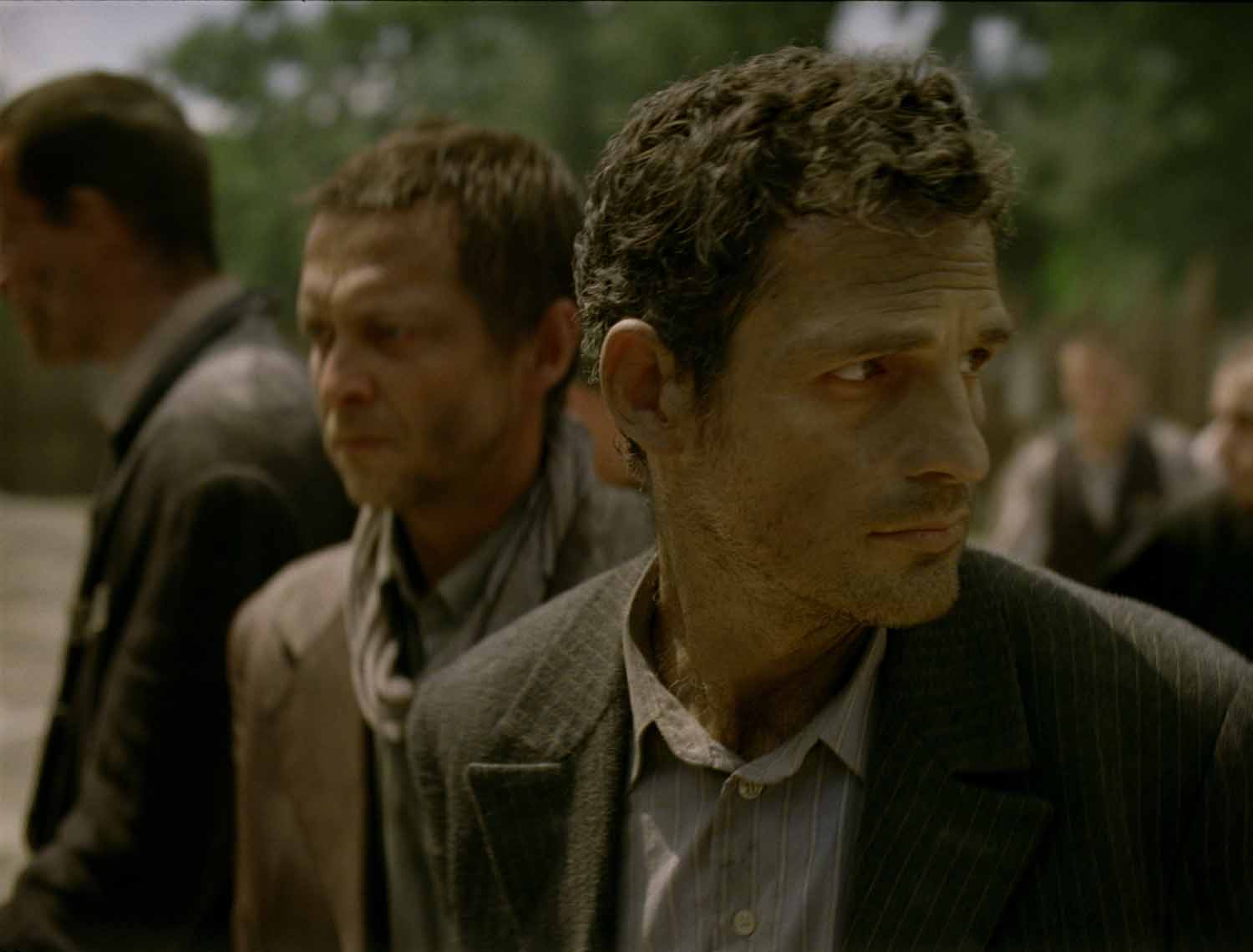
“Son of Saul” opens not only in extreme long shot and not merely in soft focus but entirely out of focus. A long focus-through ensues before we finally make out the contours of our protagonist. The opening establishes two motifs: the verdancy of nature juxtaposed with its indifference and the isolation of the individual in suffering. The solitary man in the midst of the controlled chaos that is Auschwitz-Birkenau is Saul Ausländer, a Hungarian Jew and a member of the Sonderkommandos.

In his debut feature film, Hungarian director László Nemes breaks new ground. The telling of the Holocaust, a seemingly inexhaustible source of narrative fodder, has focused on prisoners’ sufferings in the camps or on exposing and dealing out punishment to those who engineered the death camps and allowed their perpetration. The gas chambers and smoke stacks are there, but the narrative arc typically follows characters who have escaped the ovens rather than dwell on the apparatus of death for the entire course of the film.

Nemes takes us into the deepest reaches of the Nazi hell – the Sonderkommandos’ world, and though the Sonderkommandos are groups of camp prisoners, each individual is under a death sentence so that his struggle for survival isolates him from the men at his shoulders.

Geza  Rohrig is Saul in Son of Saul
Like no director I can think of before him, Nemes uses cinematography and sound and a single point of view to impress upon us the relentlessness of living cheek by jowl with the industrial scale of the Nazi killing. Moving in and out of soft focus gives a sense of the blur of exhaustion overcome only by the adrenaline of fear, the frenzied confusion and clamor of panic, the acrid burning and blistering swelter from coal dust and human ash. The sound is often unintelligible noise – the blast and blare of machinery, a cacophony of screams and struggle, the desperate Babel of incoherent tongues – a living hell made all the worse by the mounting hubris of the Nazi project by late 1944. Transports come in faster than the bodies they carry can be disposed of, making an already incomprehensibly harrowing environment beyond all tolerance or understanding.

The German sociologist Wolfgang Sofsky, in his 1992 study “The Order of Terror: The Concentration Camp” writes, “The agonies suffered by members of the Sonderkommandos defy description. Attempts at interpretation must necessarily remain superficial. Nonetheless, some comments on this most extreme form of forced collaboration are in order. These individuals worked in a situation of the constant threat of death and paralyzing violence. The SS let them live in order to work. Whoever refused was put to death. On July 21, 1944, when four hundred Jews from Corfu who had spent three weeks in the quarantine camp refused any involvement with the Sonderkommando, they were gassed. Whoever wished to live another hour had to work. The only way out was suicide – martyrdom. It is known that some did commit suicide while being admitted to the Sonderkommando or immediately thereafter. In addition, there was no certainty whatsoever about how long a respite one might have. No one could predict when the SS would liquidate the Sonderkommando. Yet one often clings to the slimmest of hopes so long as the end is not imminent, even if virtually all facts speak against it. The sheer will to survive triggers rigorous defense mechanisms that brush aside even the greatest dangers. The death of the other person is not your own. Even in a situation of certain death, people frequently do not react with rebellion, but with apathy” (270-271).

It is against this apathy – and his own complicity in death – that Saul’s consciousness and conscience seize upon one boy’s body – to spare him the ovens, to find a rabbi to say Kaddish, to give him a reverential burial. In the face of Saul’s plight, his insistence on Kaddish is profound, for in the act of saying Kaddish one affirms belief in the goodness and sovereignty of God, even – or especially – in the face of death. Central to the act of saying Kaddish is remembrance, the obligation to never forget, and above all, it is a prayer that speaks not to the past but to the future, a time of redemption.

Y'hei sh'lama raba min sh'maya,
v'chayim aleinu v'al kol Yisrael.
V'imru: Amen.


He who creates peace in His celestial heights,
may He create peace for us and for all Israel;
and say, Amen.


In his director’s notes, Nemes explains that “Our aim was to take an entirely different path from the usual approach of historical dramas, their gigantic scope and multi-point of view narration. This film does not tell the story of the Holocaust, but the simple story of one man caught in a dreadful situation, in a limited framework of space and time. Two days in the life of a man forced to lose his humanity and who finds moral survival in the salvaging of a dead body.”

Géza Röhrig, who plays Saul, was born in Hungary. His father died when he was four, and he spent several years in an orphanage before being adopted. He was expelled from high school in Paris for anti-communist activity. He studied Hungarian and Polish as a university student and holds a degree in filmmaking from the Academy of Drama and Film in Budapest. After a visit to Auschwitz, he moved to Jerusalem and then to Manhattan to study at the Jewish Theology Seminary, became an Hasidic Jew, has been teaching kindergarten since 2000 and has published many collections of poetry, including “Book of Incineration” (1995) and “Captivity” (1997). I cite this vitae at length to suggest that few actors could be as uniquely qualified to embody the cursed soul of Saul.

Speaking at the film’s press conference at Cannes, Röhrig bristled at a reporter’s suggestion that the Sonderkommandos were “half-victims, half-hangmen.” (Catherine Shoard. “ ‘Son of Saul’ star: ‘God was holding the hand of every Jew in the gas chamber.’ ” The Guardian. January/February 2016.)

“ ‘[T]he Sonderkommando were not just equally victimised but more victimised. They lived in the epicentre of hell. I think they deserve utmost respect. Some of them tried to make their way into the gas chambers instead.’ [T]he Sonderkommando have long been the victims of such ignorance. ‘Partly because everything about them was hearsay. The rules of the Nazis meant they couldn’t meet with the rest of the inmates, so they were somewhat mysterious. And the victims had so much anger and frustration, they projected it on to them.’ ”
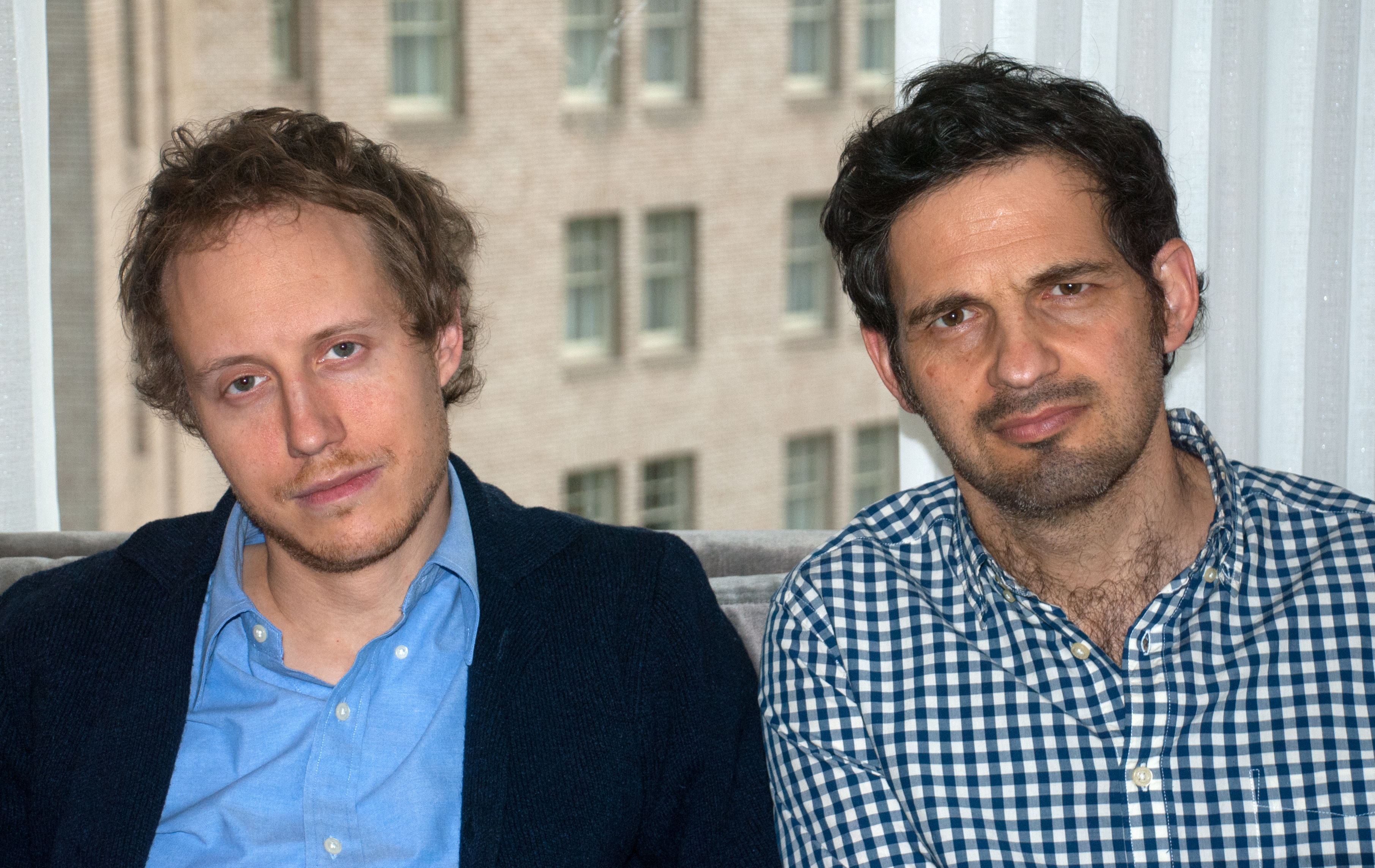
Director Laszlo Nemes and actor Geza Rohrig
“With movies like ‘Schindler’s List,’ you have an evil guy and you have a good guy,” Röhrig told The Guardian. “There’s no such thing. We are all evil and good inside. [….] [I]t wasn’t God who rounded up the Jews and the Gypsies and the Soviet PoWs and the gays and the perfectly German mental patients and the perfectly German midgets and slaughtered them,” he continued. “We did it. The human family did it.”

Röhrig wisely noted, “I think it’s fair to say that we haven’t learned anything from Auschwitz. The cruelty exhibited there exists today...”

January 19, 2016

REMEMBER THE LADIES: STELLAR PERFORMANCES FROM 2015

Much discussion has transpired this year about women vis a vis Hollywood: about percentages of women directors, producers, etc. and about salary equity -- a discussion fueled in part by information revealed in the Sony hack and by Jennifer Lawrence’s outspokenness. Yet for all the talk, we found ourselves in the midst of remarkably talented actresses who gave us a cornucopia of praiseworthy performances in 2015, though women of color were notably absent from the screen. (I very much regret that, living where I do, I did not have the opportunity to see Spike Lee’s “Chi-Raq,” Lee’s contemporary interpretation of Aristophanes’ “Lysistrata,” a play of which I have always been enamored.)

Four especially penetrating films focused on women that articulate a wide-ranging cultural critique. Taken together their impact should be nothing less than profound. “Room,” “Brooklyn,” “Carol” and “45 Years” have rightfully received their nomination due in awards in advance of the Oscars. Their impact has been amplified with greater complexity by the indie jewel “Tangerine,” giving us more reason for rejoicing.

The first decent movie of 2015 was Kenneth Branagh’s “Cinderella.” Lily James is the perfect embodiment of Ella, Cate Blanchett gives the Wicked Stepmother psychological depth, and when you say, “Fairy Godmother,” it’s a given Helena Bonham Carter be cast. Kate Winslet is wonderful as the unconventional landscape architect Sabine de Barra, who risked her career by rejecting the symmetrical design conventions of her era to create an unruly Romantic garden complete with grottos in Alan Rickman’s Louis XIV-period drama “A Little Chaos.” (Rickman himself, in a wonderful turn, played Louis XIV. He will be sorely missed.)
Kate Winslet and Alan Rickman in "A Little Chaos"
Winslet was also a knockout as Steve Jobs’s Apple marketing executive and confidant, Joanna Hoffman, in Danny Boyles’s film, for which she is receiving much-deserved recognition. Marielle Heller’s “Diary of a Teenage Girl,” starring Bel Powley in a performance that has also garnered award endorsements, also features a compelling supporting performance by the talented Kristen Wiig as her immature but sympathetic mother.

A clever satire on celebrity, Olivier Assayas’s “Clouds of Sils Maria” treads the boards of the self-reflexive trope of actors playing actors, specifically the older actress supplanted by the hungry, would-be starlet, but Assayas uses our expectations to subvert an “All About Eve” fatalistic inevitability. The film features nuanced performances from Juliette Binoche, Kristen Stewart and Chloe Grace Moret as strong-willed, independent women. Binoche challenged Assayas to write a film about women that left the rounding out of the characters to the actresses.

Binoche’s Maria is an international actress accompanied by her multi-phone wielding personal assistant, Val (Stewart). Maria’s mentor, the playwright who cast her in the role of a — perhaps manipulative — young woman in a relationship with an older woman, has died on the eve of the play’s revival. Moret as Jo-Ann Ellis is a paparazzi-baiting bad girl who has been cast in the role that made the young Maria a star. Maria’s commitment to her craft is juxtaposed with Jo-Ann’s pop culture celebrity in a film that is not ashamed to grapple with large questions of aesthetic and ethical concerns about artistic authenticity.

Juliette Binoche and Kristen Stewart in "The Clouds of Sils Maria"
Jennifer Lawrence is front and center in her third collaboration with David O. Russell and his troupe as the determined inventor of “Joy.” Paul Weitz brought the marvelous Lily Tomlin back to the big screen in “Grandma” rounding out a smart ensemble with Julia Garner as her granddaughter and Marcia Gay Harden as her daughter -- and with grace and humor they tackled the subject of abortion.

Winningly co-starring with their leading men, accomplished actresses had an opportunity to shine in little romantic vehicles: Dan Fogelman’s “Danny Collins” with Annette Bening and Al Pacino; Brett Haley’s “I’ll See You in My Dreams” with Blythe Danner and Sam Elliott; and Isabel Coixet’s “Learning to Drive” with Patricia Clarkson and Ben Kingsley. All three highlighted leading women on their own terms against their leading men.

If those pairings sparkled with chemistry, Marion Cotillard and Michael Fassbender utterly seethed with it in the Scottish play, directed by Justin Kurzel, and I found Alicia Vikander’s performance in Tom Hooper’s “The Danish Girl” more charismatic than the gender-bending Eddie Redmayne’s.
Michael Fassbender and Marion Cotillard in the Scottish play
Alicia Vikander also stars as Vera Brittain, a young woman who defied convention, first by attending Somerville College, Oxford, and then by leaving to become a nurse on the front lines in the Voluntary Aid Detachment in James Kent’s “Testament of Youth,” adapted from Brittain’s First World War memoir for the screen by Juliette Towhidi. Abi Morgan’s “Suffragette” with Carey Mulligan, Helen Bonham Carter and Anne-Marie Duff and Peter Sollett’s “Freeheld” with Julianne Moore and Ellen Page took on women’s issues, historical and contemporary respectively.

We also saw women in roles more typically inhabited by men. Taylor Sheridan’s script for Denis Villeneuve’s Mexican border drama “Sicario” cast Emily Blunt as a principled FBI agent caught in the murky amoral underworld of Mexican drug cartels. Peter Straughan’s script for David Gordon Green’s “Our Brand Is Crisis” was based on Rachel Boynton’s 2005 documentary of the same name about the campaign marketing tactics employed by James Carville and his Washington-based political consulting firm GCS for Gonzalo Sanchez de Lozada in the 2002 Bolivian presidential election. Sandra Bullock lobbied for the role of the central character, based on Carville and originally intended for a man.

In the realm of comedy stars, Melissa McCarthy has been developing her own version of franchise since 2013, this year’s installment being Paul Feig’s “Spy,” and with “Trainwreck,” Amy Schumer joined Judd Apatow’s repertoire of responsibility-phobic characters that went co-ed in 2011 with “Bridesmaids.” (N.B. Jason Moore’s abysmal “Sisters,” with Tina Fey and Amy Poehler, should never have been made.)

In addition to the supporting roles already mentioned, superb performances abounded in which a woman forms a kind of fulcrum between two male characters. Elizabeth Banks grounds Bill Pohlad’s “Love & Mercy” as Melinda Ledbetter, the savior who comes to the rescue of John Cusack’s older Brian Wilson (to Paul Dano’s younger) from the grips of his abusive therapist, Dr. Eugene Landy (Paul Giamatti). In a poignantly understated performance as the great detective’s housekeeper in Bill Condon’s “Mr. Holmes,” Laura Linney exudes an inarticulate love for the young son she lives to protect and endurance toward the irascible old man in her charge, marvelously channeled through Ian McKellen.
Ian McKellen and Laura Linney in "Mr. Holmes"
In the triad of excellent performances for Joel Edgerton’s “The Gift,” Rebecca Hall plays Robyn Callum, a woman pulled between the manipulations of her husband on the one hand (Jason Bateman) and the forgotten acquaintance (Edgerton) who shows up out of nowhere to haunt him. Laura Dern is the distraught mother of an unemployed, young single father, played by Andrew Garfield. Her salt of the earth son gets sucked into the home foreclosure racket by a ruthless real estate broker, played by Michael Shannon, in Ramin Bahrani’s chilling “99 Homes.”

The coming of age catalyst for the central character in Alfonso Gomez-Rejon’s “Me (Thomas Mann), Earl (RJ Cyler) and the Dying Girl,” is Rachel. Olivia Cooke navigates a beautiful re-invention of the dying girl trope sans sentiment and treacle. In “Youth,” Paolo Sorrentino gives Rachel Weisz’s supporting role as Lena Ballinger almost equal weight with the film’s co-stars: Michael Caine as conductor/composer Fred Ballinger -- her father -- and Harvey Keitel as film director Mick Boyle -- her father-in-law. Lena’s point of view enriches this meditation on age by considering the friends through the lens of the mature child and by presenting her understanding of Fred, not as an artist, but as a father and a husband to her mother.

Even before 2011, when his personal and creative collaboration with actress/writer Greta Gerwig began, Noah Baumbach explored multi-dimensional women in films like “The Squid and the Whale” (2005) with Laura Linney and “Margot at the Wedding” (2007) with Nicole Kidman and his then wife, Jennifer Jason Leigh. This year brought two Baumbach films, “While We’re Young,” for which he has the sole writing credit, and “Mistress America,” which was co-written with Gerwig. Like Apatow’s and Feig’s shallow creations, Baumbach’s characters have failed to grow up, but they differ by possessing a depth and complexity that the Apatow/Feig woman- man-child lacks, and as Baumbach’s films reach their denouements, we usually have a sense that the Baumbach/Gerwig character is going to come to terms with the necessity for maturity.

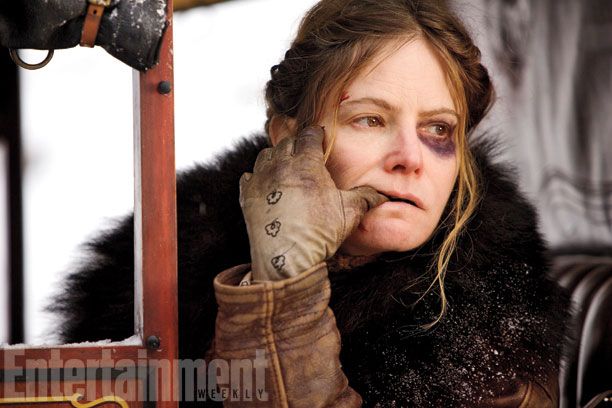
Speaking of Jennifer Jason Leigh, I do not want to overlook a performance that could have been ridiculously over the top but is not in Quentin Tarantino’s admittedly gory homage to the American western, “The Hateful Eight.” The range Leigh manages to achieve, through subtle facial expression alone, is beyond various: the contempt and scorn of a psychopath, the wounded hurt of a child or injured animal, the manipulations of a coquette, the defiance of an outlaw. Leigh seems to effortlessly traverse the gamut.

Jennifer Jason Leigh in "The Hateful Eight"
Of the plethora of astounding performances by women this year, four especially stand out, each a marvel of quiet subtly that dazzles. “Room,” “Brooklyn,” “Carol” and “45 Years” -- all four, each in its own way, share a quality of extraordinary eloquence through what isn’t said.

ROOM
I had seen Larson in small parts like Greenberg’s niece in Baumbach’s 2010 “Greenberg” with Ben Stiller and then in Oren Moverman’s 2011 “Rampart” with Woody Harrelson and Joseph Gordon-Levitt’s 2013 “Don Jon,” at which point she’d done over a dozen more roles in feature films. Yet when I encountered the force of nature that she is, in Destin Daniel Cretton’s 2013 “Short Term 12,” it was as if for the first time.

I started to write that in “Short Term 12,” Larson plays Grace..., but that would be wrong: Larson is Grace. She is both Grace the character, a supervisor at a short-term group home for troubled teens, and she is the embodiment of grace. Introverted by nature, she works with her boyfriend, Mason (John Gallagher, Jr.), who tries to draw her out, but for reasons that remain mysterious, whatever it is she feels she must guard fills a deep well of empathy she quietly yet ferociously shares with her charges barely younger than herself. In a delicate dance of ensemble reciprocity, Cretton’s cast touchingly captures the pain that is borne of abuse and the meaning of unconditional love.
Brie Larson as Joy and Jacob Tremblay as her son, Jack, in "Room"
To our wonderment, Larson dips into that seemingly bottomless emotional well again in Lenny Abrahamson’s “Room,” which Emma Donoghue adapted for the screen from her novel. Larson is Joy. Kidnapped at 17, she has been held captive in a dingy soundproofed room for seven years. Her salvation has been her son, Jack, and the action opens on the eve of his fifth birthday. Somehow, she has managed to raise Jack as a happy, well-adjusted child, allowing herself a pure joy in his being that he returns in the circumscribed life they share. Just as Jack is becoming old enough to start asking questions, Joy’s captor loses his job. The vitamins are not restocked; the heat bill goes unpaid. Joy understands the degree of their desperation, but an attempt to escape is fraught with danger, too. Larson’s visage can convey a deeply complex range of emotional subtlety, and we learn more about her and her relationship with Jack through what we see than through what she says, not simply about herself and Jack, but about the endurance of the human spirit.

Joan Allen deserves praise, too, for a poignantly perfect supporting role as Joy’s mother, a performance that has been wholly overlooked except by the Indiana Film Journalists Association. Allen almost silently conveys the tangle of a mother’s emotions in parallel with her daughter’s: the anguish, not only over the horror of her daughter’s captive experience, but of a mother’s pain in the knowledge that she will never fully fathom that experience. This understanding, in relation to her unabashed exultation in her daughter’s strength, perseverance and ability to have somehow spared Jack the clinically predictable consequences of having been raised in such unimaginable circumstances, infuses the film with a humanity almost impossible to describe.

BROOKLYN
Saoirse Ronan is the immigrant Eilis Lacey at the center of John Crowley’s bildungsroman, “Brooklyn.” Nick Hornby adapted the screenplay from Colm Toibin’s novel, and everything from the superb ensemble cast to Michael Brooks’s score to Yves Belanger’s cinematography to Jake Roberts’s editing is a quiet revelation. Just as during and after the potato famine of the 1840s, the United States generally and New York City especially, with its large Irish population, provided a beacon of hope for Irish young people fleeing a foundering rural economy in Ireland. As a wartime non-participant, Ireland received no help from the Marshall Plan that aided war-torn Western European countries. So in 1952, Eilis joins this wave of young people. A New York City parish priest (Jim Broadbent) has sponsored her passage, she secures lodging in a boarding house for young women, and she finds work in an upscale department store. She is a complex mix: overcome with loneliness but braving the unknown, filled with a sense of familial obligation but determined to forge her independence.
Saoirse Ronan in "Brooklyn"
Like Larson’s Joy, Ronan’s Eilis conveys her fluctuating feelings in her countenance. Writing for The Guardian (8 Nov. 2015), Mark Kermode says that Ronan, “the miraculous still centre of this beautiful, old-fashioned” movie, “appears to have developed the ability to act with her pupils, which seem to widen and contract at will.” Early in the film, and before Eilis meets her Italian beau (Emory Cohen), her fellow roomers take her for a dupe for agreeing to help with the parish’s annual Christmas dinner for the needy -- men, the priest explains, who built the city’s tunnels and bridges. It is a beautiful scene -- who cast this movingly realistic roomful over which the camera lovingly pans? -- in which one of the men, played by Iarla O Lionaird, stands and sings the achingly beautiful Irish love song “Casadh an tSugain” acapella.

When Eilis arrives back at her boarding house, her landlady, Mrs. Kehoe (Julie Walters), invites her in for a nip of sherry. Little is said; Mrs. Kehoe makes small talk, Eilis demurs. Yet in the course of this scene following her Christmas experience in the parish hall, Ronan’s face registers a deepening understanding of her privilege and good fortune, of the opportunity others have made possible for her, of her responsibility to make good on their generosity as well as her responsibility to honor the truth of her own self. What Ronan wordlessly conveys in these fleeting moments propels the balance of Eilis’s coming of age in America.

CAROL

Rooney Mara and Cate Blanchett in "Carol"
Phyllis Nagy adapted Patricia Highsmith’s 1952 novel “The Price of Salt” for Todd Haynes’s “Carol.” Cate Blanchett is the titular character whom we meet just at the point in her unhappy marriage when she is trying to break free. All that holds her is a deep maternal bond with the young daughter she adores. Out Christmas shopping, she encounters a department store clerk -- who, we will come to learn, is an aspiring photographer -- Rooney Mara, in an equally stellar performance. They fall in love, but it is 1952. All that can’t be said in “Carol” is paralleled with a visual leitmotif: expanses of glass -- shop and house and car windows, automotive windshields. What we see behind the glass is often obscured by rain or snow or the trickling humidity of fog. Glass is a barrier but a transparent one, and, like taboos, can be broken.

45 YEARS
Love stories are often cute or saccharine or otherwise superficial, none of which interests Andrew Haigh. His 2011 “Weekend” deals with the complexity of love, its messiness, its often bewildering lack of logic, its clumsiness and its intimacy. It is also a film about identity, the separate identity each lover confronts within the other and the thing between them, which becomes a third entity. “Weekend” is about the 48 hours two young men share; “45 Years” is about a life-long marriage confronted with an unexpected intruder who shatters that third entity. Written by Haigh from a short story by David Constantine called “In Another Country,” “45 Days” begins a week before the 45th wedding anniversary Geoff and Kate Mercer are preparing to celebrate.

Then, on the erroneous assumption Geoff is next of kin, a letter arrives explaining that the ice-encased corpse of Katya, his first love, has been recovered from a mountain crevasse she fell into as she and Geoff were hiking in the Swiss Alps 50 years earlier. Katya’s sudden presence is the wedge that opens a parallel fissure in Kate and Geoff’s marriage, and Haigh again confronts us with the complexity of love and the possibility that there is no such thing as a happy ending, at least in the conventional way we understand that phrase. Yet, whereas “Weekend” teems with the rich quickening and buoyancy of new love, “45 Years” exposes a long-ignored emotional vacuity through a specter frozen in ice and time that catches each spouse off guard.
Charlotte Rampling in "45 Years"
The couple is played by veteran actors Tom Courtenay and Charlotte Rampling in an anti-grand pas de deux communicated almost exclusively through gesture and expression. In his review for the New York Times (Dec. 22, 2015), A. O. Scott observes that “Mr. Courtenay, a naturally demonstrative actor, registers a convincing blend of longing, confusion and shame. Ms. Rampling, a stiller, deeper-running pool, conveys emotions so strange and intense that they don’t quite have names.”

That this many actresses achieved such heart-stopping performances this year — especially the intoxicating renderings from Brie Larson and Joan Allen, Saoirse Ronan, Cate Blanchett and Rooney Mara, and Charlotte Rampling -- is a veritable embarrassment of riches. They have elevated our story through characters that speak to women’s resilience and self-sufficiency through their endurance under circumstances of exploitation to the point of enslavement (“Room”), their dignity and independence (“Brooklyn”), their inherent nurturance and bravery in the face of the status quo (“Carol”) and their emotional vulnerability despite strength of character (“45 Years”). As interesting as the men were this year, the women on screen shone a brighter light on the better angels of our nature.


November 24, 2015

FACTS, ACTS AND DEEDS: AGNÈS VARDA'S THE GLEANERS AND I

with A Note on Documentary Filmmaking
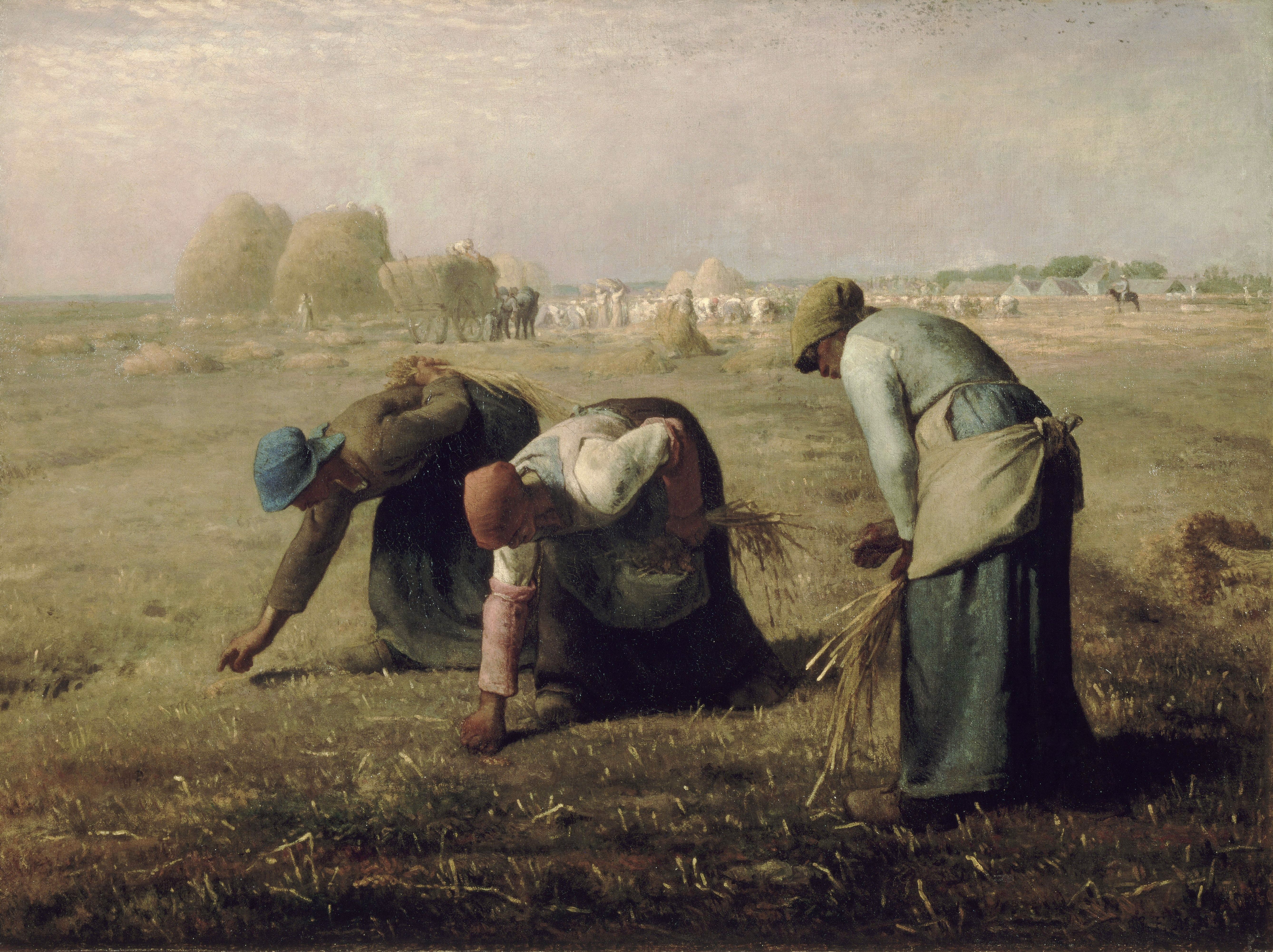
Des glaneuses1857, Jean-François Millet  
Musée d'Orsay, Paris
DOCUMENTARY FILMMAKING
Just as portraiture is the original mode of photography, so documentary is the original mode of moving pictures. A movie camera records an event in motion: a trolley barreling down a street, an athlete tumbling through space. The earliest documentaries, due to late-19th century technical limitations, could capture only a few moments in time, but as technological improvements freed recording duration, newsreels became a staple of the first couple decades of the 20th century. The one I always think of as serving the dual purposes of recording an important event for posterity and screening an event as news, is the solemn funeral cortège of Archduke Franz Ferdinand of Austria in 1914, after his assassination in Sarajevo, the spark that ignited World War I.

Funeral cortège of Archduke Franz Ferdinand of Austria, July 4, 1914 
From that time on, influenced by circumstances of wars, world-wide economic depression, fascism, the Cold War, natural disasters, and political and civil unrest, journalistic photographers and documentarians have worked at developing an ethic for how to present the world as it is. Between 1907 and 1930, Edward S. Curtis pursued his photographic opus, The North American Indian. In the interim, movie travelogues of exotic lands (sometimes called scenics) like Curtis's 1914 In the Land of the Headhunters, gained in popularity. Curtis composed his filmic scenes just as he composed his still photographs, tableaux for the camera carefully constructed just as models and objects had been  for paintings. Robert J. Flaherty took broader liberties in his romanticized 1922 Nanook of the North, subtitled "A Story of Life and Love in the Actual Arctic."

Subsequent filmmakers took issue with Flaherty's artifice, giving rise to avant-garde movements in the 1920s that professed to a higher documentary truth. Arguably, the most notable of these was the Russian director Dziga Vertov, whose Kino-Pravda group -- literally "Film Truth" -- produced a newsreel series, sometimes with a hidden camera, that focused on everyday experiences and, for the most part, eschewed reenactments. Vertov's 1929, 68-minute Man with a Movie Camera was a visual manifesto of his political and aesthetic cinematic philosophy: to present "life as it is," "life caught unawares," yet he did so, with the valiant efforts of his wife Elizaveta Svilova in the critical role of film editor, through some of the most arresting effects ever committed to film.

With the economic disruptions of the late '20s and early '30s through the war-time trauma of the '40s, fascistic and leftist ideologues alike employed the documentary mode for propagandistic purposes, e.g., Leni Riefenstahl's 1935 Triumph of the Will for the Third Reich and Frank Capra's 1942-1944 series Why We Fight for the United States government.

Poster for Dziga Vertov's 1929
Man with a Movie Camera
In 1955, ten years after the Allied liberation of Europe that ended World War II, Alain Resnais, a central figure in the French New Wave movement, made the hauntingly melancholic reverie on Hitler's concentration camps, Night and Fog. Night and Fog might be called an anti-propaganda film, diametrically opposed to the agitprop of government commissioned "documentaries." Resnais worked in collaboration with Jean Cayrol who had himself survived the Mauthausen-Gusen camp. The film is divided into 12 sections beginning with contemporary footage of the abandoned Auschwitz and Majdanek camps, eerie in their silence, and proceeding with stock footage, first from Nazi documentation and then from U.S. Allied forces documentary records. The effect is a chilling indictment of the SS and a reverent testament to the interred. Nothing so jarring as a reenactment mars Resnais's supplication to conscience.

Technical advances -- light-weight, quiet handheld cameras and portable synchronized sound capabilities -- encouraged post-World War II filmmakers to approach documentary filmmaking in new ways. In the 1950s, French anthropologist Jean Rouch developed a film philosophy of Cinéma Vérité, which sought to impose an ethic on the line between fictionalization and documentary in a style now called ethnofiction (enthnographic docufiction). The difference between Rouch's approach and what Flaherty had done in Nanook was that Flaherty's dramatization served to romanticize (melodramaticize, if you will) his subjects whereas Rouch's dramatizations served the loftier aim of political indictment. Rouch's 1958 Moi, un noir is considered a seminal work of ethnographic storytelling and is hailed as one of the signal influences on the French New Wave movement, whose auteur directors were emerging simultaneously: François Truffaut's The 400 Blows was released in 1959 and Jean-Luc Godard's Breathless in 1960. Rouch insisted, in a way that Curtis had not acknowledged, that the very presence of the filmmaker interferes with the documentary record he is attempting to capture -- cameraman as de facto agent provocateur, so to speak.


In North America, Direct Cinema grew out of Rouch's influence and his concerns regarding reality in relationship to the inevitable manipulations of the filmmaker. Yet, whereas Cinéma Vérité often involved staging, even provoking subjects, Direct Cinema's aim was for subject and viewing audience alike to have no awareness of the camera's presence, and one way to lessen the sense of the intrusive filmmaker was to eliminate the voice-over narrator.

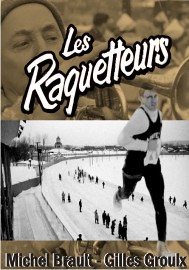
Direct Cinema was born in 1958 when the National Film Board of Canada released Québécois Michel Brault and Giles Groulx's Les raquetteurs, which documents a convention of snowshoers in Sherbrooke, Quebec. Les raquetteurs and Groulx's 1961 Golden Gloves, about three Montreal boxers in training, had a direct impact on the British-born Richard Leacock, D.A. Pennebaker, and Albert and David Maysles in the United States. Leacock's  first documentary, Toby and the Tall Corn, aired in 1954 on CBS's Omnibus, where Leacock met Robert Drew, an editor at Life magazine who specialized in the candid still picture essay. Drew was interested in a less verbal approach to television reportage, without interviews. Together Leacock and Drew interfaced a tape recorder and a mobile quartz camera with the design of an Accutron watch (which uses a 360 hertz tuning fork instead of a balance wheel as the timekeeping mechanism), thereby enabling them to synchronize the two machines without cables.


In "Richard Leacock: Bearing Witness," Brian Winston, who has written extensively on documentary and ethics, says, "Leacock was the catalyst for the development of the m  odern documentary, liberating the camera from the tripod and abandoning the tyranny of the perfectly stable, perfectly lit shot – as well as the straitjacket of ‘voice of god’ commentary."

Drew formed Drew Associates, which produced Primary in 1960 (shot by Leacock and Albert Maysles and edited by Pennebaker) "the first film in which the sync-sound motion picture camera was able to move freely with characters throughout a breaking story," John F. Kennedy's and Hubert Humphrey's respective Democratic primary campaigns in Wisconsin. Seven years later, in 1967 (the same year he shot the footage for Monterey Pop), Pennebaker's monumental portrait of Bob Dylan, Dont Look Back (created from footage shot in 1965), would be released.

Albert Maysles was a psychology professor at Boston University and head of a research project at Massachusetts General Hospital. In 1955, CBS gave him a camera with which to record a research project abroad. The resulting film was the drably titled Psychiatry in Russia. His younger brother David also studied psychology at Boston University but began working as a Hollywood production assistant in the mid-1950s. By 1957, the brothers had become a team, shooting documentaries behind the Iron Curtain. In 1960, they joined the burgeoning Drew Associates. The Maysles are best known for Salesman (1969), Gimme Shelter (1970), and Grey Gardens (1975), though their combined individual filmographies, along with their collaborations, reveal a staggeringly impressive oeuvre. Among my favorites is Running Fence (with Charlotte Zwerin), which chronicles the challenges Christo and Jeanne-Claude faced to install the 1976 environmental work in northern California.

Christo and Jeanne-Claude's 1976 Running Fence
Sonoma and Marin Counties, California
It is hard to measure the legacy Direct Cinema generally and Drew Associates in particular left to documentary filmmaking. As Winston notes, "Direct Cinema's style of handheld, available-light and long-take synch shooting, with no added effects, swept aside all other documentary modes for a quarter of a century, and to this day, such filming is what the public thinks of as documentary, dismissing alternatives as unethical or inauthentic."

Fourteen years after Resnais's Night and Fog, Marcel Ophüls' The Sorrow and the Pity was released in 1969. The film chronicles the collaboration between the Vichy government and Nazi Germany, and though The Sorrow and the Pity contains historical footage, its investigation relies on numerous contemporary interviews with those involved: a Jewish diplomat, a German officer, French collaborators, and resistance fighters among them. Organized into two parts, the first centers on an extended interview with Pierre Mendès France, a Jew who had been Secretary of State for Finance under France's Popular Front government and was arrested by the subsequent Vichy government. The second part centers on Christian de la Mazière, an aristocrat, journalist, and member of the Charlemagne Division of the Waffen SS. Though Ophüls did not associate himself with any particular documentary philosophy, he used "a characteristically sober interview style to resolve disparate experiences into a persuasive argument"* with The Sorrow and the Pity and documentaries like The Memory of Justice and Hôtel Terminus: The Life and Times of Klaus Barbi.

When most people think of the word "documentary," they think of the observational mode, the approach that Leacock, Drew, Pennebaker, and the Maysles played a pivotal role in establishing -- and the approach that Errol Morris would play a pivotal role in transforming. With his groundbreaking investigation into the unjust conviction and imprisonment of Randall Dale Adams for the murder of a Dallas police officer, Morris's award-winning documentary The Thin Blue Line made an indelible impact on subsequent documentarians. First, Morris again introduced reenactments but did so based on meticulous examinations of witness statements and testimony. Second, he developed a recording style that grew out of happenstance. On the day of the final interview with David Harris, the man (the film argues) who shot the officer, Morris's camera broke down. He resorted to a run-of-the-mill recorder for the interview, and for the finished cut of the film, shot a tape recorder from various angles from which he created a montage over which the voices from the tape were superimposed. From that serendipitous misfortune, Morris developed a technique he first employed in Fast Cheap and Out of Control (1997) that his wife later termed "interrotron": Morris behind a curtain staring into a camera that in turn feeds into a teleprompter-like device through which the interviewee looks directly at the camera.

In his commentary on his documentary on Stephen Hawking's book A Brief History of Time, Morris makes a critical distinction: "You don't judge a documentary film on whether it tells the truth. You judge it on whether it attempts to find the truth and makes you think about what the relationship between the movie and the truth may be. Truth is never given to us on a platter."

An intimately personal approach to the documentary has emerged with the turn of the 21st century, and just as Agnès Varda is credited as the mother of the French New Wave, we might credit her as the architect of this subjective, autobiographical approach to documentary with The Gleaners and I and The Beaches of Agnès.

One of the best recent explorations of this approach is Sarah Polley's 2013 documentary, Stories We Tell, in which Polley tries to tease out the "truth" of her mother's intimacies. "When [Polley] found her answer, and talked to her father and siblings about it," Mary Jo Murphy writes in the New York Times, "she became fascinated with how each of them was 'telling the story and embellishing the story and making the story their own.' The act of telling the story, [Polley] said, 'was changing the story itself.'"

Polley knows that most of us, “We do get stuff wrong and everything is kind of subjective. That’s part of who we are as human beings. We tell stories as well as we can but generally kind of sloppily even when we’re trying our hardest.”

AGNÈS VARDA AND THE FRENCH NEW WAVE
Agnès Varda has always been interested in documentary, narrative realism, social commentary, and feminist concerns. Her name is legendary as one of the pioneers of the French New Wave, and her career is remarkable in the stature of her achievement not only as the only woman in a '60s movement dominated by men, but as one of its inspirations, along with cinematic modernist forerunners Robert Bresson, Jean Cocteau, and Alexandre Astruc.

The young Agnès Varda, c. 1960s
The French New Wave can roughly be broken into two groups, the Cahiers du Cinéma and the Rive Gauche. The Cahiers du Cinéma takes its name from the magazine founded in 1951 by André Bazin, Jacques Doniol-Valcroze, and Joseph-Marie Lo Duca. As a cinematic movement, it is characterized by the director's distinctive creative vision -- "la politique des Auteurs," Truffaut called it -- and the critical evaluation of the ensuing mise en scène: a realistic visual style -- a verisimilitude of staging, blocking, lighting, set dressing, costuming, et al. -- an auteur employs to carry the narrative.

The Cahiers du Cinéma group included Claude Chabrol, Godard, Éric Rohmer, and Truffaut. Rive Gauche, or Left Bank Cinema, directors held a more traditional view of cinema as another facet of the literary arts. Though they tended to be older than their Right Bank counterparts, they too were interested in technical experimentation. The Rive Gauche group included Chris Marker, Resnais, and Varda, as well as Jean-Pierre Melville, and Alain Robbe-Grillet. Both groups identified with the political left, and those political concerns emerge in the subjects their films explore. The Cahiers du Cinéma magazine became progressively political throughout the '60s until, by 1970, it reflected a decidedly Marxist ideology. It continues to be published today but with a less political agenda.

THE GLEANERS AND I
Varda's 2000 film The Gleaners and I (literally, Les glaneurs et la glaneuse, meaning the gleaners and the female gleaner) is a singular documentary: part social commentary, part travelogue, part history and wide ranging art historical project. part memento mori. The Criterion Collection says Varda describes her style as cinécriture, or writing on film, "and it can be seen in formally audacious fictions like Le bonheur and Vagabond as well as more ragged and revealing documentaries like The Gleaners and I  and  The Beaches of Agnès."

My first encounter with Varda was the compelling 1985 Vagabond or Sans toit ni loi -- literally "without roof nor law," a play on the French idiom "sans foi ni loi," "without faith nor law." The film follows a peripatetic young woman, destitute and homeless, wandering the French countryside. The film opens on her frozen corpse, then flashes back to her last days. Varda approaches her desperate subject not as a picaresque literary figure but as a real young woman, alone and adrift in an indifferent landscape, sans any element of satire.


Subsequent to Vagabond, I have sought Varda out on DVD, most recently The Gleaners and I, Varda's first foray into digital film. She traversed the French countryside from September 1999 through May 2000 with a handheld camera. "These new small cameras," she says, "they are digital, fantastic. Their effects are stroboscopic, narcissistic, and even hyper-realistic."

The documentary that came out of that journey is personal in the extreme and like any meaningful art, an exploration of the universal concerns of the human condition: We all eat, we all lay waste the bounty that is ours, we all make human connections, we all hoard material objects just as we collect and preserve in memory our sense of who we are, and, of course, we all die.

Grain
As her entrée into France's breadbasket, Varda opens a lexicon, the seminal French Larousse Dictionary, where we learn the verb "glaner" (to glean) means not simply "to gather," but to gather after the harvest. The definition is accompanied by etchings after Jean-François Millet's 1857 Des glaneuses (The Gleaners), the original of which hangs in the Musée d'Orsay in Paris. Varda locates the practice of gleaning historically, first, as an activity that by definition is the gathering of what has been left behind and second, as labor relegated to women and carried out among them collectively. Within this context, Varda brings her inquiry forward to our own times and mores concerning bounty and waste, indulgence and want. "In the towns of today as in the fields of yesterday, gleaners still humbly stoop to glean. But men have now joined with women in gleaning. What strikes me," Varda says of contemporary gleaners, "is that each gleans on his own. Whereas in paintings they were always in clusters, rarely alone."

Des glaneuses1857, Jean-François Millet  
Musée d'Orsay, Paris
An 1877 painting by Jules Breton at the Musée des Beaux-Arts in Arras, is famous not only because it shows a lone figure but also because, unlike the stooping postures in other representations, Breton's gleaner stands nobly upright, her sheaves not in her apron but borne upon her shoulder. Varda visits the painting, and herself has her portrait photographed standing proudly upright with her sheaves, like Breton's La Glaneuse, across her shoulder. "There is another woman gleaning in this film, that's me (se moi)," and indeed, Varda sets out to glean the gleaners of every stripe in our own time, steering her crew south to the Beauce region between the Seine and the Loire, known as the granary of France.

La Glaneuse1877, Jules Breton 
Musée des Beaux-Arts, Arras
Potatoes
Beauce is renowned for its wheat, but "the harvest being over we'll focus on potato gleaning instead." A potato farmer tells Varda, "Some people are quite pleased when the machine malfunctions." We rely on the efficiency of contemporary harvesting equipment, but in our dependence, we sacrifice intimacy with the land. Worse, we have developed certain (some might say peculiar, even perverse) expectations about what our food should look like. A grocer explains that "In supermarkets, the firm [potatoes] are sold in containers of 5 1/2 to 11 pounds, and these have to be a specific caliber, of a specific size. So we dump anything bigger." Twenty-five tons of viable potatoes are abandoned each harvest just because, by arbitrary commercial standards, the produce is considered "misshapen." Varda is particularly taken with those "deformed" in heart shapes, which she collects to use in a lighthearted montage. Because so many potatoes are dumped, "The practice of gleaning has reappeared," a farmer explains. In a single day, volunteers for a charity salvage almost 700 pounds of perfectly good potatoes. "Same with cauliflower," another man tells Varda, "fruit and vegetables in other regions, but here it's potato country and we take what we can find."

Her crew travels to a gypsy caravan where Varda asks if they know they can legally gather dumped potatoes, and it turns out they do not. Nearby homeless people dwelling in tiny camper trailers not only glean from fields but from dumpsters behind supermarkets filled to brimming with food cleared from grocery shelves. "We're not afraid to get our hands dirty," one explains. "You can wash hands."


Varda stops to visit Édouard Loubet, "the youngest French chef to have earned two stars in the Michelin guide." Loubet owns Le Moulin de Lourmarin and Le Galinier de Lourmarin in the Provence-Alpes-Côte d'Azur region, but he gleans herbs and fruit for his restaurants because he wants fresh ingredients rather than refrigerated produce from Italy. Varda, by including the master chef Loubet in her film about detritus, juxtaposes the homeless with an elitist cultural attitude toward food.

Grapes
From Provence, Varda makes her way to the great terroir of Burgundy, where she stops to contemplate Rogier van der Weyden's Beaune Altarpiece (c. 1445-1450) whose subject is the Last Judgment. The Chancellor of the Duchy of Burgundy commissioned the Flemish artist to create the altarpiece in 1443. Comprised of fifteen paintings on nine panels, six of which, being hinged shutters, are painted on both sides, the altarpiece depicts the realms of the divine, the earthly, and the infernal.

Rogier van der Weyden's Beaune Altarpiece, c. 1445-1450
Varda focuses on the latter. Whereas a traditional rendering of the Last Judgment would depict demons and fiends tormenting the accursed, van der Weyden has painted tormented souls whose anguish is rendered only through their contorted expressions and postures. Varda speculates on the punishments meted out for gluttony before turning her gaze to notice that no gleaners are in sight, even though the grape harvest has just ended. A Burgundian cafe owner explains that gleaning differs from picking: "You pick the fruit that hangs but you glean things that sprout." One gleans grain; one picks olives and almonds and figs.

Rogier van der Weyden's Beaune Altarpiece, c. 1445-1450
Detail
Vintners and farmers have made picking in Burgundy illegal. One vintner explains that "If you want your wine to be ranked as a vintage, the yearly production is limited. That means you can only produce a certain quota per plot." The rest is left to rot, vintners wary that pickers will harm their vines. Like vineyard owners, fig growers purposely throw fruit deemed unworthy to the ground to molder, ensuring enforcement of the injunction against picking -- even after harvest.

Modern harvesting equipment leaves abundant sprouted crop behind -- cabbages and tomatoes -- and though Burgundians have managed to criminalize picking, French penal code allows for gleaning with impunity "from sunup until sundown" as long as it occurs after the harvest, explains Mr. Dessaud, Varda's "lawyer in the fields." Varda finds an old law commentary with an edict from November 2, 1554, "which says just the same as today. It allows the poor, the wretched, the deprived to enter the fields once harvesting is over. Old documents talk of the poor, the destitute, but how are we to consider those who want for nothing and glean just for fun?" Varda asks Dessaud. "If they glean for fun, it's because they have a need for fun," he reasons.

In the countryside of the Jura region, Varda encounters the Nenon family, in the hills near Apt, who "present a special case of picking. The vineyard they found was wholly abandoned." In this region, after November 1, they are free to take the harvest to save it from wild boars and birds.

In the fruit groves of Arles, the foreman of Cape Farm tells Varda, "We often allow gleaners to come in after our pickers, provided they remain 10 yards behind." Another fruit grower explains, "We can't prevent people providing themselves with apples once we have finished harvesting. So we proclaim an official gleaning period, we take [car] registrations down, if it's a moped, we ask for a Xerox of the owner's ID...."" "Isn't it a bit over-regulated?" Varda asks. "Once people are registered, they can take 400 pounds, I don't mind, even if it's a whole lot," he says by way of explanation. Gleaners can even enter greenhouses once the harvest is collected.

Oysters
Though the island of Noirmoutier is known for its causeway and for the delicate, almost extinct La Bonnotte potato, with its distinctive salty, earthy flavor derived from its cultivation in the algae and seaweed laden soil, Varda visits to talk to local oyster gleaners who scour the beaches after rough storms and very low tides have dislodged oysters from their beds and washed them ashore. She's told they "go in as soon as the storm has abated." Oyster gleaning is legal within certain parameters, though the gleaners almost purposefully seem to have a vague notion of the actual terms of the law. Is one to stay 10 yards away from the poles marking the beds? 15? 25? Is the maximum number of oysters per person 7 pounds? 11? "Seven pounds of clams and 11 pounds of oysters, something like that," says one. "Three dozen [oysters] per person, but surely they take more than that," says another.

Art
Throughout her travels, Varda interviews artists who incorporate the discarded into their work. Having considered gleaning and picking, she  explores loading up, "retrieving heavy objects people get rid of," an artist who makes images from salvaged material explains. He defines himself equally as a painter and a retriever. "What's good about these objects is that they've already had a life, and they're still very much alive. All you have to do is give them a second chance."

Passing an abandoned factory on one side and a shop with the sign "Finds," Varda notes, " 'Curios' is common, but 'Finds' is more inviting." Lo and behold, inside she finds a painting of gleaners, a charming amateur picture that combines "both the humble stooping of Millet's Glaneuses and the proud posture of Breton's Gleaner. "The painter," Varda surmises, "had an old dictionary at hand. Honest, this is no movie trick. We really did find these Glaneuses purely by chance. The painting had beckoned us because it belonged here in this film."

Varda loads up her serendipitous treasure and heads to the Ideal Palace of Bodan Litnianski. Litnianski immigrated from Ukraine to France around 1930 at the age of 17. He worked as a bricklayer and mason, then served France in World War II. After being released from a prisoner of war camp, Litnianski returned to France and settled in a house in Viry-Noureuil, near Chauny, in the Aisne department of northern France. Once he had decorated the exterior of the house with all manner of objets trouvés, he "started building totem towers made of scraps he found in dumps and brought back in his trailer hooked to his moped." "It's solid stuff, you know," Litnianski assures Varda, "very solid. I'm a brickmason. I like dolls, they're my system. Dolls are characters."
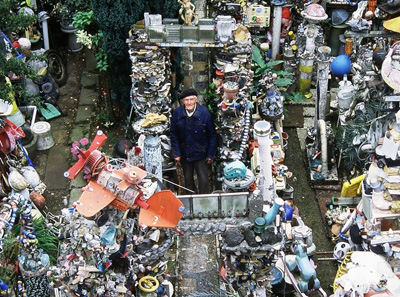
The Ideal Palace of Bodan Litnianski, c. 2000, Viry-Noureuil
Varda visits the French assemblage artist Louis Pons who describes the detritus from which he creates his work as "my dictionary, useless things. People think it's a cluster of junk. I see it as a cluster of possibilities. Each object gives a direction, each is a line, picked up here and there, indeed gleaned, and which become my paintings. The aim of art is to tidy one's inner and exterior worlds," Pons says. "I make sentences from things."
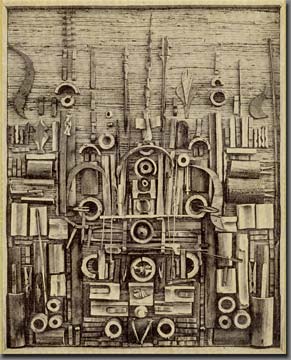
Ma ville, 1970, Louis Pons
Trash
Varda turns to Mrs. Espie, her "lawyer in the streets," to understand the French statute on abandoned objects. "The law on gleaning doesn't apply to these objects. 'Res derelictee' are ownerless things, since the owner's intention has been clearly expressed: they have deliberately abandoned them. ...[T]his property can't be stolen since it has no owner." People salvage appliances from the streets to repair or repurpose, and some glean TVs for copper wire. Varda investigates the Waste Ground artists of Villeneuve Sur Lot, a collective that creates domestic-themed tableaux resembling large-scale dollhouses from discarded refrigerators.

In Prades, Varda interviews a man only identified by his green rubber boots. He tells her, "I have a job, a salary, a social security number. Salvaging is a matter of ethics for me, because I find it utterly unacceptable to see all this waste on the streets." Back in her own Montparnasse neighborhood in Paris, Varda finally introduces herself to a man she has repeatedly noticed in the wee hours after her street market closes down. He eats as he gleans, like a ruminant grazing through the vendors' leavings. Interviewing him over a number of weeks, Varda learns he is a former teaching assistant with a Master's in biology. For whatever reason, he now sells street papers and maps in front of the train station. For eight years he has lived in a shelter many miles away where fully half of the mostly immigrant residents are illiterate. For six years, for two hours every evening, he has been teaching them to read and write in a basement classroom he has arranged for his tutees' convenience. "I'm not part of the school system, I don't get paid for it." "Meeting that man is what impressed me the most," Varda says of her cinematic journey.

Coda
"The other high point is quite different in kind." Varda talked the Musée Municipal, Villefranche-sur-Saône into bringing out a long-neglected painting by Pierre-Edmond Hédouin, which Varda had only seen reproduced in black and white. Gleaners at Chambaudoin, fleeing the storm was first exhibited in 1857, the same year as Millet's Des glaneuses. The curator and her assistant carry the large canvas outside as a storm gathers, the gusts and thunder audible on the dialogue track, while on the canvas Hédouin's gleaners run from a darkening sky, sheaves over shoulders and above their heads, their skirts pressed against their bodies by the wind. "To see them in broad daylight, with stormy gusts lashing against the canvas, was true delight."
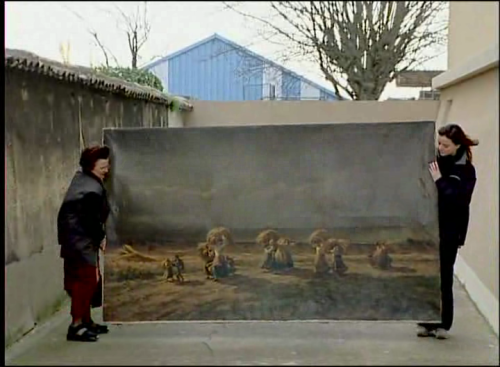
Glaneuses à Chambaudoin/Gleaners  Fleeing Before the Storm, 1857, Edmond  Hédouin  
Musée Municipal, Villefranche-sur-Saône
In the course of her travels, Varda has made a stop at the Domaine de la Folie, Côte Chalonnaise, a 16th century estate that has been in the Noël-Bouton family for three centuries and is considered a leading Burgundy wine producer in Rully. "The domaine is unique in the Rully [appellation contrôlée] in that it is...northernmost...and its 32 acres of vines are the highest in elevation. Moreover, all but one of these vineyards are monopoles (a fact that leaps out in the context of Burgundy). Lastly, unlike the main body of vineyards in the central part of Rully to the south, this northern end of the Montagne de la Folie sits on the same vein of limestone as the commune of Puligny-Montrachet, just over three miles away."

Jérôme Noël-Bouton explains that his grandmother was the daughter of Étienne-Jules Marey. At the time that Noël-Bouton's grandmother, Marey's daughter, married a Bouton, the estate had fallen out of Bouton hands. Marey bought it and returned it to the Bouton family.

But Varda has not come for wine. Marey was not a vintner but a physiologist and the inventor of chronophotography, a process by which several phases of movement are recorded onto a single photographic plate. Noël-Bouton shows Varda the tower Marey built to house his still camera equipment. "He set up wires," Noël-Bouton explains, "and waited. Animals or birds went past triggering the camera. That's the hut," he says, pointing to another structure, "from which, with his chronophotographic rifle, he broke down the flight of birds." Marey published La Machine animale (Animal Mechanism) in 1873. Eadweard Muybridge published his Photographic Investigation in 1897 in an effort to prove Marey's contention that all four hooves of a galloping horse, for however brief a moment, are together off the ground.

"He was a visionary," Varda says of Marey. "He analyzed movement before Muybridge and the Lumières. He is the ancestor of all movie makers."

"Marey's experimental pictures and film bits,"
Varda says, "...are pure visual delight."
Finally, throughout her film, Varda superimposes a second narrative, for, after all, her title is The Gleaners ... and I. She made the film when she was 72. Aptly then, in a documentary exploration of what comes after the farms' and vineyards' harvests, after the groceries' expiration dates, after use and wear have consigned material objects to dustbins, it is only fitting that Varda punctuate her rumination with a parallel narrative that gleans her own physique for traces of mortality. Like the chiming of a clock, at intervals Varda trains her inquiry onto herself. "My hair and my hands keep telling me that the end is near."

"And then my hand up close,.. this is my project: to film with one hand my other hand. To enter into the horror of it. I find it extraordinary. ...I am an animal I don't know."

"One night when the bulky refuse is thrown out, I drove around with François [Wetheimer]," a friend who scored Varda's 1977 One Sings, the Other Doesn't and who likes rummaging. Varda reports he looked at an empty clock and turned it down. "I picked it up and took it home. A clock without hands is my kind of thing. You don't see time passing," Varda explains, as her visage, like a pendulum making a sweep in one direction only, moves across the tableaux into which she has situated the clock.

The compactness and portability of her digital camera have allowed Varda to look and see and film in new ways. "I'll walk my small camera among the colored cabbages and film other vegetables which catch my eye. On this kind of gleaning, of images, impressions, there is no legislation, and gleaning is defined figuratively as a mental activity. To glean facts, acts and deeds, to glean information. And for forgetful me, it's what I have gleaned that tells me where I've been."

Agnès Varda visiting the Musée des Beaux-Arts, Arras


*Armstrong, Richard, et al. The Rough Guide to Film: An A-Z of Directors and Their Movies. London: Penguin, 2007. 399-400.

The Gleaners and I is available from Netflix DVD and Instant Play, Amazon. It can be purchased from Zeitgeist Films,

Medina, Jennifer. "Getting Ugly Produce Onto Tables So It Stays Out of Trash." New York Times 23 November 2015. Online.