THE ACT OF KILLING: A DOCUMENTARY BY JOSHUA OPPENHEIMER
Preface
We use every tactic available to us to repress the fact that mass killings (classicide, democide, gendercide, genocide, politicide) are central to history and the human condition. Indeed, Jared Diamond speculates in The Third Chimpanzee: The Evolution and Future of the Human Animal (1992) that genocide may explain the extinction of Neanderthals.
Our literature provides many historical accounts. Set toward the end of 2nd millennium BCE, the Old Testament Book of Genesis records King David’s “sacred war” of extermination against the Amalekites. The Book of Exodus tells of the command of an unnamed Egyptian Pharaoh that all newborn Hebrew boys be killed, leading Moses’ mother to set him adrift in an ark among the bulrushes. In the Book of Numbers, Moses himself orders the soldiers of Israel to take all of the Midianites’ animals and goods, to burn their villages, and to kill all Midian men, male children, and non-virgin females, save only the virgins for their own pleasure.
Athens assaulted the neutral island of Melos twice during the second phase of the Peloponnesian War (431-404 BCE), the second time using Melos as an example to possible island revolts by executing all of the adult men and selling the women and children into slavery, a common practice among Greek nation-states. The Third Punic War ended with Roman soldiers moving house by house to effect the complete destruction of Carthage in 149 BCE. Excavations at Sacred Ridge near Durango, Colorado, reveal evidence of a genocide committed against the ancient Pueblo Anasazi (“enemy ancestors”) sometime around 800 CE.
The Mongol horsemen of Temüjin Genghis Khan killed entire nations during the 13th century, while Genghis Kahn’s successor Tamerlane razed cities to the ground from the Asian steppes to the Syrian coast, and killed every Christian he could find. All the while, Europeans had begun their systematic slaughter of native populations in the Americas.
Aztec sacrifice is well documented, and the scope, though disputed, is hard to get one's head around no matter which end of the spectrum one accepts. Scholarly estimates for numbers sacrificed in central Mexico throughout the 15th century range from 20,000 per annum to 250,000.
Between 1492 and 1503, Christopher Columbus undertook four voyages to the Americas. A hundred years later, the Virginia Company of London established James Fort, or Jamestown, in 1607 in the Powhatan Confederacy’s Tsenacommacah territory inhabited by the Paspahegh, a tribe of about 14,000. In just over three years’ time the settlers had annihilated the tribe. Over the next three centuries, European colonists, and then the United States government, pursued continuous incursions against the native peoples of North America in what would collectively come to be known as the American Indian Wars.
The Chickamauga Wars were a continuation of the conflict between the Cherokee nation, as allies of the British, and the colonies. The 1787 Northwest Ordinance spurred the Northwest Indian War and the Creek War of 1812. The First Seminole War resulted in the transfer of Florida to the United States from Spain.
The justification for a policy of Indian removal in part grew out of the 19th century ideology of Manifest Destiny. With the Indian Removal Act of 1830, the Cherokee, Muscogee (Creek), Seminole, Chickasaw and Choctaw nations – collectively known as the Five Civilized Tribes – were forcibly relocated from their lands to Indian Territory in what is now the state of Oklahoma. The brutal journey has come to be known as the Trail of Tears. Thousands died of exposure, disease, and starvation; the toll on the Cherokee tribe alone was at least 4,000.
Some tribes submitted to the terms of removal “treaties;” others resisted resulting in the Black Hawk War of 1832, the Creek War of 1836, and the long and deadly Second Seminole War. During and after the Civil War, the Indian Wars relentlessly continued in Texas, New Mexico, Utah, Oregon, California, and Washington. The Northern Plains’ Sioux, Idaho’s Nez Perce, and the Comanches of Texas were perhaps the most unyielding to efforts to displace them, but other tribes put up noble resistance as well.
The Oregon Treaty set off a series of wars in the Pacific Northwest as settlers usurped the lands of the Cayuse, Yakima, Coeur d’Alene, Spokane, Palouse, Snake, Nez Perce, Bannock and Sheepeater tribes. The end of the Mexican American War in 1848 provided for the acquisition of Alta California and Santa Fe de México from Mexico. The Gadsden Purchase, present-day Arizona and southwestern New Mexico, purchased from Mexico in December of 1853, led to conflicts with the Navajo and Apache.
The California Gold Rush sparked battles with the Yuma, Mariposa, Yurok, Karok, Yokut, Chilula, Lassik, Hupa, Mattole, Nongati, Sinkyone, Tsnungwe, Wailaki, Whilkut, Wiyot, Pitt, Yuki, Paiute, Shoshone, Kawaiisu, Bannock, and Modoc, and the encroachment of Mormon emigration into the Great Basin ignited fighting with the Shoshone, Paiute, Ute, Apache, and Navajo.
To take a single example among many dozen, a 700-man Colorado Territory militia razed an encampment of friendly Cheyenne and Arapaho Indians. Two-thirds of those killed and mutilated were women and children in the Sand Creek Massacre of 1864. The American Indian Wars drew to a close in 1924 with the end of the Renegade period of the Apache Wars. It is interesting to note that the overall combat that resulted from Indian removal is referred to as war, while the individual incidents are more often – and more accurately – referred to as massacres.
Oliver Cromwell’s conquest of Ireland from 1649-1653, during the Wars of the Three Kingdoms, established penal laws against the Roman Catholic majority and confiscated much of their land. War and famine hastened the spread of bubonic plague, so that combined, the Parliamentarian campaign has left historians to guess the degree of devastation suffered by the Irish people. Estimates vary from 20 percent of the population lost, to as much as 83. Two centuries later, from 1845-1852, the potato blight would eradicate Ireland’s staple crop. The British response to The Great Irish Famine, in Gaelic an Gorta Mór “The Great Hunger,” can generously be described as cynical. In This Great Calamity: The Irish Famine 1845–52 (1995), historian Christine Kinealy writes that “As the Famine progressed, it became apparent that the government was using its information not merely to help it formulate its relief policies, but also as an opportunity to facilitate various long-desired changes within Ireland. These included population control and the consolidation of property through various means, including emigration.... Despite the overwhelming evidence of prolonged distress caused by successive years of potato blight, the underlying philosophy of the relief efforts was that they should be kept to a minimalist level; in fact they actually decreased as the Famine progressed.” Ultimately, the Irish would lose approximately 1 million to death and another million to emigration – between 20-25 percent of their people.
More than half of the Dzungar, a confederation of Oirat Mongol tribes who constituted the last nomadic empire of China, were massacred by the Manchu-led Qing dynasty in the 18th century, and less than a century later, the scorched earth policy of Hong Xiuquan’s millenarian movement against the Qing Dynasty, the Taiping Rebellion, would provide the glorified model for Mao’s Great Proletarian Cultural Revolution in the People’s Republic of China, where 20-43 million would die in the Three Years of Great Chinese Famine from 1958-1961. Many more died in exile at hard labor in “reeducation camps” during the Cultural Revolution. Following the end of the Vietnam War, military officers and government workers associated with the former South Vietnam regime were similarly interred in “reeducation camps.”
In the early 19th century, the Maori almost extinguished the Moriori in New Zealand, just as the British exterminated Tasmanian Aborigines in Australia. Meanwhile Zulu armies annihilated vast populations across the southern regions of Africa.
In the mid-19th century, at the end of the Caucasian War in the area of northwest Caucasus, Russia – which A. Tanner in The Forgotten Minorities of Eastern Europe: The History and Today of Selected Ethnic Groups in Five Countries (2004) credits with “inventing the strategy of modern ethnic cleansing and genocide” – purged the region of its indigenous people – the Circassians, Crimean Tatars, Ubykhs, Abkhaz, and Abaza.
As the 19th century waned, King Leopold II of Belgium’s insatiable lust for riches and glory enslaved the native population of the Congo Free State. Beatings and slaughter were rife, and mutilations were the usual punishment when rubber production quotas were not met. The estimated death toll from Leopold’s government ranges from 2-15 million.
The 20th century would usher in an era of unprecedented mass killings. The Botswana National Archives houses the only extant copy of German General Lothar von Trotha's 1904 Extermination Orders at the Battle of Waterberg. "Every Herero found inside the German frontier, with or without a gun or cattle, will be executed. I shall spare neither women nor children. I shall give the order to drive them away and fire at them." Even late in life, von Trotha defended his actions: “It was and is my policy to use force with terrorism and even brutality” (that last being a puzzling distinction).
Beginning in 1915, the Ottoman Empire alone was responsible for Armenian, Assyrian, and Greek genocides shortly after World War I, succeeded in 1923 by Turkey’s process of Turkification resulting in the Dersim and Batak massacres of the 1930s.
In 1919-1920, the Bolsheviks targeted the Don Cossacks during the Russian Civil War. Supported by the Kuomintang Republic of China, the Muslim warlord Ma Bufang launched seven extermination expeditions against Tibet’s Ngolok tribes throughout the 1930s. His father Ma Qi had defeated the Tibetans in 1918, was driven out in 1925, but returned in 1927 to wage genocidal war.
The Soviets confiscated not only the 1933 harvest but all food stuffs in the Baltic states resulting in a wide-spread famine that killed at least 10 million in Ukraine, Kazakhstan, the Cossack territories, and entire regions of Russia. The man-made hunger extermination was known as the holodomor or Terror-Famine in Ukraine. In 1937-1938, as a part of the Soviet Great Purge, the Party’s Central Committee Politburo undertook the Polish Operation, which called for the liquidation of Polish diversionists, espionage groups, and the POW population.
The Soviet occupation and annexation of the Baltic states in 1940 was the harbinger of mass deportations. Because of the staggering death rates for those exiled to Siberia, many consider the deportations of Lithuanians, Latvians, and Estonians to mark the onset of Stalin’s reign of genocide there. Among his stated goals was the liquidation of the kulaks as a class, well-off peasants branded class enemies. Stalin marshaled on with Operation Lentil in 1944, the deportation of the entire population of Checheno-Ingushetia, and every attempt was made to wipe all trace of their existence from the face of the earth.
As Stalin ravaged Eastern Europe, the Japanese perpetrated the Rape of Nanking, the former capital of the Republic of China, in late 1937, while Hitler, who had assumed the German Chancellorship in 1933 and introduced the anti-Semitic Nuremberg Laws in 1935, had yet to begin construction of the six extermination camps the Nazis would operate in Western Poland, and another in Minsk, Belarus. At its peak, the Auschwitz concentration camp alone gassed about 19,200 a day. In addition to Jews, the German genocidal policy targeted Slavs (Poles, Russians, Ukrainians Belarusians, Serbs, Czechoslovaks, etc.), the Romani, the mentally ill, homosexuals, Jehovah’s Witnesses, and political “subversives.” The persecution of Slavs intensified with the invasion of the Kingdom of Yugoslavia and the massacres of Poles in Volhynia and Eastern Galicia.
Meanwhile, the Dominican dictator Rafael Trujillo carried out the Parsley Massacre, executing anyone suspected of being Haitian in a mere five days in 1937.
Depending on one’s point of view, Hiroshima and Nagasaki were acts of politicide or genocide. The United States dropped an atomic bomb on Hiroshima on August 6, 1945 and another on Nagasaki three days later. In the wake of such destruction, only rough appraisals of the carnage have been possible, and historians agree that most estimates are overly conservative. Hiroshima’s population was approximately 330,000 of which 90,000-120,000 were dead by December; Nagasaki’s population approximately 250,000 of which 60,000-80,000 had perished by December.
Since 1948, North Korea has operated a brutal gulag system known as kwan-li-so to which persons suspected of disloyalty to the regime are sent – often with their entire families – without trial and without the possibility of release. The International Coalition to Stop Crimes against Humanity in North Korea estimates that kwan-li-so holds approximately 200,000 people at any given time of which as many as a quarter perish each year from hard labor, starvation, torture, extrajudicial killing, and a complete absence of medical treatment.
François Duvalier won Haiti’s 1957 presidential election through a populist appeal that demonized and scapegoated the mulatto elite. His first act as president was to exile the supporters of his mulatto opponent Louis Déjoie, an industrialist and land-owner. He created a secret police militia popularly known as the Tonton Macoutes, the Creole term for “bogeyman,” who carried out his reign of terror, which included submerging torture victims in baths of sulfuric acid. At his death in 1971, with at least 30,000 massacred, Papa Doc’s son Jean-Claude, succeeded him as president, and though he released some political prisoners and relaxed censorship of the press, little changed. By 1985, revolt had begun to brew in the provinces; Baby Doc was eventually forced into exile the following year.
The 1960s were characterized by civil war and revolution. The Sydney University Centre for Peace and Conflict Studies has estimated that more than 100,000 Papuan deaths have occurred as a direct result of the Dutch relinquishment of control of West New Guinea to Indonesia in 1963. Eighty-three percent of the victims of the 30-year Guatemalan civil war, which erupted in 1964, were Maya Indians. In 1964, the Zanzibar Revolution resulted in the killing of Arab prisoners whose mass graves were documented by an Italian film crew in Africa Addido. From 1968 until his overthrow in 1979, President Francisco Macías Nguema earned Equatorial Guinea the appellation “the Auschwitz of Africa” for the death or exile of a third of his country’s population, particularly the Bubi ethnic minority who tended to be well-off intellectuals.
In 1971, during the Bangladesh genocide of East Pakistan, the radical Islamist party Jamaat-e-Islami systematically eliminated as many as 3 million people suspected of being religious minorities, especially Hindus. Concurrently, the Pakistan Army carried out systematic executions of well over 1,000 Bengali intellectuals. The atrocities in East Pakistan are considered among the worst of the 20th century.
1971 was also the year that Idi Amin executed a coup in Uganda. It is unknown how many people perished under his eight-year reign, but Amnesty International puts the figure at 500,000. Amin began by eliminating any supporters of the Prime Minister he had displaced, Milton Obate, then Lango and Acholi soldiers before moving on to disappear civilians of other ethnic groups and foreign nationals; religious leaders, senior bureaucrats, judges, and lawyers; artists, students, intellectuals, and journalists.
In 1972, Burundi experienced the first of its genocidal conflicts when the Tutsi Army attempted to exterminate the Hutu, an event that was avenged by the Hutu people in 1993, and with the Rwandan Genocide beginning on April 6, 1994, when the Hutus slaughtered as many as a million Tutsis in a mere 100 days. The tables turned back in 1996-1997 as Rwanda’s Tutsi-led army waged genocide against the Hutus in neighboring Democratic Republic of Congo.
Indonesia occupied East Timor from 1975-1999, resorting to ever-effective starvation methods as its weapon against the East Timorese. Pathet Lao established the Lao People’s Democratic Republic in 1975, which, in collaboration with Vietnam, launched a genocidal campaign against the Hmong. The social engineering policies of Pol Pot’s Khmer Rouge led to the Cambodian Democide of 1975-1979, resulting in at least 2 million dead through political executions, disease, starvation, and forced labor.
From 1976-1983, Miguel Osvaldo Etchecolatz, police commissioner of Buenos Aires, presided over Argentina’s Dirty War intended to weed out targeted racial, religious, and political groups. Mengistu Haile Mariam oversaw the Communist military junta that spread the Ethiopian Red Terror of 1977-1978. Ba’athist Iraqi President Saddam Hussein’s al-Anfal Campaign mounted systematic attacks chiefly against Iraqi Kurds between 1986 and 1989, though Assyrians, Shabaks, Iraqi Turkmens, Yazidis, Jews, and Mandeans were hunted down as well.
Sri Lanka’s civil war lasted from 1983-2009, and both the Sri Lankan military and the rebel Liberation Tigers of Tamil Eelam have been accused of crimes against humanity, especially allegations that the Sri Lankan government attempted to destroy the Tamil people.
In Brazil, the 1988 Helmet Massacre sought to eliminate the Tikuna Indians, the 1993 Haximu Massacre was a similar attempt to eradicate the Yanamami Indians, and in 2005, Survival International received reports that armed loggers were attempting to exterminate the Kawahiva Indians of Rio Pardo. In each case the numbers were small, but because each was an attempt to destroy an entire indigenous tribe, they are now considered genocides and have been prosecuted as such.
The Social Science Research Council has reported genocide against Somalia’s Bantus and Jubba Valley dwellers since 1991, noting that “Somalia is a rare case in which genocidal acts were carried out by militias in the utter absence of a governing state structure.”
The 1995 Srebrenica genocide of more than 8,000 Bosnian Muslims, carried out by the Army of Republika Srpska under the command of General Ratko Mladić and a Serbian paramilitary group called the Scorpions, is disturbing even by the brutal standards of the Bosnian War, which lasted from 1992-1995.
From 1998-2003, during the Congo Civil War, Pygmies were hunted down and eaten by both sides in the conflict.
Darfur, Sudan, has been beset by on-going racial conflict between Arabs and Africans. The disruptions caused by famine in the mid-1980s led to the Sudanese government arming Arab Janjaweed militias. The ensuing hostilities reached a peak in 2003 with the onset of the Darfur Conflict, regarded as one of the worst humanitarian disasters in the world with hundreds of thousands dead and over 2.8 million displaced.
This catalog has touched not at all on the environmental and human degradation that our addiction to fossil fuels brings about year after year after year. This reality is chronicled in a number of excellent documentaries such as Crude, Joe Berlinger's dogged investigation into Texaco's and Chevron's 1970s oil explorations that turned a swath of Ecuador into a death sentence for tens of thousands of indigenous people. That the case even makes it to court, considering the oil behemoths' clout, is astonishing. As much as we want to bury our heads in the sand, we need the Joe Berlingers and the Joshua Oppenheimers to hold them in a vice and make us look at what our privileges wreak. When we talk about sustainability, we rarely extend the reasoning to the consequences for whole populations of exploited people.
~~~~~~~~~~~~~~~~~~~~~~~~~
The Act of Killing
Documentarian Joshua Oppenheimer first traveled to Indonesia in 2001 to produce The Globalization Tapes, a project undertaken in conjunction with the Independent Plantation Workers Union of Sumatra to explore the devastating ways in which global financial institutions and corporate hegemony continue to exploit post-colonial lands and their populations. During the course of the project he learned of General Suharto and the Indonesian military’s 1965-1966 mass massacres by organized death squads intended to purge the country of suspected communists. After completing The Globalization Tapes in 2003, Oppenheimer and his colleagues spent another three years with perpetrators and survivors of the massacres, filming interviews – a traditional documentary technique – and simple reenactments – an approach that was somewhat controversial when Errol Morris introduced crime scene reenactments in his 1988 documentary The Thin Blue Line.
Working his way up the terror squad chain of command, Oppenheimer was finally introduced to Anwar Congo, the leader of North Sumatra’s most notorious death squad, and his second in command Adi Zulkadry. Oppenheimer says, “Our starting point for The Act of Killing was…the question: how had this society developed to the point that its leaders could – and would – speak of their own crimes against humanity with a cheer that was at once celebratory but also intended as a threat?”
 |
| Anwar Congo |
In interviews with Congo, Oppenheimer was repeatedly struck by Congo’s desire not only to describe his exploits in grizzly detail, but to physically act out his methods and the reactions of his victims. Oppenheimer also discovered that the military had preferred to recruit “movie theatre gangsters,” men who scalped tickets in front of cinemas devoted to American movies and who themselves longed to play the screen characters on which they modeled their own behavior. In trying to come to an understanding of the profound degree to which the killers strove to replicate the film personae of the characters of popular American movie genres – westerns, epics, and film noir, especially of the gangster variety – Oppenheimer gave Congo free reign to fulfill his fantasy and the means to chronicle his deeds in a movie of Congo’s own design.
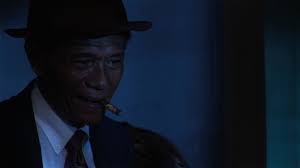 |
| Congo in his gangster persona. |
The gangster is a revered character among Congo and the thugs who surround him, a type to be studied and emulated. Greed, murder, the power to instill respect and fear, the code of loyalty – Congo’s justification for his actions, the persistent leitmotif of his reminisces, is his devotion to his conception of the gangster: the word “gangster,” he explains again and again, means “free man.”
This is the point at which Oppenheimer takes the reenactment into another realm, and what he accomplishes in daring to encourage war criminals to transform their evils into a narrative construct has profound implications for our understanding of the human condition and its relationship to art, for art and its relationship to the human condition.
 |
| Congo manning a camera. |
Like any good documentarian, Oppenheimer does not allow himself to pass judgment on his subjects as Congo and the adoring Zulkadry boast about their year-long reign of terror during which it is estimated the death squads slaughtered as many as a million people. As Larry Rohter notes in his review of the film for the New York Times, “The victims were labeled Communists but included labor leaders, ethnic Chinese and intellectuals, with paramilitary groups carrying out the killings at the behest of the Indonesian Army and with the support of the United States and its allies, who worried that Indonesia, like Vietnam, would fall into Communist hands.”
Congo explains how frustrated he became dealing with the mess of huge quantities of blood that resulted from beatings, so he took a cue from the Hollywood gangster and fine-tuned the wire garrote to achieve a bloodless kill. With a wink and a nod, Congo details his actions as an old man might describe his war exploits to his buddies down at the VFW – proud, wistful for his youth and physical prowess.
 |
| Congo demonstrating his garroting technique. |
Congo is a detail-oriented and meticulous film director, a natural if you will. He knows what he wants, a tough taskmaster who demands an intensity from his actors – many previous victims – that often leaves them trembling and sobbing uncontrollably long after the shout of “Cut!” He wonders aloud if he should dye his hair to recapture some of his youthful looks, and decides he must. After a particularly brutal scene of the routing of an entire village, Congo remarks to the filmmakers on his appreciation to the villagers for giving him the scene he was looking for, then muses that it’s unfortunate they will not be happy with him after he burns the village to the ground – but he needs the shots for the film.
 |
| Scene of the actual destruction of the village carried out for Congo's film. |
Like Werner Herzog’s crew at Antarctica’s McCurdo Station in Encounters at the End of the World who cannot intervene as they watch a young penguin lose its senses, stare bewilderingly as its fellows head to their ocean migration, swing round and race toward a mountain of ice and certain starvation – Oppenheimer’s crew films – and we watch – the villagers stand by as Congo’s men torch their homes.
In his production notes, Oppenheimer says, “To explore their love of movies, I screened for them scenes from their favorite films at the time of the killings – Cecil B. DeMille’s
Samson and Delilah and, ironically,
The Ten Commandments topped the list – recording their commentary and the memories these films elicited.”
The movie Congo makes is punctuated with stylized intervals of a chorus line of dancing girls and the rotund Zulkadry flamboyant in drag. The final scene finds them ascended to a mountaintop heaven, bathed in joy while “Born Free” fills the soundtrack.
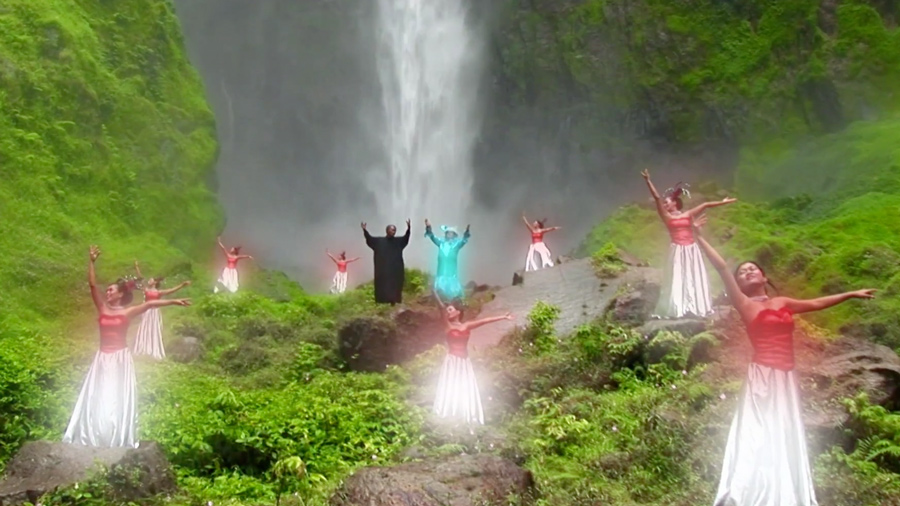 |
| "Born free and life is worth living..." |
Congo beams with pride watching scenes from the finished film Oppenheimer has brought to Congo’s home. Congo calls his young grandsons to watch a particular scene, and for the first time we hear Oppenheimer’s off-screen voice protesting: “They’re too young. No, no. They’re too young.” Congo dismisses him with a wave of the hand, lifts the two little boys onto his lap. They dutifully watch for a few minutes, and then he lets them go. Congo watches for a few more moments as something, some elusive thing, seems to start to flicker in his consciousness.
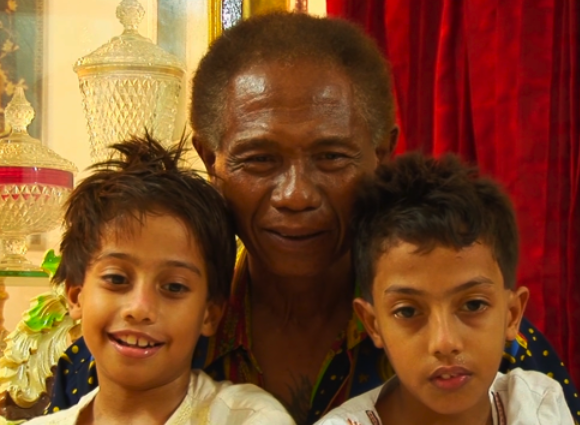 |
| Congo proudly shows his movie to his grandsons. |
Unlike Yapto Soerjosoemarno, the leader of the Pancasila Youth, Congo is not entirely without remorse. He confesses that he has haunting dreams, and he insists on incorporating a night scene of the apparition that invades his sleep, played by Zulkadry elaborately dressed as an Eastern deity, into his movie. A demonstration of his garroting method “exhausted him, physically and emotionally,” Oppenheimer recalls, “leaving him full of doubt about the morality of what he did.” But soon enough “he launched into a cynical and resigned rant against the growing consensus around human rights violations.” Playing an interrogation victim in a film noir scene, Congo has to pause to collect himself when it evokes a trace of empathy in him.
Oppenheimer writes extensively on his philosophical approach to the film in his statement and production notes. “We sensed that the methods we had developed for incorporating performance into documentary might, in [the context of spectacle intended to intimidate], yield powerful insights into the mystery of the killers’ boastfulness, the nature of the regime of which they are a part, and, most importantly, the nature of human ‘evil’ itself.”
The film’s denouement finds Congo returned to the enclosure where he garroted so many of his victims. He begins to cough, then to retch, yet nothing comes but a bit of spittle as he naturally covers his face and turns away from the camera. He struggles to possess himself, but the retching returns, more violently than before, and he cannot stop – as if some demon has taken hold inside his gut that his body is reflexively desperate to rid itself of – but the retching is dry, the bile will not come.
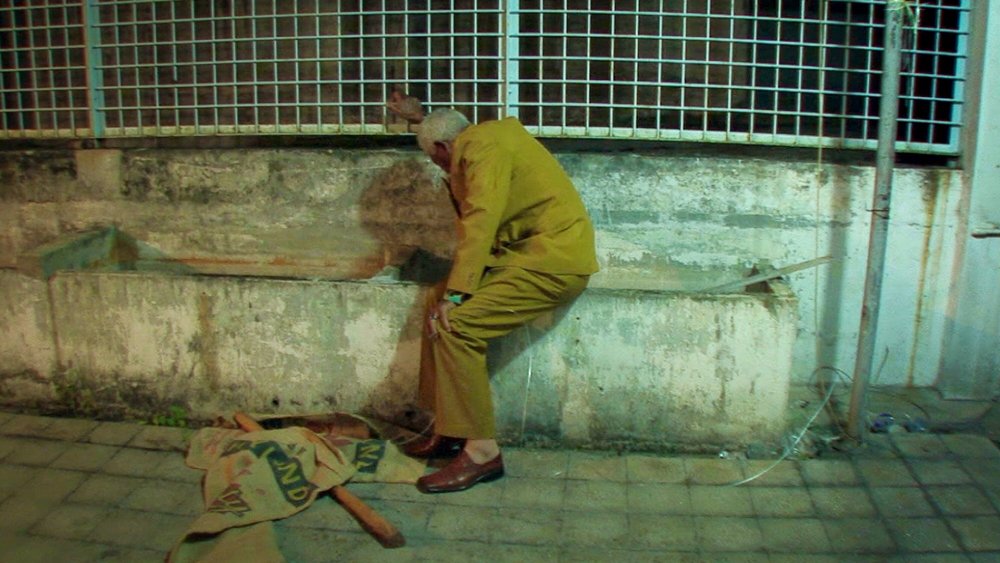 |
| Congo shows something resembling shame. |
Clearly something has affected him. He has gone through the process of turning the realities of his life into a film, a highly collaborative creative process. He has not merely reenacted the deeds of his youth; he has given them order and structure, he has struggled to put them into a mythic context. He has tried to give meaning to the meaninglessness of evil, and in that process something has penetrated his being. He has not been absolved; he may not be fundamentally changed. But for a few instants something approaching insight and a moral compass has been touched, however fleetingly.
I believe that this – along with many other accomplishments – is among the remarkable achievements of Oppenheimer and his colleagues' film. In 1976 Christo and Jeanne-Claude completed the installation Running Fence. Albert and David Maysles documented its installation. Spanning Sonoma and Marin counties in northern California, the 14-day installation was 24.5 miles long and 18 feet high, fabricated from 2,050 panels of white nylon fabric hung from 350,000 hooks on steel cables supported by 2,050 steel poles sunk into the ground and braced by steel guy wires. It began near U.S. Highway 101, crossed 14 roads and the private property of 59 ranchers to reach the Pacific Ocean near Bodega Bay. Wikipedia tells me that “The required environmental impact report for the piece was 450 pages long.”
The documentary records the rancor with which the project is initially met and the contempt in which a number of residents hold the artists, uppity New Yorkers who want to destroy their rural landscape with a pointless fence. Though there is some sympathy for it, the majority of local residents are nothing short of hostile, an active protest is mounted, tempers flare. Yet, these are the very people Christo and Jeanne-Claude need to recruit to accomplish the installation. What the Maysles capture during the course of the ensuing days is the gradual change of heart the local people experience as they actively participate in the collaborative process of making a monumental work of art, and by the end, the pride and the awe of even its harshest critics is palpable.
I do not mean to imply that Anwar Congo’s film within Oppenheimer’s film is equivalent to Running Fence. I believe, and others certainly may not agree, that we witness an alchemy through which Oppenheimer affords Congo a glimpse into his heart of darkness and gives him pause and a miniscule glimmer of self-examination – a glimmer that may be all too quickly extinguished, but a glimmer nonetheless.
I further believe that Oppenheimer’s documentary is a call to each of us to explore that same heart of darkness within. As my tragically overlong introduction to the film demonstrates, Anwar Congo is not an anomaly. What he has done has been repeated far too many times throughout human history to be thought of as an aberration. It is happening today in the United States where the “war on drugs,” as Michelle Alexander documents in The New Jim Crow (2010), has substituted mass incarceration for concentration camps; it is happening today in Egypt and Syria; it is happening today among vast networks of human traffickers; it is happening each time a suicide bomber steps into a crowd; it is happening...
Afterword
Kurt Vonnegut’s novel Slaughterhouse Five has as its backdrop the Allies’ firebombing of Dresden in World War II. Its refrain after each death, contemporary and historical, is “So it goes.” Elsa Morante’s La Storia or History: A Novel on one level recounts the impact World War II had on the ordinary people who experienced it first-hand, which in the novel are a school teacher and the child of her rape, Useppe, whose survival becomes her single-minded passion. The intimacy of their familial story is interposed with world events in ever-widening telescoping shots until they overtake the final page of the book. In a pre-magic realism stroke, Ussepe does not mature, and his childlike refrain punctuates Morante’s narrative: “Why?”
~~~~~~~~~~~~~~~~~~~
PostscriptI am unable to present a comprehensive catalog of man's inhumanity to man. Here is an example of the consequences to which we wish to blinker our consciences. A friend posted an article published on Huff Post on March 30, 2013 that cites a study published in the Bulletin of Environmental Contamination and Toxicology's November 2012 issue, "
Metal Contamination and the Epidemic of Congenital Birth Defects in Iraqi Cities."
"Within less than a decade, the occurrence of congenital birth defects increased by an astonishing 17-fold in the [Al Basrah Maternity Hospital]," the authors report. Among their conclusions: "It is well-known that exposure to stressors alters the in utero development of a human fetus and has adverse health consequences for the offspring, including a short gestation period, reduced birth weight, increased risk of metabolic, cardiac and psychiatric disease, and overall reduced lifespan (Seckl
1998; Landrigan et al.
2004; Perera et al.
2004; Llop et al.
2010). Populations caught in war-zones or forced to live with severe nutritional restrictions (such as those imposed on the Iraqi population by U.N. sanctions from 1991 to 2003) suffer immediate and chronic stress that leads to long-lasting physical and mental damage. In addition to the harsh effects of sanctions, many Iraqi cities have experienced large-scale bombardment. An accurate tally of the types and volume of ammunition dropped on the Iraqi population is not available. However, reports have indicated that large numbers of bullets have been expended into the Iraqi environment (Buncombe
2011). Thus the environmental contamination of Iraqi cities with materials contained in bullets and bombs may be expected. Toxic metals such as mercury (Hg) and Pb are an integral part of war ammunition and are extensively used in the making of bullets and bombs (Departments of the Army, the Navy, the Air Force, Joint Technical Bulletin
1998; US Department of the Army Technical Manual
1990)."


