Search This Blog

April 25, 2021

What Little Writing I Have Salvaged from 2020

 It appears the Academy of Motion Picture Arts and Sciences has spent the last 14 months watching the same six to twelve films. There were a lot more out there. I have spent eons writing about the films of 2020, but through technical disasters have lost untold hours of it. Here's what little is left (and the images will probably not come through):

DOCUMENTARIES

Our Time Machine (China)

The opening title card quotes H.G. Wells: "We all have our time machine, don't we. Those that take us back are memories... and those that carry us forward are dreams."

Had my dear friend, painter Vikki Fields, not recommended this 86-minute Chinese film to me, I might never have watched this remarkably moving film, and what a loss that would have been. This has to be one of the most artistically profound films of 2020. “Our Time Machine,” co-directed by Yang Sun and S. Leo Chiang, chronicles the herculean effort of Shanghai artist and puppeteer Maleonn to realize a production of his theatrical puppet creation in honor of his father, Ma Ke, who was director of the Shanghai Chinese Opera Theater and responsible for a remarkable 80 productions during his prolific career -- but is now a victim of Alzheimer’s. Maleonn’s wood and metal and nuts and bolts and found object puppets have a bit of a Steam Punk aesthetic, but they are perhaps more compellingly, emotionally life-like than any puppets ever created. The stage production that ultimately ensues is heartrendingly magical. A stunning meditation on creativity, art, love and legacy.
Amazon Prime Rent/Buy
 

The Mole Agent (Chile)


 In this fascinating semi-documentary, Maite Alberrdi enlists octogenarian Sergio Chamy as an undercover detective to infiltrate a nursing home and investigate possible abuse. What he encounters is anything but abuse. Rather he finds a loving, supportive community of which he becomes the most integral part. One of the most touching films of the year.

Amazon Prime Rent/Buy

Welcome to Chechnya

 We naively want to believe we have evolved, but reality perpetually tells us otherwise. Inspired by the New Yorker article “Forbidden Lies: The Gay Men Who Fled Chechnya’s Purge” (Masha Gessen, June 26, 2017), director David France’s “Welcome to Chechnya” invites us to witness the late winter of 2017, when a drug raid triggered a witch hunt against the LGBT community, which has resulted in a perpetual onslaught of extrajudicial torture and killings. Chechnya is primarily Muslim and is now controlled by Putin appointed strongman Ramzan Kadyrov. Our narrator, a human rights activist with the Russian LGBT Network that resettled 151 people abroad in the two years since 2017 explains, “It is a disgrace to be gay in Chechnya. And for a family to find out someone is gay? It is a shame so strong, it can only be washed away by blood.” Ordinary citizens and police alike claim, “All of our problems are because of you.” A whole cast of face and voice doubles was employed to provide digital disguises for the persecuted who were willing to speak out. The end title cards inform us that “Canada granted refugee status to 44 [refugees] with the help of Toronto-based Rainbow Railroad. The Trump administration has not accepted any LGBT refugees from Chechnya.”

Amazon Prime Rent/Buy and HBO

 Collective (Romania)

 Romanian director Alexander Nanau’s “Collective” investigates the October 15, 2015 fire at a Bucharest nightclub with no fire escapes and the consequences for those trapped inside in its aftermath. The deaths of 27 people in the fire would have been tragic enough, but the known septic conditions in Romanian hospitals that eventually killed 37 more burn victims is the more shocking story in this relentless investigative story.

Amazon Prime Rent/Buy

 The Cordillera of Dreams (Chile)

 Patricio Guzman's phenomenal documentary begins with an exquisite meditation on the Cordillera of the Chilean Andes -- a sculptor, a writer, an historian and the filmmaker all reflect on the profound experience of living under the spiritual aura of this geographical phenomenon, but it gradually shifts into an equally deep inquiry into the bloody Pinoche coup d'etat and the neoliberal economic capitalism it left in its wake. "Cordillera" concludes a trilogy that began in 2010 with "Nostalgia for the Light" (available on Amazon to rent/buy) and 2015's "The Pearl Button." Guzman sees the Cordillera as an eye-witness to his homeland's fate. 

Amazon Prime Rent/Buy

 DRAMA

 Family Romance, LLC (USA/Japan)

 Werner Herzog doesn’t reference “Japan’s Rent-a-Family Industry,” an April 30, 2018 article in the New Yorker, but his remarkably touching and engaging film “Family Romance, LLC.” certainly came about as a result of his awareness of an odd industry emerging in that country. As Herzog says, in the must-see interview after the conclusion of the film, he foresaw as early as 1980 that the cascading communication possibilities multiplying before us at that time would have consequences of greater and greater “solitudes.” To this end, Japan has developed enterprises that – for a fee, and with agents and stables of role-playing actors – provide substitute companions, dead relatives, estranged spouses, absent parents, et al.

“Family Romance, LLC.” is not a documentary. Rather, it is a Russian doll of a film. Herzog enlists the talents of non-actors, central to which is the star of the film, entrepreneur Yuichi Ishii who does and does not play himself. Among other relationships he cultivates as an avatar for his clients’ wishes, is his central role as father to Mahiro, a ten-year-old girl whose father left her mother when she was a tot. This relationship is the thread that creates the through-line for the film and acts as its moral compass as we explore what love, family, and human connection in general mean – in the contemporary world of technology and robotics, as well as in the most ancient sense of human community.

Herzog and the other great contemporary documentarian Errol Morris share a quest into the question of truth. Art is artifice and yet it reveals truth with a capital “T.” Morris wrote an entire book exploring this question on the subject of photography, “Believing Is Seeing.” Once we distill anything, it is no longer lived experience. So, is it truth? That is the question.
Amazon Prime Rent/Buy

Leap (China) Based on a True Story

The Painted Bird (Czechoslovakia)

 “The Painted Bird” is the brilliant creation of Czech filmmaker Vaclav Marhoul – who wrote, directed and produced. The film is adapted from Jerzy Kosinski’s 1965 novel and has been compared to the sensibility of Andrei Tarkovsky. As a Tarkovsky devote, I beg to differ. Though apparently many film critics walked out on its various 2019 premieres, citing its violence as gratuitous, I found it rather tame by comparison to Elem Klimov’s 1985 “Come and See,” a much more parallel comparison. Both films see the devolution in Eastern Europe of fascism into nihilism, as WWII wore on, from a child’s point of view. The power of this perspective cannot be overstated. Adults are already inured. The film has also been described as a catalogue of Nazi atrocities. As a percentage, the Nazi atrocities figure to a much lesser degree in the film than the sadism mounted by peasant superstition, scapegoating and misdirected revenge. I see "The Painted Bird" not so much as a film about the evils of Nazism as about the eternal evils of the human race.

Amazon Prime Rent/Buy

 Beanpole (Russia)

 Russian director Kantemir Balagov's “Beanpole” is another WWII narrative (and as far as I am concerned, there can never be enough). New York Times critic Manohla Dargis makes the insightful observation about this post WWII drama, set in 1945 Leningrad, that "the men and women in this startling movie don't complain or even speak much about their suffering, perhaps it would be because it would be like describing the air they breathe."

Amazon Prime Rent/Buy

 Mr. Jones (Poland)

 Based on the true story of Welch journalist Gareth Jones (James Norton), who, in 1933, attempted to reveal the truth of Stalin’s politically created famine (known as the Holodomor or the Terror-Famine), which killed an estimated 3.5 million, Agnieska Holland’s film, in its early scenes, rhythmically shifts between its primary narrative and George Orwell penning his allegorical masterpiece "Animal Farm." Juxtaposed against the investigative journalism of Jones is New York Times Moscow bureau chief Walter Duranty (Peter Sarsgaard), who won a Pulitzer for his Stalin apologia reportage -- an honor that has never been revoked.

Amazon Prime Rent/Buy

 Buoyancy (Cambodia)


In his 2011 book "The Better Angels of Our Nature: Why Violence Has Declined," Steven Pinker argues that, historically, violence has been abating globally. He cites a decrease in war and improved conditions for children, claiming that we now live in the most peaceful time in the history of humanity. May I call upon Voltaire's rejection in "Candide" of Leibniz's position: "If this is the best of all possible worlds, what then are the others?" Were we to take into account human trafficking in all its horrific manifestations: sex, child labor, and slave trafficking, ad nauseam, would our present moment be our best possible world? (Take a look at your computer or cell phone and consider the human misery that went into the mining of tin, tantalum, tungsten, gold and other rare metals that allowed its manufacture and function.) 

 Rodd Rathjen's "Buoyancy" follows the horrific plight of a 14-year-old Cambodian boy who, in trying to escape his father's exploitation, inadvertently finds himself enslaved on a Thai fishing boat. Though the film is a dramatic narrative, the story is all too true. The film's penultimate title card cites an anonymous Cambodian survivor: "Torture is every day and killing about every second day. You are afraid of people, even of daylight. No one can hear you out there. You have no papers, nobody knows you exist. I want to tell people about our nightmares."

 The final title card "...gratefully acknowledges the many survivors of modern slavery in South East Asia who shared their stories. An estimated 200,000 men and boys are thought to be in slavery and forced labour in the fishing industry in South East Asia. It is an industry worth over $6 billion that supplies fish products to the world." (The same is true of Mexicans held hostage to harvest tomato crops in the U.S. And the list goes on...)

Amazon Rent

 The Wolf House (Chile)

 Bacurau (Brazil)

 House of Hummingbird (South Korea)


Amazon Prime Rent/Buy

 The Man Standing Next (South Korea)

 Another Round (Denmark)

 Tommaso (Italy)

 A White, White Day (Iceland)


 Tigertail (USA/China)

 In Alan Yang's "Tigertail," a parentless young boy, Pin-Jui (Hong Chi-Lee as the young Pin-Jui and Tzi Ma as the adult) works his grandparent's rice fields. In an odd coincidence, he befriends a girl of means, but their class disparity ensures their estrangement. As a young adult working in the brutal factory where his mother is employed, the factory boss makes a deal with Pin-Jui: in exchange for marriage to his daughter, he will pay for the couple to move to New York City. "Tigertail" turns the feel-good immigrant story on its head.

Netflix

 The Wild Goose Lake (China)


March 5, 2020

PORTRAIT OF A LADY ON FIRE


Image result for portrait of a lady on fire images


Set in the 18th century on the remote shores of Brittany, Céline Sciamma’s “Portrait of a Lady on Fire” is a phenomenon of a film. The premise is feminist and straightforward. A woman – Marianne (Noémie Merlant) – is hired to secretly paint a portrait of Héloïse (Adèle Haenel), who does not want her portrait painted because she is the default fiancée of a Milanese nobleman, her sister having thrown herself off a cliff into the ocean to avoid that fate.

The portrait subject’s mother (Valeria Golino) was herself sent to an arranged marriage, a portrait preceding her. She loves her daughter, and perceives this traditional practice as necessary and legitimate.

What appears to be a story of two women in love morphs into the story of three: a working-class artist is hired to surreptitiously paint an elite virgin who is served by a devoted, though at the onset almost unknown, young servant. Sophie ((Luàna Bajrami) hardly knows her mistress because the affianced has been cloistered in a nunnery, which she recalls fondly for its library, its music, and its sense of equality.

While the film gently explores the theme of women loving women, the lovers transcend those ideas and the barriers of class when they facilitate an abortion for the housemaid in the betrothed woman’s employ. This, not the lesbian relationship, was for me, the center of the film. Two women of varying degrees of substance fall in love, but they join forces, not only in their female gaze as lovers, but to bear witness to the plight of women everywhere at any time. Nonetheless, each accepts her own fate going forward into the world as it is, with its barriers for both.

Every scene is exquisitely painterly, especially those lit by fire, and at the moments when music enters in, ethereal. The storm section of the Summer movement of Vivaldi's Four Seasons somewhat brackets the film, but its musical tour de force is the women's autumnal gathering with the unison harmonizing of "La Jeune Fille en Feu," a mesmerizing sequence written for the film by Para One. According to Slate's Matthew Dessem, "Their...inspiration was not anything period appropriate but Gyorgy Ligeti's Requiem, famously used in '2001: A Space Odyssey.' "

Taken as whole, "Portrait of a Lady on Fire" is a quiet homily on the fundamentals of love and loss, and the conventions that constrict the former and conduct the latter.

September 21, 2018

AN UNSUNG LEGEND: ETHAN HAWKE'S "BLAZE"

 Image result for blaze movie


If you have the chance to see Ethan Hawkes’ beautiful new film “Blaze” in the theater, make the effort. The story recounts the life of Texas singer/songwriter Blaze Foley, based on his wife Sybil Rosen’s memoir “Living in the Woods in a Tree: Remembering Blaze.” Blaze (born Michael David Fuller) grew up in San Antonio, Texas, and was a country singer of the Texas outlaw music movement, made familiar by the better-known singer/songwriters Waylon Jennings, Willie Nelson, Johnny Cash, Merle Haggard – and Kris Kristofferson, who features here as Blaze’s father, now reduced by age to a shell of his former, abusive self.

Sybil was Blaze’s lover, muse, and financial and emotional support, and she is embodied in a profoundly poignant performance by actress Alia Shawkat. Indeed, every performance in “Blaze” quivers with internal light, doubly informed by sadness and joy. (This film makes one despair that the Academy Awards are an exercise in Hollywood brand names, an exercise that will not even consider deeply felt performances like these.) “Blaze,” in addition to being driven by the narrative lyricism of Blaze Foley’s songs, is a celebration of cinematic poeticism realized by cinematographer Steve Cosens.

“Blaze” weaves its story by circling back on itself, around and around – from past to present to future and back again: in a treehouse with Sybil; on the musicians’ friend’s ramshackle country porch, where Blaze will die; in the radio studio, where an interviewer (Ethan Hawke) talks with fellow musicians Townes Van Zandt and Zee about Blaze’s life; in The Outhouse bar, heavy with the scent of stale beer and cigarette smoke, where Blaze performs for an afternoon before heading back to that porch one last time. The characters are like the singers in a round, and the singers are raconteurs, telling stories of various stripes – tall tale to shaggy dog to testament.

In the interview passages in the radio studio, Townes weaves wild tales (fantastically spun by singer/songwriter Charlie Sexton), which Blaze’s long-time friend and associate Zee attempts to temper with corrective interjections. (Zee may be based on singer/songwriter Guy Schwartz – or on an amalgam of other musicians Blaze worked with – and is played with the patience of a long-suffering friend by Josh Hamilton.) The film tells Blaze’s story through others’ eyes. Townes limns the myth; Zee rights the record; but at its core, “Blaze” is Sybil’s deeply personal love story, about which Townes and Zee seem scarcely aware.

This circling back and around is present in other ways in the film. Ben Dickey, who plays the title role, is not a trained actor but a Louisiana-based singer/songwriter. (Though the story is predominately set in Texas, filming primarily took place in East Feliciana, Louisiana.) In the Q&A after San Antonio’s opening showing of the film, Dickey and Hawke talked about the centrality of the music to the story. As a non-actor, Dickey explained that he worked into the role through Blaze’s songs, learning them all. Hawke observed that “It’s like doing Shakespeare. If you say the words right, you’ll be good. It’s like an incantation. Ben was doing something like the same with Blaze’s words and his songs.” Hawke went on to emphasize why he wanted to use musicians to play musicians: “because they could smell out the phoniness.”

When Sybil and Blaze move to Austin to further Blaze’s career, they meet Marsha, Blaze’s sister, at their father’s nursing home. Kris Kristofferson, as Blaze’s father, is a revelation, and, Dickey noted, having Kristofferson on the set was for him “a history lesson.” Kristofferson has only two lines: the father asks each visitor in turn, “Got any cigarettes?” Then, after Blaze and Marsha sing one of the gospel songs they grew up performing as The Singing Fuller Family, their father softly rasps, “Beautiful.” Alynda Lee Segarra (who formed the Indie rock band Hurray for the Riff Raff in New Orleans in 2007) infuses Marsha with sympathy and a quiet – we sense hard-earned – inner strength. This little interlude, this brief but affecting reunion, tells us volumes about the family dynamic – and ends on a wonderfully, blackly comic twist.

As we meet Blaze’s family, so we meet Sybil’s Jewish parents, in a, to say the least, awkward visit meant to introduce them to Blaze. In addition to adapting her memoir to the screen with Hawke, Sybil Rosen herself plays her mother in the film. Both Hawke and Dickey could not emphasize enough the value of her presence on the set. “What she wanted,” said Dickey, “was for us to take care of the music,” and she, as a professional actress, wisely told Dickey, “You don’t need to imitate Blaze. You just have to be Blaze.”

The film is also graced by the appearance of Steve Zahn, Sam Rockwell, and . . . Richard Linklater (speaking of circling and weaving). They play a trio of wildcatters looking for a way to spend their money, so take a bet on the musicians to record a hit record on the label they’ve called Zephyr Records. It is not a spoiler in the context of these self-destructive musicians to say it is an opportunity they squander. Yet this is part of philosophy according to myth. The record label cowboys walk into the ballroom where the musicians have drunk the night away and failed to show up at the recording session. Townes mocks their money and their methods. “You drill holes in the ground and hope to get lucky? See all this. These are our experts. We have this down to a science.” At one point he tells the radio interviewer, “If you’re going to write a song, everyone’s going to tell you, you have to live that. That’s wrong. You have to die a little.”

In their treehouse days – before the road, before Austin, before Chicago, before New York – Sybil, talking about her struggles learning the craft of acting, asks Blaze, “Where do you think confidence comes from?” “I think confidence is the consolation prize for knowing that you’re here. Knowing that you’re here is kind of a rarity for a human being.” And yet, reflecting on where all those songs come from, Blaze wonders, “Maybe from not living up to what I’m supposed to be.”

Throughout “Blaze,” I couldn’t help but think of Tim O’Brien’s brilliant Vietnam War novel, “The Things They Carried,” particularly the section entitled “How to Tell a True War Story.” The narrator explains:

“In a true war story, if there's a moral at all, it's like the thread that makes the cloth. You can't tease it out. You can't extract the meaning without unraveling the deeper meaning. And in the end, really, there's nothing much to say about a true war story, except maybe ‘Oh.’ True war stories do not generalize. They do not indulge in abstraction or analysis.

“For example: War is hell. As a moral declaration the old truism seems perfectly true, and yet because it abstracts, because it generalizes, I can't believe it with my stomach. Nothing turns inside.

“It comes down to gut instinct. A true war story, if truly told, makes the stomach believe.”

Throughout all of their stories, Blaze and Sybil and Townes and Zee all understand that the stomach has to believe. Theirs (Blaze and Sybil’s, Blaze and Zee’s, Blaze and Townes’s) are love stories and, in their own way, war stories – war stories in which the battles are with inner demons, between that shining confidence Blaze intuits and its lack. Circling back to the radio interview again and again, Townes, the fabulist, tells one more outrageous fish story than the last, while Zee, the realist, looks on with growing exasperation. Remarking on the human fact of multiple points of view (think the three blind men and the elephant, or Orson Welles’s “Citizen Kane”), Hawke noted, “Zee is interested in the truth, and Townes is interested in the legend. They’re both true.” As Blaze tells Sybil, “I don’t want to be a star. I wants to be a legend.” “What’s the difference?” she asks. “Stars burn up. A legend lasts forever.” One might say, a legend evolves from gut instinct and it can’t be unraveled.

“Blaze” had a limited release in August, and an expanded release in September. DVD, Blu-ray and streaming dates are TBA.

September 1, 2018

Rob Robbins on Summer Movies' Inflection Point: A Guest Essay

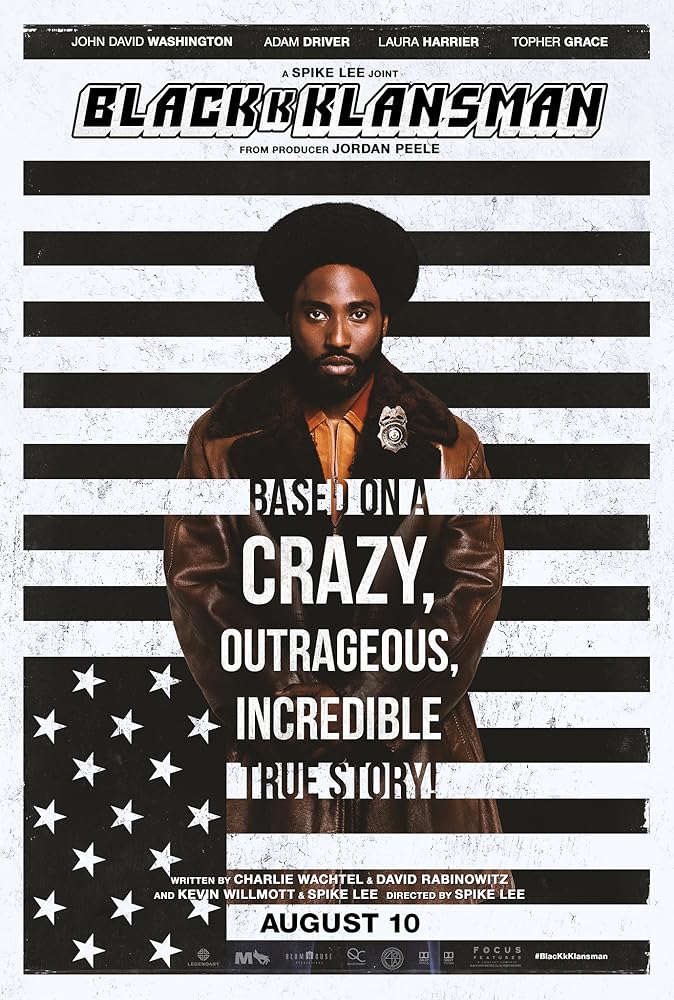
John David Washington in BlacKkKlansman (2018) 
My dear friend Rob Robbins and I watched these movies together. His commentary on them is far superior to what mine would have been (and more succinct). Here are his insights:

Clearly, we are all living in a distinct moment in American history. We are at an inflection point for everything from the devolution of the “American Dream” to the undermining of our constitutional democracy. As we suffer the daily blows of such heavy headlines, it is easy to miss the fact that we are also at a distinct moment in American film.

Film serves as a vehicle for everything from accurate self-reflection to dangerous self-delusion. But this summer we went from Oscar So White to a trio of unapologetically black films so powerful, audiences cannot contain their emotions. If you haven’t seen “Sorry to Bother You,” “BlacKkKlansman,” and “Blindspotting,” consider doing so a mandatory form of civic duty.

In doing so, you will hear the n-word more times than you thought possible. It comes in three different forms. In “Sorry to Bother You,” it arrives mostly as a cultural trope used to reduce people to a one-dimensional caricature.

In “BlacKkKlansman,” it is used mostly as a cultural artifact of an era in which its use was more casual than the modern-day use of the word “fuck.” But in “Blindspotting” it takes on a complex tangle of identity, crossing even skin color.

“Sorry to Bother You” blows your mind by simply becoming something you never expected. As it takes a severe turn into “Naked Lunch” mugwump territory, it shows how eerily close we are to stripping fellow Americans of their literal humanity.

“BlacKkKlansman” is a hard look in the mirror that forces you to see the nation’s failure to adequately mature as it relates to race relations. At the end, you feel as if we are only millimeters ahead of where we were in the 1970s. The movie tugs at your heart metaphorically through your tear ducts.

“Blindspotting” doesn’t tug at your heart in any sort of metaphorical way. Rather, it tangibly forces your heart to race. By the end of the movie, you should just count on literal heart palpitations.The movie is physically hard to watch. Although the simplest in plot, "Blindspotting" is by far the most complex emotionally. Despite taking years to get to screen, the events of the movie seem as if they could have happened yesterday.


"Sorry to Bother You" DVD and Blu-ray release date is set for October 23, 2018 and available on Digital HD from Amazon Video and iTunes on October 9, 2018.

"Blindspotting" DVD and Blu-ray release date is estimated for November 2018 and available on Digital HD from Amazon Video and iTunes is estimated for November 2018.

"BlacKkKlansman" DVD and Blu-ray release date is set for November 6, 2018 and available on Digital HD from Amazon Video and iTunes on October 23, 2018.


July 8, 2018

EXISTENTIALIST HORSERADISH: Paul Schrader’s World and “First Reformed”


“Faith is in its essence simply a matter of will…, to believe is to wish to believe, and to believe in God is, before and above all, to wish that there may be a God.” 
~~Miguel de Unamuno, “The Tragic Sense of Life,” 1912

“Let no one hope to find in contemplation an escape from conflict, from anguish or from doubt. On the contrary, the deep, inexpressible certitude of the contemplative experience awakens a tragic anguish and opens many questions in the depths of the heart like wounds that cannot stop bleeding. For every gain in deep certitude there is a corresponding growth of superficial ‘doubt.’ This doubt is by no means opposed to genuine faith, but it mercilessly examines and questions the spurious ‘faith’ of everyday life, the human faith which is nothing but the passive acceptance of conventional opinion. This false ‘faith’ which is what we often live by and which we even come to confuse with our ‘religion’ is subjected to inexorable questioning…. Hence, is it clear that genuine contemplation is incompatible with complacency and with smug acceptance of prejudiced opinions. It is not mere passive acquiescence in the status quo, as some would like to believe – for this would reduce it to the level of spiritual anesthesia.”
~~Thomas Merton, “New Seeds of Contemplation,” 1962

“And the nations were angry, and thy wrath is come…; that thou…shouldest destroy them which destroy the earth.” 
~~Revelation 11:18


In Paul Schrader’s 1976 interview included in George Stevens, Jr.’s “The Great Movie Makers: The Next Generation from the 1950s to Hollywood Today,” Schrader says, “One of the great things about being a movie critic [in the 1960s] was that criticism was part of the counterculture movement. …. That’s all gone now, and criticism has … been relegated to … a form of consumer guidance.”

The 1960s counterculture movement. A movement that rested on moral imperative. Is there any such overarching moral commitment today more than 50 years hence? No matter our political or sociological orientation, we all seem immersed in a monoculture, a monoculture of self-serving, self-righteous indignation with little sense of the common weal, a monoculture willing to sacrifice earthly, let alone spiritual, salvation for short-term gain — or just mindless escape.

“First Reformed” is writer/director Schrader’s fearless new film in which Schrader’s directorial authority and Ethan Hawke’s bold performance prove both artists are, in their collaboration, fundamentally confronting our times. “First Reformed” is the film of our moment. 

The relationship of “First Reformed" to “Taxi Driver,” Martin Scorsese’s 1976 film for which Schrader wrote the screenplay, has been much discussed and is, indeed, incontrovertible. "First Reformed" is a continuation of that narrative. The insomniac taxi driver Travis Bickle (Robert De Niro) is a 26-year-old Vietnam vet who feels mired in the sordid mean streets of New York City. The Reverend Ernst Toller (Hawke) of “First Reformed” is a 46-year-old Calvinist minister who has lost his only child, a son, and is mired in an existentialist crisis of faith — a personal guilt that accrues over the course of the film into a sense of collective guilt for the rape of the planet.

Yet the comparison is limiting. First, as Schrader himself pointed out in an interview with Terry Gross for “Fresh Air,” “…Travis being a juvenile…is experiencing loneliness in a very narcissistic way, whereas Reverend Toller, as an older man, is feeling [loneliness] in an existential way. And so the expression [in each film] is different.” Schrader said in 1976, “[Travis] has very few convictions about anything except immorality. …. [H]e doesn’t have any real beliefs or strong theories….” By contrast, the Rev. Toller does nothing if not wrestle with belief. The comparison also fails to acknowledge the debt of “First Reformed” to Schrader’s screen adaptation of Nikos Kazantzakis’s 1955 novel for Scorsese’s 1988 “The Last Temptation of Christ.”

Second, “First Reformed,” a magnum opus in the context of Schrader’s oeuvre, posits on some levels a rejection of the Calvinist Reformed tradition central to Schrader’s background, so it is important to understand the core Calvinist doctrines of predestination and election: i.e., though human beings have free agency to act in sin or in virtue, and have the capacity for goodness, they are, in Reformed theology, in bondage to sin. From eternity, God has chosen (elected) those sinners to whom he will grant mercy, and we cannot know the mind of God. This concept, that one cannot know the mind of God, becomes a leitmotif throughout “First Reformed,” an existentialist challenge for Toller and a toss-off excuse for everyone else, a way to shrug off responsibility for the most profound questions facing our present environmental crisis.

Schrader first explores Calvinist theology in “Hardcore” (1979), the five points of Calvinism being: 1) “total depravity” as a consequence of Adam and Eve’s fall into sin; 2) “unconditional election”; 3) “limited atonement,” in that atonement is intended for some, yet not all; 4) “irresistible grace,” an inward call which, when directed toward the elect, cannot be denied; and 5) “perseverance of the saints,” that those whom God elects will continue in faith into eternity. In later films, Schrader will confront this theology through a process that will upend Calvinism for, I contend, a position of philosophical existentialism. In an interview with Randall Colburn of consequencesofsound.net, Schrader says, “…I left Calvin in the way a bullet leaves a gun, because if you don’t leave with that much force, it’s going to bring you right back.” Yet eventually, “the circle is completed.”

Schrader’s influences for "First Reformed" are deep. He tells Colburn, “[Y]ou have the character from [Robert Bresson’s 1951] ‘Diary of a Country Priest,’ and you have a premise from [Ingmar Bergman’s 1963] ‘Winter Light,’ you have the [Andrei] Tarkovsky element, you have the [Carl Theodore] Dreyer element, and you have other films that are all involved, and then I didn’t realize I was working out in my head…the enormous way in which ‘Taxi Driver’ was filtering into here, that craziness.”

Schrader, like the iconic director for whom he has written a quartet of films, Martin Scorsese, is concerned with nothing less than salvation from a profoundly existentialist point of view. What is necessary to forge meaning in a conscientious human life? What is the requisite existentialist act we either undertake or renounce with consequences for existential meaning?

In “First Reformed,” Hawke’s Calvinist, the Reverend Ernst Toller, could not be more earnest nor could life have taken a greater toll. He comes from a line of military chaplains who have served out of twin commitments to church and country. He wrestles with the reality that he has lost his only son, whom he encouraged to serve in the Iraq war, a war he now believes “had no moral justification.” Subsequently, he has lost his marriage as well as his chaplaincy, and now finds himself shepherding a stagnating congregation of an historic parish that is little more than a tourist attraction now owned by a New Age mega-church, Abundant Life. The youth at Abundant Life make fun of First Reformed as the “souvenir shop.”

Like many Schrader protagonists, Toller will narrate his story in voice-over, in this instance, through the words he commits to a journal. Travis Bickle keeps a diary in “Taxi Driver,” as does John LeTour (Willem Dafoe) in “Light Sleeper,” a drug dealer who wants to get out.

Toller, in the crosshairs of twin personal crises, both physical and spiritual, has vowed to keep the journal for a year’s time, then destroy it. The journal “is a form of prayer,” he writes, a way to speak to a God from whom his crisis of faith has walled him off. Toller feels a deep affinity to Thomas Merton, the Catalan Trappist monk and author, and keeps one of Merton’s books at his bedside.

When Mary (Amanda Seyfried), whose husband is a reluctant member of Toller’s mere handful of parishioners, approaches Toller regarding concerns about her husband Michael’s (Philip Ettinger) estrangement, Toller’s initial response is to refer her to Abundant Life with its team of counselors, but she counters, “He feels it’s more a company than a church.”

Mary is pregnant, and Michael is an eco-warrior who believes it would be wrong to bring a child into the world of 2017, when most scientists long ago agreed global collapse will reach its apotheosis around 2050. Michael bemoans the fact that scientists warned us that significant action would have to be undertaken by 2015. “I thought things could change,” he laments. “I thought people would listen.” Michael confronts Toller: “How do you sanction bringing a little girl into the world, a child full of hopes and naive ideas, who grows up to be a young woman, who looks you in the eyes and asks, ‘How did you let this happen?’ ”

Toller answers, we must hold hope and despair in our minds simultaneously. “Courage,” says Toller, “is the answer to despair, not reason.” Michael persists, “Can God forgive us for what we’ve done to this world?” Toller, the Calvinist, continues, “We can’t know the mind of God.” This is the excuse everyone else will use in “First Reformed.” Only Toller imposes the existentialist qualification: “But we can choose a righteous life.” We can choose righteousness over selfishness and destruction, and if we cannot know the mind of God, we can at least ask for forgiveness and grace.

The preeminent existentialist Jean-Paul Sartre, like other atheistic existentialists, did not affirm God’s existence. Yet Sartre posits that even if God were to exist, his existence would not change the fact that mankind is free and has a human responsibility to choose. The responsibility is not God’s, it is man’s, and this fact places us in a condition of anguish. Later in “First Reformed,” Toller will write, “Discernment intersects with the Christian life at every moment.” Discernment is a word that implies both the necessity of choice and responsibility — the cornerstones of the existentialist position.

Toller’s personal crisis of faith converges with his sincere concern for his flock. What is he — what are we — to do in the face of a ruination of which we are knowingly the cause? The question Michael has posed to Toller, “Will God forgive us?” ultimately becomes Toller’s.

The conversation takes place in a study of sorts adjacent to Mary and Michael’s living room. On the right side of the couch in the living room sits a prop one must bow to the set dressers for finding or to Schrader for inventing: a 1960s/‘70s-esque floor lamp, the lighting source of which is shaped as the one-dollar bill’s Eye of Providence, the all-seeing eye of God. (Michael was granted compassionate release from Fort Providence in Canada, because of Mary’s pregnancy, where he was serving for eco-protests.) The lamp also brings to mind the giant, disembodied eyes of T. J. Eckleburg’s billboard in the valley of ashes in F. Scott Fitzgerald’s “The Great Gatsby,” which look down on the novel’s characters’ moral failures and represent America’s loss of spiritual values. How quaint that sounds today.

Toller’s benefactor and kindly nemesis is Joel Jeffers (Cedric Kyles, better known as Cedric the Entertainer), pastor of Abundant Life Church — which owns the historic First Reformed — who has reached out to provide Toller with employment out of pity. Names matter in this film and one cannot help but sense the affinity between Joel Jeffers and the ideology of a Joel Osteen-like prosperity ministry. Substitute “abundance” for “prosperity.” And yet, Jeffers seems to harbor genuine concern for Toller and counsels, “Even a pastor needs a pastor.”

At Jeffer’s suggestion, Toller attends a youth support group where a young woman takes her turn: “No one loves the Lord more than my father.” Her father has lost his job and has been unable to find another. She wants to know how this can be in the eyes of the Lord. When Toller tries to explain that Christ’s teachings make no correlation between godliness and prosperity, he is met with a young man’s offense at political correctness. “So Christians shouldn’t succeed. Christianity is for losers,” the young man angrily shoots back, along with a list of other grievances, including Muslim xenophobia.

To soothe Toller’s frustration about the young people, Jeffers commiserates: “They’re just frightened. They want certainty.” They are facing global warming, economic threats; they live in isolation, communicating on social media; they are fearful for their future. Jeffers goes on that as such, they will turn to a closed, even jihadist, mindset as a mode of self-preservation. “All we can do is guide by example.” To Toller’s ears, this is a guileless observation, as it is to Schrader.

In Colburn’s interview Schrader says, “When I was growing up on the west side of Grand Rapids [Michigan], I think we had six or seven churches. Now we have two, and then there’s Hillsong. One of the churches that I grew up going to now has lyrics on a flat screen, and it’s an evolution. It’s really become an entertainment-based religion, and I have a problem with that, because seeing a whole mass of people repeating the same actions, to me, is not that different from a football game or a political rally. It’s not about that quiet place where the holy resides; it’s about that buzz we get from being in a group and group logic and group think, which of course can be very dangerous.” Schrader makes the important distinction: the holy is meditative, not performative.

In his 1962 “An Introduction to Existentialism,” Robert G. Olson explains [emphasis mine]:
“The ordinary man believes he is most free when he is not obliged to choose or when circumstances clearly dictate which choice is best. The existentialist believes that man is most free when he recognizes he is obliged to choose. The ordinary man says that freedom is valuable because it leads to happiness, security, contentment. The existentialist says that freedom is valuable because through it man may realize his own dignity, and triumph over the unhappiness to which he is irrevocably condemned. The ordinary man tries to ignore the unpleasant facts of life, and if he is exposed to an ‘impossible situation’ where no choice would conceivably be a choice of happiness, he is without recourse. The existentialist refuses to ignore the unpleasant facts of life, and spends most [of his] time trying to find some technique by which to triumph over them.”

Schrader makes a number of fascinating directorial choices in “First Reformed.” One involves the cinematography (Alexander Dynan). The film is composed almost entirely of stationary shots. Movement is achieved through actors moving in and out of shots and through editing. The exceptions are few — the long opening shot as the camera dollies toward the church, the short dolly to the right at a crucial point in front of Mary and Michael’s house, and a zoom on Toller's glass of whiskey and Pepto-Bismol. (We’ve seen this concoction before, poured by detectives in noir films where it carries a wee bit of levity. Here it is dead serious.)

There are, in addition, a minimum of dolly shots: the bare boughs of trees as Mary and Toller bicycle through a park; the levitation scene; the daytime and nighttime streetscapes to and from the factory owned by the Koch-like industrialist Edward Balq (Michael Gaston) — should we balk at his corporate power? — whose largesse, ironically, has kept First Reformed from becoming a parking lot; and the final scene. Even these lyrical moments give the impression that the camera sits still as what it is positioned to record moves by, as if ordained.

Another is the structure of the score, which initially seems will consist exclusively of the hymns performed by the Abundant Life choristers (hymns whose naïve words betray their beauty), until, well into the film, Lustmord’s synthesizer, with its dark ambient vibrations, starts to seep in as a reflection of the maelstrom building in Toller’s psyche.

Additionally, the geography of the bare little parsonage where Toller lives is more central to the narrative than the church structure itself. Its main or living room is used only twice in the film, for the levitation scene and the final sequence — in both instances, for spiritual, one might even say, transcendent moments.

After “First Reformed” begins with, as noted above, Toller’s voice-over diary, which is intercut with one of Toller’s soliloquist sermons, the first words of actual dialogue in the first full scene of the film involve First Reformed’s Elder (Bill Hoag) asking Toller about a leak in one of the church’s toilets. As in “The Last Temptation of Christ,” the fact of the flesh is crucial. Just as the plumbing at First Reformed is failing, so we will discover, Toller’s mortal plumbing is breaking down as well.

Toller’s contemplative (and drinking) processes take place in the sparse bedroom, situated between the kitchen and the toilet. The number of scenes that take place in the toilet is striking. With its peeling plaster and single stark light, the room speaks to Toller’s somatic being. Toller wrestles with soul in the bedroom; he wrestles with viscera in the toilet — and, by extension, mortality, literally with his blood and guts. He pisses blood; plunges the clogged plumbing; vomits into the bowl; and only a few scenes on, looks into a mirror reflection of his bleeding gums. The toilet is the metaphor, not only for Toller’s clogged corporeal body, but for his clogged spirituality.

Finally, from a dramatic point of view, Schrader establishes something of a counterpoise between Toller’s scenes of spiritual crisis and scenes of banal everydayness. Whether it be the logistics of seating plans for First Reformed’s 250th reconsecration celebration, the guided tours of the historic church, the repair of the historic organ — in the interspersed scenes of day-to-day-ness, Toller is at his most awkward. He is a misfit in what we call the “real” world.

Circling back to the levitation scene that takes place in the living room of the parsonage, about which some critics have complained, it is reminiscent of Terrence Malick’s 2011 cosmic sequence in “The Tree of Life.” In Schrader’s abbreviated cinematic language, it begins in similar cosmic grandeur, then devolves into a series of nightmare images of environmental degradation.

Like “The Tree of Life,” “First Reformed” is a visual, aural and narrative masterpiece. And like “The Tree of Life,” “First Reformed” addresses profound questions of the human relationships to human community and to earth. Both are audacious films that speak against the Hollywood status quo, but "First Reformed" moves beyond Malick's romanticism to take up the desperate reality of the general refusal to recognize the threats of climate and geographic disintegration.

The trajectory of the theme of environmental collapse gains momentum as “First Reformed” progresses. Few public figures take on the existential fact, even obliquely, of the Malthusian reality of our impact on the environment. In this monumental cinematic achievement, Schrader has taken on global catastrophe within the context of the true meaning of individual sacrifice and redemption in the Christian context of grace.

Sartre’s pared down, albeit atheistic, existentialist dictum — existence precedes essence — means nothing less than that the actions one takes, moment by moment, create meaning in the face of a meaningless, indifferent universe. Man is condemned to freedom; freedom demands choice; and choice demands responsibility for the creation of existentialist meaning.

Before viewing “First Reformed,” I tried to view Schrader’s oeuvre. Of the 29 films he has written and directed, or written or directed, I was able to screen 21. I had seen many before, but the intensity of the concentrated experience distilled my encounter with “First Reformed” in ways I otherwise would have missed.

For those familiar with Schrader’s output, his is the manifestation of the desperate struggle of redemption. It is the factory worker screwed by management and the union alike in “Blue Collar” (Harvey Keitel, Richard Pryor, and Yaphet Kotto); the self-righteous Calvinist father who unwittingly drives his daughter into prostitution in “Hardcore” (George C. Scott); the gigolo who devotes himself to what he sees as a transcendent challenge in servicing older women in “American Gigolo” (Richard Gere); the commitment to the samurai code in the masterful first screenplay (co-written with his brother Leonard Schrader and Robert Towne) “The Yakuza” (Robert Mitchum and Ken Takakura) that emerges again in the amazingly original, experimental achievement that is the biographical exploration of “Mashima: A Life in Four Chapters” (Ken Ogata); a Christ (Willem Dafoe) who persists in persuading Judas (Harvey Keitel) that his betrayal is necessary to the redemption of mankind; the abused son trying to navigate his way through adult life, family, and continued abuse in “Affliction” (Nick Nolte); the holocaust survivor Adam (Jeff Goldblum) of “Adam Resurrected,” based on Yoram Kaniuk’s novel, who, in seeking his own redemption, grants it to his fellow Israeli psychiatric asylum dwellers; the mayor John Pappas (Al Pacino) of “City Hall” and the CIA agent Evan Lake (Nicolas Cage) of “The Dying of the Light,” who try to worm their way out of the rot of political manipulation and corruption.

That, early in Schrader’s career, two such radically different characters as Jake Van Dorn of “Hardcore” and Travis Bickle of “Taxi Driver” take upon themselves an essentially identical quest, to save an adolescent girl from the sex trade, tells us much about the thematic concerns that will occupy Schrader’s work for almost a half century. And then there are Schrader’s characters who succumb to a naïve belief that they can trust one axiological system to subvert another in the attempt to find their way out of the sucking quicksand of an unjust world.

A Yiddish saying has it that “For a worm in horseradish, the world is … horseradish.” Schrader’s characters are mired in their worlds. Much as they try to transcend the horseradish, they find themselves deeper in the quagmire. The more they strive for higher ground, a way out, the more entrenched they become, as though caught in a cruel cosmic joke. Wittingly or unwittingly they self-destruct or are destroyed by others. And yet, whatever their final fate, they find, if not salvation, at the very least, benediction.

In a formal existentialist perspective, for both Sartre and Martin Heidegger, no Eden from which we were expelled ever existed, yet the fallen state exists, what Heidegger calls inauthenticity and Sartre calls being-in-the-midst-of-the-word. From this fallen state there is yet a transcendence to which we must aspire. Being-in-the-world is for Sartre to be fully aware of the world. By contrast, being-in-the-midst-of-the-world is the state of fallenness, inauthenticity. To cite Olson again, it is “a state in which the individual constantly obeys commands and prohibitions whose source is unknown and unidentifiable and whose justification he does not bother to inquire into.”

Our goal is to escape from this condition of fallenness — to, at the very least, inquire — to see, if you will, beyond the horseradish. As annoying and self-absorbed as Toller's behavior is (and in Colburn’s interview Schrader says, “…this guy is using his suffering to make himself, in a selfish way, more important”), transcending the horseradish is precisely what Toller is trying to do. He is attempting to engage in the supreme existentialist act of getting beyond the being-in-the-midst-of-the-word — the horseradish — to the requisite being-in-the-world.

The arc of “First Reformed” takes place over the eight weeks leading to the 250th anniversary reconsecration ceremony of the historic First Reformed church. As the ceremony gets underway, with Toller absent, Abundant Life’s Jeffers enlists choir leader Esther (Victoria Hill) to fill the vacuum. (Esther and Toller have consummated a brief affair, but Toller in turn has spurned her as an obstacle to his spiritual path.) The final scene of “First Reformed” moves between Toller and Esther, as Esther sings the hymn “Leaning on the Everlasting Arms,” her coif and her eye glasses conjuring something like an amalgam of the two figures in Grant Wood’s 1930 painting “American Gothic.”

Leaning, leaning,
Safe and secure from all alarms;
Leaning, leaning,
Leaning on the everlasting arms.


The sentiment of the hymn goes against everything in Toller’s conception of Christ’s passion in the garden of Gethsemane. Jeffers has chided Toller for being “always in the garden. Even Jesus went to the mountaintop; he was in the temple, in the marketplace.” Jeffers goes on, “Jesus doesn’t want our suffering. Jesus suffered for us. He wants our commitment and our obedience.”

Toller will have none of it, because the idea that even the son of God could vicariously spare one’s suffering is anathema to Toller’s faith. Olson recapitulates his overview of existentialism and the existentialists' attitude toward death thus: “Even the militant atheist who vigorously denies God fares better at the hands of the Christian existentialists than the ‘serene believer’; for the energy of his despair is more akin to faith than the calm of the man who recites a creed by rote, and he is more honest than the faint who has allowed the energy of his hope to blind him to the tragic contradictions of the human condition. In sum, the Christian existentialist does not regard faith in the afterlife as a comforting illusion born of bad faith, but he does regard as illusory and morally valueless a faith which is not perpetually sharpened and daily recreated in and through despair.”

As noted at the opening of this essay, Schrader began his career in film as a critic. He published “Transcendental Style in Film: Ozu, Bresson, Dreyer” in 1972. It seems synchronous that the Anthology of Film Archives in New York City would screen a revival of Robert Bresson’s 1959 “Pickpocket” this June, about which Richard Brody wrote for "The New Yorker" that Bresson modeled “Pickpocket” on “Crime and Punishment,” and the film “evokes Dostoyevskian emotional extremes: torment and exaltation, nihilistic fury and religious passion. But the movie, above all, affirms the miracle of redemptive love and its price in humility and unconditional surrender.” Brody’s would be an accurate description of “First Reformed.”

Taken together, Schrader’s body of work suggests the path to salvation is fraught. Deliverance does not come to us. It can only be attained through acts of renunciation and sacrifice. Within the First Reformed doctrine, none of us can know who among us are the elect, but we should all act as though we are deserving of God’s mercy. A belief in God is not necessary to this world view. We each carry the burden of responsibility to act as though deserving of forgiveness and grace, whether it be of God, of Gaia, of the Hicks Boson particle, of a doe-eyed cow in the pasture, a homeless man on the street, a young woman with child— in other words, deserving of the mystery.


July 2, 2018

“Nana” and “Hitler versus Picasso and the Others”: Two Timely World War II Documentaries

Two recent documentaries, both directorial feature film debuts, approach the memory of World War II from distinctly different perspectives.

Serena Dykman’s “Nana” is a eulogy, not only for her grandmother, Maryla Michalowski-Dyamant, a survivor of Auschwitz who died when Serena was 11, but for all victims of the Holocaust. “I remember a lot of people attending her funeral,” Dykman recalls. “I remember that she was a very important person, a public person.” And she remembers hearing the vocabulary of her grandmother’s mission – words like “Auschwitz,” “Birkenau,” “ghetto,” “Mengele,” “gas chambers” – “and not understanding them, but knowing they were bad words.”

Claudio Poli’s “Hitler versus Picasso and the Others” (a misleading title about which more later) takes us through the World War II labyrinthine fate of European art, meticulously walking us through events leading up to the 1937 Degenerate Art Exhibition all the way through post World War II attempts at repatriation. Poli’s film is narrated by Toni Servillo, who starred in Paolo Sorrentino’s 2013 Oscar winner “The Great Beauty,” and his narrative monologue is derived almost entirely from primary sources.

Dykman’s “Nana” is an infinitely personal story, yet universally political. A film of three generations of women, the dynamic between Dykman and her mother Alice Michalowski, Maryla’s daughter, does much to propel the arc of the documentary narrative and imbue it with love and hope.


Dykman tells us that as more and more people became aware she was making a documentary about her grandmother, they began to send film footage until, in the end, she had almost 100 hours to mine. From home movies, extended excerpts from archival interviews with Maryla, stills, paper documentation, and extensive contemporary interviews Dykman conducted with Maryla’s many still living erudite friends and colleagues – emerges a documentary that is both a remembrance of her grandmother and a powerful addition to the literature of the Holocaust.

Maryla was born 6 November 1919 in Bedzin, Poland, two miles from the German border, with a population of about 60,000 that was equally Jewish and non-Jewish. It was a non-religious family, as comfortable celebrating Catholic holidays as Jewish ones.

In her late teens, Maryla was an aspiring opera singer who auditioned at the Krakow Opera House, one of three to get a callback. It wasn’t until about this time that anti-Semitism began to seep into the community. What happens in Bedzin in 1939 – and the ensuing events – is a story that, on the one hand, we know all too well, and on the other – perilously – we seem not to know well enough. This is the dilemma at the heart of Dykman’s project: that we not sigh at yet another Holocaust story and instead see that story afresh, through the eyes of a remarkable, intelligent and insightful individual – its tragic impact on the one who lived it and the imperative for the subsequent generational telling through daughter and granddaughter.

Dykman asks each of her interviewees: What was Maryla’s goal in making it her life’s purpose to keep her story alive? “[T]he importance of remembering what happened so we don’t forget,” says one. Maryla understood that “…blind hatred can hit anyone, anywhere, any time,” says another. And another warns, “Malevolent politicians still exist. …. And even in the most democratic countries, we’re never shielded from a bad election.”

When Dykman follows up with the question as to what Maryla would think of the political upheavals of today, her subjects are in agreement that Maryla would be dismayed. One sadly notes, “She would have been appalled with the realization that their experience wasn’t enough to show people that peace is the only objective we should have.”

Throughout “Nana,” the horror of Maryla’s historic story accrues. It is a tragic, moving story to be sure, yet the strength of her testament is equaled by the quiet alarm sounded by those who praise her tenacity, while making the case for the imperative to stay ever vigilant, for it can, indeed, happen here.

Dykman’s mother Alice insists that, as the daughter of a survivor, she has an obligation to keep her mother’s story alive. She, like her mother, knows she must forego naiveté, for what happened in the past is always a possibility for the future. Dykman, the documentarian, has internalized this understanding and takes upon herself an inheritance laden with the responsibility to “perpetuate the memory.”

“Hitler versus Picasso and the Others” takes pains to emphasize the direct parallel between a culture’s artistic production and its understanding of itself as a culture, thereby arguing that Hitler was keenly aware that, for an entire culture to be usurped and erased, its art must be erased – or at the very least, hidden. Then, perhaps ironically, as both the war progressed and with it the looting, Hitler (the failed artist) and Hermann Goring (the swaggering aristocrat) – such steadfast allies – became rivals as collectors of some of Europe’s most important masterpieces.

The documentary touches on every aspect of the circuitous story of the Reich’s rape of Europa, using as a focal point the 1937 Degenerate Art Exhibition of 650 works by 112 modern (mostly German) artists – among them Klee, Emil Nolde, Otto Dix, Picasso, Mondrian, Chagal, Kandinsky – staged concurrently with the Great German Art Exhibition, which featured mediocre artists who derivatively modeled their work after realist genre paintings of the previous century, work more appropriate to propaganda posters than 20th century galleries.

On the one hand, we learn of the myriad dealers, curators and scholars who abetted the theft and, on the other, the collectors who fell victim to the Nazi regime, the protectors like the American so-called Monuments Men, and the dealers, curators and scholars who have devoted their lives to locating artworks and unmasking the people responsible for one of the saddest chapters in art history.

Toward the end of “Hitler versus Picasso,” one scholar notes his research has revealed just how much like ourselves were the regular citizens who made the Reich’s astonishingly vast pillaging possible. Where we wish to find a distinction, people to point to as reprehensible and different from us, we find people who are not that different at all.

It is hard not to see many current films, dramatic and documentary, through the lens of our current political moment and its reliance on scapegoating for its success. One of Dykman’s subjects observes, “Genocide is not just any kind of crime. It’s a crime where one is killed because of who he is, not because he does something or occupies a territory. Simply because he exists.”

“Nana” and “Hitler versus Picasso and the Others” remind us that the personal is political. Tino Servillo leaves us with a remark Picasso made in an interview long after the war (which finally gives us reason to understand the documentary’s title): “What do you think an artist is? An imbecile who only has eyes, if he is a painter, or ears if he is a musician, or a lyre in every chamber of his heart if he is a poet, or even, if he is a boxer, just his muscles? Far from it: at the same time he is also a political being, constantly aware of the heartbreaking, passionate, or delightful things that happen in the world, shaping himself completely in their image. How could it be possible to feel no interest in other people, and with a cool indifference to detach yourself from the very life which they bring to you so abundantly? No, painting is not done to decorate apartments. It is an instrument of war.”

Serge Noel, who co-wrote Dykman’s grandmother Maryla’s 2000 memoir “Memorial des morts sans tombeau” with her, leaves us with this: “Within the deepest, blackest hole, humanity still exists; it can’t be destroyed. And we’ll never be able to destroy it. I think that was her message.” Let us hope Maryla was right.

“Nana” and “Hitler versus Picasso and the Others” were released in extremely limited markets. “Nana” and “Hitler versus Picasso and the Others” ware scheduled for DVD released on DVD in September.