Search This Blog

August 4, 2015

UPENDING A TROPE: ME AND EARL AND THE DYING GIRL


Rachel Kushner has leukemia. She's the dying girl in Me and Earl and the Dying Girl, directed by Alfonso Gomez-Rejon (former assistant to Martin Scorsese) and based on Jesse Andrews's 2012 novel. As the title suggests, the three central characters are "Me," Greg Gaines (Thomas Mann) and, as the grammar suggests, the film's principle, somewhat self-absorbed character; Earl (RJ Cyler), Greg's artistic collaborator and lone friend; and Rachel (Olivia Cooke), that groan-inducing stereotype, the dying girl.

Greg is the archetypal, adolescent misfit. He deals with his outsiderness (which is to say his intellect and talent) by adopting the tics and lingo of every high school "tribe" in an effort to earn a measure of acceptance from all while belonging to none. Greg's father (Nick Offerman) – a traveled social anthropologist who, now that he has settled into academe, spends most of his time at home outfitted in ethnic garb he wears like bathrobes while preparing exotic foodstuffs for Greg and Earl -- has probably, unwittingly, fostered his son's defensive social technique insofar as he is himself a student of tribes. 

Earl (RJ Cyler), Mr. Gaines (Nick Offerman)
and Greg (Thomas Mann)
Greg's father also has amassed an impressive library of classic and foreign films that Greg and Earl have been weaned on, leading to their shared obsession with movies to which they pay homage by making spoofs, hundreds of them: Monorash (Kurasowa/Akutagawa), The 400 Bros (Truffaut), A Sockwork Orange (Kubrick/Burgess), Death in Tennis (Visconti/Mann), the hilarity of the list goes on. 

Greg and Earl's parody of Louis Malle's film
written by and starring
Andre Gregory and Wallace Shawn
Greg and Earl seek refuge during high school lunch hours in the office of history teacher Mr. McCarthy (Jon Bernthal) where they watch his equally impressive video library, replete with Werner Herzog documentaries, among other arthouse fare. Mr. McCarthy – hip and tattooed – daily exhorts his students to "Respect the research!"

And there's Rachel, a somewhat introverted, self-deprecating young woman who is, well, dying. Greg's mother (Connie Britton) insists the reluctant Greg spend time with the stricken former schoolmate in a not quite pity party sort of way. Once Greg has re-acquainted himself with Rachel and her mother, Earl naturally enters the circle.

New York Times critic A.O. Scott describes the movie as a "terminal teen melodrama, a bittersweet coming-of-age story, a wistful tale of interracial friendship." He notes that "On paper, Mr. Andrews's book is lovely: sensitive and rueful and attuned to both the solipsism and the ethical seriousness of adolescence." Rolling Stone's Peter Travers writes that the film "deserves to be the summer's sleeper hit. It's that sharply funny, touching and vital." Writing for The Guardian, Ed Gibbs calls it an "inspired, insightful romp…. [....] The casting is excellent… and the script is sharp and authentic." Sheila O’Malley writing for rogerebert.com hates, hates, hates the film, which is unfortunate because I have read enough of Ebert's criticism over the years to be almost certain he would have liked it.

Earl (Thomas Mann), Mr. Gaines (Nick Offerman) and Mrs. Gaines (Connie Britton)
Gomez-Rejon’s film is much more than a terminal illness movie, and therein lie its rewards. To that end, I am most interested in Richard Brody’s review for the New Yorker, "What's Missing from Me and Earl and the Dying Girl." "What are movies for, what can they do, why make them?" Brody asks by way of introduction. "That is the central subject of the new teen drama Me and Earl and the Dying Girl, which is a movie of amiable sentimentality and considerable skill, but of canned sensibility."

From there Brody's essay is divided almost exactly in half. The first half concerns his quarrel with the film, encapsulated in his New Yorker title "What’s Missing…," to which I would argue that the rejoinder to part of this quarrel is planted squarely in the title of the film.

"In a way," Brody says, "the movie is the story of three bedrooms, two of which – Greg's, and that of the 'dying girl'…– are seen, and one of which, Earl's, is not." Brody sees the depiction of Greg and Rachel's neighborhood as comfortably middle-class and white and Earl's as dilapidated and poor, a risky place Greg is loath to visit, as a sociological stereotype to which Hollywood is prone. Point taken, but he goes on to extrapolate that "Greg doesn't know anything about Earl and doesn't bother to ask." We are made well aware that Greg and Earl have known each other for years; we're only seeing the slice of their lives they share with Rachel. Furthermore, the self-absorbed teen has been a staple of American literature at least since Holden Caulfield, so I find this criticism unduly harsh, and though Earl is the more emotionally sensitive of the two friends, he is an introvert himself. 
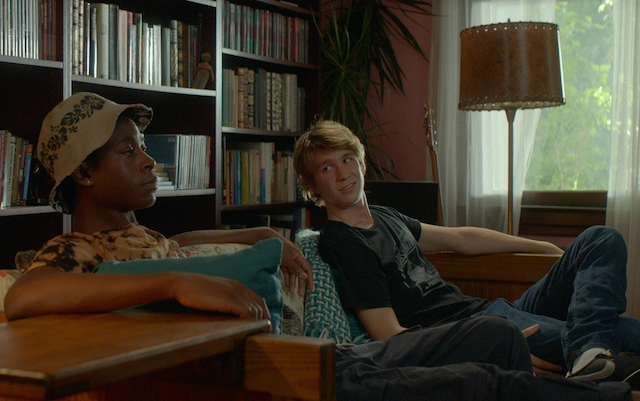
Earl (RJ Cyler) and Greg (Thomas Mann)
Brody also complains that "only Greg, the movie's first-person character, gets a voice-over, not Earl or Rachel." Did Billy Wilder slight Norma Desmond by giving all of the voice-over to Joe Gillis in Sunset Boulevard? Should Alvy Singer and Annie Hall have engaged in parallel points of view with the audience? Somehow I don't think so.

In Ancient Greek theater the protagonist is not simply the principle character, but the character with whom the audience is meant to identify and who undergoes some change through the crucible of conflict. The deuteragonist is the secondary character, who alternately acts as the protagonist's ally and challenger, depending on the deuteragonist's own conflict. The tritagonist is the tertiary character, who prompts the protagonist's empathy.

Me and Earl and the Dying Girl is about Greg. It is not about Earl nor is it about Rachel the dying girl, except insofar as these two characters fulfill their classic dramatic roles and additionally round out the meditation on adolescence. In that regard at the very least, the film deviates from the dying heroine trope, which trains its sights on the suffering heroine. But Me and Earl and the Dying Girl is about something bigger than Greg, and to this, Brody directs the second half of his essay. The unattainable object of Greg's young affections, Madison (Katherine C. Hughes), suggests, "in a plot twist," says Brody, "that's the most significant matter in Me and Earl and the Dying Girl" that the cinéastes make a film for Rachel.

Rachel (Olivia Cooke) and Greg (Thomas Mann)
Surely Me and Earl and the Dying Girl has already been added to searchable Internet lists of self-reflexive movies, and indeed, the plot explores three cinematic storytelling modes (Brody calls them "genres"). "There are, first," Brody notes, "the parodies that Greg and Earl make together…. Then there's Greg and Earl's first stab at a film for Rachel, a documentary tribute…. And then…there's the film that Greg makes for Rachel, on his own, without Earl's involvement [….] an abstract animation. [….] It's a highly labor-intensive film that reveals devotion, imagination, craft, skill, and discipline. It also suggests, in its abstraction, the unrepresentable enormity of Rachel's situation. ([I]n 2006, the late musician Ornette Coleman told Fred Kaplan, 'This term abstract art—what it means is something that causes you to see more than what you're looking at.')"

Brody is writing for a major publication that probably has a policy against spoilers, so he leaves it at that, but the film's coda is the grail of its trajectory. Three narrative scraps will come together to become the wonderment of the film's close. The first is a throw pillow. On his initial foray into Rachel's room, Greg makes the small-talk observation that Rachel has a lot of pillows. The second is Greg's mother prodding him to pore through an encyclopedic catalog she foists on him of America's colleges and universities. Over the course of the year, however, preoccupied as he is, Greg ceases to engage academically, and the college that had accepted him must subsequently reject him. He gives the college guidebook to Rachel, something as a talisman of both hope and hopelessness. Thirdly, during the course of their failed documentary attempt, Greg and Earl interview Rachel's mother, who describes Rachel's reaction to her parents’ divorce. Rachel, her mother reveals, has a seriously destructive streak. She took all of the books in the house and hacked them to pieces with scissors.

Rachel (Olivia Cooke)
Two parallel narratives are interlaced in Tim O'Brien's masterwork The Things They Carried, both about love and loss. The first story – and The Things They Carried, if it is about anything, is about the primacy of storytelling to the human condition – is a war story, specifically a Vietnam war story: "In any war story, but especially a true one, it's difficult to separate what happened from what seemed to happen. What seems to happen becomes its own happening and has to be told that way. The angles of vision are skewed. When a booby trap explodes, you close your eyes and duck and float outside yourself. …[T]he pictures get jumbled, you tend to miss a lot. And then afterward, when you go to tell about it, there is always that surreal seemingness, which makes the story seem untrue, but which in fact represents the hard and exact truth as it seemed."

The parallel narrative in The Things They Carried is the narrator's reminiscence on his childhood – specifically his first, deep love, Linda. Linda has leukemia, and senses Tim's apprehension about her impending death. In her nine-year-old matter of factness, she tries to console him: "Well, right now I'm not dead. But when I am, it's like... I don't know, I guess it's like being inside a book that nobody's reading. [....] An old one. It's up on a library shelf, so you're safe and everything, but the book hasn't been checked out for a long, long time. All you can do is wait. Just hope somebody'll pick it up and start reading."

At Rachel's Shiva, Greg steals up to her room, ostensibly to take a particular one of those pillows. Once there he sees that college guide doorstop of a book, and he picks it up. Inside, what he finds is Rachel – or something larger – Rachel's inner, creative life. Only in the final scenes do we – and Greg – come to understand that Rachel was an artist. She painstakingly cut each page after page of book after book, Greg finds, to layer each into a three-dimensional world. Indeed, she has turned her entire room into a realm of her creative imagining.

Rachel (Olivia Cooke) and Greg (Thomas Mann)
Me and Earl and the Dying Girl comes at the deathbed heroine obliquely and slips her into something else, something larger, something profound. Early on Greg tells us, "So if this was a touching romantic story, this is where our eyes would meet and we would be furiously making out with the fire of a thousand suns –––– but this isn't a touching romantic story." It is a story about agape and about the redemptive power of art – the art of movie making, the art of sculpture, the art of college entrance essays, the art of the stories we tell. In the decades that I taught freshman English, I was repeatedly struck by the preponderance of literature that explores the failure of human communication, and yet, there I found myself, day after day, standing in front of a class full of people with 300+ pages of words in my hands. Is there any more eloquent a testament to hope than the efforts of one human being after another – using every trope, every medium in the arsenal – to try to craft meaning in the midst of despair?

~~~
This essay is followed by a companion essay, "The Sentimental Journey of the Dying Girl."


Interview with director Alfonso Gomez-Rejon

Charles Ealy provides “A Guide to Fun Movie References in Me and Earl and the Dying Girl” in Austin 360, but to peek before you see the movie would be a real spoiler.

June 24, 2015

UPON THE AWFUL TREE: A CINEMATIC SYMPHONIC POEM

Click for Options

Throned Upon the Awful Tree

Throned upon the awful tree,
King of grief, I watch with Thee;
Darkness veils Thine anguished face,
None its lines of woe can trace,
None can tell what pangs unknown
Hold Thee silent and alone.

Silent through those three dread hours,
Wrestling with the evil powers,
Left alone with human sin,
Gloom around Thee and within,
Till the appointed time is nigh,
Till the Lamb of God may die.

Hark, that cry that peals aloud
Upward through the whelming cloud!
Thou, the Father's only Son,
Thou, His own anointed One,
Thou dost ask him -- can it be?
"Why hast Thou forsaken Me?"

Lord, should fear and anguish roll,
Darkly o'er my sinful soul,
Thou, who once wast thus bereft
That Thine own might ne'er be left,
Teach me by that bitter cry
In the gloom to know Thee nigh.


THE HYMNS

Englishman John Ellerton -- whose long and illustrious career in the Church of England was eclipsed by his prominence as an hymnologist, editor, hymnwriter, and translator -- wrote these words in 1875 at the request of Henry Baker, Vicar of Monkland Priory Church in Herefordshire, and editor-in-chief from 1860 to 1877 of Anglican Hymns Ancient and Modern.


San Antonio Symphony violist Matthew Diekman, inspired by the hymn -- and his introduction through a colleague to the complicated, almost ceremonial process of preparing absinthe with its unique accoutrements -- set about writing a story involving the intoxicating ritual of fire and ice and a mysterious stranger who insinuates himself into a traveling party sheltering for the night under an old tree in the Texas wilderness. Diekman conceived the story as a film and enlisted his friend Matthew Dunne, composer and University of Texas at San Antonio associate professor of music, to write an original score to bring the tale to life. He then recruited a number of his San Antonio Symphony colleagues to perform it. Upon the Awful Tree is the film that grew out of that collaboration. 


Musically, Diekman says, what drew him to "Throned Upon the Awful Tree" is its tonality. The hymn "is in G minor," composer Dunne explains, "but the first measure or so is really in G major. It doesn't turn minor until the second bar. It's an unexpected note when you hit that B-flat in the second bar."

The tune traces back to a Welsh folk melody entitled "Arfon," named for the southern shore of the Menai Strait in mainland Wales closest to the Island of Anglesey, and in Welsh means "facing Anglesey." "Arfon" is in G major, or G modal, with a hymn meter (not the musical meter but the pattern of syllables and stresses in the text) set to 7.7.7.7 D (the "D" indicating that the four lines of seven syllables each are doubled), a common structure in the folk tunes and hymns of English, Irish,
Scots, and Welsh immigrants that found their way into the United States with the westward expansion, being most authentically preserved in the isolated hollers of Appalachia.

The tune was published in Edward Jones's Musical and Poetical Relicks of the Welsh Bards in 1784, and itself can be traced back to a six-phrase tune in minor tonality, "Tros y Gareg" ("Over the Stone" or "Crossing the Stone"), a Celtic folk song.


"The sentiment of ['Tros y Gareg']," says Lesley Nelson-Burns, author of the comprehensive Contemplator's Folk Music Site, "is attributed to Rhys Bodychen, who led a troop of Welsh forces at the Battle of Bosworth Field where Richard III was defeated by Henry Tudor in 1485." The English lyrics were written by the 19th century linguist, translator, and playwright John Oxenford. 

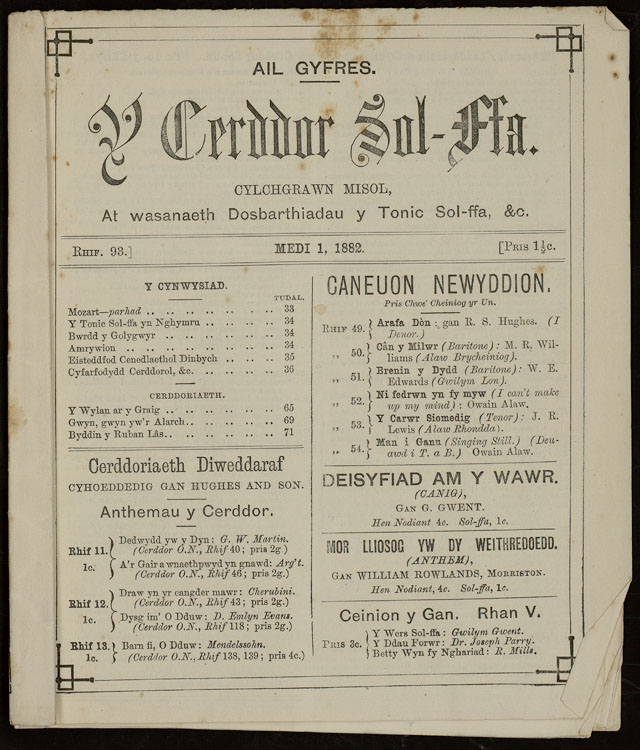
"Arfon" and "Tros y Gareg" have many heirs, the major tune (originally a jig) being the source for "See How Great a Flame Aspires," "Life Has Loveliness to Sell," "Jesus, Savior, Pilot Me," "Source and Sovereign, Rock and Cloud," among others. In the late 19th century in France, the tune "'Arfon' was associated with the Christmas texts 'Un nouveaux present des cieux" and "Joseph est bien marie." The minor tune provides the source for "Bread of Heaven on Thee We Feed" and "Throned Upon the Awful Tree," the melody of which was arranged in 1906 by Hugh Davies, a Welsh Methodist minister, composer, and editor of the Welsh music periodical Cerddor y Tonic Sol-ffa. 

Dunne drew thematic material for the score from the opening two bars of "Throned Upon the Awful Tree" and the hymn "Day Is Dying in the West," which, Dunne says, "is really more like a jig than a hymn." The original words for the latter hymn were written by Mary A. Lathbury in 1877 (verses 1-2) and 1879 (verses 3-4). Ironically -- or not considering the consequences of Diekman's characters' lapse of judgment in the film -- Lathbury was a preeminent force in the Temperance Movement, co-authoring Woman and Temperance with Frances Elizabeth Willard in 1883. She was also an artist and book illustrator and a central figure in the Chautauqua Movement, christened the "poet laureate of Chautauqua." The tune was composed in 1877 by William Fiske Sherwin, a vocal teacher and composer of carols and hymn-tunes, and variously titled "Twilight," "Evening Praise," or "Chautauqua."

David Russell Hamrick, an academic librarian who has done extensive research on hymns for many years, feels that "Day Is Dying in the West" is among the most beautiful of hymns and unusual in that it is a call to Vespers or evening worship. Hamrick makes an interesting observation: "I have always wondered what tempo best suits 'Day Is Dying in the West.' I suspect that with a large number of people singing outdoors [as it would have been sung on Lake Chautauqua at the ecumenical evening assemblies held by the Methodist Church there], it was sung pretty slowly (maybe 60 beats per minute?) in its original context. Following my rule of thumb that a cappella congregational singing should be a little faster than accompanied singing because there is nothing filling the pauses, I have usually tried to pick the tempo up to a moderate walking pace (about 78 bpm at least). It can be sung faster, of course, but that seems to get in the way of the grandeur of the words." Having the luxury to work without the words, Dunne gradually hastens the tempo of his score as the Devil's drink increasingly overtakes the party in Diekman's film.


THE WESTERN

Diekman readily acknowledges his debt to Sergio Leone and the Spaghetti Western. In Leone's variation on the Western theme, the hero uses cunning and deceit to undermine the terror and brutality his nemeses deploy against the townspeople and against the hero himself once his double-cross is unmasked. Dunne says his composition was very much influenced by Ennio Morricone's Spaghetti Western scores. Leone and Morricone went to school together, but it was not until 1964 when Leone heard an American folk song Morricone had arranged that he enlisted his friend to write the score for A Fistful of Dollars, which would forever transform the impact a score would have in developing cinematic narrative thematic concerns.


In Westerns, the mysterious stranger is a loner, a drifter. He has undergone some trauma that functions by way of ritual initiation. The Western is not concerned with the rites of puberty, but with the rites of mystical vocation. Like the medicine man or the shaman, the stranger is able to transcend his human limitations in sacrifice to the common weal and will ultimately bring redemption (temporary though it may be) to an individual, a family, a town. The avenging angel is central to the Western genre's mythology, and he is surrounded by an olio of the good (prostitute with a heart of gold, farm family, idealistic -- Eastern -- newspaperman, The Kid, Mexican farmers); the bad (wealthy landowner, evil gunslinger, greedy bounty hunters, bankers); and the ugly, i.e. weak (milquetoast dry goods proprietor, spineless sheriff, town drunk, saloon patrons standing in for the ubiquitous mob swayed by whichever way the wind blows). 


Perhaps the most powerful character in the Western, the character at its very heart, is the omniscient landscape itself -- that vast expanse of silent wilderness that is the grandeur of indifferent nature. By contrast, Diekman has trained his lens onto a claustrophobic corner of the woods, and he strips the Western's cast of stock characters down to a microcosm of traveling "innocents." A wealthy and devout rancher Wallace Hardman (J.R. Rhoades) and his daughter Sally (Morgen Johnson) have pitched camp for the night under the titular tree along with Hardman's ranch foreman (Diekman), the hand (Dave Milburn), the cook (Don McCann), and a preacher (Jack Howland). Generously played by Diekman's friends and symphony colleagues, the nonprofessional actors accomplish a subtle range of gradations of expression -- from suspicion to complicity to abandon to remorse -- without the help of words.

Click for Options
Wallace Hardman (J.R. Rhodes)
Sally Hardman (Morgen Johnson)
Absent from Diekman's Western are the villains (Satan is supernatural and doesn't count) -- rustlers, stagecoach abushers, gambling cheats -- and, most noticeably, the central hero/antihero: no "good guys," no "bad guys," just ordinary folk. As the party sits around the campfire, finishing up their supper, a natty stranger appears (Ryan Murphy) -- a man with no name and mysterious to be sure -- but not the avenging angel. He carries not a six-shooter but a Gladstone bag full of alchemistic paraphernalia and a potion that will unlock the nethermost compulsions of the human psyche. 
Discerning their initial hesitation, especially the disapproval of the Bible thumping Hardman and The Preacher, The Stranger cunningly manages to win the party's confidence and lure them in to the mysteries of the tincture contained within the bag. The gaiety of the music primes the men to abandon self-restraint, and as they imbibe, Sally, by turns nervous and coquettish, looks on. Upon the Awful Tree is not without moments of levity, but what begins as frivolity turns to transgressive miasma.

Click for Options
The Stranger (Ryan Murphy)
Click for Options
The Preacher (Jack Howland)
Click for Options
The Fiddler (Matthew Diekman)
Diekman as the fiddling foreman introduces the central passage of the symphonic poem on his viola. Dunne's score allows the orchestra to sneak in little by little to gradually step up the tempo and the frenzy -- of music and camera -- as the absinthe worms its way into the revelers' veins and visions. 
Even Hardman and The Preacher are eventually sucked in to the poisoned night. When they awake, they find themselves bared by the harsh glare of the light of day that gives the lie to their superficial morality.
The Hand (David Milburn)

Click for Options
The Fiddler (Matthew Diekman)
THE MYSTERIOUS STRANGER

In his remarks about the film, Diekman does not mention Mark Twain's novella, posthumously published in 1916, The Mysterious Stranger, A Romance, but the obtruder of Upon the Awful Tree bears a striking resemblance to Twain's titular character who alternately refers to himself as Satan and Satan's nephew. 


Among the three boys to whom Satan reveals himself is Twain's narrator, "Theodor Fischer, son of the church organist, who was also leader of the village musicians, teacher of the violin, composer, tax-collector of the commune, sexton, and in other ways a useful citizen, and respected by all" (15). On a May morning, the three playmates stretch out on the grass of a woody hilltop to smoke, but "we had been heedless and left our flint and steel behind."
     Soon there came a youth strolling toward us through the trees, and he sat down and began to talk in a friendly way, just as if he knew us. But we did not answer him, for he was a stranger and we were not used to strangers and were shy of them. [....] Then I thought of the pipe, and wondered if it would be taken as kindly meant if I offered it to him. But I remembered that we had no fire, so I was sorry and disappointed. But he looked up bright and pleased, and said:
     "Fire? Oh, that is easy; I will furnish it."
     I was so astonished I couldn't speak; for I had not said anything. He took the pipe and blew his breath on it, and the tobacco glowed red, and spirals of blue smoke rose up. [....] He went on coaxing, in his soft, persuasive way; and when we saw that the pipe did not blow up and nothing happened, our confidence returned little by little, and presently our curiosity got to be stronger than our fear (17).
Satan explains that his uncle is the only one of his clan of angels who has ever sinned, for he alone ate of the fruit of the Tree of Knowledge. "We others are still ignorant of sin; we are not able to commit it; we are without blemish, and shall abide in that estate always" (21). A leitmotif within Theodor's descriptions of Satan's talk -- perfect for the parallel purposes of Upon the Awful Tree -- is its musicality. He "worked his enchantments upon us again with that fatal music of his voice. [....] He
made us drunk with the joy of being with him...and of feeling the ecstasy that thrilled our veins from the touch of his hand" (23). And again, "words cannot make you understand what we felt. It was an ecstasy; and an ecstasy is a thing that will not go into words; it feels like music, and one cannot tell about music so that another person can get the feeling of it" (28).

Mark Twain (Samuel Clemens, 1835-1910)
The Mysterious Stranger revolves around Satan's argument (which is Twain's) that humanity's downfall derives from its Moral Sense. Having eaten the fruit of the Tree of Knowledge of Good and Evil, we know what is right, yet every useful citizen respected by all inevitably, knowingly chooses to do wrong for so trivial a reason as to save face in the eyes of equally unworthy others. The story proceeds episodically from one admonitory plot twist to another, beginning when Satan takes
Theodor into the torture chamber of the village jail, which makes Theodor feel "faint and sick."
     I said it was a brutal thing.
     "No, it was a human thing" [, says Satan]. "You should not insult the brutes by such a misuse of that word; they have not deserved it.... It is your paltry race -- always lying and always claiming virtues which it hasn't got, always denying them to the higher animals, which alone possess them. No brute ever does a cruel thing -- that is the monopoly of those with the Moral Sense" (48).
Satan's cautionary vignettes heighten for Theodor scenes close to home as they play out in juxtaposition to "a history of the progress of the human race -- its development of that product which it calls civilization" (94). 

The Mysterious Stranger is among the darker works from a writer enshrined as America's great humorist, and it depicts life as a nightmarish dream. Indeed, when the boys introduce Satan to their friends, he asks that they introduce him as Philip Traum: "You see, [Theodor explains to the reader,] 'Traum' is German for 'Dream'" (62). James Joyce's Stephen Dedalus will make the succinct observation that "History is a nightmare from which I am trying to awake," an eternal stream of violence against the disenfranchised, the violence justified by absolving the persecutors of blame, which, as Twain's time-traveling Satan demonstrates again and again, is indeed the perpetual history of both church and state.

"In Upon the Awful Tree," Diekman says, "the time-traveling Mysterious Stranger/Satan is timeless in his appearance, yet there are subtle hints in his attire and his gestures that are throwbacks -- and throw-forwards -- that the viewer will understand but the characters won't. The Stranger's bag of tricks draws from the past, present, and future," Diekman explains, "just as the biblical struggle between good and evil starts at the beginning of humankind and is eternal."

THE ABSINTHE

Satan recounts for Theodor and his mates a litany of the progress of the human race -- from Cain bludgeoning Abel to death "followed by a long series of unknown wars, murders, and massacres" (95). The Flood provides humanity with a second chance. Instead the peoples of the earth carry on: from Sodom and Gomorrah; to Lot and his daughters; to the Hebraic wars; to Jael; to the Egyptian, Greek, and Roman wars, and Caesar's invasion of Britain; down to Christianity and Civilization "leaving famine and death and desolation in their wake..." (96). "And always," Theodor laments, "we had wars, and more wars, and still other wars..." (96). 

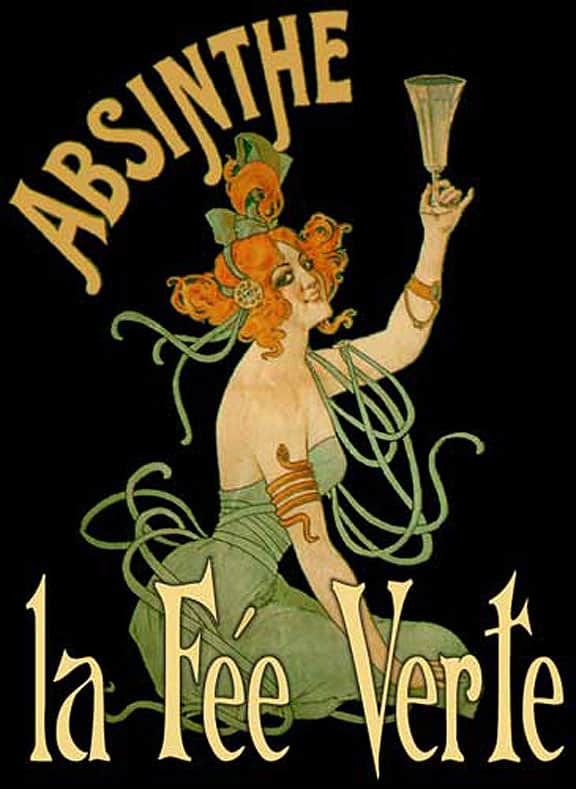
The only rational reaction to the eternal human condition is madness, oblivion, or the slumber of death. The Stranger in Upon the Awful Tree offers the oblivion of la fée verte (the green fairy), the anise-flavored spirit made of wormwood, anise, fennel, and herbs long believed to possess hallucinogenic properties.

The oldest and purest method of preparing absinthe, the French Method, is to pour the green spirit into the properly measured bulbous well at the bottom of a Pontarlier glass and then to rest a silver absinthe cuillere -- a special slotted spoon -- across the rim. A sugar cube is placed on the cuillere and the absinthe diluted by slowly dripping iced water over the sugar from a carafe, which causes the absinthe's less soluble essences -- wormwood, anise, and fennel -- to dissolve and cloud. This allows the aromatic subtleties that remain muted in the neat spirit to blossom or bloom. The resulting opalescent liquid is called the louche. 


In 1899, the English Decadent poet Ernest Dowson wrote "Absinthia Taetra" ("abominable absinthe"):
     Green changed to white, emerald to an opal: nothing was changed.
     The man let the water trickle gently into his glass, and as the green clouded, a mist fell from his mind.
     Then he drank opaline.
     Memories and terrors beset him. The past tore after him like a panther and through the blackness of the present he saw the luminous tiger eyes of the things to be.
     But he drank opaline.
     And that obscure night of the soul, and the valley of humiliation, through which he stumbled were forgotten. He saw blue vistas of undiscovered countries, high prospects and a quiet, caressing sea. The past shed its perfume over him, to-day held his hand as it were a little child, and to-morrow shone like a white star: nothing was changed.
     He drank opaline.
     The man had known the obscure night of the soul, and lay even now in the valley of humiliation; and the tiger menace of the things to be was red in the skies. But for a little while he had forgotten.
     Green changed to white, emerald to opal: nothing was changed.

The Bohemian Method used in Upon the Awful Tree involves first soaking the sugar cube in absinthe, then setting it aflame before dropping it into the absinthe-filled Pontarlier glass. The spirit ignites and is finished by tossing an ice cube in to douse the flames, resulting in a stronger drink. This is a modern technique not employed at the turn of the 20th century, but Twain stretches the plausibility of his schoolboys smoking as early as 1590. Phantasmagoria can happily admit anachronism and allow for Satan's fiery breath upon Twain's tobacco and Diekman's absinthe.

THE WORDLESSNESS

The degree of prominence the role music would play in Upon the Awful Tree evolved throughout the film's conception. "When I started writing the screenplay," Diekman says, "I thought I'd see how far I could get without anybody saying anything. And if somebody needs to say something, I thought, I'll let them. But I wrote and wrote and wrote, and I got to 'the end' and nobody said anything."

Wordless narrative is nothing new. Pantomimus was the name for a masked dancer in Ancient Greece, and unscripted mummer plays were a staple of Medieval European folk performance.


The masque was central to 16th and 17th century court entertainments in Europe. From dumbshows at London's Globe Theater to the new dance drama that emerged in early 17th century Japan that would become kabuki to the play-within-the-play in Samuel Beckett's Waiting for Godot, pantomime has endured. 


Upon the Awful Tree plays like an extended surrealist interlude that Alejandro Jodorowsky, the father of the Acid Western, would appreciate. Jodorowsky studied mime in Paris with Étienne Decroux and joined Marcel Marceau's troupe. He worked as a clown before founding Teatro Mimico in Mexico City in 1947. His 1970 El Topo follows a silent sharp-shooter on a violent quest for enlightenment through a mystical Western landscape.

Alejandro Jodorowsky's 1970 El Topo

Screen actors of the silent era utilized the mime's exaggerated gestures and facial expressions, but their dialog was relayed to audiences in intertitles (or title cards) between action shots. "I don't consider [Upon the Awful Tree] a silent film," Diekman insists. "I consider it a dialogue-free film." Indeed, unlike silent films, Upon the Awful Tree incorporates only a smattering of intertitles, interspersed among its opening shots, by way of setting the stage, and then abandons them altogether. "Some of my favorite scenes in my favorite movies are the ones in which people stop talking and take action to advance the plot," Diekman continues. "I wanted to see if I could expand that kind of non-verbal storytelling to an entire film narrative. It worked." 

In print, the closest relatives to Diekman's experiment grew out of German Expressionism and were initiated with Frans Masereel's 1918 wordless novel 25 Images of a Man's Passion. 
Last four panels of Frans Masereel's 1918
25 Images of a Man's Passion 
The first and most prominent practitioner of the medium in the United States was Lynd Ward, who, beginning in 1929, produced a series of six "wordless novels in woodcuts," as he called them. I inherited a first edition of the second novel in the series, Mad Man's Drum, a story of the sins of the fathers that Art Spiegelman, author of the Pulitzer Prize-winning graphic novel Maus: A Survivor's Tale and editor of The Library of America's 2010 boxed-set edition of Ward's collected novels, describes as "a multigenerational saga worthy of Faulkner [that] traces the legacy of violence haunting a family whose stock in trade is human souls."
Lynd Ward's Mad Man's Drum
Ward was a friend of my grandfather Charles W. Richards. In addition to the trade edition in 1930, a special edition of 309 signed copies was published of which 299 were for sale. Ward gave my grandfather #171 of the signed edition. In undergraduate school, a friend and I pored through it page by page one summer and wrote out the narrative, a document I have often wished I would run across in my files, though I seriously doubt is extant.

Ballet relies on the language of music and the gesture of dance to convey narrative, and musical compositions have been composed for centuries around narrative stories. Fred Everett Maus introduces his (highly recommended) paper "Music As Narrative," published in the Indiana Theory Review, arguing that "For many listeners, some instrumental music, especially in the tradition of Haydn and Mozart through Brahms, invites comparison to drama or narrative" (1).

Discussing Schumann's Second Symphony he notes, "Musical events can be regarded as characters, or as gestures, assertions, responses, resolutions, goal-directed motions, references, and so on. Once they are so regarded, it is easy to regard successions of musical events as forming something like a story, in which these characters and actions go together to form something like a plot" (6).

Maus's analysis of the last movement of Beethoven's Piano Sonata, Gp. 14, No. 1 concludes, "This description treats the events in the Rondo as a series of actions, repeated attempts to reach a satisfactory state of affairs that requires no further action. The attempts are defeated, repeatedly, because satisfaction involves a return of the opening key and opening thematic material, but the thematic material throws the pitch materials off balance. The attempts are not exactly those of the
composer or performer, but seem to be best understood as behavior in a fictional world created through the music. The Rondo does not encode a story about something completely nonmusical, in the manner of program music. Rather, the goals, actions, and problems of the story are musical ones, and they share only rather general descriptions (for instance, 'trying to return to a position of stability') with everyday actions. Though it would be possible to add specifications of agents to the story, it is not necessary to do so, and in fact it seems best to give an account...that leaves the determination of character vague" (13-14).

Though it is a film, Upon the Awful Tree places its dominant reliance on the vaguer, less literal musical composition. Indeed in describing the film, Diekman refers to it as "The little movie with the million dollar soundtrack." Budgetary constraints put writer, director, producer, cinematographer, editor, production/art/set/costume designer Diekman in a do-the-best-with-what-you've-got quandary. He shot with a DSLR camera in video mode, so it is not surprising that production values are somewhat compromised. He recruited his colleagues for the orchestra, and as professional symphony musicians they turn in a superb performance. As nonprofessional actors (and generous friends indeed), they rose to the thespian challenge as well.

Under the Awful Tree premiered in San Antonio on June 2, and interestingly, Ukrainian director Myroslav Slaboshpytskiy's The Tribe opened June 19 in New York. Though it has not made its way to San Antonio yet, I mention it because it shares a number of aspects with Diekman's film: it features a nonprofessional cast; it explores a microcosm -- a boarding school -- governed by the teens' violent code of transgression; and, because all of the characters are deaf, it is performed entirely in sign language with no subtitles or intertitles. In the case of The Tribe, there is also no orchestral soundtrack or incidental music. Peter Bradshaw of The Guardian noted that he "couldn't help remembering the quotation attributed to Nietzsche about dancers being thought insane by those who can't hear the music."
Myroslav Slaboshpytskiy's The Tribe
The Tribe also shares, from all accounts, Twain's bleak view of the human condition: were we to remove the blinkers Twain's Satan calls our Moral Sense, we would realize we are irredeemable. Among the few intertitles that punctuate the opening shots of Upon the Awful Tree is a quote from Oscar Wilde that informs the arc of the action that will follow:
"After the first glass of absinthe you see things as you wish they were. After the second you see them as they are not. Finally you see things as they really are, and that is the most horrible thing in the world."   
"Throned Upon the Awful Tree" depicts the solitary Christ upon the rood:
               silent and alone.
Silent through those three dread hours,
Wrestling with the evil powers,
Left alone with human sin,
Gloom around Thee and within
....
Christ speaks only to implore of God, "Why hast Thou forsaken Me?" The speaker of the hymn in turn asks Christ to "Teach me by that bitter cry/In the gloom to know Thee nigh." If that final line is supposed to inspire hope, it falls distressingly short, in my opinion. Not a day, nay an hour, goes by that negates Satan's measure of man, yet I continue to put my faith in the redemptive power of art. Art does a peculiar thing. It simultaneously transports us out of and into the human condition, and unlike absinthe, the experience of art is clear-headed with the potential to make us rise above that condition: the hymn and the jig, the sacred and the profane, the existential paradox of the human double helix.


ACKNOWLEDGEMENTS

The majority of Matthew Diekman's and Matthew Dunne's remarks quoted in this essay are taken from Nathan Cone's interview for Texas Public Radio KSTX 89.1 FM. Cone, Director of Cultural and Community Engagement at KSTX, organizes the TPR Cinema Tuesday series in San Antonio, where Upon the Awful Tree premiered on June 2, 2015 at the Santikos Bijou theater.

Quotations from Mark Twain's The Mysterious Stranger come from Prometheus Books' 1995 Literary Classics edition.


May 11, 2015

BEHOLD THE WOMAN: CLOUDS OF SILS MARIA

For the game of creation ... a sacred “Yes” is needed: the spirit now wills [her] own will, and [s]he who had been lost to the world now conquers the world.
~~Friedrich Nietzsche, Thus Spake Zarathustra, 1883


Nietzsche Haus in Sils-Maria
Writing to his friend Heinrich Köselitz in 1883, Friedrich Nietzsche relates finding “the first outline of the thought related to [Zarathustra]. Underneath it says ‘Beginning August 1881; in Sils Maria; 6000 feet above the sea, and even higher above all human things.’” In Ecce Homo (1888), Nietzsche would again write that “The fundamental conception of [Zarathustra], and the Eternal Recurrence-Thought, this highest affirmation at all attainable – belongs in August 1881: it was penned on a sheet with the notation underneath, ‘6000 feet beyond man and time.’”

Clearly it was a profound moment for the philosopher, the telling of which he felt necessary to reiterate: this time, August 1881; this place, beyond man and time. 


Maloja Pass in the Upper Engadin Valley
Olivier Assayas’s Clouds of Sils Maria takes us to the exalted place of Nietzsche’s epiphany – and to denials, contradictions, and paradoxes. Sils Maria is lost to time, all but unchanged since Nietzsche summered there, yet it sits within intimate proximity to that global jet set destination, St. Moritz, the holy grail of the rich and famous, the toniest ski resort in the world.

In one regard, Clouds of Sils Maria is a self-reflexive tale about the dramatic life and the blessings of celebrity and its curse. The film jostles our perception between reality – at least the reality that is the film – and the play being analyzed and rehearsed within it. The distinction starts to blur between our main characters’ spirited arguments and the playwright’s rehearsed lines, but writer/director Assayas constructs the dialogue so that we are caught just short of that blurring when the protagonist’s assistant interjects stage direction. 

Just as the voicing of stage direction jolts us into understanding we are not in reality but the play, Assayas’s editing takes us quite deliberately in and out of scenes. Fadeouts – if we can call them that, abrupt as they are, punctuate the film, as Anthony Lane of the New Yorker says, “before we have readied ourselves” for the transition. They add to the dramatic self-consciousness of the film by imitating a curtain’s descent at scene's close.

On a deeper level, Clouds of Sils Maria is about the relationship between youth and age, lived experience and art, and our fundamental identity in the face of the electronic virtual. Indeed, it asks whether, in the electronic age, the struggle for self-knowledge has become a quaintly old-fashioned idea.

Assayas limns the film’s outline in a few quick strokes. The story centers on internationally renowned Maria Enders (a stunningly complex Juliette Binoche). Maria owes her stardom to the venerable playwright Wilhelm Melchior, who cast the 18-year-old unknown as the ingénue Sigrid in the stage premier of his play Maloja Snake and then in the film adaptation. The play explores the dynamic – erotic, generational, political – between Helena, who has inherited a family business, and her less than innocent teenage employee, Sigrid, who, by manipulating Helena’s insecurities and growing romantic infatuation, ultimately drives Helena
 to suicide. 

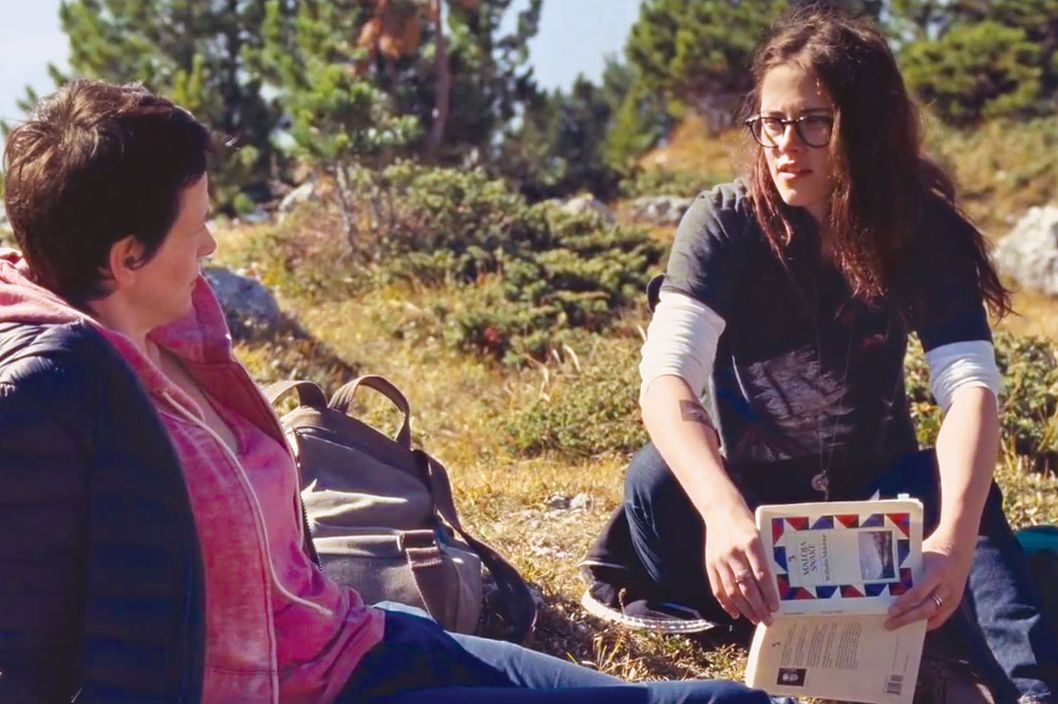
We meet Maria a quarter century hence, on a train to Zurich with her multi-phone wielding personal assistant Val (Kristen Stewart of Twilight Saga fame in a deeply realized performance). Maria is to accept a prestigious honor on Melchior’s behalf. He despises awards, and when Val relays the news of Melchior's sudden, unexpected death, Maria’s visceral instinct is to retreat back to London as a bow of respect to the values of her friend and mentor – but she conforms, and will speak for what now will be a memorial.


Kristen Stewart as Val and Juliette Binoche as Maria
in Olivier Assayas's Clouds of Sils Maria
We soon learn Maria is being dogged by Klaus Diesterweg (Lars Eidinger), a theater director – “the best of his generation,” Val tells Maria – who is anxious to revive Maloja Snake with Maria in the role of the older woman. After Melchior’s memorial, Diesterweg corners Maria in the opulent Zurich hotel where the post-ceremony reception is being held, to try again to convince her to perform in his stage production as Helena – with Jo-Ann Ellis (Chloë Grace Moretz), a paparazzi-baiting celebrity who cultivates a Lindsay Lohan-esque bad girl-persona, in the role that made Maria a star.

Melchior’s widow Rosa (Angela Winkler), who lives in the Upper Engadin – the valley of the Swiss Alps through which flows Lake Sils – invites Maria and Val to stay at her home in Sils Maria while she is away. “Stay as long as you want. I like to think that you’re working on your part here where it was written.”

The title of the play, Maloja Snake, within the play – the film we are watching, itself self-consciously dramatic and divided into two acts and an epilogue – is the name of a meteorological phenomenon unique to the Engadin. In autumn, warm morning air rising up the slopes of the Maloja Pass is transformed into a low-lying thick, white cloud that wends its way along the mountainsides. Its annual constancy played a part in shaping Nietzsche’s concept of Eternal Recurrence, and it is the central metaphor of the film.  
The Maloja Snake
Nietzsche called Eternal Recurrence "The greatest weight." In The Gay Science (1882), he poses the scenario: "What, if some day or night a demon were to steal after you into your loneliest loneliness and say to you: 'This life as you now live it and have lived it, you will have to live once more and innumerable times more; and there will be nothing new in it, but every pain and every joy and every thought and sigh and everything unutterably small or great in your life will have to return to you, all in the same succession and sequence – even this spider and this moonlight between the trees, and even this moment and I myself. The eternal hourglass of existence is turned upside down again and again, and you with it, speck of dust!' Would you not throw yourself down and gnash your teeth and curse the demon who spoke thus? Or have you once experienced a tremendous moment when you would have answered him: 'You are a god and never have I heard anything more divine'? If this thought gained possession of you, it would change you as you are, or perhaps crush you."

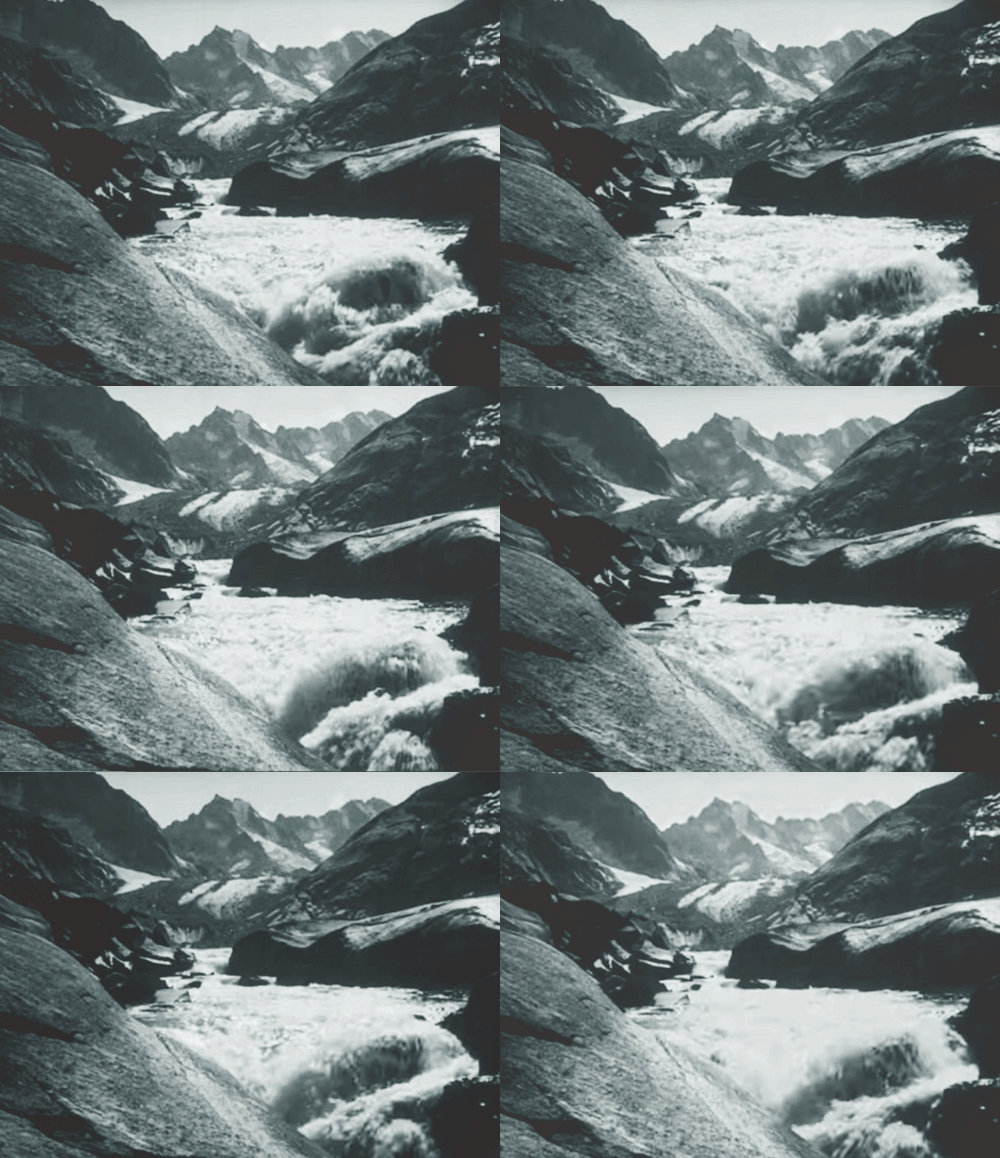
The night before she sets off, Rosa shows Maria a film, the film that influenced her husband to write his most famous play. Assayas can thus incorporate Arnold Fanck’s hauntingly beautiful 1924 silent Das Wolkenphänomen von Maloja. Though made at the height of German Expressionism, it is more firmly grounded in Romanticism, and the black and white images of the serpentine cloud juxtaposed with the intertitles’ stylized typeface serve as an apt device to transition the narrative from the populated train and the society of the awards ceremony to the film’s second act amidst the isolation of inviolate nature.


Arnold Fanck's 1924 Das Wolkenphänomen von Maloja
(link to 10-minute film)
This storied site overlooking the Maloja Pass becomes the crucible where Maria will penetrate deeper into Melchior’s play through the role of the older Helena and begin to come to terms with her own process of becoming in the face of aging’s inevitability. The play, which has been so central to her self-image (Wanting out of her contract, she pleads with her lawyer, “I am Sigrid! I want to stay Sigrid!”), now becomes her life. In the remote Engadin, rehearsing lines with Val, Maria wrestles not only with the truth of the play, but with the truth of herself as an actress and as a woman. Sils Maria will serve as Val’s crucible as much as Maria’s, the place where she will, through the medium of Maloja Snake, come to understand that she is suffocating in Maria’s shadow. Life, that is, will imitate art.

The improvised rehearsals at the house in Sils Maria are at the film’s core. As they become more and more intense, we come to see the depth of Maria’s method, but we also start to realize Val’s great sense of obligation. She serves Maria, not merely as a faithful assistant, but as a smart, independent thinker; a valuable sounding board; and a devoted confidante. (Though she holds the script in hand, Val has committed Sigrid’s part to memory as thoroughly as Maria has Helena’s.) Yet by degrees, Val questions whether that loyalty may be misplaced in a relationship that is not reciprocal.


In serving to demonstrate Maria’s commitment to her craft, the intensity of the rehearsal scenes functions in diametrical opposition to Jo-Ann’s pop culture celebrity based on roles defined by little more than costumes, set dressing, and CGI. Hard as Val tries to convince Maria that distinctions between “high” and “low” are passé (of Jo-Ann’s most recent film and character: “There’s no less truth in it than in a more serious film.” “I know it’s a silly convention, but it’s no sillier than any other convention.”), Maria persists in the belief that aesthetic and ethical concerns about authenticity matter and that the examined life is necessary to the realization of art. She chides the people around her for their simplistic readings of both art and life. Yet it is Val who will admonish Maria: “You can’t be as good as you are, as accomplished as you are, and still hold on to the privileges of youth.” Clouds of Sils Maria keeps circling the question of the viability of a society that pits a privileged culture of youth over the wisdom of age.


Jo-Ann Ellis (Chloë Grace Moretz) as a hybrid
in her most recent blockbuster in Clouds of Sils Maria
When Maria and Val meet Jo-Ann for the first time at the Hotel Waldhaus, Jo-Ann’s new boyfriend, the novelist Christopher Giles, is with her. Back home Val says, “I can’t believe we got the first scoop tonight.” Maria has no idea what Val is talking about, no idea who Christopher Giles is, no idea he’s married. “Is he famous?” she asks. “He’s über famous! When word gets out it’s going to be a tsunami.” “Yah,” Maria scoffs, “on their planet.” “Their planet has a name,” Val protests. “It’s called the real world.”


Johnny Flynn as Christopher Giles and Chloë Grace Moretz as Jo-Ann Ellis
meet Maria and Val at the Hotel Waldhaus 
In 1905, the Austrian poet Rainer Maria Rilke could write, “Nearby is the country they call life./You will know it by its seriousness.” The stately Hotel Waldhaus, built in 1908, may sit timelessly above the village of Sils Maria, a classical music ensemble still a staple of the cocktail hour, but its clientele is of a different breed since Einstein and Jung and Adorno, Otto Klemperer and Bruno Walter, Hermann Hesse and Thomas Bernhard, Claude Chabrol and Alexander Kluge, Andreas Gurskey and Gerhard Richter graced its halls. Not that the rich and famous haven’t always been among Hotel Waldhaus’s guests, but at more than $400 a night for a small room for one, its doors are now only within reach of celebrity and the very rich, often one and the same.

Maria and Val’s exchanges allow additional levels of cultural critique to accrue as the Millennial Val argues to defend the Generation Z Jo-Ann, who – as the curtain on our story is about to drop and the curtain on Maloja Snake is about rise – will make clear to Maria she has no need of defense – the world, after all, belongs to the young. This fact is the source of the desire the older lover has for the young beloved. It is also a fact that in 2015, technology is ubiquitous, and the experience of being in the world is mediated, when it is mediated at all, not by scholars, intellectuals, and connoisseurs but anyone with a smart phone and an opinion.

Amidst these discussions, Assayas sees to it that Maria and Val are rarely separated from their digital devices – Googling, texting, Skyping – even in the relative wilderness of the Swiss Alps. Despite her feeling of cultural superiority, Maria is unable to insulate herself from the unmediated backdrop that frames the contemporary zeitgeist. The British cultural critic Alan Kirby, in the ongoing struggle of philosophers and critics to find a label for a post-postmodern terminology that supersedes what he calls “the neurosis of modernism and the narcissism of postmodernism,” coined the terms “digimodernism” and “pseudo-modernism” to describe the “ignorance, fanaticism and anxiety” that result from instantaneous participation in triviality and the overall vapidity of what passes for the cultural landscape. 

A clever satire on celebrity, Clouds of Sils Maria is at once novel and old fashioned. It treads the boards of the self-reflexive trope of actors playing actors, specifically the older actress supplanted by the hungry, would-be starlet. The Times review of the 1937 London premier of Stage Door noted that “Stories of life on the stage have always appealed to Hollywood: …success is sensational and meteoric, and failure equally sudden and dramatic. We know the formula by heart, and expect of our entertainment that it ... [culminate] in the rise of the central character to fame in the bright lights of Broadway. ...and failure for another.” Assayas uses these very expectations to subvert the All About Eve fatalistic inevitability we expect.


All three actresses deliver nuanced performances as strong-willed, independent women, still a rarity in cinema, and always all the more reason to welcome an Assayas production. Binoche had challenged Assayas to write a film about women, but left the rounding out of the characters to the actresses. In the Nashville Scene, Jason Shawhan provides a succinct analysis of the dramatic technique Assayas employs to present the dramatis personae. Shawhan says that “Clouds of Sils Maria …is bound by physical space, but not by time or identity. Its characters are often screens onto which their personae are projected, in a deeply personal style of montage. Jo-Ann we encounter through gossip, TMZ-bought meltdown footage, press appearances and Internet profiles long before we meet her as a person. Valentine, whom we see before anyone else, comes into focus not even as herself but in reaction to organizing Maria’s life: taking calls, arranging appointments, fielding offers, dealing with representatives of mysterious concerns. We see and hear her defined as if by negative space; when we finally are allowed a peek inside her life, it’s almost completely overwhelming. Maria, meanwhile, is referred to as the sum of her roles, defined by triumphs and flops and the degree to which she’s esteemed by directors.”


Juliette Binoche as Maria in Olivier Assayas's Clouds of Sils Maria
Shawhan further admires each actress’s deepening of her role. From the opening scenes, he says, Binoche lays out the story’s emotional stakes with heightened “intensity and goes further. Moretz does something amazing here, finding humanity in the kind of starlet that junk media trains us to despise, and expanding her own repertoire to find a delicate vulnerability we’ve not seen before. And for just a bit of perspective, Kristen Stewart was the first American to win an acting award at the Cesars (France’s Oscar equivalent).”

For all the cynicism Maria harbors as she gazes out at a generation raised on blockbusters and cyberspace, the film ends on a profound grace note of hope borne of the power of Binoche’s performance. When Maria meets Jo-Ann and Giles at the Hotel Waldhaus, Giles recalls attending a revival screening of Maria’s French films and being struck by a remark she made in the interview afterward: “If we are sincere, we are the sum total of our experiences without exception.” “I said that!?!” she self-deprecatingly laughs. She has, in what Giles recollects, succinctly summed up Nietzsche’s Eternal Recurrence. 

“My formula for greatness in a human being,” Nietzsche wrote in Ecce Homo, “is amor fati: that one wants nothing to be different, not forward, not backward, not in all eternity. Not merely bear what is necessary, still less conceal it …but love it.”

In the final, brief succession of scenes, Maria’s visage undergoes metamorphosis – from confident mentor generously suggesting a way to empower a scene, to barely betrayed surprise at a young actress’s dismissal, to traces of loss and melancholy, to assuredly felt confidence as the seasoned actress takes her mark for the opening curtain of the premier – and Zarathustra’s sacred Yes. “Become who you are!” Thus Spake Zarathustra.


Maria (Juliette Binoche) as Helena, waiting for the curtain to rise on
Wilhelm Melchior's play Maloja Snake