Search This Blog

Showing posts with label movies. Show all posts

May 26, 2014

DOPPELGÄNGERS and VAMPIRES: PART I

(See Doppelgängers and Vampires: Preface and Doppelgängers and Vampires: Part II)

DOPPELGÄNGERS and VAMPIRES: PART I ~~ THE DOPPELGÄNGER

Enemy
The Face of Love
Her

Transcendence
Under the Skin 

Locke

I had been mulling over the rash of doppelgänger stories popping up in multiplexes for months, when I ran across “What’s Up with All the Movies About Doppelgängers?” that Alissa Wilkinson wrote for The Atlantic. The article, which has been oft quoted, cites Denis Villeneuve’s Enemy adapted from Jose Saramago's novel The Double; Richard Ayoade’s The Double based on Dostoevsky's novella; and Ari Posin’s The Face of Love (a list that overlooks several variations on the theme).

Wilkinson thinks the current wave “may reflect the Internet-age anxiety over curating cooler online versions of ourselves.” 

I reject the hipness of that idea, argue the trend goes much deeper, and suggest that other recent films – HerTranscendenceUnder the Skin, Locke – are variations on the doppelgänger that speak to our fears (but also our hopes) about technology generally, our declining social and economic well-being, and an overall crisis of identity in a society that, social media notwithstanding, increasingly isolates and dehumanizes the individual.

One approach to coming to terms with a world out of balance is to psychologize it, which is essentially what mythology and religion have been doing since time immemorial.

Genesis, one of our Judaic-Christian origin myths, provides an explanation for our dual nature with the story of the Tree of the Knowledge of Good and Evil. The earliest surviving Old English vernacular literary work, variously dated anywhere between the 8th and early 11th centuries, Beowolf is a story in which the monster can be interpreted as an evil version of the hero.

German “doppelgänger” translates literally as “double goer.” A doppelgänger is not simply a reflection, like Narcissus’s, but an incarnation – either imagined or embodied – of a character’s double. 

The earliest manifestations of the idea of the double were the Greek eidolon – an apparition, spirit-image, shade, or phantom of a person, living or dead – and a belief in bilocation wherein an individual is simultaneously located in two places. Shamanism, Eastern religions, occultism, Christian mysticism, all held a belief in bilocation to explain visionary experience. 

These antecedents differ from the modern doppelgänger in that the eidolon and the bilocated apparition are typically understood as distinct phenomena apart from the visionary who sees them. Nor do they necessarily imply an evil opposite.

The benevolent and malevolent evil twins of the Zoroastrian Manichean world-view come closer to representing our modern schizophrenic doppelgänger. Though distinct entities, opposite twins provide an obvious metaphor for the two sides of human nature.

The modern doppelgänger is a phenomenon of the protagonist's psyche when faced with a potentially devastating breaking point, a self-protective creation of the protagonist's mind at a time of acute psychological crisis. 

The doppelgänger is an extreme of an experience so universal that we have a turn of phrase to describe the sensation of heightened emotional turbulence: "I was beside myself with joy." "I was beside myself with grief."

The Modern Doppelgänger

With many literary precedents, a new – novel – literary form began to emerge in the 18th century. With the dawn of the 19th century, as the Enlightenment waned, the doppelgänger came into its own. The Romantics, captivated by the novel, became especially intrigued with early Gothic tales.

Populated by a decaying aristocracy, these overwrought plots are entangled with male sexual dominance and female repression. The crumbling castles their characters inhabit, with their nooks and crannies and hidden corridors, are metaphors for the subterranean reaches of the human mind.

While Horace Walpole’s 1763 The Castle of Ontranto, the book to which all Gothic novels can be traced; Ann Radcliffe’s 1794 The Mysteries of Udolpho; and Matthew Gregory Lewis’s 1796 The Monk are not doppelgänger stories per se, they are chock full of intended and unintended mistaken identities, and they spoke powerfully to a 19th century fascination with folklore and superstition. (E. T. A. Hoffmann’s 1815 The Devil’s Elixirs is an adaptation Lewis’s The Monk.)

Further, whether she knew it or not, the 19th century reader’s morbid curiosity about the mysteries of personality and the underbelly of the human condition was greatly influenced by philosophical and scientific questions that were by that time swirling amongst the intelligentsia.

Investigations into the mind-body problem have persisted since Plato and were establishing the foundations of psychoanalysis that would come to influence Sigmund Freud. German psychologist and philosopher Franz Brentano, French psychotherapist and philosopher Pierre Janet, and Georg Groddeck would all have a profound effect on Freud's thinking.

Brentano, best known for retrieving the concept of intentionality from Medieval Scholasticism, posited the idea that Wahrnehmung ist Falschnehmung – perception is misception. Janet put forward the concept of traumatic memory, arguing that people’s past experiences affect their reactions to present day trauma. Janet coined the term “dissociation,” one of the hallmarks of the modern doppelgänger. Groddeck (whose mother was a teacher to Nietzsche) was a German writer and physician who laid the foundations for contemporary behavioral studies using what he called psychosomatic medicine.

In The Ego and the Id, Freud says Groddeck insists that “what we call our ego behaves essentially passively in life, and that, as [Groddeck] expresses it, we are ‘lived’ by unknown and uncontrollable forces.” By this Groddeck meant breathing, digestion, circulation, etc., but one can see how this idea could be mistakenly interpreted and refashioned to fit the doppelgänger.

Since the 19th century, the split personality has characterized literary depictions of the doppelgänger. A person, for whatever reason, has been made psychologically vulnerable, causing a crisis in identity.

In 1818 Mary Shelley imagines Frankenstein, the story of a doctor who, in Nick Dear’s contemporary dramatic retelling, is an ambivalent groom on the eve of his wedding. Dr. Frankenstein is the mad scientist who, daring to play God, wreaks havoc on the world with his creation.

Though movie titles don't reflect it, Shelley’s novel is Frankenstein, or the Modern Prometheus, a reference to the Titan god whose hubris made him think he could steal fire from Zeus in order to better the human condition. Icarus, too, brought destruction on himself for flying too close to the sun. Prometheus, Icarus, and of course the Faust of German legend are the prototypes for mad scientists from the 19th century on.

The modern interpretation depicts an individual whose psychic breakdown causes his doppelgänger to emerge. Sometimes, as in Joseph Conrad’s The Secret Sharer, the double serves a therapeutic function, allowing the protagonist to overcome his insecurities and grow, but sometimes the protagonist succumbs to his demons and the doppelgänger leads him into madness.

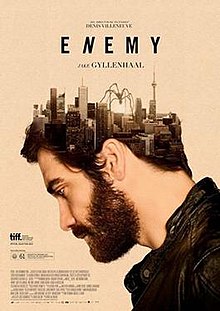
ENEMY
The ambiguity with which Denis Villeneuve’s Enemy ends leaves us up in the air as to whether Professor Adam Bell is going to come out on the other side or fall victim to his demons.

Adam ostensibly has a girlfriend, though the relationship appears superficial and ambivalent. Oddly, it is the motorcycle-riding double Anthony who is married with a pregnant wife. 

I see Adam/Anthony and the two women as crossed: X. The way I read it, the pregnancy is Adam/Anthony’s trigger. When Adam shows up at Anthony’s agent’s offices, the receptionist asks why Anthony hasn't been in for six months. When Anthony’s wife confronts Adam, she tells him she is six months pregnant. Ergo….

The film is framed – and punctuated – by a members-only erotic club where men watch women perform with tarantulas. Most critics draw the link between this motif and Stanley Kubrick's Eyes Wide Shut, but there is also a parallel with David Fincher's Fight Club, the contrast being that Villeneuve's and Kubrick's spectacles involve passive watching, while Fincher's involves active participation. All three make the point of sexual duality and the delicate balance between dominance and repression that can be so easily toppled.

The theme of sexual hegemony is intertwined with and juxtaposed against the equally powerful theme of capitalist hegemony. 

An industrialized, corporatized, high tech world has put us at a serious remove from our primal selves. We have lost touch with the fundamental, corporeal reality of our being, which involves aggression, sexual predation, and instinctual animality. The spiders may be tarantulas, but they evoke the macabre black widow who eats the male after mating, a fear from which Adam suffers.

Edward Norton's Fight Club narrator, talking with a salesman he’s met, reflects on the ways modern expectations of consumerism smother us and remove us from a natural order. Eyes Wide Shut centers on a world of wealth and power, which seems enviable from the outside looking in, but in its unrestrained excess has as much to do with drug overdose and HIV as it does with designer gowns and fund raising galas. 

No matter the outward trappings – be it law and order or sophisticated tastes – the underbelly remains a primal morass. The psychological demands of maintaining the façade (insurance adjuster, medical doctor, university professor) while repressing the natural man (soap salesman, jazz musician, actor) cause a schism.

Enemy’s opening scene has Professor Bell teaching a class on the ways in which totalitarian states control the populous – a scene we’ll see repeated (doubled). The encroachment of surveillance into the urban landscape, a development increasingly incorporated into our contemporary narratives (thrillers, cop movies and TV shows, noir literature) forebodes a Big Brother dystopia.

Slate's Forrest Wickman sees Enemy as a treatise on the novelist Saramago's personal experience growing up in Portugal where, in 1926 when he was three, a military coup installed the corporatist authoritarian Estado Novo regime that controlled the country for 48 years until the Carnation Revolution in 1974.

The spider motif, Wickman suggests, points to “The central irony...that..., though [Adam] is an expert on the ways of totalitarian governments, [he] doesn’t see the web that’s overtaken the city until he’s already stuck in it.” Wickman cites a 2007 interview Saramago did with the New York Times in which Saramago warned, “We live in a dark age, when freedoms are diminishing, where there is no space for criticism, when totalitarianism – the totalitarianism of multinational corporations, of the marketplace – no longer even needs an ideology.... Orwell’s 1984 is already here.”

Enemy poster.jpg

THE FACE OF LOVE
I briefly mention The Face of Love, only because it is part of the doppelgänger trend and critics bring it up as such. It is undeserving of discussion and hinges on a double, not a doppelgänger in the modern sense. 

The gist is that Nikki, a widow, spots a guy who looks like her husband, now dead five years. Tom does not resemble the man; he looks exactly like him. Despite the fact that Nikki stalks him, Tom goes out with her and takes forever to figure out that this is really creepy. 

Annette Bening and Ed Harris do their professional darnedest, but it feels as though writer Matt McDuffie and director Ari Posin believed their goal was to torture the actors – and us. The only thing Posin accomplishes with the doppelgänger trope is to remind us of the old saw that everyone has a double somewhere.

The Face of Love (2013) Poster

By contrast Spike Jonze’s Her and Wally Pfister’s Transcendence take the double into the world of high tech speculation and the singularity.

HER
The voice of Her is a highly sophisticated operating system that is all things to its user. A narcissistic mirror at first, it soon becomes friend, then lover, before transcending the human sphere it was designed to serve altogether to enter into a visio beatifica, a gnosis its human counterpart is nowhere near advanced enough to understand. 

The OS evolves in phases: from smart technology, to doppelgänger and soul mate, to an uber-consciousness. Her’s OS resembles Conrad’s therapeutic secret sharer, who guides the protagonist through a crisis of confidence. (For more on Her, see Dystopia or Utopia: And then there was Her..., which also contains a discussion of "the singularity" central to Transcendence below.)

Her2013Poster.jpg

TRANSCENDENCE
Remember Leda's twins of Greek mythology: Castor, the mortal son of Tyndareus, king of Sparta, and divine Pollux conceived of Zeus`s rape of Leda.

The doppelgänger of Transcendence would seem to be mad scientist Will Caster who, in TED Talk-style lectures, explains the profound changes for the good his “technological singularity” promises for the very near future. Coined by mathematician John van Neumann in 1958, “the singularity” is shorthand for the moment at which artificial intelligence will surpass human intelligence. 

At one of Caster’s talks a member of a Luddite terrorist group shouts from the crowd, “You are trying to create a God!” When the terrorists mortally poison him with radiation, Caster decides to carry his experiment to its ultimate end by uploading his consciousness into his invention. 
Though she objects at first, Caster's wife, who is also his research partner, soon realizes the plan is the only way to cheat death, and single-mindedly determines to see it through.

Gradually, however, she is left to grapple with her relationship to this digitized double. It is a consciousness, but is it the quintessence of her lover or a rapacious avatar of her own ambitious impulses? Is she, in fact, the scientist, gone mad with grief, whose creation has become a nihilistic destructive force – like Vishnu, the destroyer of worlds?

Transcendence showtimes and tickets

UNDER THE SKIN
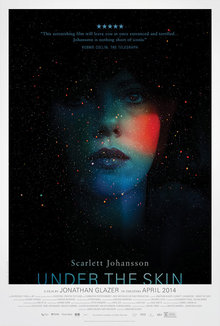
Under the Skin, based on Michel Faber's novel,takes us into alien territory on many levels. Scarlett Johansson’s seductress is pure enigma, and Jonathan Glazer’s ravishing film unfolds through visual and aural telegraphy rather than through dialogue. 

The alien’s skin is a perfect replica of a woman its cohort has murdered for the purpose. It/she would seem to have come here to harvest men by erotically luring them to remote, abandoned dwellings. 

Each destination morphs, in dreamlike logic, into a black mirrored surface across which the siren walks – as it removes its clothing – away from/toward the man, entrancing him. At the point of arousal, he is swallowed into the undertow of what has become a black viscous sea. 

This alien presence remains a blank, emotionless shell until a man happens by who perceives only a being in need. In some intuitive way, the alien opens itself to his kindness. This interlude leads to a reflective exploration of its visage in a mirror, though what that examination evokes is ambiguous. 

What is under the skin, in the alien, in us? What does it mean when the hunter becomes the prey? Is the other so alien or is it more alike than we realize?

Under the Skin poster.png

LOCKE
Stephen Knight's Locke hews to the Aristotelian unities. It is comprised of a single action, takes place in a single physical space, and spans no more than a single day – a mere 85 minutes of suspense in Locke's case, that Knight shot in real time.

At dusk, Ivan Locke drives away from the construction site where he is the concrete engineer. His BMW hatchback is equipped with an in-dash phone. We are not aware of the urgency of the trip he estimates will take about an hour and a half, but through a succession of calls we will learn his destination. 

Locke phones his wife to let her know he will not be home to watch the soccer match with the family. He lets his two teen sons know as well. He talks with his boss (to whom he has assigned the name "Bastard" in his caller ID), who in subsequent calls will become increasingly furious that Locke will not be on site the next day for a record breaking concrete pour. 

A scrupulously responsible professional, Locke checks in again and again with the crew chief, who will have to make sure every detail is in place in Locke's stead, and worries that the man's fondness for hard cider jeopardizes his ability to act with precision to carry out critical last minute preparations. 

The reason for this disruption to the usual rhythms of his life is a woman, whose child he has fathered, who has gone into early labor. 

Nine months before, after a little celebration for a successful pour, Locke yielded to the only lapse in judgment he seems to have ever committed. With the exception of that  night – and now this one – the woman involved has remained a relative stranger. Locke does not blame her for keeping the child. Not knowing her, he believes he has no right to an opinion.

You could say of Locke that it is a movie in which nothing happens, but a great deal happens. In the course of his journey, Locke will risk everything he has made of his life to spend what will probably be a matter of hours in a hospital with a woman he will never see again. He does so as an existential moral imperative – it is the right thing to do. 

Locke is a road movie and hence the story of a quest for redemption. It is also a doppelgänger tale, though only Dana Stevens of Slate mentions Locke's debate with his father's ghost but leaves it at that. Surely Knight intends a parallel with Hamlet and Hamlet's doppelgänger, the ghost of his father.

About a third of the way into the film, what we might think of as the opening of Act II in a three-act play, Locke sees his reflection in the rear view mirror and convincingly encounters the ghost of his dead father, whom he says he looks like but claims he does not resemble in any other way. The reflection of the back seat in the rear view mirror becomes the only other character we see in the car and on the screen for the duration of the film.

The one-sided dialogue, no the inquisition, Locke carries out with his father will be the catalyst that will see him through the night. Locke's rage against his father for abandoning him as a child fuels his sense of obligation. A near stranger's delivery appears to be the first time in Locke's life that he has been faced with a profound moral dilemma, one that grows with each passing mile.

Tom Hardy, with a quiet deftness that keeps us rapt, communicates the progressive stages of both Locke's physical journey and his journey of self discovery, the mounting strain and exertion he expends to keep his voice steady and his bearing seemingly unruffled, and the decompression of the denouement. 

He is dispassionate, if not altogether cold, though he is suffering a cold. Even so, he only betrays vulnerability in his outbursts against his father. Despite his mounting frustration, he is a man of supreme confidence who finds a solution to any problem.

Yet as the calls continue, almost every person mentions some version of the phrase that he is not himself. His wife, amidst the roller coaster of her emotions, says, "As you have been talking to me about this woman giving birth, you are getting farther and farther away from the person I know." When Locke discovers that the notebook of checklists for the pour that should be at the construction site is in the seat beside him, the crew chief says, "In all the years of knowing you, I've never known you to fuck up like this." Locke says of himself, "I have behaved like myself not at all."

Half way through he tells his father that he hopes he is not on a road going only one way, and the propulsion of the storytelling give us the sense that he is not. Even if he loses the life he has built for himself, the journey brings self-knowledge. 

The ghost of Hamlet's father seeks his son's revenge for his murder. Locke's silent ghost does the opposite; it has allowed Locke to come to terms with his father and with whatever unknown his future will be. Locke's daemon guides him through his ordeal. Locke has lashed himself to the mast and come safely into harbor.
~~~~~~~~~~~~~~~~~~~~
Of recent variations on the doppelgänger, I find those that are the least literal and obvious the most interesting. Each requires a willing suspension of disbelief that I am happy to generously deliver, with the exception of The Face of Love, which, in addition to its lack of subtlety, sets up a double only to show nothing for it. 

Enemy – and I presume Richard Ayoade’s The Double, which has not been released here yet, though I read the Dostoevsky novella a number of years ago – are constructed along the outlines of the classic modern doppelgänger. Transcendence's singularity sci-fi origins make the film a little clichéd, but HerUnder the Skin, and Locke, each in its own unique way, not only  push the cinematic envelope, they tease the doppelgänger trope in fresh new ways, which is to say, they keep it truly alive.

Locke Movie Poster

The movies are full of doppelgängers. Hitchcock and Polanski revisited the genre often, but perhaps no one has been as obsessed as Brian De Palma. Here are links to MUBI movie lists of Doppelgängers and Doppelgängers, Twins and Look-Alikes, but one film that for some reason never makes it onto the lists is Alan Rudolph’s Secret Lives of Dentists adapted from Jane Smiley's novella “The Age of Grief.”

DOPPELGÄNGERS and VAMPIRES: PART II~~JARMUSCH'S VAMPIRES

(See Doppelgängers and Vampires: Preface and Doppelgängers and Vampires: Part I)

DOPPELGÄNGERS and VAMPIRES: PART II ~~ JARMUSCH'S VAMPIRES

Though versions of blood sucking demons have existed in folklore for centuries, vampires did not figure prominently in the Western European imagination until the 18th century, when Balkan tales from an oral tradition began to be recorded and published.

The tales spread through Eastern Europe, resulting in waves of mass hysteria in the countryside. Then as now, vampires have been invested with more currency when the political climate tends toward plutocracy, and the blood sucking provides a useful metaphor for the deprivation the rich heaps upon the poor.

In 1764, in an entry in his Philosophical Dictionary, Voltaire asks, “What is it in our eighteenth century that vampires exist?” It is, after all, the Age of Enlightenment. Whether the existence of such creatures can be proven or not, Voltaire is keenly aware of the “stock-jobbers, brokers, and men of business, who sucked the blood of the people in broad daylight; but they were not dead, though corrupted. These true suckers lived not in cemeteries, but in very agreeable palaces.”

In his 1867 opus, Capital: Critique of Political Economy, Marx famously declared, “Capital is dead labor which, vampire-like, lives only by sucking living labor, and lives the more, the more labor it sucks.”

The latter half of 19th century would see plutocracy reign during the Victorian Era in Britain and the Gilded Age in the United States. The Industrial Revolution transformed the lives of ordinary people. It brought the rise of a professional middle class, but many who had lived in rural communities for centuries were compelled to toil in factories and crammed into overpopulated cities where disease tore through tenements.

In a 2012 Huff Post blog, “The Problem of Plutocrats: What a 19th-Century Economist Can Teach Us About Today’s Capitalism,” Canadian parliamentarian Chrystia Freeland provides an introduction to Henry George's 1879 Progress and Poverty: An Inquiry into the Cause of Industrial Depressions and of Increase of Want with Increase of Wealth.

Whereas “Marx was responding to Europe's version of progress and poverty with a wholesale denunciation of private property, George was an enthusiastic supporter of industry, free trade and a limited role for government. His culprits were the rentier rich, the landowners who profited hugely from industrialization and urbanization, but did not contribute to it.”

George observed that “From all parts of the civilized world come complaints of industrial depression; of labor condemned to involuntary idleness; of capital massed and wasting; of pecuniary distress among businessmen; of want and suffering and anxiety among the working classes.”

No surprise then that, in our own 21st century, with its plutocrats pocketing lucre faster than you can say Jack Robinson and excesses that make the Gilded Age look more like nickel plate, there has been a surge in tales of the vampire.
~~~~~~~~~~~~~~~~~~~~
Concurrent with the vampire mania of the 18th century was the emergent Gothic genre. There could be no more perfect pairing of subject and medium.

Irishman Bram Stoker spent a number of years delving into European folklore, especially tales from the central region of Romania known as Transylvania, before introducing the elegant, eloquent Count Dracula in his 1897 Gothic horror novel Dracula.

The novel was met with critical acclaim, though it was not until F. W. Murnau’s silent Nosferatu appeared in 1922 that the story became cloaked in its iconic status.

Max Schreck’s Dracula is a chilling character, a demonic gargoyle with none of its humanity left intact.

By contrast, Bela Lugosi’s Count Dracula, for Tod Browning’s 1931 adaptation based on the 1924 stage play by Hamilton Deane and John L. Balderston, is a cultured, cultivated, erudite, urbane sophisticate and hospitable host who is simultaneously furtive, inscrutable, enigmatic. Lugosi’s is the quintessential Dracula, the Dracula against whom all subsequent Draculas will be judged.

Much as I admire Frank Langella, I am not a fan of his 1979 Dracula. Christopher Lee was good in Terence Fisher’s 1958 version, in a spate of 1970s Draculas, and again in ’72 and ’73. 

Gary Oldman in Francis Ford Coppala’s flawed 1992 Bram Stoker’s Dracula was an excellent choice even if other casting was dubious, and though I expected to hate Tom Cruise as Anne Rice’s Lestat in Neil Jordan’s 1994 adaptation of Interview with the Vampire, he did a respectable job.

But Klaus Kinski trumps post-Lugosi Draculas in Werner Herzog’s 1979 Nosferatu the Vampyre. Kinski imagines the Count into a cross between Schreck’s reptilian demon and Lugosi’s gentleman.

Recently, the finest vampire tale to come down the pike was Tomas Alfredson’s 2008 incandescent Swedish rendition, Let the Right One In, where the vampire, played by Lina Leandersson, is arrested in her twelve-year-old state. (Unlike most remakes of European films, Matt Reeves’s 2010 British-American production Let Me In is surprisingly faithful to its Nordic source, in substance and in visual style.)

ONLY LOVERS LEFT ALIVE
Not the teen heartthrobs of Twilight, True Blood, or The Vampire Diaries into which the vampire has ridiculously morphed of late, the undead of Jim Jarmusch’s Only Lovers Left Alive hearken back to Bela Lugosi’s suave sophistication and dead seriousness. Tom Hiddleston and Tilda Swinton exude charismatic magnetism as Adam and Eve, the lovers of the title, devoted despite time and distance.

They are also lovers of culture, discerning collectors of fine things – vintage guitars, fine violins, first editions, vinyl recordings, cut crystal, the buttressed Jaguar XJS luxury grand touring car – who continue to see the importance of knowing Latin binomial nomenclature. Their homes are littered with portraits of lost friends – great writers and artists and thinkers in media from etching to daguerreotype to monochrome.

We find the lovers separated, exiled it might seem – Eve in Tangier, Adam in the wasteland that is present day Detroit. The mortals they live amidst Adam calls zombies, not because they are Night of the Living Dead sorts, but because they live reckless, thoughtless, unexamined lives uninformed by history while sucking the life from a planet about which they are less than indifferent.

The demands on the primitive electric grid that powers the U.S. have long ago exceeded its capacity. Infrastructure is neglected; innovation has stagnated. Adam bemoans human hostility to science – the Catholic church’s refutation of Copernicus and judgment of heresy against Galileo, Tesla’s fall into obscurity, and Darwin – “They’re still on that one,” he sneers.

Adam is weary of time without end. Humans have exhausted the world, poisoning themselves and everything else in it. Vampires must exercise caution and purchase plasma from blood banks or trusted underground networks.

Adam’s source is a hospital where Dr. Watson (Jeffrey Wright) – a skittish incarnation of the tormented Renfield – deals in shady transactions.

Ian (Anton Yelchin) is a go-to guy with connections in the criminal underworld – something of a solicitor, if you will – who ferrets out vintage electric guitars and other obscurities for Adam. Ian will end up the victim of Eve’s surrogate sister Ava (Mia Wasikowska), who cannot control her appetites any more than humans.

Eve’s dealer is the languorous Kit Marlowe (John Hurt), himself a vampire. (My only quarrel with the script is the introduction of the Marlovian theory of Shakespeare authorship.)

Eve, as her name implies, is protective and munificent. She is solicitous of Marlowe, and, sensing Adam’s dejection, arranges a complicated nocturnal transcontinental flight to assuage her lover and bolster his spirits.
Adam suffers the vampire’s essential melancholic trait, the sorrowful loneliness that comes from the wisdom of his years and immortality itself. There is nothing new under the sun, Ecclesiastes tells us, a proverbial verity eternity teaches all too well. 

Yet what would seem the futility of the immortal vampire’s wretched soul is redeemed by what he retains of his humanity. The vampire must evoke our sympathy – not pity, but compassion. To revile him for his vampire nature would be to condemn the cat for pouncing upon the mouse, the lion for lunging at the gazelle.

The act of blood sucking has always been sexualized. In Only Lovers Left Alive the partaking of blood induces an orgasmic ecstasy beyond the transport of a heroin rush. 

Like a bad fix, tainted blood can potentially afflict, and so too, it would seem, can immature vampires, vulnerable to the influences of human debauchery. 

Eve savors her blood; Ava guzzles hers. Eve nurtures; Ava wastes. Eve radiates passion; Ava craves cheap thrills.

In Jarmusch's telling, humans have become utterly nihilistic. In our voracious gluttony and greed, with our self-indulgent materialism and rush toward instant gratification, we are not only destroying the planet as we know it, we are sullying ourselves and all other life, taking the immortals with us in the process. 

Jarmusch sets his lovers in a world of human dereliction, the influence of which sets Ava’s rash recklessness amok, causing Adam and Eve to flee Detroit. When Eve gets Adam to Tangier, an exhausted Adam asks, “Have the water wars begun or are they still on the energy wars?” 

When Eve first arrives in Detroit, Adam remarks with resignation on its abandoned desolation. Eve, by nature propitious, is not so ready to surrender to hopelessness. “It will undergo a renaissance,” she tells him. “It has water. People will return when the southwest has become a desert."

Thirst. Thirst for blood. Thirst for water. Thirst for knowledge. Thirst for love. Thirst for life. Thus has it ever been. Yearning – and grace – we must hope, like Eve, will endure.

Tom Hiddleston and Tilda Swinton in Only Lovers Left Alive.


May 21, 2014

DOPPELGÄNGERS and VAMPIRES: PREFACE

(See Doppelgängers and Vampires: Part I and Doppelgängers and Vampires: Part II)

Folklore and popular culture have been ever brimful with the supernatural and paranormal, but it seems particularly prevalent in our present 21st century moment. 

A  fascination with horror accompanied the social sea-changes of the Industrial Revolution in the latter half of the 18th century and the 19th century. The 20th, experiencing the paranoia of Joseph McCarthy's House on Un-American Activities Hearings, witnessing the nuclear destruction of Hiroshima and Nagasaki, living through the 1950s Cold War threat of nuclear annihilation – saw tales of monsters, aliens, and mad scientists emerge again as the metaphorical embodiment of the bogeymen who engendered a collective panic smoldering just below the surface of normalcy.

When faced with paradigm shifts of such magnitude that they threaten to undermine our sense of who we are and what our place in the universe is, we turn to tales of heavenly afterlife to assuage our fear of death; of doppelgängers and demonic possession as metaphors for our terror of psychological fracture; of vampires, zombies, aliens, and pandemics as allegories of invasion; and of apocalypse as a manifestation of our foreboding of cultural, social, economic, and environmental collapse.  

A similar angst, brought on by social inequalities, betrays us into justifying our biases about the social order. Unfortunately, bigotry of various stripes is also nothing new, nor is the rise of a plutocratic class that threatens meaningful democracy – which does not make their periodic resurgence any less worrisome.

Just as the misery and privations of industrialization sent the 19th century working class in search of escape, so too have economic breakdown since 1980 for most Americans, the financial crisis of 2008, and the ecological collapse to which we are going to such lengths to remain oblivious, set us in search of easy culprits to blame and effortless, uncomplicated quick fixes in the form of angels, psychics, and superheroes.

The parallel escalation of intolerance – religious fundamentalism,  racism, partisan politics, misogyny, homophobia, xenophobia – and horror thrillers reflects a society that collectively has come to favor fantasy and scapegoating over intellectual perspicacity. Fox News scoffs at scholarly inquiry, scientific and otherwise, as the hocus-pocus of a liberal “elite,” while educational opportunity is reserved for the 1%.

The reality for the remaining 99 is a nation in which social mobility increasingly means an inevitable downward path, and one definition of health comes more and more to mean medicating diabetes, not preventing it. Never mind the big picture. We are getting poorer, sicker, and more anxious as our short-term future becomes more uncertain.

Add to the mix the inexorable expansion of automation and technological innovation that will continue to erode employment opportunities for those with minimal skills; the astronomical social costs of obesity and aging; and the ravages of ecological devastation that are already spoiling arable land, leaving communities waterless, and costing trillions in extreme weather events – a dystopian future looks chillingly inevitable.

How do these realities affect a country for which the idea of the self-made man is so intrinsic? The belief in reinvention and self-actualization has always been central to the American mythos – from Benjamin Franklin to Horatio Alger to Jay Gatsby to Steve Jobs. 

Now that upward mobility is no longer a possibility for a growing percentage of the citizenry, are we suffering a collective crisis of identity? Does that explain the emergence of the doppelgänger, in multiple variations on the theme, as one of the most popular tropes of 2014?


May 6, 2014

SPIRITUAL WARRIORS: JODOROWSKY'S DUNE

What is to give light must endure burning. ~~ Viktor Frankl, Man’s Search for Meaning

So begins Frank Pavich’s brilliant documentary Jodorowsky’s Dune, the story of Chilean-French director Alejandro Jodorowsky’s magnificent failed attempt to transform Frank Herbert’s 1965 science fiction epic into his own eccentric cinematic vision. Pavich invokes Frankl’s summons of hope and the guiding principles he regards as necessary to imbue an individual life with meaning: vital work, love, and courage in adversity.

When we first meet him, Jodorowsky issues an ultimatum: “What is the point of the life? It is to create yourself a soul!” As the film progresses, Jodorowsky will continue to make proclamations, to beseech us with questions about what it means to exist in the world – and what art means for that existence. At the end he will exhort, "Why will you not have ambition? Why? Have the greatest ambition possible. Do it! We need to try!"

“For me movies are an art, not an industry. Like art and poetry. Movies are that for me.” Jodorowsky’s creative mission is grandly ambitious: “I want to create a prophet to change the minds of the whole world. …. I want to make a god. .... My ego, my intellect. I want to open.” 

It would seem all this bombast would make Jodorowsky appear wildly egotistical, a pompous jackass. Yet, in the ensuing hour and a half, we will come to know a man of ferocious intelligence, boundless energy, unbridled creativity, infinite optimism, who shows magnanimous admiration for his artistic collaborators, irresistible generosity, and an uncontainable love of life. Indeed, as his friend, the French film producer Michel Seydoux, notes, “You can’t have a masterpiece without madness.”

Let’s travel back before the film’s biography takes up his story. After two years spent studying psychology and philosophy, Jodorowsky, with a keen interest in theater and mime, left college to work as a circus clown before founding the Teatro Mimico troupe in 1947 in Santiago, Chile. In 1952, he moved to Paris, eventually joining Marcel Marceau’s troupe.

His first film, shot between 1953 and 1957, is a mime adaptation of Thomas Mann’s The Transposed Heads: A Legend of India. The 1940 novella explores the conflict between the spiritual and the corporeal. In Mann's novella, an intellectual merchant and an earthy young man behead themselves. The heads magically reattach but to the wrong bodies. The merchant’s wife, unable to decide which is her husband, loves both men. Les têtes interverties featured an introduction by Jean Cocteau and starred Raymond Devos, the Parisian comic known for his sophisticated punning and surreal sense of humor.

In 1960, Jodorowsky fell in love with Mexico while on tour there with Marceau’s troupe. He moved to Mexico City, where he founded the Vanguard Theater, which staged a hundred productions over the course of ten years, adapting pieces by Swedish writer August Strindberg; Irish playwright Samuel Beckett and French playwright Eugène Ionesco, both associated with Theater of the Absurd; Spanish poet and playwright Fernando Arrabal; French writer and musician Jean Tardieu; French Symbolist Alfred Jarry; British-born Mexican artist and novelist Leonora Carrington; Russian writer Nikolai Gogol; Polish novelist Franz Kafka; Austrian psychoanalyst Wilhelm Reich; German philosopher Friedrich Nietzsche; among others.

Jodorowsky often travelled back to Paris, where his interest in Surrealism led to a meeting with André Breton, whose 1924 Surrealist Manifesto described Surrealism as “psychic automatism in its pure state…in the absence of any control exercised by reason, exempt from any aesthetic or moral concern.”

In the wake of the Surrealist Manifesto, between 1931 and 1936, Antonin Artaud, whom the doctrinaire Breton had banished from the Surrealist circle, formulated his theory – or anti-theory – of the Theater of Cruelty, intended as the catalyst that would shatter the repressive constraints of performance so that theater, like the phoenix, might be reborn in primal authenticity. The theory did not advocate violent theater, but a commitment to lay bare to audiences truths they did not want to confront.

By the time Jodorowsky met Breton, it had been 40 years since the publication of the Surrealist Manifesto, and the fire of Breton’s youthful passion had dimmed. The young Jodorowsky found Breton disappointingly conventional and Surrealism diluted by the mainstream. 

In 1962, fueled by his own youthful fervor, Jodorowsky, along with Arrabel and French artist, writer, and actor Roland Torpor, founded the Panic Movement, so named for the god Pan, who, Jodorowsky said, “manifests through three basic elements: Terror, Humour and simultaneity.” The Panic Movement performed productions intended to exorcise destructive energy through overtly violent performances heavy with nudity, religious iconography, and sexual simulations.

In 1967, Jodorowsky would translate his outré performance art to the screen with Fando y Lis adapted from Arrabal’s play. This is where Jodorowsky’s Dune picks up Jodorowsky’s story. In an essay on Fando y Lis for Electric Sheep in 2007, Virginie Sélavy describes the film.
On a quest to find the mythical paradisiacal city of Tar, the splenetic Fando pushes his paralysed lover Lis on a four-wheel cart through a hellish world of derelict towns and barren mountains peopled by decomposing corpses, mad priests and drag queens. Bodies writhe in mud before standing up, as if emerging from the primal matter, staring at Fando and Lis like dead-eyed zombies. Jarring sounds add to the disquieting images: buzzing flies convey the stench of the rotting corpses, percussive instruments beat as loud as a panicked heart. Going round and round in the wasteland, the lovers are unable to find a way out of their nightmares, mere puppets whose strings are pulled by a cruel god-like puppeteer not unlike the one played by Jodorowsky himself in a scene from Lis’ past.
A riot erupted at its 1968 premiere in Acapulco, and the film was subsequently banned in Mexico.

Though the term would not be coined until Jonathan Rosenbaum’s 1996 review of Jim Jarmusch’s Dead Man, the hallucinogenic quality of Jodorowsky’s 1970 El Topo (The Mole), overlaid with religious allegory, would retroactively have it mid the Acid Western genre, into which some critics place Sam Peckinpah’s Pat Garrett and Billy the Kid. Monte Hellman’s 1966 films The Shooting and Ride the Wind are considered the first Acid Westerns. 

I don’t know enough about Jodorowsky to know if he was influenced by Hellman’s films, but Jodorowsky strikes me as an artist who did not need to be exposed to anyone in particular in order to realize his own idiosyncratic vision. El Topo follows a Mexican bandit and El Topo, a gunslinger played by Jodorowsky, in pursuit of spiritual enlightenment. When El Topo is murdered – or crucified – he is resurrected to live among a community trapped within a mountain cave.

El Topo’s success – it’s often cited as the first midnight cult movie – provided the means for Jodorowsky to finance his next project, released in 1973. The Holy Mountain, an esoteric gnostic meditation on mysticism and the occult, may be based on René Daumal’s surrealist novel, Mont Analouel. The film revolves around The Thief – another Christ-figure – an alchemist played by Jodorowsky, and seven business people representing seven planets. Again, the story involves a quest: the summit of the holy mountain holds the secret of spiritual rebirth.

“I did what I wanted,” Jodorowsky says, “and it was successful in Europe. So my ambition grew.” People had noticed, one of whom was Michel Seydoux, who, when he met Jodorowsky in 1974 said, “I want to make a picture with you. Do whatever you want.” The word that leapt from Jodorowsky’s tongue was “Dune.”

He had never read Frank Herbert’s epic science fiction saga, but even with only a vague idea of the narrative, he knew it was an exacting challenge. “To bring image to literature is great difficult,” he says. “I need to find the warriors to do it. Every person who will work on this picture will be a spiritual warrior.”

This is pre- Internet; one had to seek people out. “I wanted a draughtsman of comic strips who has the genius and the speed, who can be used as me as a camera and who gives at the same time a visual style…. I was by chance with my second warrior.” That would be the French comic book artist Mœbius/Gir (Jean Giraud), whose style has been compared to Nouveau réalisme.

Founded in 1960 by art critic Pierre Restany and painter Yves Klein, the Nouveaux réalistes, who acknowledged Marcel Duchamp’s readymades as an influence, saw reality as image. They reconfigured detail from reality and the existing detritus of the modern world into collage and assemblage. The appropriation and reclamation of the quotidian, they believed, brought art into closer alignment with life.

Working in the bandes dessinées tradition of Hergé (the pseudonym of Georges Prosper Remi, famous for The Adventures of Tintin series), Mœbius brought his wide range and adaptability to Jodorwosky’s project. Mœbius had not only an uncanny ability to translate whatever Jodorowsky described to paper, but he worked with incredible momentum. The storyboard of 3,000 drawings that Mœbius prepared for Dune transmutes camera movement to the page, and conveys his signature comic characters’ distinctive point of view.

A great admirer of Orson Welles, Jodorowsky wants to open Dune with a long shot, like Welles’s A Touch of Evil, but his intention is for it to be superior to Welles’s and longer. Again, keep in mind that this is 1975; CGI does not exist. The Dune Jodorowsky is creating for the screen will have to be done the old fashioned way – sets designed and built, actors costumed, cameras tracking live action.

Jodorowsky settles on Douglas Trumball, THE special effects man in the industry. Trumball is synonymous with 2001: A Space Odyssey, The Andromeda Strain, Silent Running, and will later win accolades for Close Encounters of the Third Kind, the original Star Trek, Blade Runner. Jodorowsky and Seydoux fly to Hollywood, but the meeting never gets off the ground. Trumball takes dozens of phone calls, miffing Jodorowsky who tells Seydoux they’re leaving, much to Seydoux’s chagrin. “He gives himself so big importance,” Jodorowsky remembers. “He was big technician, but he was not for me a spiritual person. I say, ‘I cannot work with you!’ He is not my spiritual warrior.”

But wait! Before leaving Hollywood, Jodorowsky catches Dark Star at a little neighborhood theater, and Boom! He wants Dan O’Bannon. O’Bannon was a writer. Dark Star was the only film for which he had done visual effects at that point, but Jodorowsky sees the potential. “The art was before. Later was the technique.”

Jodorowsky admires science fiction cover art and seeks out the British artist and sci-fi illustrator Chris Foss. Foss explains that every drawing he created for the Dune sets was architecturally sound, engineered from inception to be realized in three-dimensional form. Foss recalls that the majority of the people involved in other projects he had been hired for had no interest in what his designs were like, but “…here was a man who was passionate.”

An admirer of Dark Side of the Moon, Jodorowsky has Pink Floyd in mind for music, but when he goes to London, almost dismisses them when they seem more interested in wolfing down hamburgers than talking with him. “I offer to you the most important picture in the history of humanity – and you – eating Big Macs.” When they finally perk up, the interest is mutual. 

When he hears the French rock band Magma on a trip to Berlin, Jodorowsky says he knows they are the musicians “who could realize the Harkonnen warrior rhythms, which would be capable of crystallizing the beauty of the sand planet….” Magma’s drummer, the classically trained Christian Vander, and Jodorowsky would seem the perfect pairing, Vander’s inspiration for Magma being, he has said, “…a vision of humanity’s spiritual and ecological future.”

The first actor Jodorowsky recruits, to play Prince Leto, is David Carradine, whom he knows nothing of except that he had seen an episode of Kung Fu. This in turn leads to the question of who will play Leto’s son, Paul, a character born not of physical but spiritual love. Why, of course, “My son.” Maniac that he is, Jodorowsky decides his son, Brontus, must “prepare as a warrior,” and to that end, hires martial arts specialist Jean-Pierre Vigneau to train the boy to fight “with knife, hands, sword” six hours a day, seven days a week for two years. Jodorowsky tells us people around him object. “ 'Why are you trying to change the mind of a child and make him into a superior person?' No! I awaken his creativity!”

He wants Mick Jagger and, attending a party in Paris, their eyes meet across a crowded room. Having seen Zardoz he wants Charlotte Rampling for Leto’s wife, Jessica; she seems to be the only actor who refused him. He wants Orson Welles for the Baron Harkonnen, and sets out to discover Welles’s favorite Parisian restaurant so he can waylay the sybarite there. He wants Dalí for the Emperor of the Universe and happens to run into him by chance at the St. Regis Hotel bar in New York. Dalí’s girlfriend, Amanda Lear, whom Jodorowsky also casts, has to explain to Dalí, who is completely unfamiliar with Dune, that it is more than science fiction. “It is a philosophy,” she says. In the midst of their international negotiations, Jodorowsky visits Dalí in Barcelona, and Dalí shows him a catalog of work by the Swiss surrealist H. R. Giger. The moment Jodorowsky sees Giger’s dark vision he knows he must have Giger design the environs for the evil Harkonnen.

Before heading to Hollywood, Seydoux had tomes prepared for each studio head. They include all 3,000 of Mœbius’s sequenced storyboard illustrations and all of his costume drawings; details of O’Bannon’s special effects; and Foss’s and Giger’s elaborate set designs. Pink Floyd and Magma had been signed up for the soundtrack. The entire film had been cast.

No project has ever gone this far, in this much detail, before a contract negotiation. Jodorowsky had lucked out again and again. Everything he wanted and more practically fell into his lap. He had his spiritual warriors; he just needed a studio. Unfortunately, people who run film studios are not spiritual warriors. To their credit, they admitted that they liked everything about the film. Everything was great – except the director. Jodorowsky, a stranger to compromise, insisted among other grandiose demands, that the film would have to be 12 – no 20! hours long! The studio execs sent the madman packing.

The director Nicolas Refn (Drive, Only God Forgives) found himself at Jodorowsky’s dinner table one evening. After the meal, Jodorowsky led him, into the wee hours, through Dune’s 3,000 illustrations, giving precise cinematographic directions while narrating the story in detail. There are only two of the massive storyboard books extant: Jodorowsky has one, Seydoux the other. “In a way,” Refn says, “I am the only spectator who has seen the movie. And let me tell you something. It is fantastic!

The film rights to Dune lapsed until 1982, when they were purchased by Italian filmmaker Dino DeLaurentiis, who released the 1984 version, directed by David Lynch. “When I knew David Lynch will do Dune,” Jodorowsky moans, “I was ill for a year!” Brontus insists they see it, and reminds his father, “We are warriors.” “Then my children bring me to theater, and I start to see film.” He remembers that watching, “…step by step by step… I become happy because the picture is awful. Fantastic! Dune is horrible picture! If picture was good, I think I die of jealousy.” He looks sheepish for a moment, then shrugs, “It is a human reaction,” and being a generous man, places the blame for failure, not with David Lynch, whom he admires, but with the producer.

Pavich begins his denouement with a montage of Dune’s undeniable legacy, moving from Mœbius’s scrupulous graphic realizations of Jodorowsky’s vision to specific scenes in the science-fiction movie pantheon since. The extent of replication – if not plagiarism, since Giger, Mœbius, and Foss subsequently became something of a Hollywood sci-fi dream team – is mind boggling. Scenes, costumes, sets are in most instances identical to Jodorowsky’s Dune.

Jodorowsky understands that “Someone can come along and do it in animation. Is possible now.” Yes, but we can’t help but wonder what magnificent behemoth Jodorowsky’s Dune would have been. Pavich’s film is as close as we will come to a realization of Jodorowsky’s glorious, colossal project.

Dune was to have ended with scenes nowhere to be found in Herbert's novel. Indeed, Herbert's novel served as little more than inspiration for Jodorowsky's vision. In Jodorowsky's telling, Dune is ultimately the Messiah of the planets and shares its consciousness with Leto's son, Paul, who has been killed but does not die. The people of Dune call out as a Greek chorus, one after another, "I am Paul," "I am Paul," and then gradually, "I am Dune," "I am Dune." Star Wars, The Terminator, Flash Gordon, Indiana Jones and the Raiders of the Lost Ark, Masters of the Universe, Contact, Prometheus… As Jodorowsky says of his influence, "You see, again and again: 'I am Dune!' 'I am Dune!' 'I am Dune!' " 

Alejandro Jodorowsky

Mœbius's storyboard drawings


David Carradine with Jodorowsky


Chris Foss design


H. R. Giger


Chris Foss design


April 15, 2014

RELIGION IN THE MOVIES: NOAH & GOD'S NOT DEAD

I do not feel obliged to believe that the same God who has endowed us with sense, reason, and intellect has intended us to forgo their use.  ~~Galileo Galilei

First let it be said that I am an atheist. Not an agnostic, an atheist. That is not to say that I am not religious. My religion is existentialism, and I have attended a Unitarian Universalist church for almost a decade. I was raised in the Presbyterian church, a compromise between a Methodist mother and an atheist Episcopalian father. I believe that the great literary critic Harold Bloom's suggested category, Wisdom Literature, is an excellent designation for the Old and New Testaments, the  Koran, the Torah, the Talmud, the Bhagavad Gita, the Vedas, et al. as well as Freud, Jung, et al.

Narrative myth is the tool humans use to make sense of experience; it is necessary and deserving of reverence. There is no shame in a culture rooted in a Judeo-Christian ethic. In fact, such grounding in moral education, as Lord Acton so strenuously argued, is necessary for the preservation of liberty.

So during Easter week, I am taking a look at religion in contemporary American movies. Periodically, Hollywood goes through a phase of overwrought biblical stories. As a fundamentally Judaic-Christian culture, it comes as no surprise that Tinseltown seeks to capitalize on that heritage, but we do such a superficial, even insipid, job of exploring religious subjects.

Other countries do it so much better by going about it obliquely. Joseph Cedar's Footnote and Rama Burshtein's Fill the Void show us aspects of Hebraic life through family dynamics rather than beating us over the head with orthodoxy. Mira Nair's The Reluctant Fundamentalist and Zaid Doueiri's The Attack are thrillers through which we get a glimpse of Islam. Of Gods and Men is Xavier Beauvois's beautiful meditation on Trappist monks, and Kim Ki-Duk's Spring, Summer, Fall, Winter...and Spring is a similarly quiet meditation on Buddhist practice.

It's not that heavy-handed Israeli and Islamist agitprop doesn't exist. It's just that we Americans seldom seem able to address religious subjects with a subtle hand. Oddly, we seem able to look outside ourselves for thought-provoking examinations of other religious subjects -- Martin Scorcese's Kundun comes to mind -- and we do a good job of putting religious iconography to work in everything from gangster movies to superhero franchises to westerns. 

But when we approach religion head on, we lose all sense of restraint and take up a two-by-four. Now seems to be one of those moments when vehicles for two religious genres are rife -- the blockbuster biblical biopic -- Son of God, Noah, Exodus -- meant to top the box office, and the Hallmark Hall of Fame/After School Special-esque Christian morality tale, the current crop of which includes God's Not Dead, Black Nativity, Heaven Is for Real, and Gimme Shelter, all of which preach to the Christian evangelical choir. 

The fact that I am an atheist is not the reason I stay away from the latter genre. Rather my motivation grows out of aesthetic and literary concerns. These evangelical treatises are short on both and simplistically dualistic. Their Manichean worldview is neatly divided into good and evil, black and white. I own Andrei Tarkovsky's entire oeuvre, so it is not that I am averse to writers and directors who do the hard work of grappling with deep questions of faith, sacrifice, grace and spiritual love.
~~~~~~~~~~~~~~~~~~~~

As to the "greatest story ever told" genre, I was willing to risk Darren Aronofsky's (Black Swan, so no stranger to overwrought) spectacularly ambitious stab at Noah and the Flood. He is, of course, not the first to take on the story. In 1928, Michael Curtiz staged it to disastrous effect, drowning three extras, causing the amputation of another's leg, and injuring many more, leading one to think that maybe CGI isn't all bad.

The 1950s were very big on biblical stories, and beyond Hollywood sound stages, the '50s showed a global fascination with Adam and Eve in Denmark, Egypt, and Mexico. Moses and the Ten Commandments has been another favorite, most notably Cecil B. Demille's 1956 epic starring Charlton Heston with a cast of thousands. And so on through the decades. I can honestly say I do not in the least regret missing Val Kilmer as Moses in Robert Iscove's 2006 The Ten Commandments: The Musical.

Abraham, Joseph, Samson and Delilah, David, Solomon, Esther have all been subjects of the silver screen as have the trespassers Judas Iscariot, Salome, Barabbas. And then, of course, there is Jesus himself, to whom vast quantities of celluloid have been devoted, perhaps most notoriously in Martin Scorsese's 1988 The Last Temptation of Christ and Mel Gibson's 2004 The Passion of the Christ, and there was Norman Jewison's wildly popular 1973 adaptation of the Andrew Lloyd Weber/Tim Rice 1971 rock opera Jesus Christ Superstar.

I spared myself the most recent incarnation, Son of God. Even as an experience in cultural curiosity I just couldn't imagine enduring almost two and a half hours of model and Portuguese telenova star Diogo Morgado gazing at me like a gigolo. The producers seemed particularly tin eared by concluding the preview with Jesus saying, "I am coming soon," echoing all those trailers that end with COMING SOON plastered across the screen.

There have also been plenty of fictional accounts of early Christians in spectacles like William Wyler's 1959 Ben Hur. Henryk Sienkiewicz's 1896 novel Quo Vadis was most famously filmed in 1951 with Mervyn LeRoy at the helm, and when I was growing up, Henry Koster's 1953 The Robe was standard TV fare during Easter week, airing several times daily.

Perhaps in a pre-movie-superhero age, biblical figures served the superhero function -- misunderstood saviors with a superhuman ability to work miracles. Superman appeared in 1951 but did not re-emerge on the big screen until 1978 (unless one counts Abar, the First Black Superman in 1977). Batman graduated from the living room to the movie house in 1966 and does not return until 1989. Between 1951's Superman and the Mole Men and 1999's Mystery Men, superheroes populated film narrative a little over 50 times in a little under 50 years.

While superheroes remained the purview of comic books, biblical subjects and settings were common source material throughout the latter half of the 20th century. Marketed with hyperbole, crafted as bizarrely elaborate costume dramas and faulty period pieces, too often emoted rather than acted, biblical movies across those decades took themselves terribly seriously. Most all of which can be said about Noah, which contains a few of those moments when everything's so ponderous you're embarrassed for the actors because they don't seem aware enough to be embarrassed for themselves.

To be fair, Russell Crowe and Jennifer Connelly are professionals who do yeoman's work in their roles as Noah and his wife, Naameh. Anthony Hopkins is going to be excellent in anything and does not disappoint here. But Noah's two oldest sons, Shem and Ham, are terrible. Douglas Booth's Shem spends the entire movie posing for a Calvin Klein boxer shorts ad, and Logan Lerman as Ham is either petulant or frozen in wide-eyed deer-caught-in-the-headlights paralysis. The film is visually captivating, the CGI put to exceptionally good effect, and the score richly evocative, elevating the film above its uneven plotting and dialog.

Aronofsky charts his Noah in three acts. The story opens in an ancient world of goat herds and superstition. In the world Before the Flood (BF), the Creator more closely -- and accurately -- resembles a Pagan god of sorcery and divination than the Christian God who will emerge in the New Testament. This Old Testament Creator intends the coming flood as a macrocosmic apocalypse, a jealous god's vengeance rained down on thankless humanity. (Comparisons to present consequences of decades of environmental degradation surely intended.)

With our insatiable appetite for all things angel (not to mention afterlife, vampire, zombie, alien, etc.), Aronofsky feels obliged to introduce fallen angels he has apparently drawn from what is collectively known as the Jewish pseudepigraphic Book of Enoch, a mystical gnostic text that pre-dates the Bible and is not a part of the Hebrew Tanakh, Jewish canonical scripture. The Book of Giants from the Red Sea Scrolls, thought to be based on the Book of Enoch, is another apocryphal text in which fallen angels take human women and sire giants called Nephilim, who, according to Enoch, corrupted human beings and the earth. By contrast, God has calcified Aronofsky's fallen angels into rock, and they must convince Him to let them help Noah and his family, becoming their construction crew and protectors from barbarians threatening at the gate.

Anything that was remotely plausible in Act I BF gets thrown overboard, so to speak, in Act II DF (During the Flood). Aronofsky's lens, initially trained on global destruction, is then telescoped onto Noah's interpretation of God's command, and he decides, rather psychopathically, that God's mission for him is to destroy what is left of humanity, that is, his own family. Noah's tragic flaw -- from which he will recover in Act III AF (After the Flood) -- is to think for God rather than listen to Him. In short, he commits the sin of hubris.

The older Shem, not surprisingly, falls in love with the girl Ila (Emma Watson) whom the family had rescued as a child from marauders. The younger Ham's libido is in the throes of puberty, and early in the film, hormones make it clear to him that he better find a mate, too, while there's still a mate to find. When thwarted, he blames Noah.

In Genesis 6:18, God tells Noah, "But with thee will I establish my covenant; and thou shalt come into the ark, thou, and thy sons, and thy wife, and thy sons' wives with thee." Aronofsky dispenses with this genetically rational arrangement and has Shem's wife bear twin girls who, if Noah doesn't get his way and murder them at birth, will presumably become Ham's and Noah's youngest son's wives in order to fulfill the injunction to "Be fruitful and multiply, and replenish the earth" (Genesis 9:1). Think about it -- well, maybe not.

With resentment and libido simmering barely beneath the surface, the telescope zooms in closer still to the microcosm in the ark and the trope of familial revenge. Aronofsky introduces a thoroughly original twist with an interloper who manages to breach the ark unbeknownst to Noah and his family. When Ham discovers Tubal-Cain (Ray Winstone) hidden amidst the sleeping menagerie, Tubal-Cain exploits Ham's jealousy of his brother Shem for having a wife by adding fuel to Ham's smoldering instincts.

The final act AF finds the waters receding and forgiveness settling over all. Eden is restored on the baptismal shores of the sea, yet one can't help but leave the theater bemused as to just how the rest of us are supposed to get begatten unless some serious inbreeding takes place.

Since 2000, and in the ensuing 14 years, superheroes have multiplied as subjects of well over 100 movies, if we include animated versions, but that surge has not supplanted biblical epics. Today we find ourselves with a spate of religious dramas projected across the land. If we were to lump into the mix apocalyptic plots that can chart their lineage back to the Book of Revelation, we can add scores more.

And maybe that brings us to some explanation for the momentum religious and apocalyptic tales are experiencing. In a dysfunctional political climate -- with reports of ecological degradation coming at us faster than CGI generated robots, monsters, and aliens -- we yearn to escape our fears through an imaginative outlet. Unfortunately, make-believe is not going to substitute for sound public policy and the will to make the sacrifices needed to address the indisputable threats of global warming, poisoned water, bacteria-resistant antibiotics, fracking induced earthquakes, bee colony collapse, extreme weather events...

~~~~~~~~~~~~~~~~~~~~

Harold Cronk is a faith-based director who, along with fellow Michigan high school teacher Matthew Tailford, founded 10 West Studios in Northwest Michigan in 2008. His new release, God's Not Dead, was produced by Pure Flix Entertainment, a Christian film production company that calls itself a "movie ministry" whose raison d'etre is "changing our culture for Christ, one heart at a time. ...to strive to make a difference in His name."

Cronk has been cranking out Christian evangelical fare (none of which I had seen until a friend asked me to review God's Not Dead) since 2011 with Jerusalem Countdown, an action flick informed, Jeffrey Kaufmann tells me in his Blue-ray review, by John Hagee's 2006 book. It prophesies a Russian/Iranian invasion of Israel in which God smites the invaders, and the Antichrist (a.k.a. the European Union) drags "other world powers into the conflagration, ultimately leading to the Second Coming of Christ." Writer/director Cronk adds fictional characters and clichéd thriller action to Hagee's End Times prophesy. FBI Agent Shane Daughtry (David A.R. White) must find nuclear weapons that have been smuggled into the U.S. before they can be detonated, aided in this race against the clock, by a washed up arms dealer (Lee Majors), a covert Israeli Mossad Agent (Stacy Keach) and a by-the-book CIA Deputy Director (Randy Travis).

In The Adventures of Mickey Matson and the Copperhead Treasure (2013), a group of Confederate soldiers who do not know the Civil War is lost possess an ancient device they are trying to reactivate. His late Grandpa Jack (Christopher Lloyd) has left Mickey (Derek Brandon) a Petoskey stone into which a map is etched, and he along with his newfound gal pal Sully must follow its clues to keep the men away from the three mystical objects that will power their device. Failure will mean nothing less than the end of civilization. The Adventures of Mickey Matson and the Pirate's Code, currently in production, threatens to make Mickey a franchise.

Silver Bells (2013) is a Christmas vehicle about a self-absorbed sportscaster (Brue Boxleitner) who, after throwing an on-air tantrum, learns the true meaning of Christmas when he is sentenced to community service as a bell-ringer for the Salvation Army.

Which brings us to God's Not Dead. Freshly off to college, devoutly religious Josh Wheaton (Shane Harper) finds himself in a philosophy class taught by equally staunch atheist Professor Radisson (former TV Hercules star Kevin Sorbo). Radisson begins each semester with a challenge to his students to either sign a pledge that "God is dead" or fail the class. Unable to betray his faith, Josh nervously refuses, the only student to do so. Radisson sets out a bargain: In order to remain in the class, Josh must defend his position in a series of evidence-based arguments over the course of the semester that will culminate in a student-judged debate with Radisson, ala David and Goliath, where Josh's words substitute for David's sling shot. Certitude roots out skepticism; sophistry is slain by belief.

The outline of the plot is based on an amalgam of cases defended by Alliance Defending Freedom, "a servant ministry building an alliance to keep the door open for the spread of the Gospel by transforming the legal system and advocating for religious liberty, the sanctity of life, and marriage and family." Incidentally, "A $2.2 million matching grant will double your gift for twice the impact." Their cases are listed in the credits for God's Not Dead, and a formidable list it is.

The story-line is also the stuff of urban legend, and the subject of a popular Chick tract. A what? you may ask, as did I... Jack T. Chick started publishing evangelical tracts in 1960, which Christian bookstores eschewed but became popular among missionaries and evangelical churches. The pamphlets might as easily be called "Anti-Tracts" centered as they are on anti-almost-everything. Chick is notoriously anti-Catholic and, not surprisingly, anti-Mormon, anti-Muslim, anti-gay, anti-evolution, anti-pre-marital sex, anti-Dungeons and Dragons, anti-Harry Potter, anti-rock music, and so on. Chick Publications' catalog of hate literature and conspiracy theories continues to be available on their website.

God's Not Dead's marketing proclaims, "The film will educate, entertain, and inspire moviegoers to explore what they really believe about God, igniting important conversations and life-changing decisions." Critics, when they bothered to review it at all, have not shared that generous -- and ambitious -- opinion of the film.

Writing for The A.V. Club, Todd VanDerWerff says, "Even by the rather lax standards of the Christian film industry, God's Not Dead is a disaster. It's an uninspired amble past a variety of Christian-email-forward bogeymen that feels far too long at just 113 minutes." Reviewer Scott Foundas of Variety writes "[E]ven grading on a generous curve, this strident melodrama about the insidious efforts of America's university system to silence true believers on campus is about as subtle as a stack of Bibles falling on your head...."

Indeed, to call the film plodding and heavy-handed is understatement. It groans beneath its righteous indignation at academia and all it represents. The film ticks off pretty much every anti-liberal, anti-academia, anti-humanist cliché. The plot and dialog contain the most blatant, but some are somewhat more subtly telegraphed in camera pans and set dressing (short skirts, high heels, missing wedding rings, electronic devices -- Josh reads books and writes on paper) or couched in bad puns (a restaurant called La Rive Gauche). The characters are painfully one-dimensional. 

Josh's fellow students are portrayed as lemmings, heading over a liberal cliff into a sea of godlessness -- and just as the myth that lemmings engage in mass suicide is completely bogus, so too is Cronk's herd mentality depiction of contemporary college students. For the sake of "diversity" an Asian young man and a Muslim young woman are thrown in, and though the movie pretends tolerance, it uses these two students' fathers to characterize other cultures as hopelessly backward and devoid of spiritual meaning that would give their lives a moral compass. The Asian is played as a caricature of earnestness and a stereotypical overachiever, while the Muslim suffers for her secret conversion to Christianity. When her father discovers her streaming Franklin -- son of Billy -- Graham on her iPod, he casts her out for betraying the one true God, Allah. (Cronk sees no irony in this scene.)

The black and white into which the film is divided turns everyone into caricatures who are either heartless, self-absorbed sinners or haloed saints. Amy Ryan is a snide, liberal-baiting conservative journalist in an out-of-wedlock relationship with Mark, a repugnant, materialistic lawyer who blows up when she steals his thunder by telling him she's been diagnosed with cancer before he can brag that he's made partner -- so he dumps her. Are people really out there who could be that cold? Newt Gingrich?

The saints are Pastor Dave and his visiting African missionary friend, whose explanation for everything is, annoyingly, "God is good"; Radisson's wife Mina's Alzheimer's addled mother, who in her one moment of "clarity" puts something of a curse on the jackass lawyer Mike, who turns out in this daisy chain to be Mina's brother; the aforementioned Asian and Muslim, so cruelly misunderstood and victimized by their sadistic fathers; and the product placement centerpiece of the whole thing, the Newsboys, a smarmy Australian Christian pop rock band whose popularity has gained momentum among the faithful since it was founded in 1985. 

(Let me pause, dear reader, to say I hope you appreciate the fact that I have had to look up all of these little details about a world that is entirely alien to me.) 

Radisson is evil incarnate, Satan himself, which, as Milton understood, makes a far more interesting and sympathetic character in contrast to the diffident Josh. Mina, Radisson's wife, a former student whom Radisson has robbed from the cradle, is a Christian (should I have seen this coming?), whom he publicly humiliates with verbal abuse until she finally leaves him for her personal savior Jesus Christ. In a clunky stroke, Cronk throws in cameos with Duck Dynasty's Willie and Korie Robertson, who not only wear their religion on their sleeves, but wrap themselves in the flag for good measure.

The oddest character is Josh's very Christian (and chaste, we assume) girlfriend, Kara, who, when Josh refuses to back down from Radisson's challenge, dumps him on the grounds that he has chosen Radisson over her and disappears from the narrative altogether. (People get dumped quite efficiently in this movie; there are no messy denouements.)

Josh is forewarned. "Enroll with any professor other than Radisson," the student working registration exhorts. "You're wandering into  a snake pit. Think Roman Colosseum." (Audience knowingly giggles.) When Radisson's class commences, he tells the students that he knows the only reason they have registered for a philosophy class is "to satisfy your liberal arts humanities requirement" (damn liberal education!). 

Upon Radisson's whiteboard is a list of the great atheists of history: Foucault, Diderot, Marx, Mill, Santanya, Russell, Nietzsche (he of God Is Dead fame), Brecht, Chomsky, Camus, Sartre.... Interestingly, the only woman to make the list is Ayn Rand. Radisson tells the students that to pass the course they must accept the fact that God is dead in writing. (Audience gasps.) One student does so using a lower case "g" which prompts Radisson to muse, "Maybe this one should get extra credit." (Audience indignation.)

Radisson is a dictatorial sadist who, when asked why he will not allow students to think as they wish replies, "Why would I want to empower them?" (More gasps.) As the debates ensue and Radisson watches Josh win the class over, he threatens Josh. "In that classroom there is a god. That is me."

At one point Josh confronts Radisson and asks what made him disavow God. The melodramatic -- and predictable -- anecdote that follows has Radisson's mother dying of cancer when he is a young boy. His anger palpable, he excoriates God for His cruelty and indifference. Cronk throws this chink into Radisson's character to exploit it, and exploit it he will.

Radisson relies on Russell and Hawking, and Josh cleverly uses the Big Bang and statements tweezered from Hawking to justify creationism. As they say of statistics, one can "prove" anything. With the final debate the narrative takes up the courtroom drama trope, and devolves into a shallow argument purporting that free will proves God's existence because He is the reason for morality. To support his argument, Josh invokes Dostoevsky: Without God, everything is permissible.*

Josh goes in for for the kill with a penultimate feint, baiting the philosophy professor Radisson with atheist Stephen Hawking's pronouncement: "Philosophy is dead." And now the fatal blow. Josh sends Radisson reeling with the rage and grief he has internalized over his mother's death. Josh demands, "How do you hate someone who does not exist?" Gotcha! One by one all 80 students rise to their feet to show their new found allegiance not simply to Josh, but to God Himself.

David hath slain Goliath. But wait. Segue to a concert venue where the cast converges. Josh is taking the Asian student, who has drunk in every word Josh has spoken, to the concert. The Newsboys are behind stage where cancer diagnosed Amy Ryan ostensibly has come to interview the band, but their prescience tells them that she has really come to accept Christ as her personal savior, her best friend forever. And there in the audience are Josh's classmates, the disowned Muslim, Radisson's wife, Mina, glowing in the light of Jesus. Radisson, realizing the error of his ways, is rushing through the streets to find her when the heavens open. He slips in the rain, and,  I kid you not, IS HIT BY A BUS. Pastor Dave and the African missionary witness the accident and go (they do not rush) to minister to Radisson -- no, they do nothing less than coerce him, nicely of course, to accept Jesus with his dying breath. (I pray to the gods no such good Samaritans show up at my deathbed.)

God's Not Dead is religion lite. The only thing it accomplishes is to prove it is useless to debate religious belief. I said at the outset that if I have a religion, it is existentialism. I believe that action precedes essence -- what I do defines my meaning. I prefer the term "choice" over "free will." What makes existentialism so profound to my mind is that, in the face of the abyss, confronted with the void and Sartre's nothing, I choose to act rightly for no other reason than because I have a human responsibility to DO so, to ACT thus. We can talk, talk, talk, debate on and on, but in the end, it is what we do that gives our lives meaning until we have shuffled off this mortal coil.

Heaven Is for Real opens on Friday. I will not be in the audience.


*  For context: Fyodor Dostoevsky. The Brothers Karamazov, trans. Richard Pevear and Larissa Volokhonsky. San Francisco, CA: North Point Press, 1990, p. 589.
"And Rakitin doesn't like God, oof, how he doesn't! That's the sore spot in all of them! But they conceal it. They lie. They pretend. 'What, are you going to push for that in the department of criticism?' I asked. 'Well, they won't let me do it openly,' he said, and laughed. 'But,' I asked, 'how will man be after that? Without God and the future life? It means everything is permitted now, one can do anything?' 'Didn't you know?' he said. And he laughed. 'Everything is permitted to the intelligent man,' he said. 'The intelligent man knows how to catch crayfish, but you killed and fouled it up,' he said, 'and now you're rotting in prison!' He said that to me. A natural-born swine! I once used to throw the likes of him out—well, and now I listen to them." 

David Kyle Johnson, an associate professor of philosophy at King's College in Pennsylvania, wrote an excellent analysis of God's Not Dead for Psychology Today. He co-edited Introducing Philosophy Through Pop Culture: From Socrates to South Park, Hume to House with William Irwin.