Search This Blog

August 27, 2015

A QUIET HUMILITY: THE END OF THE TOUR


A road movie and a variation on the buddy movie, which often go hand in hand, James Ponsoldt's The End of the Tour instead most resembles Louis Malle's 1981 My Dinner with Andre in which the actors Andre Gregory and Wallace Shawn, playing Andre and Wally, talk. The dinner is prompted at the urging of a mutual friend Andre comes across in the street sobbing -- so profoundly has he been moved by Charlotte Andergast's (Ingrid Bergman) line in Ingmar Bergman's 1978 Autumn Sonata: "I could always live in my art, but never in my life."

This question or dilemma or predicament of existing within narrative order to keep the random chaos of lived experience at bay informs Autumn SonataMy Dinner with Andre, and The End of the Tour. Another quandary hovers around, beside, and within the first, which is to what extent the artist (not unlike the rest of us -- an important consideration) seeks the substance of creative work (and the man-child seeks the substance of slacking) as one method (there are many) to avoid the tedium of adult responsibility.

Ingrid Bergman and Liv Ullmann in Ingmar Bergman's 1978 Autumn Sonata
In My Dinner with Andre, the old childhood friends reluctantly agree to meet, and over dinner the conversation ranges from a discussion of the nature of theater, which is to say a discussion of the nature of art, which is to say a discussion of the nature of life. Andre, a director of experimental theater who often leaves his family to embark on soul-searching sojourns to exotic lands, has just returned to the city after a five year hiatus.

Wally, a stage actor and bon vivant, argues that Andre's is a rarefied life, impossible for most people who, all other considerations aside, at the very least would not even be able to remotely afford such peripatetic luxuries. Wally makes the case for quotidian joys and little pleasures. Andre argues that what passes for life in New York City is an artificial construct of desires and sums up his position saying, "I don't know about you, Wally, but I just had to put myself into a kind of training program to learn how to be a human being." 

Wallace Shawn and Andre Gregory in Louis Malle's
1981 My Dinner with Andre
The End of the Tour gives us David Lipsky, a self-absorbed writer for Rolling Stone who, we'll come to learn, has bi-coastal romantic involvements, and David Foster Wallace, the depression-haunted and reclusive but newly lionized novelist who has reluctantly agreed to Lipsky's interview.

Lipsky heads out to Normal, Illinois, and after an uncomfortable introduction -- and the intrusion of a pocket recorder that itself becomes a character -- immediately begins to tape. The two writers settle into a sometimes relaxed, sometimes awkward rhythm of smoking, soft drinks, junk food, and conversation that ranges from a discussion of the meaning of Wallace's new novel Infinite Jest; to a discussion of the nature of popular culture; to a discussion of the meaning of life, the nature of despair and the conditions necessary for hope. 

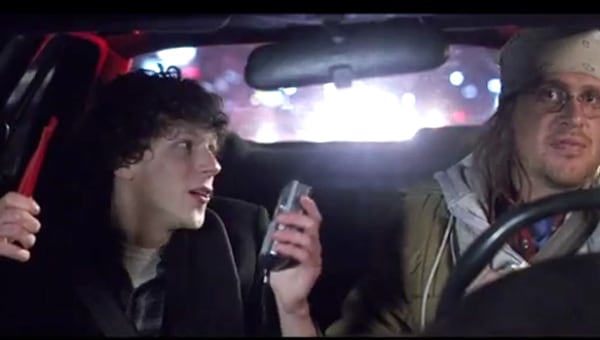
Jesse Eisenberg as David Lipsky in The End of the Tour

Jesse Eisenberg as David Lipsky and Jason Segel as David Foster Wallace
 in The End of the Tour
After hitting what twelve-step programs call rock bottom, Wallace put himself into a kind of training program to learn how to be a human being. Lipsky has just been trying to get ahead and doesn't mind using other people to his own ends  -- which is to bask in the fame he envies Wallace for.

Wallace knows the addictive nature of contemporary life first hand. In the past he has alternately used alcohol and running to assuage crippling depression. He has at one point committed himself, fearing he would botch a suicide.

One of Lipsky's first observations is that there is no television in Wallace's house, and before long we realize there is good reason for that. Wallace's real Achilles' heel is junk television, and its ubiquity on the road sucks him in like Lorelei. 
Jesse Eisenberg as David Lipsky, Jason Segel as David Foster Wallace
and Joan Cusak as their Minneapolis escort in The End of the Tour
In my opinion, Jesse Eisenberg lacks range, but he has developed a weaselly persona that has been put to good use, not least in The End of the Tour where Lipsky's exploitative nature, journalistic and otherwise, inhibits his relationships.

I first saw Eisenberg as one of William Hundert's (Kevin Kline) pupils in Michael Hoffman's The Emperor's Club (2002), but he really emerged in 2005 in Noah Baumbach's The Squid and the Whale as the elder of two sons forced to take sides in their parents' self-involved breakup. I did not see any of his intervening films until he appeared in David Fincer's The Social Network (2010) playing the contemptuous billionaire Mark Zuckerberg; then a cavalier Woody-Allen-character in To Rome with Love (2012), an arrogant street magician in Louis Leterrier's Now You See Me (2013), a scornful domestic terrorist in Kelly Reichardt's Night Moves (2013), and the self-righteously inferior office drone James/bumptious Simon in Richard Ayoade's The Double (2013).
Then there's Jason Segel who has made a career out of the eternal man-child persona, yet demonstrates in The End of the Tour that he has range galore. His name is inextricably linked with Judd Apatow's, though only five of Segel's 25 films to date (a surprising number I come to find out he wrote) were made with Apatow.

The only Segel film I've liked (of the very few I've seen) was the Duplass brothers' Jeff, Who Lives at Home about an adult stoner who still lives with his mother (Susan Saradon) and who, in his quest to find meaning, has latched on to the movie Signs, and thus believes that every single thing he witnesses is indeed an omen he must pursue to realize his destiny. 


Ponsoldt's master stroke with The End of the Tour has been to cast both actors to type. "Some David Foster Wallace fans recoiled when they heard that sitcom veteran Jason Segel had been cast to play the Infinite Jest author in a movie," Mark Jenkins noted in his NPR review.

My reaction on first viewing was that The End of the Tour is quintessentially American but uniquely so, though I left that "uniquely" vague. That is wrong. It is not unique at all.

Indeed, the argument the film makes is that Infinite Jest is a quintessentially American novel; that David Foster Wallace was a quintessentially American novelist; and that the man-child is the quintessential American character. If our protagonists are not the kids Huckleberry Finn or Holden Caulfield themselves, they are grown men behaving like boys: Jay Gatsby, Augie March, Rabbit Angstrom. American literature is one big song of myself.

The Davids of The End of the Tour are traveling the road of the American mythos like Sal Paradise and Dean Moriarty. In the film, the Minneapolis NPR affiliate's interviewer begins by disdainfully describing the physical size of Infinite Jest: "1,079 pages and weighing in at three pounds, three ounces." Philip Roth took more time to do it, but his affair with Nathan Zuckerman ran to 2,200 pages.

Jesse Eisenberg as David Lipsky and Jason Segel in The End of the Tour
Though we hear Lipsky read from his novel, The Art Fair, and from Although of Course You End Up Becoming Yourself: A Road Trip with David Foster Wallace, the book that came out of the days he spent with the writer, we never hear anything from Infinite Jest. The camera cuts away from the bookstore reading just as Wallace walks toward the microphone, as if to divorce the novelist from the man.

Wallace talks and talks and talks about the very motifs the novel explores -- our abandonment of genuine community for the artificial connectedness of screens, our detachment from the natural world, our active disinterest in existential meaning, our addiction to porn -- not necessarily actual pornography, though that's part of it, too, but the pornographic pleasure we derive from the mastication, in the words of the film, of junk food and junk TV and junk consumerism and junk politics and junk thinking that sustain us neither nutritionally nor spiritually.

Keep in mind that Infinite Jest was published in 1996, almost 20 years ago; our disengagement has only intensified since. It's not the glamorous decadence of heroine addiction ala Lou Reed lyrics. It's just banal addiction that makes American consumerist culture thrive, which the film juxtaposes with the valiant attempt Wallace makes to resist the siren song.

Even if it is all talk, this is a raw, moving narrative about an enormously creative individual trying to come to terms with the truth of his own addictions and the truth of some overarching meaning.

Jesse Eisenberg as David Lipsky and Jason Segel as David Foster Wallace
in The End of the Tour
For all his idiosyncrasies and introversion, Wallace is possessed of a deep empathy that the opportunistic Lipsky lacks. At one point Wallace proudly insists that what is most important to him is his regular guy-ness. If the unexamined life is not worth living, then the irony -- and it hangs like a pall over The End of the Tour -- is that this deeply examined life ends a suicide.

On the morning of Lipsky's departure, Wallace goes outside to scrape snow from his car. Lipsky uses the opportunity as one last chance to pry, quickly speaking a list into his tape recorder of the random set dressing of Wallace's life: doggie chew toys, posters, refrigerator postcards, books, soda cans, tchotches, a fluffy toilet seat cover, and then, for the first time, Lipsky notices a plaque in the bathroom:

O my God, teach me to be generous,
teach me to serve you as I should,
to give without counting the cost,
to fight without fear of being wounded
to work without seeking rest, to labor without expecting any reward
but the knowledge that I am doing your most holy will.
                     
~~ St. Ignatius of Loyola

Jason Segel as David Foster Wallace and Jesse Eisenberg as David Lipsky
in The End of the Tour
If there is one element of Wallace that Segel's characterization brings most to the fore, it is Wallace's humility, and it is this humility that Ponsoldt plays against Lipsky's self-interest.

In his now famous 2005 Commencement Address at Kenyon College (I am an admirer of Wallace as an essayist and probably never will read Infinite Jest), Wallace opens with a story about two young fish to whom an old fish passing by calls out: "Morning, boys. How's the water?" "[O]ne of them looks over at the other and goes, 'What the hell is water?'"

The point, Wallace explains, "is that the most obvious, ubiquitous, important realities are often the ones that are the hardest to see and talk about." The point is to cultivate critical awareness about ourselves and about our certainties, which are usually false. 

"This is not a matter of virtue," Wallace insists, "It's a matter of my choosing to do the work of somehow altering or getting free of my natural, hard-wired default-setting, which is to be deeply and literally self-centered, and to see and interpret everything through this lens of self. [....] "[L]earning how to think really means learning how to exercise some control over how and what you think. It means being conscious and aware enough to choose what you pay attention to and to choose how you construct meaning from experience. Because if you cannot exercise this kind of choice in adult life, you will be totally hosed." 

Jason Segel as David Foster Wallace in The End of the Tour
David Foster Wallace made a conscious effort to grow out of the egoistic man-child default-setting where Lipsky is stuck.

If you can do that, Wallace so generously advises the Kenyon graduates, "It will actually be within your power to experience a crowded, loud, slow, consumer-hell-type [adult] situation as not only meaningful but sacred, on fire with the same force that lit the stars -- compassion, love, the sub-surface unity of all things. Not that that mystical stuff's necessarily true: The only thing that's capital-T True is that you get to decide how you're going to try to see it. You get to consciously decide what has meaning and what doesn't. You get to decide what to worship." 

"None of this is about morality, or religion, or dogma, or big fancy questions of life after death. The capital-T Truth is about life before death. .... It is about simple awareness -- awareness of what is so real and essential, so hidden in plain sight all around us, that we have to keep reminding ourselves, over and over: "This is water, this is water.'"


Links to Additional Resources

The End of the Tour. Critics Round Up.

Andrew O'Hehir. "Jason Segel on Playing David Foster Wallace." Salon, July 29, 2015.

A.O. Scott. "The Death of Adulthood in American Culture." New York Times, September 11, 2014.

Amy Taubin. My Dinner with Andre: Long, Strange Trips. The Criterion Collection. June 8, 2015.A Qui

August 4, 2015

THE SENTIMENTAL JOURNEY OF THE DYING GIRL

Emotion and Morality

The idea that emotion directs moral behavior was articulated as early as the 4th century BCE by Mencius, the most significant interpreter of Confucius. "The feeling of commiseration is the beginning of humanity; the feeling of shame and dislike is the beginning of righteousness; the feeling of deference and compliance is the beginning of propriety; and the feeling of right or wrong is the beginning of wisdom."

The western philosophers of moral sensibility – Anthony Ashley-Cooper, 3rd Earl of Shaftesbury; Francis Hutcheson; David Hume; and Adam Smith – all sought to refute Thomas Hobbes's mechanistic view of human nature. Hobbes's 1651 Leviathan lays out a safety net for human interaction that Hobbes calls the social contract – to assure their protection the people agree to accept government, an admittedly artificial political construct, though in doing so they relinquish their own power. Hobbes sees the social contract as a vital necessity for orderly co-existence, but he does not envision rights as inalienable in the Jeffersonian sense. It will be Jean Jacques Rousseau who expands the concept of the social contract to include popular sovereignty, the belief that governmental power emanates from the people, and John Locke who extends the idea to protecting the rights of the individual.

The establishment of the social contract is necessary, Hobbes believes, because without it our animal nature will inevitably leave us in a state of every man for himself (and God against all, as Werner Herzog would have it). This egoistic doctrine of self-interest – the belief that to act in the interest of others is a violation of human nature and that even actions disguised as sympathy are actually in service to self-love – troubled 18th century philosophers who tended toward a theory of moral sensibility.

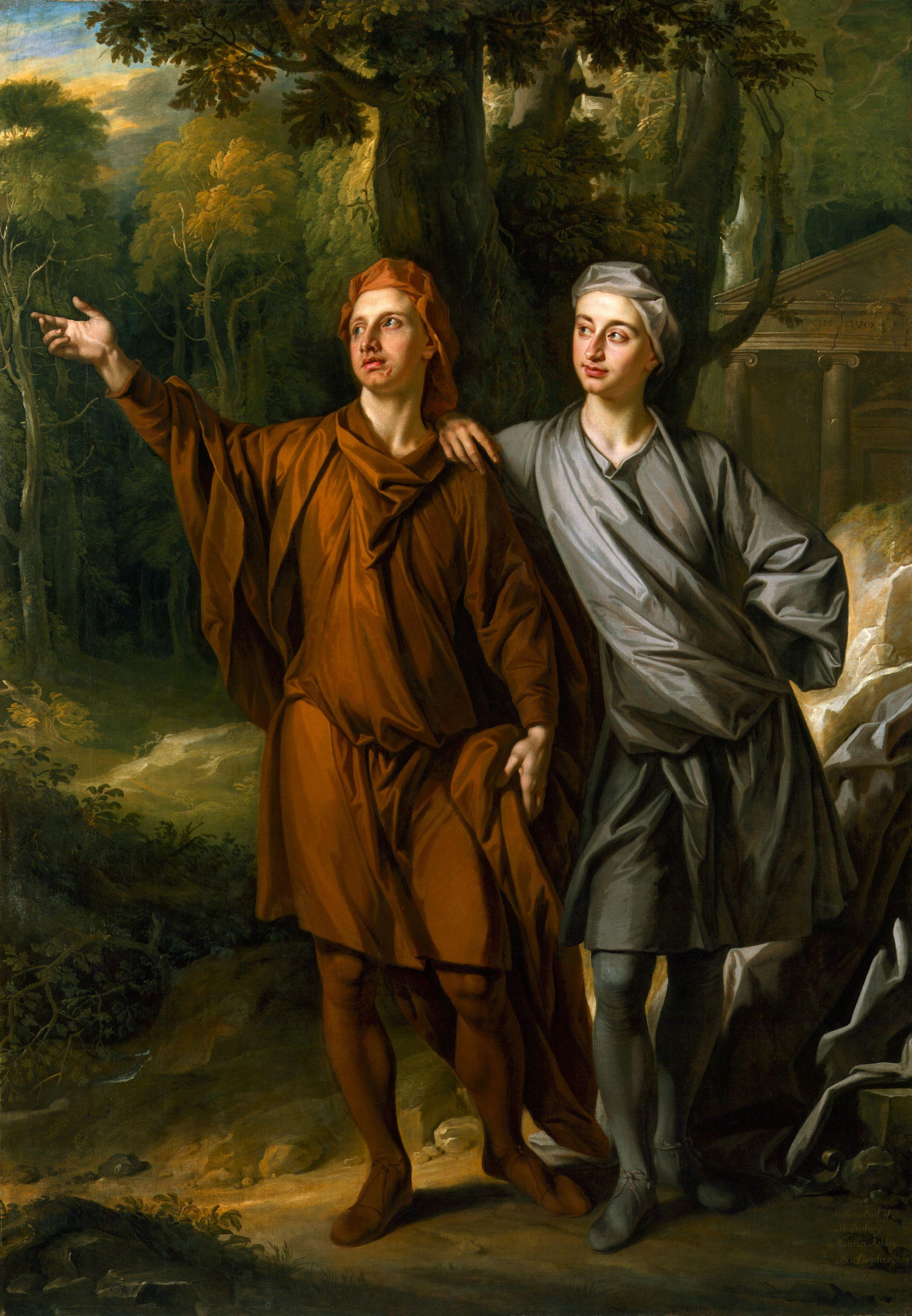
Shaftesbury’s 1699 An Inquiry Concerning Virtue, or Merit espouses a moral sense theory that both the impulse toward egoism and the impulse toward altruism are natural, yet imperfect, and must be balanced.

Anthony Ashley-Cooper with his brother Maurice in a
1702 painting by John Closterman designed to illustrate
his Neo-Platonist beliefs. (National Portrait Gallery)
In An Essay on the Nature and Conduct of the Passions and Affections, with Illustrations on the Moral Sense (1728) and the posthumous System of Moral Philosophy (1755), Hutcheson (whose family of Scottish Presbyterians are known as the founding fathers of the Scottish Enlightenment) identifies, in addition to the five external senses, six internal senses – consciousness, the sense of beauty, the public sense, the moral sense, the sense of honor, and the sense of the ridiculous – of which the moral sense is the most important, being instinctive and immediate, unlike reason, which is mediated.

Hume's An Enquiry Concerning the Principles of Morals (1751) also provides a naturalistic explanation of morality – that it "depends on some internal sense or feeling, which nature has made universal in the whole species." Hume’s moral sense theory, or sentimentalism, is based on a principle of communication and sharing of sentiments, positive and negative – what we call empathy – and rejects psychological egoism.

In The Theory of Moral Sentiments (1741), Adam Smith argues that even as selfish human beings, we are inclined toward pity and compassion. "That we often derive sorrow from the sorrows of others, is a matter of fact too obvious to require any instances to prove it; for this sentiment…is by no means confined to the virtuous or the humane, though they perhaps may feel it with the most exquisite sensibility."

Shaftesbury, Hutcheson, Hume, and Smith share the view of human beings, not in isolation, but in community. Shaftesbury believed humans are social beings and only through virtuous interaction with their fellows can they be deemed moral. Hutcheson held that actions that flow from self-love alone are morally indifferent, that only actions that promote "the greatest happiness for the greatest number" can be regarded as morally good. For Hume, sentiment, because it is based in sympathy, motivates us to pursue altruistic ends.

From Philosophy to Fiction

Of his novel Sentimental Education (1869), Gustave Flaubert wrote, "I want to write the moral history of the men of my generation – or, more accurately, the history of their feelings." The concept of sensibility – the idea that knowledge comes by way of acute perception that heightens certain individuals' feelings for the world, for others, for beauty and moral truth – entered the popular culture in the century before Flaubert's through poetry, music and the newly minted novel.

Among the 18th century's freshly fashioned novelistic genres was the Bildungsroman, the novel of the sensitive young man's coming of age. The genre typically involves a traumatic event that occasions the young protagonist to journey into a world whose values he finds hostile. Only by adapting to society through a trajectory from oppression to worldly acceptance can the character reach maturity.


Though the genre has precursors dating as far back as the 12th century, and is related to ancient quest narratives, its popularity gained momentum throughout the 18th century in England and France: Henry Fielding’s Tom Jones (1749), Voltaire’s Candide (1759), Laurence Sterne’s Tristram Shandy (1759), Rousseau’s Emile (1762), culminating in Goethe’s German masterpiece, Wilhelm Meister’s Apprenticeship (1795-1796). Indeed, 19th and 20th century German writers produced exemplary works in the genre from Gottfried Keller’s Green Henry (1855) and Adalbert Stifter’s Indian Summer (1857) to Robert Musil’s The Confessions of Young Törless (1906) and Thomas Mann’s The Magic Mountain (1924).

Pierre Staal illustration from Rousseau's Emile
No Bildungsroman of the 18th century features a female protagonist (that I know of), and in the 19th, only Charlotte Brontë’s Jane Eyre (1830) and Henry James’s What Maisie Knew (1897) come to mind – in both of which the main characters determine their fates outside marriage. Jane refuses St. John Rivers’ proposal (though she will ultimately decide to marry Edward Rochester), and Maisie chooses her guardian over her parents. By and large, the female protagonist figures in the novel of sensibility rather than in the Bildungsroman, and her fortunes are determined by the man she does or does not marry. Her emotions and sensitivity inform her virtue from Samuel Richardson’s Pamela (1740) to Jane Austen's heroines struggling to balance sense (prudence) and sensibility (emotion) in their choice of husbands. By the mid-late 19th century, she's cheating her way through men and money like William Thackeray’s Becky Sharp in Vanity Fair (1847) who ends well and Gustave Flaubert’s Emma Bovary (1856) who makes a mess of things and ends it all with arsenic, or she is at the mercy of fate (and libertines) in Thomas Hardy's Wessex.

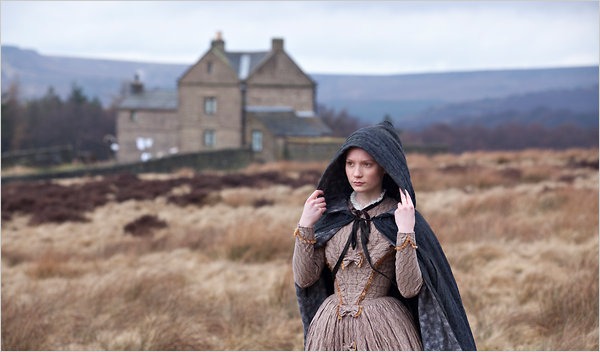
Mia Wasikowska as Jane Eyre in Cary Fukunaga's 2011 film adaptation
Sentiment and Consumption

Because the protagonist of the Bildungsroman has experienced persecution, he often grows up to mitigate others' misfortunes, whereas the protagonist of the sentimental novel grows up to marry, if she is lucky. By the 19th century, however, she might not get the nuptial chance, for when the nerves of young women of sensibility are over-taxed, they have a tendency to succumb to illness in one form or another.

Susan Sontag’s Illness as Metaphor was published in 1978. In it Sontag assaulted the metaphorical uses to which illness is put to turn disease into mythology. The Romantic poets of the 19th century made consumption an innate psychic state experienced by sensitive artistic spirits possessed of the spiritual and moral attributes of nobility, creativity, and melancholy. In "Ode to a Nightingale" (1819), Keats's "youth grows pale, and spectre-thin, and dies...." (Keats himself died of tuberculosis in 1821, aged 25 – as did much of his family.) The female consumptive, by contrast, suffers the wasting disease as a natural consequence of her desires. She is sensitive, yes, but she brings her suffering on herself.

Joseph Severn's "Sketch of the Dying Keats" inscribed:
"20 Janry 3 o'clock mng. Drawn to keep me awake -
a deadly sweat was on him all this night."

Sometimes female characters die because they reject the established social order. Samuel Richardson's Clarissa (1748) succumbs to illness as a result of her attempts to evade the vile Lovelace’s captivity. In Mary: A Fiction (1788), Mary Wollstonecraft's only completed novel, Mary's sensibility runs counter to the conventions of the times, and the ending suggests that, forced as she is to conform to those conventions, she faces the inevitability of premature death. Both women are doomed because they seek to live lives of freedom on their own terms.

Just as the philosophical concepts of moral sentiment paved the way for 19th century Romanticism, they laid the groundwork for Freud. From Hippocrates until the late 19th century, the disorder that went by the name "hysteria" was believed to be a uniquely female malady of sexual dysfunction. (Greek "hystera" means "uterus.") Freud would alter that view by arguing that hysteria was the unconscious mind's attempt to shield an individual from psychic trauma, though he, too, would focus attention on the condition as evinced in women. In literature the manifestation of psychic distress is a literal disease rather than vague hysteria.

And so the popular imagination, just as it had venerated female martyrs throughout the ages, was primed by the 19th century to romanticize, even idolize, the dying heroine, making the dying girl a staple of Romance (with an upper case "R") novels, Italian opera – and in our own time, romance (with a lower case "r") novels, young adult lit, and Hollywood tear-jerkers.

Prior to the 20th century most people lived amidst death with an immediacy that we (that is "we" in first world, affluent countries) cannot imagine, so it is natural that mortality should inform the fiction. Disease and dying in literature, however, are disproportionately the province of heroines over heroes.  In Jane Austen's Sense and Sensibility (1811), Marianne suffers from a "putrid tendency" (probably typhus). Though she doesn't die, the illness creates a crisis of sense to bring her back round to sensibility. 

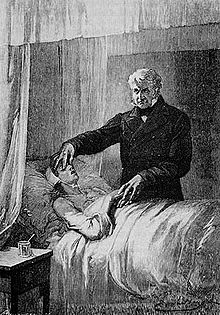
The death of Fantine: Valjean (as Mayor Madeleine)
closes her eyes.
The allure of the dying heroine, particularly those wasting away from consumption, was not exclusive to English writers. Afflicted heroines become standard fare in French literature as well. In Victor Hugo’s 1862 novel Les Misérables, Fantine, having had to resort to prostitution, succumbs to consumption. Another two novels – and the Italian operas adapted from them – feature likewise stricken heroines. In 1848, Alexandre Dumas (fils) created the consumptive Marguerite – based on his lover Marie Duplessis – in The Lady of the Camellias. The dramatic adaptation became the basis for Giuseppe Verdi’s 1853 opera La Traviata. Violetta, a consumptive courtisane, moves among the aristocracy but their wealth and status cannot save her.

Three years after Dumas’s novel, Henri Murger, best known for his poem “La Chanson de Musette,” penned the episodic novel La Vie de Bohème with Mimi, another consumptive heroine, at its center. Giacomo Puccini adapted the novel into the late-Romantic opera La Bohème, which premiered in 1896. The wan youths of the Romantic poets and then Romantic heroines like Marguerite/Violetta and Mimi gave consumption the cachet Sontag so vociferously excoriated. Indeed the English poet Lord Byron declared, “I should like to die from consumption.” (He would die instead of banal sepsis from unsterilized bloodletting instruments.) La Traviata and La Bohème remain among the most performed operas across the globe to this day, attesting to the allure of the tragic heroine dying in the fullness of youth.

To say Dumas’s courtisane has legs is understatement. In addition to many Camille stage adaptations, there are the musical adaptations – the 2008 production Marguerite set in 1944 Vichy France and Baz Luhrmann's 2001 film Moulin Rouge! with Nicole Kidman set at the fin de siècle.

Baz Luhrmann's 2001 Moulin Rouge! with Nicole Kidman:
Satine's death scene
The Lady of the Camellias has been dramatized in dance as well. In 1963 Sir Frederick Ashton premiered his choreography specially created for Rudolph Nureyev and Dame Margot Fonteyn, Marguerite and Armand. Veronica Paeper premiered her Camille in 1990, which has been performed ever since; and Lady of the Camellias set to music by Frédéric Chopin was choreographed for Marcia Haydée by John Neumeier in 1978 and for Ballet Florida by Val Caniparoli in 1994.

Silent films include the 1907 Danish Kameliadamen with Oda Alstrup; the 1911 French La Dame aux Camélias with Sarah Bernhardt; the 1915 Italian La Signora delle Camelie with Hesperia; a 1921 English version with Nazimova and Rudolph Valentino; and the 1925 Swedish Damen med kameliorna with Tora Teje.

The first sound adaptation was the 1934 La Dame aux Camélias adapted by Abel Gance and directed by Gance and Fernand Rivers with Yvonne Printemps and Pierre Fresnay; then George Cukor’s 1936 Camille with Greta Garbo and Robert Taylor; a 1944 Mexican Camelia with Lina Montes and Emilio Tuero; the 1953 French La Dame aux Camélias with Micheline Presle and Gino Cervi; the 1954 Mexican Camelia with María Félix and Jorge Mistral; the 1954 Argentinean La mujer de las camellias with Zully Moreno and Carlos Thompson; a 1957 Turkish Kamelyalı Kadın with Çolpan İlhan and Fikret Hakan; yet another French version, the 1981 La Dame aux Camélias with Isabelle Huppert and Gian Maria Volonté; and a 1994 Polish Dama Kameliowa with Anna Radwan and Jan Frycz.

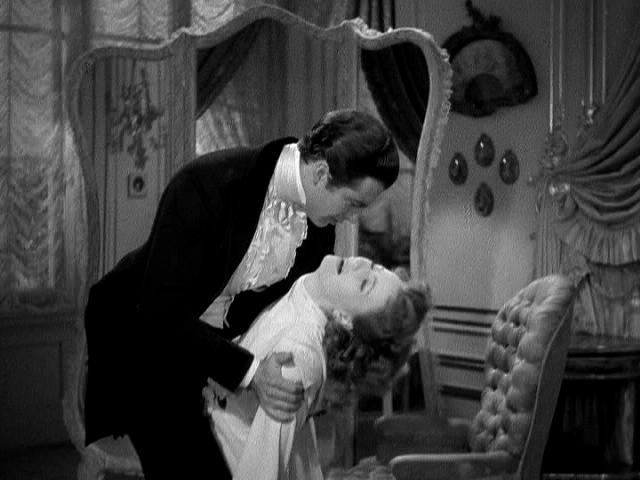
Greta Garbo and Robert Taylor in George Cukor's 1936 Camille
And then there was Eric Segal's book and Arthur Hiller's movie adaptation of Camille that besotted teen girls throughout the 1970s: Love Story. (Film critic Judith Crist called Love Story,"Camille with bullshit.") By this time, Love Story absurdly and vacuously makes the claim that "Love means never having to say you're sorry," and the disease du jour has changed from consumption to the scourge of our era – cancer, specifically in Love Story's case, leukemia. 

Arthur Hiller's 1970 Love Story
Maladies in the Movies 

(NB: The criteria for the films under discussion do not allow the central character to be a child or elderly, but young or relatively young – even middle aged – characters ailing from disease, and do not allow for Christian or Nicholas Sparks movies.)

In contrast to the more vague – and romantic – diagnosis of "consumption," post-19th century fiction is predominated by cancer, identified with increasing specificity as time has gone by. Judith Traherne (Bette Davis) in Edmund Goulding's 1939 Dark Victory suffers from a brain tumor, and the film goes to some lengths to incorporate the medical terminology of the day. In Gary Marshall's 1988 Beaches, Hillary Whitney (Barbara Hershey) is dying of viral cardiomyopathy; in Pat O'Connor's 2001 Sweet November, Sara Deever (Charlize Theron) is dying of Non-Hodgkin lymphoma; in Ol Parker's 2007 Now Is Good, Tessa Scott (Dakota Fanning) is dying of acute lymphoblastic leukemia; and in Josh Boone's 2014 The Fault in Our Stars, Hazel Lancaster (Shailene Woodley) is dying of thyroid cancer that has spread to her lungs.

Bette Davis and Humphrey Bogart in Edmund Goulding's 1939 Dark Victory
Sontag held that in the 20th century, cancer patients are characterized as emotionally repressed, pessimistic loners. Again, the popular culture has more often than not gendered the stereotype, and the young women dying of cancers in the movies far outweigh the young men. I came up with only a few films that treat a young man's impending death from cancer from a purely dramatic perspective, the earliest of which was Joel Schumacher's 1991 Dying Young. Others include Bruce Joel Rubin's 1993 My Life; Wendell Morris's 2001 The Medicine Show; Chris Kraus's 2002 Shattered Glass; Patrice Chéreau's 2003 Son frère; Todd Kessler's 2008 Keith; and Conrad Jackson's 2011 Falling Overnight.

Filmmakers seem to feel more at ease wedging dying male characters into more comfortable tropes like the Buddy Movie: Neal Israel's 1992 Breaking the Rules; Judd Apatow's 2009 Funny People; Jonathan Levine's 2011 50/50; and the German director Thomas Jahn's 1997 Knockin’ on Heaven’s Door, in which two hospital patients, both of whom have what we are only told is an untreatable disease, go on a picaresque spree.

Martin Brest and Rudi Wurlitzer in Thomas Jahn's 1997
Knockin' on Heaven's Door
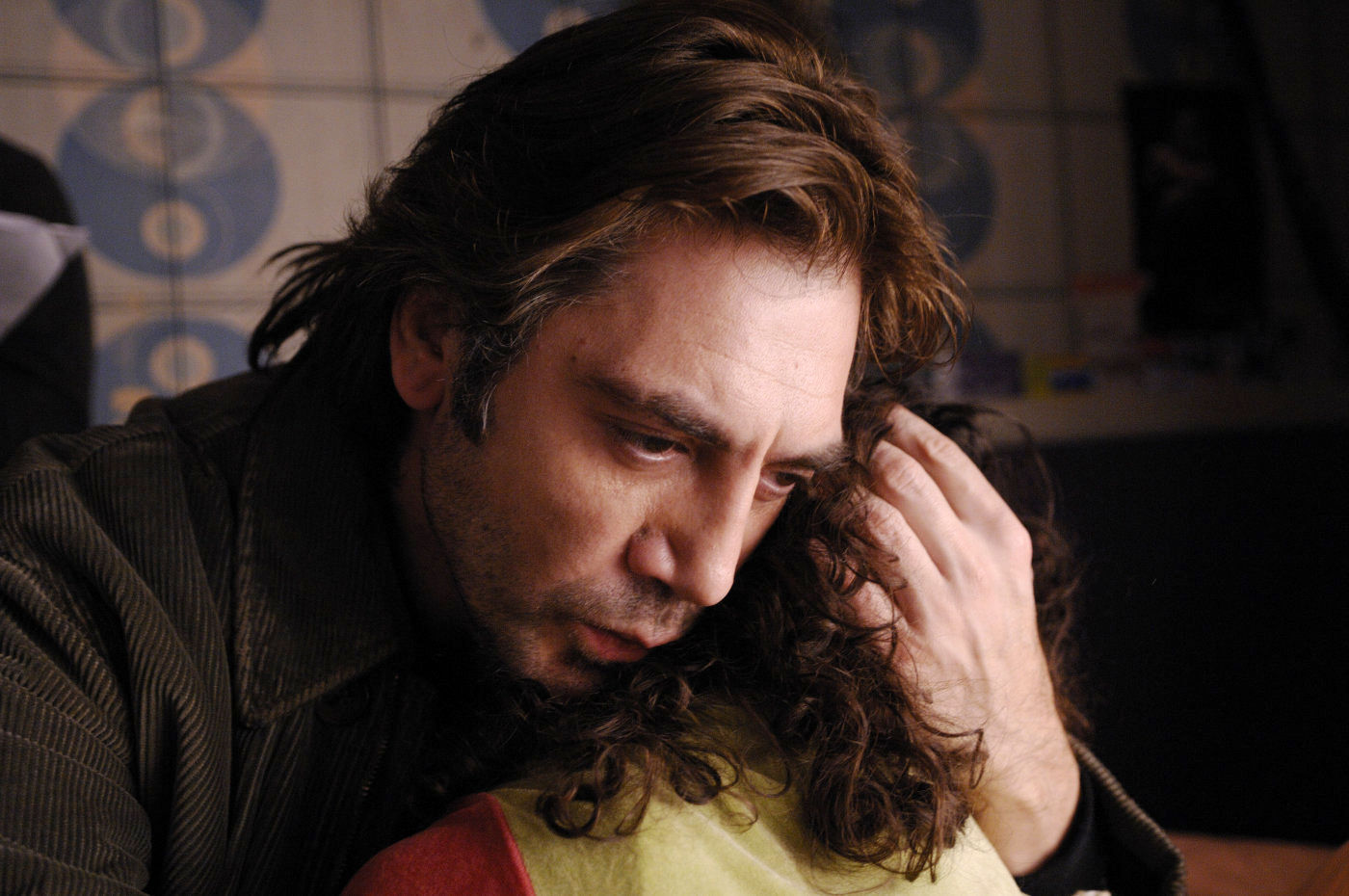
The two films with dying men that come closest to reflecting the redemptive character type are Irwin Winkler's 2001 Life as a House, in which Kevin Kline's disagreeable architect ultimately functions as a catalyst of grace for his family, and Alejandro González Iñárritu's 2010 Biutiful, in which the rumpled, beatific Javier Bardem is cast as something of a modern-day shaman/saint.

I have excluded films like Bill Sherwood's 1986 Parting Glances, Jonathan Demme's 1993 Philadelphia, and Joe Mantello's 1997 Love! Valour! Compassion! – based on Terrence McNally’s 1994 play – where the protagonist is dying of AIDS, because the AIDS drama has evolved into something of a genre unto itself, and its central characters, as men, exhibit more obstinacy and resolve than their wasting female counterparts. 

Javier Bardem in Alejandro Gonzalez Inarritu's 2010 Biutiful
In contrast to Hobbes's belief that without a social contract our animal nature will inevitably leave us in a state of anarchic chaos were philosophers who believed not only that emotion and its attendant morality are inherently human, but that empathy is universal and bound up in feeling. The Bildungsroman was, and to some extent still is, predominantly the province of male protagonists, the sentimental novel the province of heroines: men make their way in the world, women marry – or die. The Romantics pathologized feeling and introduced the young man whose nearness to death heightens his sensitivity, making him a conduit of transcendent insight. Also pathologized is the young woman who resists marriage and has little to teach us of transcendent worlds. His sickness is a result of his creative soul, hers the result of her resistance to her proper place in nature.

Dying Alone

Part of the dramatic appeal of La Traviata and La Bohème and their heirs (including Jonathan Larson’s 1996 musical Rent, which transports La Bohème into an East Village, HIV-positive gay theater milieu) is the demi-monde community that circulates around their protagonists. The 20th and 21st century dying girl is surrounded by much smaller casts of supporting dramatis personae. She may only have a boyfriend or husband at her side (Love Story), maybe a best friend (Beaches), or estranged members of a nuclear family (James Brooks's 1983 Terms of Endearment adapted from Larry McMurtry's 1975 novel).

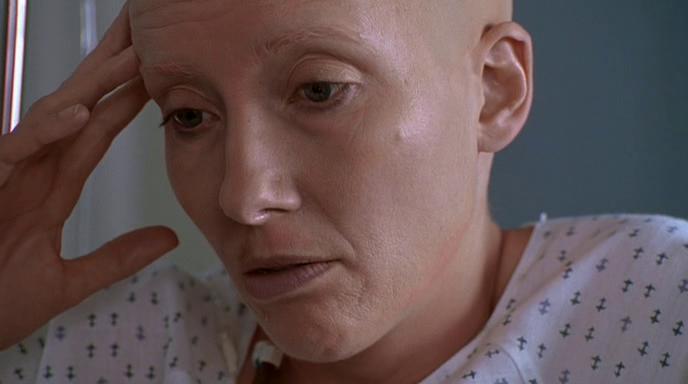
Emma Thompson as Vivian Bearing in Mike Nichols's 2001 adaptation
of Margaret Edson's 1995 play
The character who goes it solely alone is Vivian Bearing, a scholar of metaphysical poet John Donne, in W;t, Margaret Edson's 1999 Pulitzer Prize-winning play adapted by director Mike Nichols and actress Emma Thompson into the 2001 Emmy Award-winning television drama. On its surface, W;t might seem to break the trope of the dying heroine, but in reality it only reinforces it. In one of the best analyses of W;t I have read, Jacqueline Vanhoutte of the University of North Texas places the play squarely in the midst of the dying heroine metaphor with all its trappings, most notable among them that Vivian's intellectual rigor is the root cause of her cancer and that her suffering provides the catalyst for her redemption. Vanhoutte cites the Shakespearean scholar A. C. Bradley: tragedy necessitates "calamities and catastrophe follow inevitably from the deeds of men." From that premise, Vanhoutte argues that "to make a cancer patient the subject of a tragedy is to reproduce and legitimate the 'moralistic and punitive' fantasies about cancer that Sontag describes."

"Edson proposes," Vanhoutte continues, "that, in privileging reason over emotion, 'research' over 'humanity,' Vivian has pursued a course that ensures her 'immense success' as an academic even as it proves detrimental to her health." Treated as an object of research with a piteous absence of compassion, Vivian comes to realize that intellectual rigor (sense) is a barrier to kindness (sensibility).

In the previous essay I said that Me and Earl and the Dying Girl comes at the sentimental trope of the deathbed heroine obliquely and makes it into something else, something larger. Rather than a movie about a dying girl, it is a story about art, a story about the stories we tell, a story about the idea that in doing and making we transcend mortality. And focusing as it does on "ME," Me and Earl and the Dying Girl is not a story of sentiment but a modern-day Bildungsroman, in which the dying girl is an impetus for the young man's coming of age.

The Redoubtable Woman Instead

Dying is universal and profound so we are bound to tell stories about it, but aside from being sad, the dying girl trope is too often pretty shallow – and sexist. There is sometimes something even prurient about it. The dying girl notwithstanding, independent heroines have been out there – for centuries. In the 6th century Chinese poem, The Ballad of Mulan, a 17-year-old goes to war in her father's stead and triumphs in battle again and again. She has been variously imagined since, most recently and unfortunately in 1998 as a bumbling Disney animated character. Chaucer invented the bawdy Wife of Bath in the 14th century, who would become the most memorable of his pilgrims. There are the various heroines of YA trilogies, and there is that Nordic goth of The Girl with the Dragon Tattoo (2005), Stieg Larsson's Lisbeth Salander, brilliant computer hack and rebellious outsider.

Hua Mulan
In America's Women: Four Hundred Years of Dolls, Drudges, Helpmates, and Heroines, Gail Collins observes that "Some of our national heroines were defined by the fact that they never nested  – they were peripatetic crusaders like Susan B. Anthony, Clara Barton, Sojourner Truth, Dorothy Dix." Let's tell more stories – not biopics about these actual women necessarily – but stories about strong, imagined women like them. Doing so would deepen and enrich our understanding not only of our female compeers but of our collective human psyche.


UPENDING A TROPE: ME AND EARL AND THE DYING GIRL


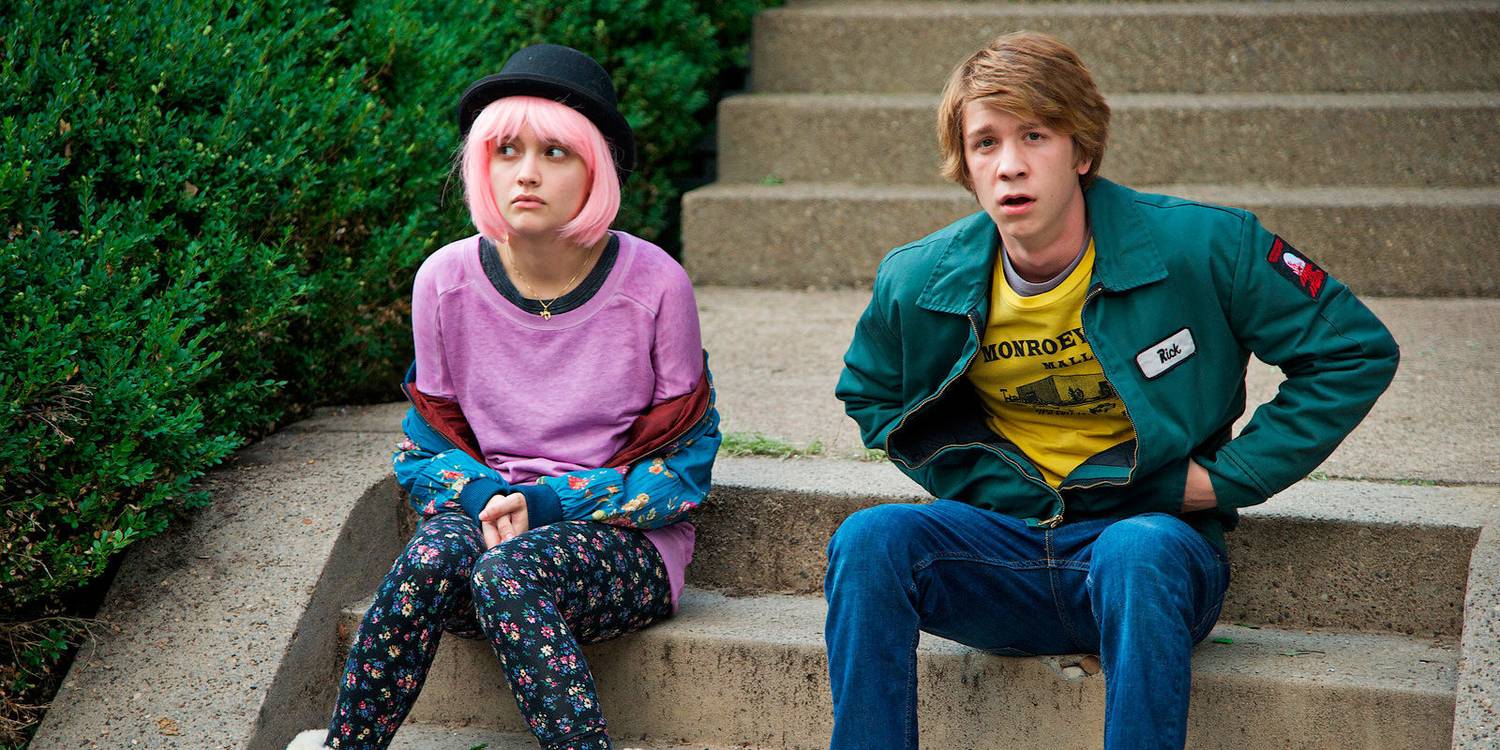
Rachel Kushner has leukemia. She's the dying girl in Me and Earl and the Dying Girl, directed by Alfonso Gomez-Rejon (former assistant to Martin Scorsese) and based on Jesse Andrews's 2012 novel. As the title suggests, the three central characters are "Me," Greg Gaines (Thomas Mann) and, as the grammar suggests, the film's principle, somewhat self-absorbed character; Earl (RJ Cyler), Greg's artistic collaborator and lone friend; and Rachel (Olivia Cooke), that groan-inducing stereotype, the dying girl.

Greg is the archetypal, adolescent misfit. He deals with his outsiderness (which is to say his intellect and talent) by adopting the tics and lingo of every high school "tribe" in an effort to earn a measure of acceptance from all while belonging to none. Greg's father (Nick Offerman) – a traveled social anthropologist who, now that he has settled into academe, spends most of his time at home outfitted in ethnic garb he wears like bathrobes while preparing exotic foodstuffs for Greg and Earl -- has probably, unwittingly, fostered his son's defensive social technique insofar as he is himself a student of tribes. 

Earl (RJ Cyler), Mr. Gaines (Nick Offerman)
and Greg (Thomas Mann)
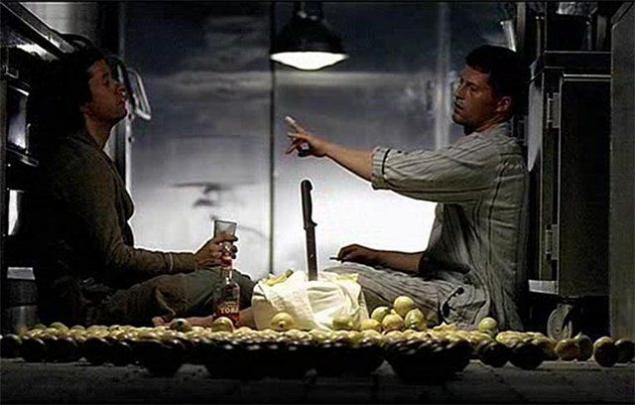
Greg's father also has amassed an impressive library of classic and foreign films that Greg and Earl have been weaned on, leading to their shared obsession with movies to which they pay homage by making spoofs, hundreds of them: Monorash (Kurasowa/Akutagawa), The 400 Bros (Truffaut), A Sockwork Orange (Kubrick/Burgess), Death in Tennis (Visconti/Mann), the hilarity of the list goes on. 

Greg and Earl's parody of Louis Malle's film
written by and starring
Andre Gregory and Wallace Shawn
Greg and Earl seek refuge during high school lunch hours in the office of history teacher Mr. McCarthy (Jon Bernthal) where they watch his equally impressive video library, replete with Werner Herzog documentaries, among other arthouse fare. Mr. McCarthy – hip and tattooed – daily exhorts his students to "Respect the research!"

And there's Rachel, a somewhat introverted, self-deprecating young woman who is, well, dying. Greg's mother (Connie Britton) insists the reluctant Greg spend time with the stricken former schoolmate in a not quite pity party sort of way. Once Greg has re-acquainted himself with Rachel and her mother, Earl naturally enters the circle.

New York Times critic A.O. Scott describes the movie as a "terminal teen melodrama, a bittersweet coming-of-age story, a wistful tale of interracial friendship." He notes that "On paper, Mr. Andrews's book is lovely: sensitive and rueful and attuned to both the solipsism and the ethical seriousness of adolescence." Rolling Stone's Peter Travers writes that the film "deserves to be the summer's sleeper hit. It's that sharply funny, touching and vital." Writing for The Guardian, Ed Gibbs calls it an "inspired, insightful romp…. [....] The casting is excellent… and the script is sharp and authentic." Sheila O’Malley writing for rogerebert.com hates, hates, hates the film, which is unfortunate because I have read enough of Ebert's criticism over the years to be almost certain he would have liked it.

Earl (Thomas Mann), Mr. Gaines (Nick Offerman) and Mrs. Gaines (Connie Britton)
Gomez-Rejon’s film is much more than a terminal illness movie, and therein lie its rewards. To that end, I am most interested in Richard Brody’s review for the New Yorker, "What's Missing from Me and Earl and the Dying Girl." "What are movies for, what can they do, why make them?" Brody asks by way of introduction. "That is the central subject of the new teen drama Me and Earl and the Dying Girl, which is a movie of amiable sentimentality and considerable skill, but of canned sensibility."

From there Brody's essay is divided almost exactly in half. The first half concerns his quarrel with the film, encapsulated in his New Yorker title "What’s Missing…," to which I would argue that the rejoinder to part of this quarrel is planted squarely in the title of the film.

"In a way," Brody says, "the movie is the story of three bedrooms, two of which – Greg's, and that of the 'dying girl'…– are seen, and one of which, Earl's, is not." Brody sees the depiction of Greg and Rachel's neighborhood as comfortably middle-class and white and Earl's as dilapidated and poor, a risky place Greg is loath to visit, as a sociological stereotype to which Hollywood is prone. Point taken, but he goes on to extrapolate that "Greg doesn't know anything about Earl and doesn't bother to ask." We are made well aware that Greg and Earl have known each other for years; we're only seeing the slice of their lives they share with Rachel. Furthermore, the self-absorbed teen has been a staple of American literature at least since Holden Caulfield, so I find this criticism unduly harsh, and though Earl is the more emotionally sensitive of the two friends, he is an introvert himself. 

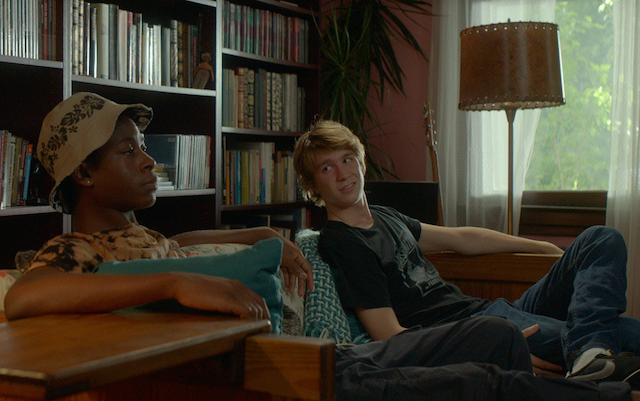
Earl (RJ Cyler) and Greg (Thomas Mann)
Brody also complains that "only Greg, the movie's first-person character, gets a voice-over, not Earl or Rachel." Did Billy Wilder slight Norma Desmond by giving all of the voice-over to Joe Gillis in Sunset Boulevard? Should Alvy Singer and Annie Hall have engaged in parallel points of view with the audience? Somehow I don't think so.

In Ancient Greek theater the protagonist is not simply the principle character, but the character with whom the audience is meant to identify and who undergoes some change through the crucible of conflict. The deuteragonist is the secondary character, who alternately acts as the protagonist's ally and challenger, depending on the deuteragonist's own conflict. The tritagonist is the tertiary character, who prompts the protagonist's empathy.

Me and Earl and the Dying Girl is about Greg. It is not about Earl nor is it about Rachel the dying girl, except insofar as these two characters fulfill their classic dramatic roles and additionally round out the meditation on adolescence. In that regard at the very least, the film deviates from the dying heroine trope, which trains its sights on the suffering heroine. But Me and Earl and the Dying Girl is about something bigger than Greg, and to this, Brody directs the second half of his essay. The unattainable object of Greg's young affections, Madison (Katherine C. Hughes), suggests, "in a plot twist," says Brody, "that's the most significant matter in Me and Earl and the Dying Girl" that the cinéastes make a film for Rachel.

Rachel (Olivia Cooke) and Greg (Thomas Mann)
Surely Me and Earl and the Dying Girl has already been added to searchable Internet lists of self-reflexive movies, and indeed, the plot explores three cinematic storytelling modes (Brody calls them "genres"). "There are, first," Brody notes, "the parodies that Greg and Earl make together…. Then there's Greg and Earl's first stab at a film for Rachel, a documentary tribute…. And then…there's the film that Greg makes for Rachel, on his own, without Earl's involvement [….] an abstract animation. [….] It's a highly labor-intensive film that reveals devotion, imagination, craft, skill, and discipline. It also suggests, in its abstraction, the unrepresentable enormity of Rachel's situation. ([I]n 2006, the late musician Ornette Coleman told Fred Kaplan, 'This term abstract art—what it means is something that causes you to see more than what you're looking at.')"

Brody is writing for a major publication that probably has a policy against spoilers, so he leaves it at that, but the film's coda is the grail of its trajectory. Three narrative scraps will come together to become the wonderment of the film's close. The first is a throw pillow. On his initial foray into Rachel's room, Greg makes the small-talk observation that Rachel has a lot of pillows. The second is Greg's mother prodding him to pore through an encyclopedic catalog she foists on him of America's colleges and universities. Over the course of the year, however, preoccupied as he is, Greg ceases to engage academically, and the college that had accepted him must subsequently reject him. He gives the college guidebook to Rachel, something as a talisman of both hope and hopelessness. Thirdly, during the course of their failed documentary attempt, Greg and Earl interview Rachel's mother, who describes Rachel's reaction to her parents’ divorce. Rachel, her mother reveals, has a seriously destructive streak. She took all of the books in the house and hacked them to pieces with scissors.

Rachel (Olivia Cooke)
Two parallel narratives are interlaced in Tim O'Brien's masterwork The Things They Carried, both about love and loss. The first story – and The Things They Carried, if it is about anything, is about the primacy of storytelling to the human condition – is a war story, specifically a Vietnam war story: "In any war story, but especially a true one, it's difficult to separate what happened from what seemed to happen. What seems to happen becomes its own happening and has to be told that way. The angles of vision are skewed. When a booby trap explodes, you close your eyes and duck and float outside yourself. …[T]he pictures get jumbled, you tend to miss a lot. And then afterward, when you go to tell about it, there is always that surreal seemingness, which makes the story seem untrue, but which in fact represents the hard and exact truth as it seemed."

The parallel narrative in The Things They Carried is the narrator's reminiscence on his childhood – specifically his first, deep love, Linda. Linda has leukemia, and senses Tim's apprehension about her impending death. In her nine-year-old matter of factness, she tries to console him: "Well, right now I'm not dead. But when I am, it's like... I don't know, I guess it's like being inside a book that nobody's reading. [....] An old one. It's up on a library shelf, so you're safe and everything, but the book hasn't been checked out for a long, long time. All you can do is wait. Just hope somebody'll pick it up and start reading."

At Rachel's Shiva, Greg steals up to her room, ostensibly to take a particular one of those pillows. Once there he sees that college guide doorstop of a book, and he picks it up. Inside, what he finds is Rachel – or something larger – Rachel's inner, creative life. Only in the final scenes do we – and Greg – come to understand that Rachel was an artist. She painstakingly cut each page after page of book after book, Greg finds, to layer each into a three-dimensional world. Indeed, she has turned her entire room into a realm of her creative imagining.

Rachel (Olivia Cooke) and Greg (Thomas Mann)
Me and Earl and the Dying Girl comes at the deathbed heroine obliquely and slips her into something else, something larger, something profound. Early on Greg tells us, "So if this was a touching romantic story, this is where our eyes would meet and we would be furiously making out with the fire of a thousand suns –––– but this isn't a touching romantic story." It is a story about agape and about the redemptive power of art – the art of movie making, the art of sculpture, the art of college entrance essays, the art of the stories we tell. In the decades that I taught freshman English, I was repeatedly struck by the preponderance of literature that explores the failure of human communication, and yet, there I found myself, day after day, standing in front of a class full of people with 300+ pages of words in my hands. Is there any more eloquent a testament to hope than the efforts of one human being after another – using every trope, every medium in the arsenal – to try to craft meaning in the midst of despair?

~~~
This essay is followed by a companion essay, "The Sentimental Journey of the Dying Girl."


Interview with director Alfonso Gomez-Rejon

Charles Ealy provides “A Guide to Fun Movie References in Me and Earl and the Dying Girl” in Austin 360, but to peek before you see the movie would be a real spoiler.

June 24, 2015

UPON THE AWFUL TREE: A CINEMATIC SYMPHONIC POEM

Click for Options

Throned Upon the Awful Tree

Throned upon the awful tree,
King of grief, I watch with Thee;
Darkness veils Thine anguished face,
None its lines of woe can trace,
None can tell what pangs unknown
Hold Thee silent and alone.

Silent through those three dread hours,
Wrestling with the evil powers,
Left alone with human sin,
Gloom around Thee and within,
Till the appointed time is nigh,
Till the Lamb of God may die.

Hark, that cry that peals aloud
Upward through the whelming cloud!
Thou, the Father's only Son,
Thou, His own anointed One,
Thou dost ask him -- can it be?
"Why hast Thou forsaken Me?"

Lord, should fear and anguish roll,
Darkly o'er my sinful soul,
Thou, who once wast thus bereft
That Thine own might ne'er be left,
Teach me by that bitter cry
In the gloom to know Thee nigh.


THE HYMNS

Englishman John Ellerton -- whose long and illustrious career in the Church of England was eclipsed by his prominence as an hymnologist, editor, hymnwriter, and translator -- wrote these words in 1875 at the request of Henry Baker, Vicar of Monkland Priory Church in Herefordshire, and editor-in-chief from 1860 to 1877 of Anglican Hymns Ancient and Modern.


San Antonio Symphony violist Matthew Diekman, inspired by the hymn -- and his introduction through a colleague to the complicated, almost ceremonial process of preparing absinthe with its unique accoutrements -- set about writing a story involving the intoxicating ritual of fire and ice and a mysterious stranger who insinuates himself into a traveling party sheltering for the night under an old tree in the Texas wilderness. Diekman conceived the story as a film and enlisted his friend Matthew Dunne, composer and University of Texas at San Antonio associate professor of music, to write an original score to bring the tale to life. He then recruited a number of his San Antonio Symphony colleagues to perform it. Upon the Awful Tree is the film that grew out of that collaboration. 


Musically, Diekman says, what drew him to "Throned Upon the Awful Tree" is its tonality. The hymn "is in G minor," composer Dunne explains, "but the first measure or so is really in G major. It doesn't turn minor until the second bar. It's an unexpected note when you hit that B-flat in the second bar."

The tune traces back to a Welsh folk melody entitled "Arfon," named for the southern shore of the Menai Strait in mainland Wales closest to the Island of Anglesey, and in Welsh means "facing Anglesey." "Arfon" is in G major, or G modal, with a hymn meter (not the musical meter but the pattern of syllables and stresses in the text) set to 7.7.7.7 D (the "D" indicating that the four lines of seven syllables each are doubled), a common structure in the folk tunes and hymns of English, Irish,
Scots, and Welsh immigrants that found their way into the United States with the westward expansion, being most authentically preserved in the isolated hollers of Appalachia.

The tune was published in Edward Jones's Musical and Poetical Relicks of the Welsh Bards in 1784, and itself can be traced back to a six-phrase tune in minor tonality, "Tros y Gareg" ("Over the Stone" or "Crossing the Stone"), a Celtic folk song.


"The sentiment of ['Tros y Gareg']," says Lesley Nelson-Burns, author of the comprehensive Contemplator's Folk Music Site, "is attributed to Rhys Bodychen, who led a troop of Welsh forces at the Battle of Bosworth Field where Richard III was defeated by Henry Tudor in 1485." The English lyrics were written by the 19th century linguist, translator, and playwright John Oxenford. 

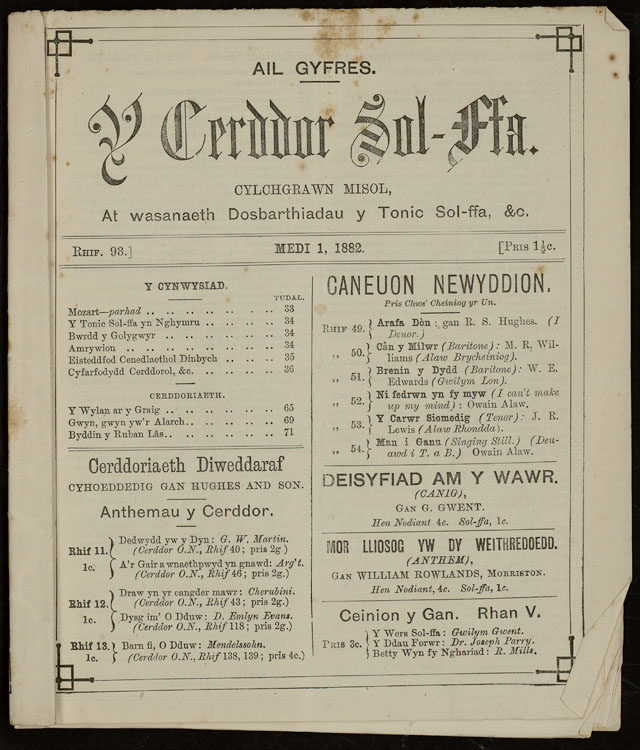
"Arfon" and "Tros y Gareg" have many heirs, the major tune (originally a jig) being the source for "See How Great a Flame Aspires," "Life Has Loveliness to Sell," "Jesus, Savior, Pilot Me," "Source and Sovereign, Rock and Cloud," among others. In the late 19th century in France, the tune "'Arfon' was associated with the Christmas texts 'Un nouveaux present des cieux" and "Joseph est bien marie." The minor tune provides the source for "Bread of Heaven on Thee We Feed" and "Throned Upon the Awful Tree," the melody of which was arranged in 1906 by Hugh Davies, a Welsh Methodist minister, composer, and editor of the Welsh music periodical Cerddor y Tonic Sol-ffa

Dunne drew thematic material for the score from the opening two bars of "Throned Upon the Awful Tree" and the hymn "Day Is Dying in the West," which, Dunne says, "is really more like a jig than a hymn." The original words for the latter hymn were written by Mary A. Lathbury in 1877 (verses 1-2) and 1879 (verses 3-4). Ironically -- or not considering the consequences of Diekman's characters' lapse of judgment in the film -- Lathbury was a preeminent force in the Temperance Movement, co-authoring Woman and Temperance with Frances Elizabeth Willard in 1883. She was also an artist and book illustrator and a central figure in the Chautauqua Movement, christened the "poet laureate of Chautauqua." The tune was composed in 1877 by William Fiske Sherwin, a vocal teacher and composer of carols and hymn-tunes, and variously titled "Twilight," "Evening Praise," or "Chautauqua."

David Russell Hamrick, an academic librarian who has done extensive research on hymns for many years, feels that "Day Is Dying in the West" is among the most beautiful of hymns and unusual in that it is a call to Vespers or evening worship. Hamrick makes an interesting observation: "I have always wondered what tempo best suits 'Day Is Dying in the West.' I suspect that with a large number of people singing outdoors [as it would have been sung on Lake Chautauqua at the ecumenical evening assemblies held by the Methodist Church there], it was sung pretty slowly (maybe 60 beats per minute?) in its original context. Following my rule of thumb that a cappella congregational singing should be a little faster than accompanied singing because there is nothing filling the pauses, I have usually tried to pick the tempo up to a moderate walking pace (about 78 bpm at least). It can be sung faster, of course, but that seems to get in the way of the grandeur of the words." Having the luxury to work without the words, Dunne gradually hastens the tempo of his score as the Devil's drink increasingly overtakes the party in Diekman's film.


THE WESTERN

Diekman readily acknowledges his debt to Sergio Leone and the Spaghetti Western. In Leone's variation on the Western theme, the hero uses cunning and deceit to undermine the terror and brutality his nemeses deploy against the townspeople and against the hero himself once his double-cross is unmasked. Dunne says his composition was very much influenced by Ennio Morricone's Spaghetti Western scores. Leone and Morricone went to school together, but it was not until 1964 when Leone heard an American folk song Morricone had arranged that he enlisted his friend to write the score for A Fistful of Dollars, which would forever transform the impact a score would have in developing cinematic narrative thematic concerns.


In Westerns, the mysterious stranger is a loner, a drifter. He has undergone some trauma that functions by way of ritual initiation. The Western is not concerned with the rites of puberty, but with the rites of mystical vocation. Like the medicine man or the shaman, the stranger is able to transcend his human limitations in sacrifice to the common weal and will ultimately bring redemption (temporary though it may be) to an individual, a family, a town. The avenging angel is central to the Western genre's mythology, and he is surrounded by an olio of the good (prostitute with a heart of gold, farm family, idealistic -- Eastern -- newspaperman, The Kid, Mexican farmers); the bad (wealthy landowner, evil gunslinger, greedy bounty hunters, bankers); and the ugly, i.e. weak (milquetoast dry goods proprietor, spineless sheriff, town drunk, saloon patrons standing in for the ubiquitous mob swayed by whichever way the wind blows). 


Perhaps the most powerful character in the Western, the character at its very heart, is the omniscient landscape itself -- that vast expanse of silent wilderness that is the grandeur of indifferent nature. By contrast, Diekman has trained his lens onto a claustrophobic corner of the woods, and he strips the Western's cast of stock characters down to a microcosm of traveling "innocents." A wealthy and devout rancher Wallace Hardman (J.R. Rhoades) and his daughter Sally (Morgen Johnson) have pitched camp for the night under the titular tree along with Hardman's ranch foreman (Diekman), the hand (Dave Milburn), the cook (Don McCann), and a preacher (Jack Howland). Generously played by Diekman's friends and symphony colleagues, the nonprofessional actors accomplish a subtle range of gradations of expression -- from suspicion to complicity to abandon to remorse -- without the help of words.

Click for Options
Wallace Hardman (J.R. Rhodes)
Sally Hardman (Morgen Johnson)
Absent from Diekman's Western are the villains (Satan is supernatural and doesn't count) -- rustlers, stagecoach abushers, gambling cheats -- and, most noticeably, the central hero/antihero: no "good guys," no "bad guys," just ordinary folk. As the party sits around the campfire, finishing up their supper, a natty stranger appears (Ryan Murphy) -- a man with no name and mysterious to be sure -- but not the avenging angel. He carries not a six-shooter but a Gladstone bag full of alchemistic paraphernalia and a potion that will unlock the nethermost compulsions of the human psyche. 
Discerning their initial hesitation, especially the disapproval of the Bible thumping Hardman and The Preacher, The Stranger cunningly manages to win the party's confidence and lure them in to the mysteries of the tincture contained within the bag. The gaiety of the music primes the men to abandon self-restraint, and as they imbibe, Sally, by turns nervous and coquettish, looks on. Upon the Awful Tree is not without moments of levity, but what begins as frivolity turns to transgressive miasma.

Click for Options
The Stranger (Ryan Murphy)
Click for Options
The Preacher (Jack Howland)
Click for Options
The Fiddler (Matthew Diekman)
Diekman as the fiddling foreman introduces the central passage of the symphonic poem on his viola. Dunne's score allows the orchestra to sneak in little by little to gradually step up the tempo and the frenzy -- of music and camera -- as the absinthe worms its way into the revelers' veins and visions. 
Even Hardman and The Preacher are eventually sucked in to the poisoned night. When they awake, they find themselves bared by the harsh glare of the light of day that gives the lie to their superficial morality.
The Hand (David Milburn)

Click for Options
The Fiddler (Matthew Diekman)
THE MYSTERIOUS STRANGER

In his remarks about the film, Diekman does not mention Mark Twain's novella, posthumously published in 1916, The Mysterious Stranger, A Romance, but the obtruder of Upon the Awful Tree bears a striking resemblance to Twain's titular character who alternately refers to himself as Satan and Satan's nephew. 


Among the three boys to whom Satan reveals himself is Twain's narrator, "Theodor Fischer, son of the church organist, who was also leader of the village musicians, teacher of the violin, composer, tax-collector of the commune, sexton, and in other ways a useful citizen, and respected by all" (15). On a May morning, the three playmates stretch out on the grass of a woody hilltop to smoke, but "we had been heedless and left our flint and steel behind."
     Soon there came a youth strolling toward us through the trees, and he sat down and began to talk in a friendly way, just as if he knew us. But we did not answer him, for he was a stranger and we were not used to strangers and were shy of them. [....] Then I thought of the pipe, and wondered if it would be taken as kindly meant if I offered it to him. But I remembered that we had no fire, so I was sorry and disappointed. But he looked up bright and pleased, and said:
     "Fire? Oh, that is easy; I will furnish it."
     I was so astonished I couldn't speak; for I had not said anything. He took the pipe and blew his breath on it, and the tobacco glowed red, and spirals of blue smoke rose up. [....] He went on coaxing, in his soft, persuasive way; and when we saw that the pipe did not blow up and nothing happened, our confidence returned little by little, and presently our curiosity got to be stronger than our fear (17).
Satan explains that his uncle is the only one of his clan of angels who has ever sinned, for he alone ate of the fruit of the Tree of Knowledge. "We others are still ignorant of sin; we are not able to commit it; we are without blemish, and shall abide in that estate always" (21). A leitmotif within Theodor's descriptions of Satan's talk -- perfect for the parallel purposes of Upon the Awful Tree -- is its musicality. He "worked his enchantments upon us again with that fatal music of his voice. [....] He
made us drunk with the joy of being with him...and of feeling the ecstasy that thrilled our veins from the touch of his hand" (23). And again, "words cannot make you understand what we felt. It was an ecstasy; and an ecstasy is a thing that will not go into words; it feels like music, and one cannot tell about music so that another person can get the feeling of it" (28).

Mark Twain (Samuel Clemens, 1835-1910)
The Mysterious Stranger revolves around Satan's argument (which is Twain's) that humanity's downfall derives from its Moral Sense. Having eaten the fruit of the Tree of Knowledge of Good and Evil, we know what is right, yet every useful citizen respected by all inevitably, knowingly chooses to do wrong for so trivial a reason as to save face in the eyes of equally unworthy others. The story proceeds episodically from one admonitory plot twist to another, beginning when Satan takes
Theodor into the torture chamber of the village jail, which makes Theodor feel "faint and sick."
     I said it was a brutal thing.
     "No, it was a human thing" [, says Satan]. "You should not insult the brutes by such a misuse of that word; they have not deserved it.... It is your paltry race -- always lying and always claiming virtues which it hasn't got, always denying them to the higher animals, which alone possess them. No brute ever does a cruel thing -- that is the monopoly of those with the Moral Sense" (48).
Satan's cautionary vignettes heighten for Theodor scenes close to home as they play out in juxtaposition to "a history of the progress of the human race -- its development of that product which it calls civilization" (94). 

The Mysterious Stranger is among the darker works from a writer enshrined as America's great humorist, and it depicts life as a nightmarish dream. Indeed, when the boys introduce Satan to their friends, he asks that they introduce him as Philip Traum: "You see, [Theodor explains to the reader,] 'Traum' is German for 'Dream'" (62). James Joyce's Stephen Dedalus will make the succinct observation that "History is a nightmare from which I am trying to awake," an eternal stream of violence against the disenfranchised, the violence justified by absolving the persecutors of blame, which, as Twain's time-traveling Satan demonstrates again and again, is indeed the perpetual history of both church and state.

"In Upon the Awful Tree," Diekman says, "the time-traveling Mysterious Stranger/Satan is timeless in his appearance, yet there are subtle hints in his attire and his gestures that are throwbacks -- and throw-forwards -- that the viewer will understand but the characters won't. The Stranger's bag of tricks draws from the past, present, and future," Diekman explains, "just as the biblical struggle between good and evil starts at the beginning of humankind and is eternal."

THE ABSINTHE

Satan recounts for Theodor and his mates a litany of the progress of the human race -- from Cain bludgeoning Abel to death "followed by a long series of unknown wars, murders, and massacres" (95). The Flood provides humanity with a second chance. Instead the peoples of the earth carry on: from Sodom and Gomorrah; to Lot and his daughters; to the Hebraic wars; to Jael; to the Egyptian, Greek, and Roman wars, and Caesar's invasion of Britain; down to Christianity and Civilization "leaving famine and death and desolation in their wake..." (96). "And always," Theodor laments, "we had wars, and more wars, and still other wars..." (96). 

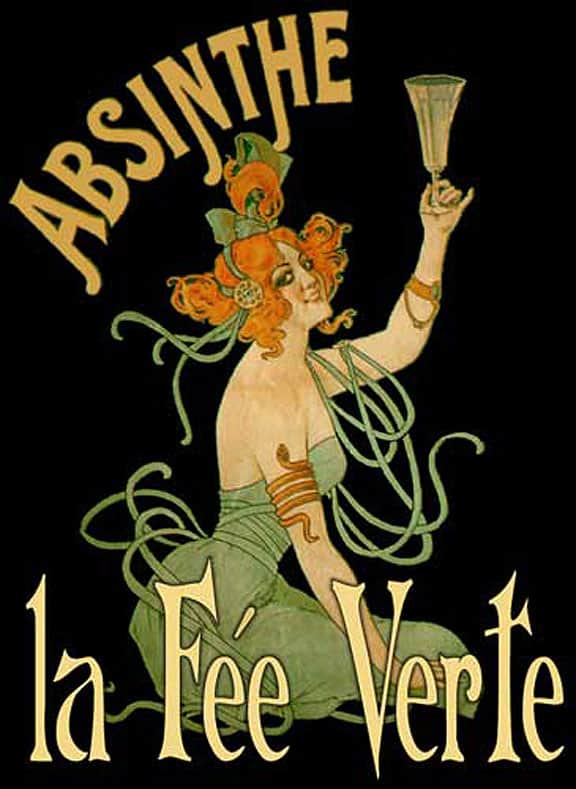
The only rational reaction to the eternal human condition is madness, oblivion, or the slumber of death. The Stranger in Upon the Awful Tree offers the oblivion of la fée verte (the green fairy), the anise-flavored spirit made of wormwood, anise, fennel, and herbs long believed to possess hallucinogenic properties.

The oldest and purest method of preparing absinthe, the French Method, is to pour the green spirit into the properly measured bulbous well at the bottom of a Pontarlier glass and then to rest a silver absinthe cuillere -- a special slotted spoon -- across the rim. A sugar cube is placed on the cuillere and the absinthe diluted by slowly dripping iced water over the sugar from a carafe, which causes the absinthe's less soluble essences -- wormwood, anise, and fennel -- to dissolve and cloud. This allows the aromatic subtleties that remain muted in the neat spirit to blossom or bloom. The resulting opalescent liquid is called the louche


In 1899, the English Decadent poet Ernest Dowson wrote "Absinthia Taetra" ("abominable absinthe"):
     Green changed to white, emerald to an opal: nothing was changed.
     The man let the water trickle gently into his glass, and as the green clouded, a mist fell from his mind.
     Then he drank opaline.
     Memories and terrors beset him. The past tore after him like a panther and through the blackness of the present he saw the luminous tiger eyes of the things to be.
     But he drank opaline.
     And that obscure night of the soul, and the valley of humiliation, through which he stumbled were forgotten. He saw blue vistas of undiscovered countries, high prospects and a quiet, caressing sea. The past shed its perfume over him, to-day held his hand as it were a little child, and to-morrow shone like a white star: nothing was changed.
     He drank opaline.
     The man had known the obscure night of the soul, and lay even now in the valley of humiliation; and the tiger menace of the things to be was red in the skies. But for a little while he had forgotten.
     Green changed to white, emerald to opal: nothing was changed.

The Bohemian Method used in Upon the Awful Tree involves first soaking the sugar cube in absinthe, then setting it aflame before dropping it into the absinthe-filled Pontarlier glass. The spirit ignites and is finished by tossing an ice cube in to douse the flames, resulting in a stronger drink. This is a modern technique not employed at the turn of the 20th century, but Twain stretches the plausibility of his schoolboys smoking as early as 1590. Phantasmagoria can happily admit anachronism and allow for Satan's fiery breath upon Twain's tobacco and Diekman's absinthe.

THE WORDLESSNESS

The degree of prominence the role music would play in Upon the Awful Tree evolved throughout the film's conception. "When I started writing the screenplay," Diekman says, "I thought I'd see how far I could get without anybody saying anything. And if somebody needs to say something, I thought, I'll let them. But I wrote and wrote and wrote, and I got to 'the end' and nobody said anything."

Wordless narrative is nothing new. Pantomimus was the name for a masked dancer in Ancient Greece, and unscripted mummer plays were a staple of Medieval European folk performance.


The masque was central to 16th and 17th century court entertainments in Europe. From dumbshows at London's Globe Theater to the new dance drama that emerged in early 17th century Japan that would become kabuki to the play-within-the-play in Samuel Beckett's Waiting for Godot, pantomime has endured. 


Upon the Awful Tree plays like an extended surrealist interlude that Alejandro Jodorowsky, the father of the Acid Western, would appreciate. Jodorowsky studied mime in Paris with Étienne Decroux and joined Marcel Marceau's troupe. He worked as a clown before founding Teatro Mimico in Mexico City in 1947. His 1970 El Topo follows a silent sharp-shooter on a violent quest for enlightenment through a mystical Western landscape.

Alejandro Jodorowsky's 1970 El Topo

Screen actors of the silent era utilized the mime's exaggerated gestures and facial expressions, but their dialog was relayed to audiences in intertitles (or title cards) between action shots. "I don't consider [Upon the Awful Tree] a silent film," Diekman insists. "I consider it a dialogue-free film." Indeed, unlike silent films, Upon the Awful Tree incorporates only a smattering of intertitles, interspersed among its opening shots, by way of setting the stage, and then abandons them altogether. "Some of my favorite scenes in my favorite movies are the ones in which people stop talking and take action to advance the plot," Diekman continues. "I wanted to see if I could expand that kind of non-verbal storytelling to an entire film narrative. It worked." 

In print, the closest relatives to Diekman's experiment grew out of German Expressionism and were initiated with Frans Masereel's 1918 wordless novel 25 Images of a Man's Passion
Last four panels of Frans Masereel's 1918
25 Images of a Man's Passion 
The first and most prominent practitioner of the medium in the United States was Lynd Ward, who, beginning in 1929, produced a series of six "wordless novels in woodcuts," as he called them. I inherited a first edition of the second novel in the series, Mad Man's Drum, a story of the sins of the fathers that Art Spiegelman, author of the Pulitzer Prize-winning graphic novel Maus: A Survivor's Tale and editor of The Library of America's 2010 boxed-set edition of Ward's collected novels, describes as "a multigenerational saga worthy of Faulkner [that] traces the legacy of violence haunting a family whose stock in trade is human souls."
Lynd Ward's Mad Man's Drum
Ward was a friend of my grandfather Charles W. Richards. In addition to the trade edition in 1930, a special edition of 309 signed copies was published of which 299 were for sale. Ward gave my grandfather #171 of the signed edition. In undergraduate school, a friend and I pored through it page by page one summer and wrote out the narrative, a document I have often wished I would run across in my files, though I seriously doubt is extant.

Ballet relies on the language of music and the gesture of dance to convey narrative, and musical compositions have been composed for centuries around narrative stories. Fred Everett Maus introduces his (highly recommended) paper "Music As Narrative," published in the Indiana Theory Review, arguing that "For many listeners, some instrumental music, especially in the tradition of Haydn and Mozart through Brahms, invites comparison to drama or narrative" (1).

Discussing Schumann's Second Symphony he notes, "Musical events can be regarded as characters, or as gestures, assertions, responses, resolutions, goal-directed motions, references, and so on. Once they are so regarded, it is easy to regard successions of musical events as forming something like a story, in which these characters and actions go together to form something like a plot" (6).

Maus's analysis of the last movement of Beethoven's Piano Sonata, Gp. 14, No. 1 concludes, "This description treats the events in the Rondo as a series of actions, repeated attempts to reach a satisfactory state of affairs that requires no further action. The attempts are defeated, repeatedly, because satisfaction involves a return of the opening key and opening thematic material, but the thematic material throws the pitch materials off balance. The attempts are not exactly those of the
composer or performer, but seem to be best understood as behavior in a fictional world created through the music. The Rondo does not encode a story about something completely nonmusical, in the manner of program music. Rather, the goals, actions, and problems of the story are musical ones, and they share only rather general descriptions (for instance, 'trying to return to a position of stability') with everyday actions. Though it would be possible to add specifications of agents to the story, it is not necessary to do so, and in fact it seems best to give an account...that leaves the determination of character vague" (13-14).

Though it is a film, Upon the Awful Tree places its dominant reliance on the vaguer, less literal musical composition. Indeed in describing the film, Diekman refers to it as "The little movie with the million dollar soundtrack." Budgetary constraints put writer, director, producer, cinematographer, editor, production/art/set/costume designer Diekman in a do-the-best-with-what-you've-got quandary. He shot with a DSLR camera in video mode, so it is not surprising that production values are somewhat compromised. He recruited his colleagues for the orchestra, and as professional symphony musicians they turn in a superb performance. As nonprofessional actors (and generous friends indeed), they rose to the thespian challenge as well.

Under the Awful Tree premiered in San Antonio on June 2, and interestingly, Ukrainian director Myroslav Slaboshpytskiy's The Tribe opened June 19 in New York. Though it has not made its way to San Antonio yet, I mention it because it shares a number of aspects with Diekman's film: it features a nonprofessional cast; it explores a microcosm -- a boarding school -- governed by the teens' violent code of transgression; and, because all of the characters are deaf, it is performed entirely in sign language with no subtitles or intertitles. In the case of The Tribe, there is also no orchestral soundtrack or incidental music. Peter Bradshaw of The Guardian noted that he "couldn't help remembering the quotation attributed to Nietzsche about dancers being thought insane by those who can't hear the music."
Myroslav Slaboshpytskiy's The Tribe
The Tribe also shares, from all accounts, Twain's bleak view of the human condition: were we to remove the blinkers Twain's Satan calls our Moral Sense, we would realize we are irredeemable. Among the few intertitles that punctuate the opening shots of Upon the Awful Tree is a quote from Oscar Wilde that informs the arc of the action that will follow:
"After the first glass of absinthe you see things as you wish they were. After the second you see them as they are not. Finally you see things as they really are, and that is the most horrible thing in the world."   
"Throned Upon the Awful Tree" depicts the solitary Christ upon the rood:
               silent and alone.
Silent through those three dread hours,
Wrestling with the evil powers,
Left alone with human sin,
Gloom around Thee and within
....
Christ speaks only to implore of God, "Why hast Thou forsaken Me?" The speaker of the hymn in turn asks Christ to "Teach me by that bitter cry/In the gloom to know Thee nigh." If that final line is supposed to inspire hope, it falls distressingly short, in my opinion. Not a day, nay an hour, goes by that negates Satan's measure of man, yet I continue to put my faith in the redemptive power of art. Art does a peculiar thing. It simultaneously transports us out of and into the human condition, and unlike absinthe, the experience of art is clear-headed with the potential to make us rise above that condition: the hymn and the jig, the sacred and the profane, the existential paradox of the human double helix.


ACKNOWLEDGEMENTS

The majority of Matthew Diekman's and Matthew Dunne's remarks quoted in this essay are taken from Nathan Cone's interview for Texas Public Radio KSTX 89.1 FM. Cone, Director of Cultural and Community Engagement at KSTX, organizes the TPR Cinema Tuesday series in San Antonio, where Upon the Awful Tree premiered on June 2, 2015 at the Santikos Bijou theater.

Quotations from Mark Twain's The Mysterious Stranger come from Prometheus Books' 1995 Literary Classics edition.