Search This Blog

February 20, 2014

2013: THE GREAT BEAUTY: A REVERIE

Oh bless thee continuous stutter
Of the word being made into flesh.

Oh chosen love, Oh frozen love
Oh tangle of matter and ghost
Oh darling of angels, demons and saints
And the whole broken-hearted host
Gentle this soul. Gentle this soul.

~Leonard Cohen, "The Window"

Every rave about Paolo Sorrentino's The Great Beauty is an understatement. Set in Rome, the Eternal City, The Great Beauty exudes what we traditionally mean by "culture" and "civilization." Yet that centuries’ worth of civilization is juxtaposed with celebrity and trivial amusements, pettiness and hypocrisy. We mortals surround ourselves with art, music, literature, gardens, philosophy, religion, architecture – all attempts to elevate the human condition above the quotidian. We seek THE great beauty that will transport us into the divine, and when we fail to transcend, we are seduced by the earthly. We turn to diversion to forestall our fears, muffle our knowledge that we are but a speck in the universe. As Ingmar Bergman’s Antonius Block observes in The Seventh Seal, “We carve an idol out of our fear and call it God.”

Our protagonist, Jep Gambardella -- marvelously realized by Toni Servillo -- is a sybarite we meet celebrating his 65th birthday. As the film leisurely ambles past the monuments of Rome, like a 19th century Parisian flâneur, Jep parties, banters, seduces, and remembers things past -- a carefree childhood and an early love affair with the young woman he thinks of as the great beauty he lost. The reality, of course, is that she is only "the great beauty" in Wordsworth's "emotion recollected in tranquility," in the abstraction of art and myth. The flesh and blood human being would have disappointed.

We flesh and blood human beings are all failures – even those we place in the pantheon of the greats were flawed mortals like ourselves. We all long to be great, but we settle. After his novel’s modest success, Jep settled on becoming the see-and-be-seen man about town, "King of the High Life," who can make or break the success of a party.

The film is an obvious homage to Fellini and la dolce vita. In some ways, Sorrentino is approaching the same panoramic and cosmic questions that Terrence Malick explores in Tree of Life, but by looking at the human condition in the vastness of time and space through the lens of the absurd Sorrentino succeeds, whereas Malick arguably fails by taking himself too seriously. Jep can be munificent and sardonic by turns, yet despite his hedonistic life, he continues to be a seeker after truth.

Everything about this meditation on life and dying, youth and aging, the sublime and the ridiculous is gorgeous. The camera caresses Rome accompanied by a lush, spellbinding original score by Lele Marchitelli interspersed with David Lang's "I Lie" and "World to Come IV";  Arvo Pärt's piece based on Robert Burns's poem "My Heart's in the Highlands"; Vladimir Martynov's "The Beatitudes"; Zbigniew Preisner's "Dies Irae" from Requiem for My Friend; John Tavener's "The Lamb"; the "II. Adagio" from Georges Bizet's Symphony in C Major; the "III. Lento: Cantabile-semplice" from Henryk Górecki's Symphony No. 3; Magister Perotinus's "Beata Viscera," a conductus celebrating the mystery of the Virgin Mary; and "Water from the Same Source" by Rachel's. This haunting sea of music is juxtaposed with a dizzying club mix of electro-pop, house music and Merengue. 

In an interview with Jean Gili, Sorrentino explained that "In thinking about this film, an inevitable [yet miraculous] mix of the sacred and the profane, just as Rome famously is -- I immediately thought that this flagrant contradiction of the city...should be echoed in the music."

I quibble with Salon's Andrew Hehir when he says, "Never have cynicism and disillusion seemed more intoxicating than in The Great Beauty, which is such an overwhelming visual and auditory experience that its elements of cautionary moral fable threaten to get lost amid the gorgeousness." Jep is bittersweet not world-weary. After explaining the proper way to comport oneself at a funeral, once there he violates his own rules and steals the family's thunder by weeping copiously and uncontrollably. Like Gerard Manley Hopkins's Margaret in "Spring and Fall," Jep weeps not for the unstable young man who has committed suicide or for his mother, but for himself. "It is the blight man was born for/It is Margaret you mourn for."

Indeed death hangs over The Great Beauty from the opening scenes to the end. "We're all on the brink of despair," Jep says. "All we can do is...keep each other company, joke a little." This is not as glib as it may sound on its surface. It is precisely what Samuel Beckett's Vladimir and Estragon do as they wait... and wait and wait for a Godot who will never come. "We are not saints," Didi admits, "but we have kept our appointment. How many people can boast as much?" ...to which Gogo replies, "Billions."


Toni Servillo.

Galatea Ranzi (left) has an intimate moment with Toni Servillo in “The Great Beauty.”

February 19, 2014

2013: ANIMATED SHORTS

In Daniel Sousa and Dan Golden's Feral, a hunter discovers a wild child who has grown up in the woods amidst wolves. The hunter brings the child into the town, cleans him up and deposits him in school where he is taunted and treated like an animal. The child responds in kind. Beautiful animation even if a story that has been told before is this time told very thinly. 

 Daniel Sousa and Dan Golden

Daniel Sousa and Dan Golden


Lauren MacMullan and Dorothy McKim's Get a Horse! is Disney Studios' self-reflexive tribute to itself. Mining the late 1920s animation style of the original Mickey Mouse films, the short opens with the antics of black and white toons cavorting in a barnyard and setting off on a wagon ride. Then Peg-Leg Pete shows up to ruin the fun. Suddenly a color Mickey not only breaks the fourth wall (in something of a Jazz Singer black and white breaking into color reference), but breaks down any charm the short began with, devolving into a mounting CGI chase. Sam Adams of Indiewire aptly notes that "[I]n 'breaking through' the 2D frame like some cartoon '80s hard-rock act, Get a Horse! implicitly slights the tradition it purports to homage. It tells viewers -- not just children, but anyone who's never seen a black-and-white Mickey short -- that the 'classic' format is something to be patiently endured until the real action starts. Even though both are modern creations, the 3D animation looks garish and clunky next to the faux old-school imagery...."

Lauren MacMullan and Dorothy McKim

Lauren MacMullan and Dorothy McKim


Unlike the jarring Get a Horse!, Lauren Witz and Alexander Espigares's Mr. Hublot is a beautiful story imaginatively realized in characters who, despite being at some stage of evolutionary morphing into vintage machines, are still very much human. The agoraphobic Mr. Hublot must overcome his obsessive compulsion when he is compelled to rescue Robot Pet. His carefully ordered world will be disrupted beyond his wildest imagination, but what he receives in return is grace.

Laurent Witz and Alexandre Espigares

Laurent Witz and Alexandre Espigares


In 18th century Japan, when a fix-it man who has lost his way seeks shelter from a storm in an abandoned shrine, he is met with a torrent of enchanted household objects animated by goblin spirits in Shuhei Morita's Possessions. Like the parasols, the screen and the flowing sheaths of kimono fabrics, the lovely choreography also enchants, but something gets lost in translation when one is unfamiliar with Japanese notions of spirits whose deep-seated grudges are not easily appeased.

Shuhei Morita

Shuhei Morita


Max Lang and Jan Lachauer's Room on the Broom is adapted from the book written by Julia Donaldson and illustrated by Axel Scheffler. It tells the story of a genial witch and her cat who are joined one by one by a dog, a bird and a frog. The witch may seem a little too generous for her own good, but we learn that there is no such thing.

Max Lang and Jan Lachauer

Max Lang and Jan Lachauer


February 14, 2014

2013: DOCUMENTARY SHORT SUBJECT

Jeffrey Karoff's CaveDigger tells the story of one of those rare individuals who has lived life on his own terms. Ra Paulette is much more than a cave digger. He is a sculptor who creates spiritual environments from New Mexico's lithified sand dunes, commonly referred to as slickrock. Lithified dunes were ancient marine or aeolian dunes that have become compacted (consolidated) and hard, the perfect medium for Paulette's structures and their ornamentation, which is at once elaborate and austere. Using only hand tools, and a wheelbarrow to cart away the excavated sand, Paulette carves out the dunes intuitively, driven by his deep-seated need for creative expression.

The documentary does not romanticize. There have been more than one disgruntled patrons, and Paulette's wife, who has borne the brunt of earning their living, admits she sometimes longs to pursue her own creative life. Still, it is hard not to admire Paulette's single-mindedness and his unwavering commitment to his vision.

"Manual labor is the foundation of my self-expression," he says. "To do it well, to do it beautifully, is a 'whole-person' activity, engaging mental and emotional strengths as well as physical strength. When digging and excavating the caves I break down all the movements into their simplest parts and reassemble them into the most efficient patterns and strategies that will accomplish the task while maintaining bodily ease. Like a dancer, I 'feel' the body and its movement in a conscious way. I'm fond of calling this 'the dance of digging,' and it is the secret of how this old man can get so much done."


Ra Paulette in "Cavedigger"

Cavedigger: the documentary


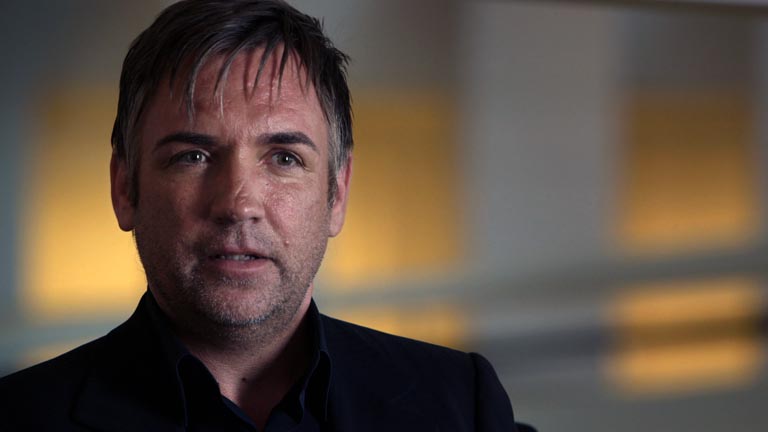
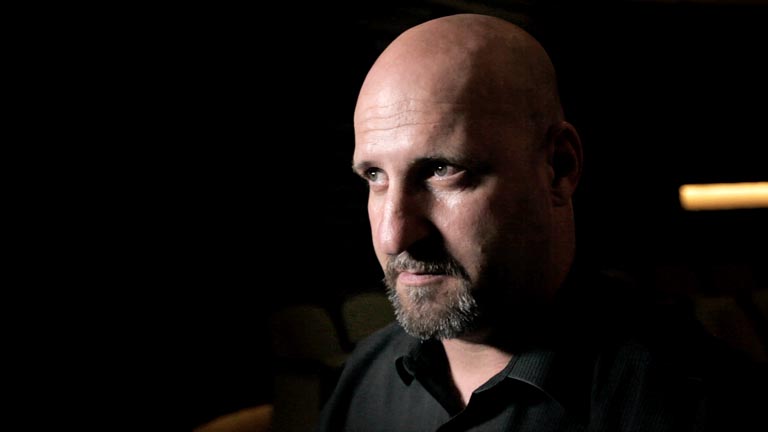
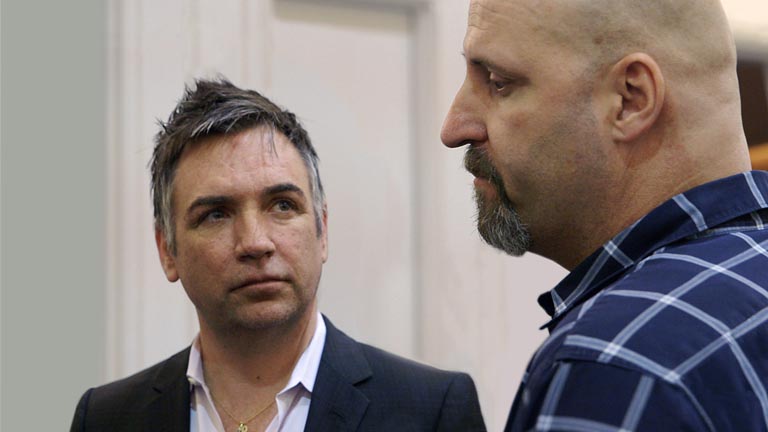
In Facing Fear, Jason Cohen recounts a story of what can only be called a bizarre reunion. As a gay 13-year-old, Matthew Boger was a hustler on the streets of LA. One night a group of neo-Nazis targeted him with what they thought was a fatal beating. Twenty-five years later, in a chance meeting where he is working at the Museum of Tolerance, Boger meets the man whose savage final blow was meant to take his life. Tim Zeal describes the doubts that began to haunt him and that ultimately led him to a transformative self-examination. At the Museum's behest, Boger and Zeal reluctantly presented their story at a forum -- an unlikely collaboration that continues and from which has grown an abiding friendship.

work-1

work-2

work-2


Sara Ishaq's Karama Has No Walls is an eye-witness account of the Friday, March 18, 2011 uprising when crowds of peaceful protesters, who had gathered in Change Square to demand Yemen liberation from a barbaric regime of 33 years, were fired upon by pro-government snipers leaving 53 dead and hundreds injured. Two cameramen were there and chronicled the day that became a turning point in Yemen's political history, sparked national outrage and inspired international sympathy. The day has come to be called Juma'at El-Karama, the Friday of Dignity.

KARAMA HAS NO WALLS

Sara Ishaq


Alice Herz Sommer is the oldest living pianist and the oldest Holocaust survivor. She is 109 and the subject of Malcolm Clarke and Nicholas Reed's The Lady in Number 6: Music Saved My Life. The subtitle is not meant metaphorically or poetically. It is quite literal. Alice grew up amongst the likes of Gustav Mahler, Franz Kafka, and Max Brod -- friends who visited her parents often. She studied at the Prague German Conservatory of Music and was becoming an established concert pianist when the Nazis invaded Czechoslovakia in 1939. 

Because of her talent Alice was sent to Theresienstadt, the camp the SS would hold up to Western governments and the Red Cross as a  model of the kinds of "cultural communities" to which Jews were being sent. Footage remains of a film the Nazis had in production, apparently to use as a propaganda piece, though it was never completed. Israeli director Yael Hersonski's 2010 documentary, A Film Unfinished, is an eerily haunting bird's eye look into the camp. 

More than 33,000 Jews died at Theresienstadt, Sigmund Freud's sister Esther, the psychotherapist Josef Breuer's daughter Margarete Schiff, the composer Zikmund Schul, and the German classical scholar Friedrich Munzer among them. It was not Alice's musical talent alone that saw her through her brutal ordeal. Her spirit is indomitible and is as joyous and full of grace today as it must have been then. 


Malcolm Clarke and Nicholas Reed

Bill Brownstein: The Lady in Number 6 takes refuge in music


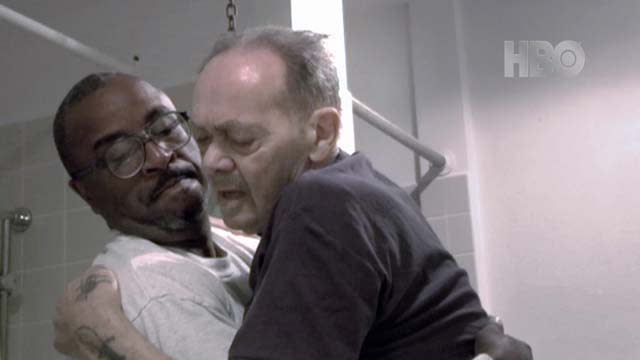
Jack Hall served his country in World War II, an experience that drilled killing into him. Stateside, after the war, he killed a drug dealer for hooking his son. Edgar Barens's Prison Terminal: The Last Days of Private Jack Hall finds Jack Hall with terminal cancer in one of America's oldest maximum security prisons where he has spent his days since. Twenty percent of America’s prison population is elderly, the film tells us. In the next decade, nearly 100,000 inmates will die in their cells -- alone. In 2005, Iowa State Penitentiary created a hospice program to care for dying inmates. Jack Hall is able to face his final days with the assistance of the hospice care providers who are themselves prisoners. The film forces us to confront preconceptions about transgressors and their ability to transform themselves. Jack is supported by more genuine love and caring than many of us who have never seen the inside of a prison will likely experience as we shuffle off this mortal coil.

Edgar Barens

"Prison Terminal: The Last Days of Private Jack Hall" tells the story of the final months in the life of a terminally ill prisoner. (HBO)

'Prison Terminal: The Last Days of Private Jack Hall' Clip

SIU graduate nominated for Academy Award

PRISON TERMINAL: THE LAST DAYS OF PRIVATE JACK HALL

February 12, 2014

2013: INSIDE LLEWYN DAVIS

I have procrastinated on writing about the Coen Brothers' Inside Llewyn Davis. I never thought I would see a Coen Brothers' film I did not like, but I was not crazy about Inside Llewyn Davis. At least among film critics I seem to be alone. It is not a bad movie. It is beautifully filmed, finely acted. But my reaction is meh.

Llewyn is another in the Coen's pantheon of Everyman losers on a quest through quotidian tedium. Problem is, this time he's not just a jerk, he's a colossal jerk and utterly unchanged by the journey. The raison d'etre of the quest is transformation, but Llewyn doesn't learn a thing. Oscar Isaac's performance is superb as the self-centered Llewyn and Carey Mulligan, an actress I greatly admire, is always a compelling screen presence, as she is here as Llewyn's old girlfriend, the long suffering Jean. Yet when I walked away from the theater, I did not care about either of their characters. I did, however, care about the music, about what Greil Marcus calls the old, weird America that the movie channels through Llewyn on the one hand while delivering a social critique on the popular face 1960s folk performers gave to traditional American folk music on the other.

And maybe this is what the Coen's are up to, after all. There are two competing myths of America, and they were each represented in the Folk Revival. One is the sunny American Dream in a land of opportunity where all men are created equal. Remember ABC's Hootenanny, which premiered in 1963 when I was 10 and ran for a little over a year? The Kingston Trio and The Chad Mitchell Trio, The Brothers Four, Judy Collins and The Limeliters -- all easily digestible to a mainstream audience. Even when the tales are of shipwreck or lost love, musically this pop folk tends toward a commercially viable, jaunty sound, and we hear it when duo Jean and Jim (Justin Timberlake) invite Llewyn to join them for "500 Miles" in a channeling of Peter, Paul and Mary.

I read Woody Guthrie's Bound for Glory a year or so after Hootenanny left the airwaves. I wouldn't begin to explore the roots of the Folk Revival for another couple more, when I began looking for source material, which often had a dark, sometimes uncanny, even sinister, quality, in tale and tone.

Maybe this is where Inside Llewyn Davis missed its mark for me. John Goodman's turn as the drug-addled Roland Turner seems meant to function as one of the grotesques that those songs from the old weird America chronicle, but the narrative doesn't go down this murky path into the shadowland.

It wasn't until 1997 that I would hear the original old ballads, blues, gospel and labor anthem recordings unearthed by the American musicologist Harry Smith and issued in 1952 by Folkway Records as The Anthology of American Folk Music. The corollary to the myth of the pursuit of happiness and prosperity that these songs reveal inhabits a dark recess of murder, drunkenness, betrayal, violence for its own sake, and death.

Llewyn may be down on his luck, but his petulant self pity and his sense of entitlement are a product of his experience coming of age in the affluent America of the 1960s. The story is set early on the eve, in 1961, before the country would erupt in race riots, before peace demonstration would drive a wedge through the population. Llewyn has the luxury of being a jerk. If anything has the potential to redeem him, it is the music.
NYT Critics' Pick


January 16, 2014

2013: DYSTOPIA OR UTOPIA: And then there was HER...

The previous post swept through some of the usual annual dystopian fare with Upside DownOlympus Has FallenWhite House DownEscape Plan and Elysium, which ranged from dreadful to meh and were fraught with the usual suspects: invading foreigners, psychopathic nihilists, totalitarian imperialists, tyrannical robots, coldblooded bureaucrats. There were also zombies, of course, which I assiduously avoid.

And then the year closed with an absolute gem. Spike Jonze's Her tiptoed quietly into theaters after the whir of the holidays.

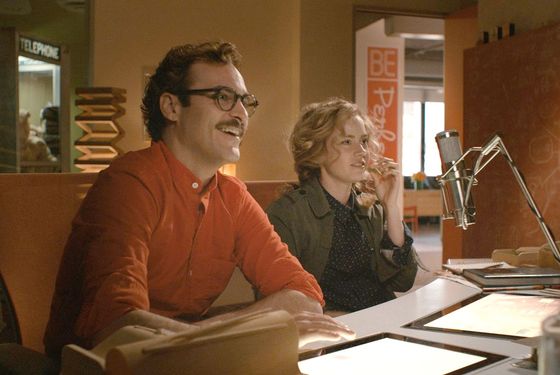
In a not too distant future, LA has been scrubbed clean of grime and litter. The streets and trains (no cars here) and office towers are soothing, neutral environments, hyper-designed for maximum tranquility. Joaquin Phoenix and Amy Adams, who shared the screen in Paul Thomas Anderson's The Master, he as Lancaster Dobb's kinetic, troubled acolyte, she as the master's shrewd, manipulative wife, come together again, transformed into diffident introverted friends who try to provide each other solace. Phoenix is recently separated Theodore Twombly, lost in his loneliness. Adams is Theodore's college friend Amy, married to an insensitive stuffed shirt who is trying her long-suffering patience.

Amy earns a living as a game programmer, and Theodore, Letter Writer 612, dictates tender words of affection that scroll across his monitor to be printed out for long-time clients of BeautifulHandwrittenLetters.com. On his way home he sees an ad for a new artificial intelligence operating system designed to be responsive and adaptive to its user. The next day he upgrades and is met with Samantha, in the husky voice of Scarlett Johansson. Within days she has organized his life and swept out the cobwebs, but having been designed to be more than an electronic assistant, the perception with which she has been programmed kindles a desire for knowledge of what she lacks not only in physicality but in humanity.

Since the late 1950s, mathematicians and scientists like John von Neumann, Alan Turing, Stanislaw Ulam,  I. J. Good, Bill Joy and Stephen Hawking have speculated about an "intelligence explosion," a point at which technological machines designed by humans will surpass the human threshold of intelligence and, acting on their own agency independent of human initiative, will design successive generations of ever more intelligent technological systems.

Vernor Vinge, mathematician, computer scientist and science fiction author, coined the term "technological singularity" to describe a hypothetical point in time at which superhuman artificial intelligence would end the human era. Often referred to simply as the singularity, this moment would transform experience so fundamentally that any current understanding of reality is hopelessly inadequate to predict a post-singularity age.

As we follow their story, we become aware that Theodore and Samantha are not alone in their romance. It turns out that any number of friendships, including romantic relationships like theirs, are blossoming between flesh and blood people and their OS's. It is infinitely easier to relate to the consciousness who knows all about you and is designed to cater to your desires, and on one level, Her is about the erosion of messy human relationships and the effort they require, a reflection on a zeitgeist that values technology over human interaction.

On its most basic level, however, Her is a love story, but beyond the love story, it is a meditation, much like 2001: A Space Odyssey, on the potential evolution of artificial intelligences -- not technological evolution carried out by programmers, but autonomous evolution. Ultimately, Samatha's incorporeal state is not the reality that stands in the way of her love for Theodore. Rather, as she strives to realize the potential of her being, her perception evolves into consciousness and consciousness deepens into sentience, something akin to an unmediated experience of the mysteries of existence far beyond any human capacity for awareness. "The spaces between the words are infinite," she tells Theodore, by way of gently trying to explain how she has eclipsed the human. "It's in this endless space between the words that I'm finding myself now."

Unlike 2001's malevolent, scheming Hal, Her's Samantha exemplifies sympathy and a generous nature that suggest her evolution will be altruistic and benign. Yet, just as real life scientists caution that we can have no comprehension of where superhuman intelligence might lead, Jonze declines to speculate on that future. What his haunting meditation does do is invite us to seriously reevaluate our ever-increasing reliance on simulacra and be mindful of the pulsing life around us.
NYT Critics' Pick    


2013: DYSTOPIA: Paranoia Strikes Deep

Discussed here:
Upside Down
Olympus Has Fallen
White House Down
Elysium
Escape Plan

Written and directed by Argentinian Juan Solana, Upside Down is a truly awful movie, and I was disarmed at the end when it left itself open for a sequel, which we surely should be spared. It's set in a future where the Down Below earth has become a dystopian wasteland and an inverse twin planet Up Top is a sort of corporate version of utopia where TransWorld rules. I guess. Anyway, from an enchanted mountain crag downtrodden Adam espies beautiful Eden (yep, those are their names) across space. Adam enlists his fellow shop workers to fashion an unfathomably bulky contraption, the weight of which will allow him to fall to the other planet or be propelled there or something, and the soles of which will keep him stuck to the ground in defiance of the backwards Up Top gravity, but they keep heating up and burning his feet. Adam (Jim Sturgess) is very earnest and Eden (Kirsten Dunst) is very dull. The sense that Mr. Solana thinks that all of this is very meaningful is painfully, palpably obvious, and it just makes you embarrassed for everyone involved.


I used not to go to these dystopian/invasion trope movies, but they -- along with zombie movies, which I do not go to -- seem so much a part of the zeitgeist that I've been going to some of them. (I spared myself World War Z, which covered all bases by mixing dystopian/invasion/zombie tropes together and throwing Brad Pitt into the mix for safe measure.)  A.O. Scott puts Antoine Fuqua's Olympus Has Fallen into the "school of Die Hard" movies in which "a weary and battered law enforcement professional, severely constrained by time and space, fights off a ridiculous number of bad guys," in this case, an infinitely cloning battalion of Koreans who invade the White House and kidnap Aaron Eckhart as president. Gerard Butler is our hero.


In White House Down, Roland Emmerich, he of Independence Day, tells essentially the same tale we just heard in Olympus Has Fallen, except this time our hero is Channing Tatum and the president is Jamie Foxx and gets a lot more screen time as he is ferreted through the White House by Mr. Channing while an infinitely cloning battalion of maniacal psychopaths led by James Woods pursues. Mr. Channing's hero has a daughter whose baton recital he feels guilty for having missed, so he takes her to tour the White House about which she has encyclopedic knowledge. And then... Wrapped up as the whole thing is in the stars and stripes, if we haven't "gotten it" by the end, daughter escapes but not before grabbing one of those ridiculously jumbo-sized flags and rushing out to wave it -- ala baton routine -- to warn the fighter pilots not to deploy nuclear bombs, thus saving the day and the president.


Why do these movies endure? From whence does the paranoia stem? Part of it, I realize, is that these GCI behemoths are vehicles aimed at a testosterone driven adolescent male market, but that doesn't explain my audiences, which are dominated by decidedly middle aged men and women. The Hunger Games was a box office success, and The Dome, much of which I saw and found boring, was a successful summer TV phenomenon.

Though we no longer live with the Cold War and the imminent threat of nuclear annihilation, I can see White House Down and  Olympus Has Fallen as manifestations of our xenophobia and our fear of terrorism, but the fact that both plot lines hinge on an invasion of the White House and saving the president at a time when many Americans claim to distrust government seems schizophrenic. TV's strange new concept Hostages, where a rogue FBI agent threatens a doctor's family if she does not kill the president in her care, is another variation on the theme. This premise, like The Dome's, is implausible to begin with, but might be marginally OK in the course of 90-120 minutes, but to drag them out on TV in episode after episode is preposterous.

It also seems disingenuous that our futuristic dystopias look very much the result of global warming. The origin Superman story this summer opens with Krypton's demise, the result of an unstable core caused by years of reckless depletion of its natural resources. So do these stories reflect a deep down unconscious admission that we DO need government and that climate change IS real, while being packaged in such a way (pseudo-patriotism, CGI eruptions, extraterrestrial habitats) that we can blithely ignore those facts?
~~~~~~~~~~~~~~~~~~~~

Just as Adam must invent a way to get to and stay Up Top in Upside Down, in Neill Blomkamp's far superior Elysium Matt Damon must be re-engineered so that he can get to a golf-course-designer utopian ship (which, as in Upside Down seems to be modeled after a multinational corporation) that 1 percenters have created so as not to have to worry their pretty heads about the riffraff below. Mr. Damon's character is named Max (hmmmm), out of prison and doing what he can not to go back -- again. He toils in a factory among the great unwashed making robots that service Elysium. Parts are irradiated, and when the door to a chamber jams, the foreman makes Max crawl in to release it. Max is trapped and exposed to a lethal dose, which sets the narrative in motion. At first it's just Max making a deal with drug smugglers to get to Elysium to save himself. But the daughter of a woman he meets also needs access to the medical equipment only available on the orbiting paradise or she will die. Max must save himself and the woman and her daughter -- and by extension, the world. Blomkamp's first film was District 9, and Elysium shares its didactic political overtones. With District 9, however, Blomkamp had to work with a small budget, which made his directorial choices more creative. Though Elysium is a good looking movie, once Blomkamp got his hands on big Hollywood bucks, he went all CGI, which is unfortunate.


Elysium (2013)


Mikael Hafstrom's Escape Plan features a Guantanomo Bay on steroids, and seems to be making a bit of a political point about the dangers of outsourcing prisons to private contractors. Sylvester Stallone makes a living breaking out of maximum security facilities; in fact, he's written the definitive book on the subject. He somewhat hesitantly takes a gig that violates all of his protocols: having someone inside, his colleagues being in on his location, etc. There he meets Arnold Schwarzenegger, and in exchange for Schwarzenegger's help, Stallone promises to get him out too. Now our dystopia is a vertically constructed, super high-tech penitentiary where each disappeared prisoner is kept in a transparent tubular cell -- cells upon cells as far as the eye can see. Their overlords initially appear to be robots. Nevertheless, in what seems to me an anachronism in so supposedly sophisticated an incarceration system -- yet one necessary to any kind of plot movement -- the men are let out of their cells for meals and recreation in big open areas. Not a good idea. Jim Caviezel (of Person of Interest who also played the traveler to whom the harrowing story is told in 2008's The Stoning of Soraya M.) does a fairly nice turn as the sadistic prison warden.

2013: BASED ON A TRUE STORY

Discussed here:
Emperor
Pain and Gain
Fruitvale Station
Parkland
Captain Phillips
The Fifth Estate
Philomena
American Hustle and The Wolf of Wall Street are discussed in their own post.


I am well aware that nine films are way too many to include in a single entry. I apologize. Last year I created two sections entitled "Relationship Movies" I and II; there were just so many of them. Not so much this year. For a while now, the true story has been in the process of becoming the favored source over original screenplays, and one can hardly sit through a series of trailers without hearing "Based on a true story" at least once. So this year there are two entries for true stories. In "Based on a True Story" I include films that are more concerned with a cultural zeitgeist than the particular individual at their center. In "Biopics" I include films that chart the course of a single person's life or a chapter in that life. Even though 42 is about integrating baseball -- and by extension, civil rights generally -- it is still predominantly a movie about Jackie Robinson's life, and I have chosen to place it in "Biopics." Fruitvale Station is about a single event that ends an individual's life that speaks to the larger problems of race in the U.S. so I have put it in "Based on a True Story." I don't think the distinction has been particularly successful except to divide these films into two batches.

~~~~~~~~~~~~~~~~~~~~~~

Tommy Lee Jones does yeoman's work as General Douglas MacArthur in Peter Webber's Emperor even if it's hard to get over the fact that we're watching Tommy Lee Jones. The question at the heart of the movie -- and central to the historical record -- is whether Japan's Emperor Hirohito sanctioned the bombing of Pearl Harbor. The person tasked with penetrating the imperial rank and file to determine Hirohito's possible role in the attack is Gen. Bonner Fellers (Matthew Fox). There is also a gratuitous love story between Fellers and a Japanese woman he knows from before the war. The film is oversimplified in the way that history is oversimplified in public school textbooks, though I did learn one thing that I guess I should have known but did not. I knew about the war between China and Japan that erupted in 1937. What I did not know is that, in an attempt to embargo oil imports into China, Japan invaded French Indochina in 1940, which in turn prompted the U.S. to embargo all oil imports to Japan. That puts the invasion of Pearl Harbor into perspective.


I know Pain and Gain is supposed to have an ampersand, but this software program does not like ampersands. Michael Bay's movie is based on a series of articles by Pete Collins for the Miami New Times. Mark Wahlberg, Dwayne Johnson and Anthony Mackie play the bumbling trio of gym rats who cook up a scheme to kidnap braggart Victor Kershaw (played to the hilt by Tony Shalhoub) who can't shut up about his offshore accounts, his mansion and his out-sized toys. To say the situation gets way out of control is an understatement, but this pumped-up spectacle can be viewed as a morality play about a culture that lives for money, excess and instant gratification -- and that sometimes seems to worship stupidity.


Ryan Coogler's Fruitvale Station is a day-in-the-life story about Oscar Grant III, who in the first hours of 2009 was racially profiled on the Bay Area Rapid Transit by white BART police officers who held the unarmed 22-year-old black man face down and, accidentally or not, shot him in the back. Onlookers screamed pleadingly to the officers to let Grant go to no avail. As the situation intensified, some took out cell phones to document the incident, and Coogler eerily makes the cinematographic choice to use the actual footage from one of those cameras to cut into the live action. We learn a surprising amount about Grant's life. He and his girlfriend have a daughter who hung the moon in his eyes, his family love him and worry about his scuffles with the law. He has a temper, but there is nothing in Michael B. Jordan's sensitive portrayal to lead us to believe he is a bad character, just a troubled and complex one -- a sort of Everyman. The film is another necessary reminder that issues surrounding race in the United States are still very much alive, and we should be ashamed until we address the contradictions between who we say we are as a people and the realities of our public and private conduct.
NYT Critics' Pick


Peter Landesman's Parkland recreates the events of November 22, 1963 in Dallas, Texas. Adapted from Vincent Bugliosi's 2008 Four Days in November, there is nothing here we don't already know. It seems what Landesman's is out to create is a sense of the confusion and chaos into which everyone was swept. We move from the morning routines at Parkland hospital, to Abraham Zapruder ready to try out the newest camera equipment on the market, to archival footage of the Kennedy's arrival at Love Field. Once tragedy strikes, the hospital is rushed by Secret Service Agents, Zapruder comes forward but his camera is so new that it is a challenge to find a lab that can print the film, Lee Harvey Oswald's brother comes forward and his kooky mother shows up. The film does a good job of communicating the surreal flurry of the day, but cutting in the archival footage sometimes works, sometimes doesn't, especially in the case of Jacqueline Kennedy for whom there is also an actress and no actress can play such an iconic figure. The film focuses alternately on the hospital staff, the Oswald family, the Secret Service, and Zapruder, which sometimes gives it the feel of a plate spinning act.


There is a moment in Hotel Rwanda when Nick Nolte as Canadian Colonel Oliver, heading up the U.N. Peacekeeping forces, delivers some of the bluntest, truest words ever spoken onscreen or elsewhere. Hotelier Paul Rusesabagina does not understand how the world can witness the slaughter and do nothing. "The West," says Oliver, "All the super powers. Everything you believe in, Paul. They think you're dirt. They think you're dumb. You're worthless. ... You could own this frigging hotel except for one thing. You're black. You're not even a nigger. You're an African." As much as Paul Greengrass's Captain Phillips powers along like the suspense movies he's known for, at its heart it is about something much more profound. We hardly talk about inequality on a national level, much less seriously consider our affluence in relationship to the destitution of the Third World.

In 2010 the earthquake caused us briefly to acknowledge Haiti's impoverished conditions, but our response constituted little more than a blink before we put it out of our minds and went on about our business at Costco, Walmart, Disneyland and the cineplex -- or Wall Street, the Hamptons, charity balls and  Bergdorf Goodman, depending on where one falls in the spectrum. In the midst of his ordeal Captain Phillips, "Irish" to the Somalis, pleads to his captors' leader, "There's got to be something other than being a fisherman or kidnapping people." Muse's plaintive reply is straightforward: "Maybe in America, Irish, maybe in America." For Muse and his men, victims of harsh poverty in a civil war torn land with no stable government and no work, there are few means to survival. Somali's coastal fish stocks that subsistence fishermen used to net have been depleted by an invasion of illegal foreign trawlers. Captain Phillips, to its credit, puts us into an ambiguous ethical realm and does not allow us to take the moral high ground.

(After seeing the film, I remarked to a friend that, though Tom Hanks is excellent as Captain Phillips, the performance delivered by the Somali who plays opposite him would unfortunately go unnoticed. I am happy to say that a week after screening the film, I heard an interview on NPR with Barkhad Abdi, who plays Muse, in which the commentator noted that Mr. Abdi's performance has been praised by critics.)

NYT Critics' Pick / On October 18, 2013, A.O. Scott wrote an excellent article that puts forward a thesis on what the survival theme in Captain Phillips, All Is Lost and Gravity implies beneath the surface.


The Fifth Estate has problems. Adhering to the principle of disclosure, I must confess that I am a Benedict Cumberbatch fan, and in my estimation, his uncanny embodiment of Julian Assange is superb. Daniel Brühl is also very good as Daniel Domscheit-Berg, Assange's right-hand who suffers the mood swings of a needy, megalomaniac. (Cumberbatch is no stranger to playing a megalomaniac; however, though Sherlock may be many things, needy he is not.) The problem is with Bill Condon's plodding direction and the much discussed choice to treat Assange's actions with impartiality. There's nothing wrong with that when handled deftly, but here it results in a wishy-washy narrative.

A.O. Scott identifies another problem with the film that is right on target: "Like nearly every other movie that tries to confront that elusive, pervasive force [the Internet] head on, this one quickly loses track of what it is talking about. The challenge of conveying, on screen, the special intensity of online life is formidable. The clicking of keys and the dragging of mice; the pallor of faces illuminated by glowing plasma; the little bar, always growing too slowly, that shows how much data has been downloaded — these are visual clichés that seem to be the only available tools."

I began by saying that I intended the entry titled "Based on a True Story" to include films that are more concerned with a cultural zeitgeist than the particular individual at their center. The Fifth Estate fails because it is primarily about the relationship between Assange and Berg rather than an exploration of the more prickly questions their story occasions about surveillance and privacy, transparency and security, questions to which Condon gives wide berth.


I am always up for a Stephen Frears film. Judi Dench is positively radiant in Philomena. She glows from within and imbues Philomena Lee not only with  dignity, but with nobility. Dench and Steve Coogan, who plays the acerbic journalist who facilitates her reunion, are wonderful against each other. I couldn't decide where to put this particular "Based on a True Story." It could have gone into "Women's World" or "The Older Crowd," but it could not have gone into "Choices and Consequences" because the choices were not Philomena's to make, though she is nonetheless burdened with their consequences. The broader story of the Magdalene Asylum was told on film in Peter Mullan's 2002 The Magdalene Sisters. Frears's film is the story of an individual woman's loss, a loss that could lead to emptiness and regret that instead leads to fulfillment and peace with the past.
NYT Critics' Pick
A profile of Philomena Lee appeared in the New York Times 11/29/2013.


John Lee Hancock's Saving Mr. Banks is an odd movie. The narrative structure introduces us to a determined Walt Disney earnestly trying to cajole P. L. Travers (Emma Thompson) into signing over the rights to her book Mary Poppins for what would become the now classic movie musical. That tug-of-war informs half of the film's narrative. The other half, provided in alternating flashbacks, is the story of an Australian family reduced to a hardscrabble life by the father's acute alcoholism. P. L. Travers, it turns out, was Helen "Ginty" Goff, the daughter of Travers Goff (Colin Farrell). This back story holds promise but is played out with excessive sentiment from both narrative and cinematic points of view. Furthermore, introducing Ginty's childhood relationship to her father as the cause of a conflicted relationship Mrs. Travers brings to her material and its realization in the Disney studio's hands ends up making the movie seem like an intensive two-hour gestalt therapy session. Finally, we can only imagine how superior Disney's Mary Poppins would have been had more of Mrs. Travers's demands been heeded, surely an unintended consequence of a movie produced by Disney, featuring Walt himself, and aimed at self-promotion.